論文解説
Language Defaults Before Content: A Causal Layer Map of Multilingual Generation
内容以前の言語デフォルト:多言語生成の因果的レイヤーマップ
- 課題 多言語生成でモデルが内容と出力言語をどの層の順序で決めるのかは、出力だけからは分かりにくいです。
- 手法 翻訳の対照インスタンスで、最後のトークンの残差状態を層ごとにパッチングし、matched、shuffled、mean、mean_diffの各供与者を比較します。
- 結果 中間層の英語デフォルト、L17での内容転移、その後の目標言語の解決という順序が、3つのモデルで確認されました。
多言語生成で内容と言語がどう絡み合うか
多言語生成では、モデルは何を話すかと、どの言語で話すかを同時に決める必要があります。ただし、モデルの出力だけを見ると、この2つの決定が内部のどの層で起きるのかを区別するのは困難です。この論文は翻訳を制御されたプローブとして使い、同じ内容を2つの方向に訳した対照インスタンスを作ります。
一方の方向は、モデルがよく翻訳するHIGHです。もう一方は、あまりうまく翻訳できないLOWです。2つの方向は内容が同じで言語だけが違うため、どの層の情報が言語の切り替えと内容の転移を担うのかを、層ごとに追跡できます。
最後のトークン状態のアクティベーションパッチングと供与者の比較
手法の中心はアクティベーションパッチングです。HIGHプロンプトの最後のトークンの残差ストリーム状態を、LOWプロンプトの同じ層の状態に上書きするか、LOWの状態に方向ベクトルを加えます。一度に介入する層は1つだけなので、層ごとの曲線は、その層の最後のトークン状態が周辺の因果寄与をどう示すかを表します。
供与者は4種類です。matchedは同じインスタンスのHIGH状態で、shuffledは別のインスタンスのHIGH状態です。meanは、すべてのHIGH状態の層ごとの平均を平均ノルムで再調整したベクトルです。mean_diffは、平均HIGHと平均LOWの差を操舵ベクトルとして加える方法です。この比較により、特定の内容に依存する効果と、複数の成功した生成に共通する効果を区別します。
英語の流れ、内容転移、目標言語解決の層ごとの順序
英語の対象ペアでは、L15とL16の間で、4つの供与者条件がそろって∆HIGHを押し上げました。この結果から、matchedとshuffledの間に大きな差はなかったことがわかります。中間層の状態は、内容よりも英語のデフォルトとして機能していることを示しています。
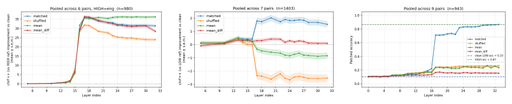
Figure 1 : Per-layer effect of last-token patching in gemma-3-4b-pt, pooled over instances and read per donor condition.Left:∆ HIGH (chrF++ against the HIGH target’s gold translation) for the six different-target pairs whose HIGH direction targets English (n=980). All four donors rise together at L15–16; only at L17 doesmatchedseparate. Middle: ∆LOW for the seven same-target pairs (n=1403), where no language flip is possible; thematched–shuffled gap opens at L17.Right: Belebele accuracy for nine language contrasts ( n=943); the clean baseline is 0.10 and the HIGH pass scores0.87. xCOMET-XL versions of the two MT panels are in Appendix F.
出典 · CC BY 4.0 · Shenbin Qian, Yves Scherrer · Language Defaults Before Content: A Causal Layer Map of Multilingual Generation · 論文の図を引用 · 元のPDFの5ページ目から図の部分を抽出しています。同じ対象ペアの設定では、内容転移はL17で現れました。matchedはL17で+1.79 chrF++、shuffledは−2.35 chrF++でした。この結果は、内容の信号がL17で因果的に現れるという著者らの解釈を裏付けています。
スパース特徴分析と再構成忠実度の限界
スパースオートエンコーダによる分析は、言語選択の信号がスパースな特徴として表現されているかを確かめるために使われました。一方、同じ層のdense供与者であるmatched、mean、mean_diffは、英語の対象ペアで、その層において出力の76–97%を英語に移しました。
ただし再構成忠実度が低いと、残差の残りの部分は特徴レベルの操作では見えなくなるため、この分析で確定できる範囲は、その辞書と特徴選択の手順に限られます。論文は、これをスパースな表現が存在しないという結論とは区別しています。
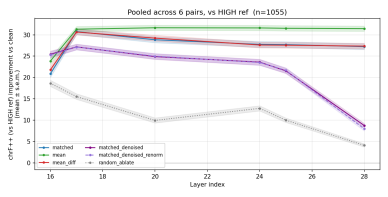
Figure 3 : ∆HIGH when patching the denoised vectors and their two controls ( n=1055), pooled over the six different-target pairs with English as HIGH target.
出典 · CC BY 4.0 · Shenbin Qian, Yves Scherrer · Language Defaults Before Content: A Causal Layer Map of Multilingual Generation · 論文の図を引用 · 元のPDFの7ページ目から図の部分を抽出しています。3段階の構造と適用範囲
3つのLLMでは、中間層の英語デフォルト、その後の内容の利用可能性、最終的な目標言語の解決という順序が一貫して見られると報告されています。QwenとLlamaでも同じ順序が再現されましたが、層の深さと切り替えの明確さはモデルごとに異なりました。
したがって、この研究で主に確認されたのは、最後のトークン残差状態の因果的な利用可能性に関する順序です。正確な層の位置や効果の大きさが、すべての構造や言語に一般化されるとは主張していません。
論文情報
- 著者
- Shenbin Qian, Yves Scherrer
- 学会・ジャーナル
- arXiv · プレプリント
- 公開日
- 2026年11月5日
- 登録日
- 2026年11月10日
- 更新日
- 2026年11月5日
- バージョン
- v1
- arXiv
- 2611.12538
- カテゴリ
- cs.CL
- ライセンス
- CC BY 4.0
- 掲載内容
- 論文情報・解説・論文の図
この解説は、Refivuの韓国語解説をAIで翻訳したものです。不正確な翻訳や誤りが含まれる可能性があります。論文と図の利用条件は各出典に従います。
アブストラクト
Multilingual generation requires large language models (LLMs) to determine both what to say and in what language to say it, yet these two commitments are difficult to disentangle from model outputs alone. We use translation as a controlled probe: for multi-parallel segments that a model translates well in one language direction but poorly in another, content is held fixed while language varies. Using activation patching, we write residual-stream states from successful runs into failing ones and compare content-matched states with content-independent controls, allowing us to trace content-specific and language-related signals across layers. Across three LLMs of different scales and architectures, we find a consistent three-stage pattern of multilingual generation. Intermediate layers first express a default English signal; content information becomes causally available one layer later; and the final target language is resolved only at later layers. The ordering of the English default before content also appears in a reading-comprehension task. Our sparse autoencoder analyses reveal a further dissociation: the intermediate language signal is only weakly represented by sparse features, whereas a later language distinction is clearly sparse, but resists intervention at the patched position. These results provide a mechanistic account of how language selection and content information emerge and interact during multilingual generation.
この論文を引用
Shenbin Qian, Yves Scherrer (2026). Language Defaults Before Content: A Causal Layer Map of Multilingual Generation. arXiv:2611.12538v1. https://arxiv.org/abs/2611.12538v1
BibTeX
@misc{qian2026language,
  title = {{Language Defaults Before Content: A Causal Layer Map of Multilingual Generation}},
  author = {Shenbin Qian and Yves Scherrer},
  year = {2026},
  eprint = {2611.12538},
  archivePrefix = {arXiv},
  url = {https://arxiv.org/abs/2611.12538v1}
}