論文解説
CoReMem: Cost-Internalizing Memory for Successive Coding Tasks with Prospective Valuation
CoReMem:前向きな価値評価を用いる連続コーディングタスクのためのコスト内在化メモリ
- 課題 メモリが次のタスクの労力を実際に減らすかどうかを、事前に判断するのが難しい点が問題です。
- 手法 現在のタスクの軌跡のセグメントを次のタスクの結果で評価し、その結果からアンカーメモリを作ったうえで、アクターをオンポリシーで学習します。
- 結果 ChainSWEでは、27Bアクターの解決率を21.0%から25.7%に上げ、ステップ数を17%、総キャッシュ認識トークンを11%減らしました。
連続コーディングタスクにおけるメモリの価値
連続コーディングエージェントは、変化していく同じリポジトリで、タスクを順番に解いていきます。先行するタスクが残したリポジトリの状態は、そのまま引き継がれます。一方で、過去の軌跡は失われ、メモリの塊だけが次のタスクへ渡されます。次のタスクが何かを知る前にメモリを書く必要があるため、メモリが将来のタスクの労力を減らすかどうかをどう判断するかが難しい問題です。既存のコーディング向けメモリの手法の多くは、同じタスク内や独立したタスク間で使われてきており、次のタスクのステップ数やトークンを減らすことはできませんでした。この論文は、次のタスクが実際に得る利益によってメモリの価値を定義する問題から出発しています。
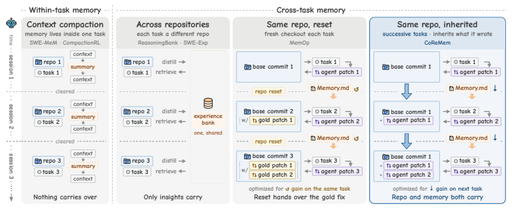
Figure 2 :What crosses coding-task boundaries and where memory is valued and optimized.Existing settings keep memory within one task, transfer general experience across independent tasks, or carry memory while resetting the repository. Our setting carries both repository state and memory to unseen future tasks. The ⟲ and ↓ symbols indicate whether memory is valued and optimized on its source task or on future tasks.
出典 · CC BY 4.0 · Peiwen Li, Harshit Verma, Sophia Zhou, Haiwen Wang, Ngoc Bui, Heng Chang, Fei Fei, David van Dijk, Rex Ying · CoReMem: Cost-Internalizing Memory for Successive Coding Tasks with Prospective Valuation · 論文の図を引用 · 元のPDFの2ページ目から図の部分を抽出しています。セグメントの価値によるメモリ設計
まず、メモリmのプロスペクティブ価値を定義しました。境界でメモリを入れた次のタスクの実行と、入れなかった実行との結果の差を測る方法です。続いて、現在のタスクの軌跡を、推論テキスト、命令、リポジトリ内容、テスト出力、変更内容、結果、一時ファイルの7つのセグメントに分けました。各セグメントを取り除いたときに、次のタスクのステップ数とトークンがどれだけ変わるかを中央値で測り、取り除くとステップが増えるセグメントは残し、トークンだけを増やすセグメントは捨てるルールを適用しました。その結果、命令とリポジトリ内容が次のタスクに役立つ鍵として現れ、これを位置と実行チェックを指すアンカーとしてまとめました。
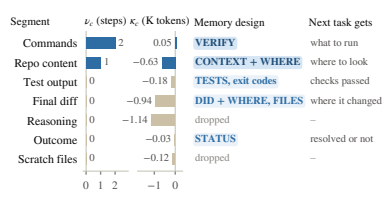
Figure 5 :From segment values to the memory design. The median change in steps (νc) and in thousand actor tokens ( κc) when one segment is removed from the current task’s trajectory (Eq.(3); 27B actor model). Blue bars mark segments whose removal adds steps. The right columns give the field each segment becomes in the memory design, kept as a main field (blue), in reduced form (light blue) or dropped (gray), and what the next task gets from each of them.
出典 · CC BY 4.0 · Peiwen Li, Harshit Verma, Sophia Zhou, Haiwen Wang, Ngoc Bui, Heng Chang, Fei Fei, David van Dijk, Rex Ying · CoReMem: Cost-Internalizing Memory for Successive Coding Tasks with Prospective Valuation · 論文の図を引用 · 元のPDFの4ページ目から図の部分を抽出しています。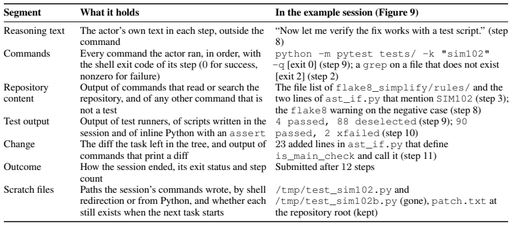
Table 7 :The seven segments of a trajectory.The first five partition the transcript, and the last two come from the boundary.
出典 · CC BY 4.0 · Peiwen Li, Harshit Verma, Sophia Zhou, Haiwen Wang, Ngoc Bui, Heng Chang, Fei Fei, David van Dijk, Rex Ying · CoReMem: Cost-Internalizing Memory for Successive Coding Tasks with Prospective Valuation · 論文の図を引用 · 元のPDFの22ページ目から図の部分を抽出しています。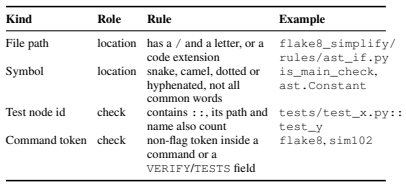
Table 9 :The four kinds of anchor.Examples are from the memory in Figure 10 except the node id, whose form is shown.
出典 · CC BY 4.0 · Peiwen Li, Harshit Verma, Sophia Zhou, Haiwen Wang, Ngoc Bui, Heng Chang, Fei Fei, David van Dijk, Rex Ying · CoReMem: Cost-Internalizing Memory for Successive Coding Tasks with Prospective Valuation · 論文の図を引用 · 元のPDFの22ページ目から図の部分を抽出しています。オンポリシーなメモリ価値とprovenanceクレジット
アクターは、メモリなし、自身のメモリ、誤った別リポジトリのメモリが混ざったロールアウトグループで学習します。報酬は、解決すると高く、ステップを少なく使うほど有利になるよう設計されており、解決したセッションは未解決のセッションより常に高く評価されます。自身のメモリを使ったセッションとメモリなしのセッションの平均報酬の差を、現在のポリシーを基準としたメモリ価値として使い、メモリ由来のアンカーを使ったステップにだけこの価値項を加えます。すべてのステップは結果のクレジットをそのまま保ちます。命題1は、この価値をすべてのステップに同じく与えると、メモリ使用を押す勾配が打ち消され、ゲートを通ったステップにだけ与えると、メモリ使用頻度を調整する効果が残ると示しています。
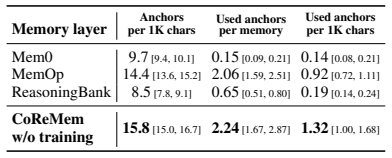
Table 2 :Anchors the next task can act on, per mem- ory layer.27B frozen actor model, test set; an anchor is usedwhen it occurs only in the memory and appears in a message of the next task’s session; brackets give 95% intervals over the test chains.
出典 · CC BY 4.0 · Peiwen Li, Harshit Verma, Sophia Zhou, Haiwen Wang, Ngoc Bui, Heng Chang, Fei Fei, David van Dijk, Rex Ying · CoReMem: Cost-Internalizing Memory for Successive Coding Tasks with Prospective Valuation · 論文の図を引用 · 元のPDFの8ページ目から図の部分を抽出しています。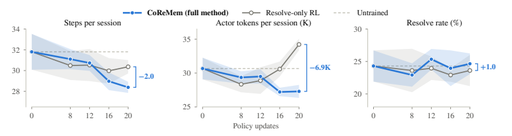
Figure 8 : Training dynamics of the 27B actor on the test sessions with the memory. Lines are means over three replays and bands their standard deviation. Update 0 is the untrained actor, also drawn as the dashed line. The number beside each panel is the paired difference at update20.
出典 · CC BY 4.0 · Peiwen Li, Harshit Verma, Sophia Zhou, Haiwen Wang, Ngoc Bui, Heng Chang, Fei Fei, David van Dijk, Rex Ying · CoReMem: Cost-Internalizing Memory for Successive Coding Tasks with Prospective Valuation · 論文の図を引用 · 元のPDFの15ページ目から図の部分を抽出しています。ChainSWEでのメモリ階層の比較
ChainSWEのチェーン100個を、リポジトリ単位で学習用の半分とテスト用の半分に分け、テスト用の半分で、メモリなし、全履歴、Mem0、MemOp、ReasoningBankと比較しました。事後学習した27Bアクターでは、解決率が21.0%から25.7%に上がり、ステップ数は17%減り、総キャッシュ認識トークンは11%減りました。比較対象のメモリの一部はトークンをより多く使い、解決率に対するトークン効率ではCoReMemが最も良い結果を示しました。この数値は、ChainSWEのテスト用の半分と、Pythonリポジトリをベースにしたmini-swe-agentの設定で得られたものです。
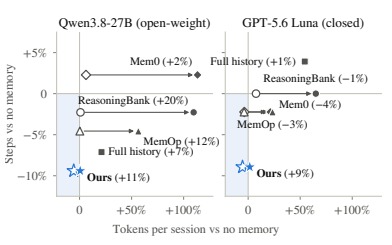
Figure 3 :Steps and tokens of each memory form against no memory.Hollow marks count only the acting model’s tokens, and the arrows add the tokens of the memory module. Parentheses give the relative change in resolve rate. The star isCoReMemw/o training (§3.1), the one form near the shaded quadrant where steps and total tokens both fall.
出典 · CC BY 4.0 · Peiwen Li, Harshit Verma, Sophia Zhou, Haiwen Wang, Ngoc Bui, Heng Chang, Fei Fei, David van Dijk, Rex Ying · CoReMem: Cost-Internalizing Memory for Successive Coding Tasks with Prospective Valuation · 論文の図を引用 · 元のPDFの3ページ目から図の部分を抽出しています。各要素の寄与
アンカーメモリ(M1)は、凍結アクターで解決率をわずかに上げながら、アンカーの使用密度を高めました。この結果は、各要素を取り除いた変種同士の比較として解釈すべきです。
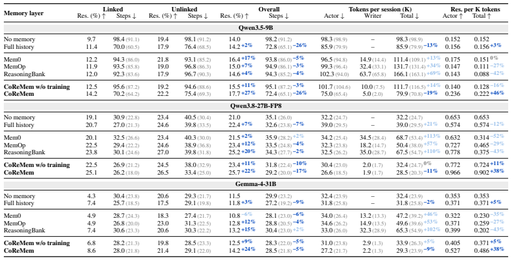
Table 1 :Cost and outcome of each memory layer for the open-weight actor models on the test set.Resolve rate and steps on linked and unlinked boundaries (App. B) and overall, cache-aware tokens per session of the actor model and of the memory module (Writer), and resolve per thousand actor or total tokens. Tags give the change against the no-memory row of the same actor model. Gray values in parentheses are medians over sessions.CoReMemw/o training is our memory on the frozen actor model andCoReMemthe post-trained actor model with it; replay counts and tests are in App. B, with the definition of every column.
出典 · CC BY 4.0 · Peiwen Li, Harshit Verma, Sophia Zhou, Haiwen Wang, Ngoc Bui, Heng Chang, Fei Fei, David van Dijk, Rex Ying · CoReMem: Cost-Internalizing Memory for Successive Coding Tasks with Prospective Valuation · 論文の図を引用 · 元のPDFの7ページ目から図の部分を抽出しています。残された制約
主要な実験は、Pythonリポジトリとmini-swe-agentのハーネスで行い、事後学習は3つのオープンウェイトアクターにのみ適用しました。他のプログラミング言語や、より大きなアクターモデルでは検証していません。効率はステップ数とキャッシュ認識トークンで測定し、実際のレイテンシとエネルギーは報告していません。長期のリポジトリ履歴でメモリをどう蓄積し更新するかは、今後の課題です。
論文情報
- 著者
- Peiwen Li, Harshit Verma, Sophia Zhou, Haiwen Wang, Ngoc Bui, Heng Chang, Fei Fei, David van Dijk, Rex Ying
- 学会・ジャーナル
- arXiv · プレプリント
- 公開日
- 2026年11月12日
- 登録日
- 2026年11月14日
- 更新日
- 2026年11月12日
- バージョン
- v1
- arXiv
- 2611.17316
- カテゴリ
- cs.AI · cs.CL · cs.SE
- ライセンス
- CC BY 4.0
- 掲載内容
- 論文情報・解説・論文の図
この解説は、Refivuの韓国語解説をAIで翻訳したものです。不正確な翻訳や誤りが含まれる可能性があります。論文と図の利用条件は各出典に従います。
アブストラクト
Coding agents tackle successive tasks on an evolving repository, carrying forward edits and writing memory before the next task is known. Selecting memory for unknown next tasks requires balancing future usefulness against the costs of writing and reading it. The actor must also decide when acting on available memory saves effort as the task unfolds. We introduce Coding-Repository Memory (CoReMem), a cost-internalizing framework that guides memory design and actor adaptation through measured memory value on the next task. Prospective segment valuation compares runs of the next task with and without individual trajectory segments from the same inherited repository state, guiding a compact memory built around anchors: repository locations and executable checks. Actor adaptation estimates on-policy memory value within rollout groups with and without memory, using a reward that prioritizes resolution and penalizes step count in successful runs. Provenance-gated value credit assigns the additional value term to steps identified as using memory-supplied anchors, while every step retains outcome credit. On ChainSWE, CoReMem raises the 27B actor's resolve rate from 21.0% to 25.7%, with 17% fewer steps and 11% fewer total cache-aware tokens, including memory-module calls, relative to the untrained actor model without memory.
この論文を引用
Peiwen Li, Harshit Verma, Sophia Zhou, Haiwen Wang, Ngoc Bui, Heng Chang, Fei Fei, David van Dijk, Rex Ying (2026). CoReMem: Cost-Internalizing Memory for Successive Coding Tasks with Prospective Valuation. arXiv:2611.17316v1. https://arxiv.org/abs/2611.17316v1
BibTeX
@misc{li2026coremem,
  title = {{CoReMem: Cost-Internalizing Memory for Successive Coding Tasks with Prospective Valuation}},
  author = {Peiwen Li and Harshit Verma and Sophia Zhou and Haiwen Wang and Ngoc Bui and Heng Chang and Fei Fei and David van Dijk and Rex Ying},
  year = {2026},
  eprint = {2611.17316},
  archivePrefix = {arXiv},
  url = {https://arxiv.org/abs/2611.17316v1}
}