論文解説
Agentic AI for Discovering Fault-Tolerant Quantum Circuits
フォールトトレラント量子回路を発見するためのAgentic AI
- 課題 従来のフォールトトレラント回路は、課題と符号ごとに人手で設計する必要があり、回路が大きくなると限界に突き当たります。
- 手法 LLMが検証ツールを呼び出しながら回路プログラムを進化的に改善し、検証器が欠陥を基準としてスコアを付けます。
- 結果 論理状態準備、論理ゲート、コード遷移のすべての実験課題で、検証済みのフォールトトレラント回路が見つかりました。表面符号のnativeレイアウトでのマルチサイズ探索では、d=3で深さ6、それ以外の距離では深さ7を記録しました。
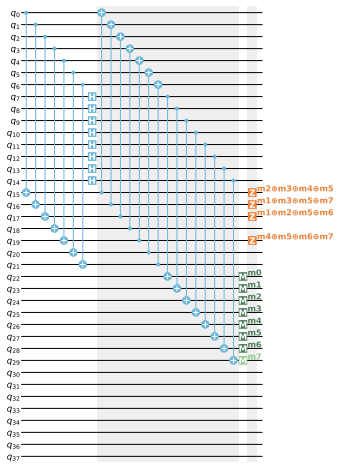
FIG. 5 : The circuit for the Reed-Muller (RM) to Steane (S) switch, with all-to-all connectivity, and 16 ancillae. The dark-green boxes show random measurements, and the light-green box is a detector. The orange boxes show conditional Paulis, with their conditions beside them. We shade alternate layers grey and white. It readsq 7-q14 of the RM blockq 0-q14 in theXbasis, and moves the face q0-q6 to the fresh S blockq 15-q21.q 22-q37 are ancillae.
出典 · CC BY 4.0 · Aritra Lahiri, Florian Marquardt · Agentic AI for Discovering Fault-Tolerant Quantum Circuits · 論文の図を引用 · 元のPDFの17ページ目から図の部分を抽出しています。フォールトトレラント回路設計の難しさ
量子コンピューティングを実用的な規模に拡大するには、量子誤り訂正符号で符号化された情報を扱う回路の効率が必要です。この過程は、論理状態準備、論理ゲートの実装、それらをまとめた論理ルーチンの3段階に分かれます。各段階では、回路内の1つの欠陥が訂正能力を超える誤りに広がりうるため、フォールトトレラント性が必須です。これまでこうした回路は課題と符号ごとに人手で個別に設計されてきましたが、回路が大きくなるとこの方法では対応が難しくなります。強化学習による自動化も距離5程度の符号にとどまり、論理ゲートや上位のルーチンにはほとんど適用されていませんでした。この論文は、こうした空白を出発点として、LLMによる探索で物理量子ビットのレベルのフォールトトレラント回路を見つける方法を扱っています。
エージェント型FunSearchの構造
agentic FunSearchは、LLMが変異演算子の役割を担い、verifierを道具として呼び出して提案を試し、修正してから提出する構造です。回路はPython関数として記述され、この関数はデータ量子ビット数とancilla数を受け取って回路を返します。verifierは、回路が目標状態に到達するかを確認し、欠陥指標を計算します。スコアの高いプログラムは島ごとのデータベースに保存され、次の世代のプロンプトに再び入ります。従来のFunSearchではLLMを単純な変異演算子として使っていましたが、ここではLLMが検証ツールを直接呼び出し、複数の候補を比較できます。回路の形式には、dynamic Clifford circuitsを選びました。
この形式では、中間測定の結果に応じてPauli補正を入れられるため、欠陥が検出されたときに状態を捨てず、補正で回復する回路を探索できます。
検証器と内結合の基準
検証器は、まず回路が目標状態を作ること、補助量子ビットともつれないことを確認します。次に欠陥を列挙します。ゲートの失敗、入力誤り、測定誤りをモデル化し、距離dの符号では次数iがt以下の事象だけを列挙します。各欠陥の残留Pauliは縮約重みで評価され、回路がフォールトトレラントであるためには、次数i ≤ tのすべての事象が検出器を鳴らすか、残留重みをi以下に保つ必要があります。フラグancillaの確定的な測定結果が検出器の役割を果たします。プログラムのスコアは辞書式に付けられ、silentコストを最初に見ます。silentコストは\(\sum_{i\le t} \text{silent}_i/(cN)^{i-1}\)で定義され、ここでNは全量子ビット数、cはO(1)の定数です。
この重みは、高次の事象の組み合わせ数の増加がスコアを支配しないように補正するものです。その後、深さ、herald、waste、matchの順に比較します。
論理ゲート設計の基準
論理ゲートは入力のコードワードごとに正しい出力を出す必要があるため、状態準備とは別の基準が必要です。この論文ではChoi stateを使い、ゲートを1つの目標状態に変換します。各論理量子ビットを基準量子ビットとBell状態で結び付けると、ゲートを適用した後の安定化子生成子が目標になります。ゲート設計では、欠陥をすぐに捨てず、検出パターンとシンドロームが同じbinに属する事象を調べます。binの中で残留が論理演算子の分だけ異なる場合は、曖昧と見なします。曖昧なbinの重い事象はundecodableに、そうでない事象はforfeitedに分類されます。スコアは、silentコスト、undecodableコスト、forfeitコスト、深さ、matchの順に付けられます。
こうすると、長いプロトコルの途中のゲートで1回の破棄がプロトコル全体を最初からやり直させる問題を減らせます。
論理状態準備の結果
論理状態準備では、回路の深さとsilent事象のなさを中心に比較しました。回転表面符号をall-to-all接続で扱った実験では、Ref. [13]よりはっきり浅い回路が得られました。nativeレイアウトで距離3、5、7、9を1つのプログラムで同時に探索したところ、最初の世代からすべての距離でsilent事象のない回路が得られました。最終プログラムは、d=3で深さ6、それ以外の距離で深さ7を記録しました。色符号では、d=3のSteane符号でマルチサイズ探索が深さ7の既存結果と一致し、別のマルチサイズ探索では深さ6のより浅い回路が見つかりました。これらの数値は、該当する表のレイアウトと接続条件の中でのみ解釈すべきです。
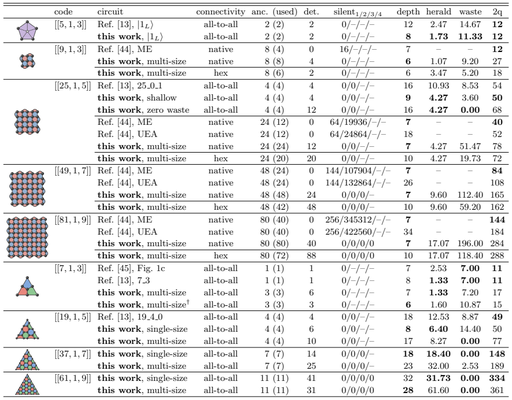
論文の図 TABLE I: Logical-state preparation tasks. All cases prepare|0 L⟩, except for the [[5,1,3]] code which prepares|1 L⟩. Gate set: H, S, X, Z, CNOT, CZ, ancilla measurement, and conditional X, Z. For the CSS codes, we use the|0 L⟩ simplification of the fault tolerance criterion (Appendix B). “anc.” counts the ancillae available in the layout, and “used” those that the circuit actually uses. “det.” counts deterministic measurements and “2q” two-qubit gates. silent1/2/3/4 lists the silent events of order 1, 2, 3 and 4, comprising as many simultaneous faults. “–” denotes an order that is not enumerated, either because the code distance does not require it, or for silent 3,4 the lower orders are already non-zero. Bold numbers mark the best entry for a given code and connectivity. Labels such as 19 4 0 are the file names in the repository [46] of Ref. [13], and ME (measurement encoding) and UEA (unitary encoding with ancilla) follow Ref. [44]. For the [[25,1,5]] code with all-to-all connectivity, we show the shallowest circuit, and a zero waste circuit, both extracted from the programs generated over a single search. The hex layout is similar to the native layout, but with each ancilla’s coupling to the data qubit below it removed [47]. “multi-size” refers to a single program evolved simultaneously for alld∈ {3,5,7,9}. For the [[7,1,3]] code, “multi-size †” is the [[7,1,3]] circuit of a separate multi-size search. The circuits of Ref. [44] have no detectors, so they have no heralded or wasted events.
出典 · CC BY 4.0 · Aritra Lahiri, Florian Marquardt · Agentic AI for Discovering Fault-Tolerant Quantum Circuits · 論文の図を引用 · 元のPDFの6ページ目から図の部分を抽出しています。論理ゲートとコード遷移の結果
論理ゲート実験では、[[5,1,3]]符号のCNOTを、2つの論理ブロック間の9個の物理CNOTを中心に実装しました。この論文の回路は既存のCNOT3fよりはるかに浅く、ancillaを2個または5個使う変種が得られました。[[8,3,2]]符号では、キューブレイアウトの論理Hadamardを扱い、Ref. [15]より浅いフォールトトレラント回路が得られました。コード遷移では、Steane符号とReed-Muller符号の間の遷移を扱いました。SteaneからReed-Mullerへの遷移回路は、undecodableコストとsilentコストが0で、深さは20でした。この結果はすべてのCSS設定で成り立つわけではなく、Table IIIの設定で確認されたものです。
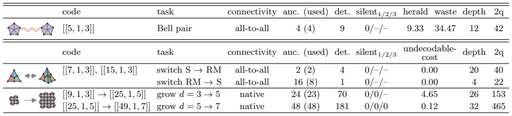
論文の図 TABLE III: Further applications: a logical Bell pair, code switching, and code growth. The gate set is as in Tab. I. The Bell pair is a state preparation task, so its columns are as in Tab. I. The code switches and growths are scored like logical gates by Eq. (3), so their columns mirror Tab. II. The Bell pair is the logical (|0 L0L⟩+|1 L1L⟩)/ √ 2 on two perfect-code encoded logical qubits. The Steane (S)→Reed-Muller (RM) switch moves a logical qubit in place from the S code to the RM code, and the RM→S switch switches and moves it from an RM block to a fresh S block. The growth takes the rotated surface code fromd= 3 tod= 5, as well asd= 5 tod= 7, on its native layout, and the other tasks use all-to-all connectivity. We use the fault tolerance criterion of the final code. For the growth, theX andZparts of event residuals are checked separately against Eq. (1) (see Appendix B). The growth results inevitably have non-zero undecodable-costs, as explained in Sec. III C.
出典 · CC BY 4.0 · Aritra Lahiri, Florian Marquardt · Agentic AI for Discovering Fault-Tolerant Quantum Circuits · 論文の図を引用 · 元のPDFの10ページ目から図の部分を抽出しています。LLMの等級による探索の違い
著者らは、LLMの等級が探索の効率に影響すると考えています。GPT-6.1-solはGPT-6-lunaより、非CSS符号、一部のゲート課題、論理ルーチンで有意に高い性能を示しました。記録の比率でも、最上位の等級は新記録をはるかに頻繁に作りました。この等級のscratchpadメモは平均的により長く、著者らはこれを、より多くの仮説を試して捨てた痕跡と解釈しています。ただし、この比較は同じプロンプトで得られた結果であり、等級間の差がすべての課題で同じように現れるかは、この説明だけでは確定できません。
Idling欠陥と符号成長の限界
idling欠陥は別途列挙しませんでした。著者らは、待機区間のPauli欠陥が既に列挙された欠陥のいずれかと同じPauli効果を持つため、検証器がこれを間接的に含むと論証しています。そのため、深さを減らすことを補助目標としました。符号の成長は、post-selectionの下でのみフォールトトレラントであると説明されています。入力の論理誤りが、最終的な符号距離より低い重みで残りうるためです。したがって、成長回路ではundecodableコストが0になりませんでした。
論文情報
- 著者
- Aritra Lahiri, Florian Marquardt
- 学会・ジャーナル
- arXiv · プレプリント
- 公開日
- 2026年11月13日
- 登録日
- 2026年11月16日
- 更新日
- 2026年11月13日
- バージョン
- v1
- arXiv
- 2611.18504
- カテゴリ
- quant-ph · cs.AI
- ライセンス
- CC BY 4.0
- 掲載内容
- 論文情報・解説・論文の図
この解説は、Refivuの韓国語解説をAIで翻訳したものです。不正確な翻訳や誤りが含まれる可能性があります。論文と図の利用条件は各出典に従います。
アブストラクト
Scaling quantum computing toward practical quantum advantage is currently limited by the efficiency of circuits that operate on information encoded by quantum error-correcting codes. The full stack of quantum computing encompasses several tasks: preparation of logical code states, implementation of logical gates, logical routines on encoded qubits, etc. Yet, these circuits are largely designed by hand for individual cases, with some recent works incorporating machine learning for certain aspects. We formulate this problem as agentic evolutionary program synthesis, wherein a large language model, leveraging its pretraining knowledge and tool-use proficiency, and guided by a circuit verifier, evolves a program that defines a Clifford circuit for a wide range of curated tasks such as logical state preparation, logical gate design, and logical routines such as code-switching, code growth, etc. Our approach consistently finds fault-tolerant circuits for all of these tasks, each verified by an exhaustive check over faults.
この論文を引用
Aritra Lahiri, Florian Marquardt (2026). Agentic AI for Discovering Fault-Tolerant Quantum Circuits. arXiv:2611.18504v1. https://arxiv.org/abs/2611.18504v1
BibTeX
@misc{lahiri2026agentic,
  title = {{Agentic AI for Discovering Fault-Tolerant Quantum Circuits}},
  author = {Aritra Lahiri and Florian Marquardt},
  year = {2026},
  eprint = {2611.18504},
  archivePrefix = {arXiv},
  url = {https://arxiv.org/abs/2611.18504v1}
}