論文解説
When Answer Decodability Is Not a Decision: Separating Final-Answer and Imminent-Emission Signals in Chain-of-Thought
答えの解読可能性は決定ではない:Chain-of-thoughtにおける最終回答の信号と間近の出力信号の分離
- 課題 Chain-of-thoughtの隠れ状態から答えを読むプローブが、決定の信号なのか、次に言及される候補を出力する信号なのかを分離します。
- 手法 同じ位置で、次の言及候補と最終回答を同じreader系列で別々に適合させ、目標ごとのnullを使ってemission gapを計算します。
- 結果 DecisionDepthでは、次の言及候補が最終回答よりはるかに強く読み取られました。一方、Qwen3-8BによるMMLUの事前指定評価では順序が逆でした。
答えプローブの解釈上の問題
Chain-of-thoughtの隠れ状態に対する答えプローブは、モデルがすでに最終回答を決めていることの証拠として、しばしば解釈されます。しかし推論文は、候補を書く直前にその名前を生み出すための情報を隠れ状態に保持している必要があります。そのため、最終回答と次に言及される候補は、同じ位置で競合する信号になります。この論文は、この2つの信号を同じ位置で分離することを課題としています。正解ロールアウトで、最終回答がまだ現れていない最初のdistractorへの言及の直前のトークンが、中心となる位置です。
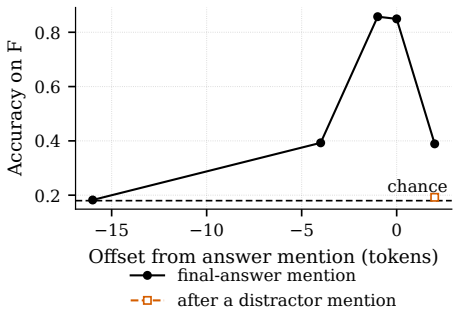
Figure 3 : Final-answer readout aligned to the first mention of the answer in the conclusion (Qwen3.5-4B, DD, all correct rollouts). The readout peaks one token before the answer is written and decays after it. The square is the readout two tokens after a distractor mention.
出典 · CC BY 4.0 · Han, Hyojung, Kim, Jongmin, Jeon, Seung-Hun · When Answer Decodability Is Not a Decision: Separating Final-Answer and Imminent-Emission Signals in Chain-of-Thought · 論文の図を引用 · 元のPDFの7ページ目から図の部分を抽出しています。ECDPの目標とemission gap
ECDPは、同じ位置で次の言及候補Mtと最終回答Fを、同じlow-rankのreader系列で別々に適合させます。2つの目標のnullは異なるように設定します。Fは、K個の候補に対する一様基準であるE[1/K]を使います。Mtは、正解ではないという事実だけを学習しても得られるE[1/(K−1)]を使います。Emission gapは[Acc(Mt)−E[1/(K−1)]]−[Acc(F)−E[1/K]]で定義され、この値が大きいほど、同じ位置で次の言及候補が最終回答より強く読み取られていることを意味します。Emission Separatedと判定するには、Mtのz値とnullに対する向上、Fの低いz値、差の大きさ、区間下限の条件を同時に満たすことが求められます。

Table 1 : Emission-controlled probing results. Nulls in parentheses:E[1/(K− 1)]for M, E[1/K]for F. † marks the decision set selected by the pre-specified rule for each setting (BBH uses the secondary set because its primary set falls below 150 items). The pre-specified verdicts come from the original single-seed analysis; accuracies andz shown here are post-hoc medians over reader seeds 1–3, and applying the same decision rule to them leaves every decision-set verdict unchanged. The bracketed interval is a 10,000-resample item bootstrap for the median-gap seed; it is descriptive and does not include training-seed variation. Shuffled:M labels permuted, scored against trueM. Position: a random non-mention position in the same item (controls from seed 1).
出典 · CC BY 4.0 · Han, Hyojung, Kim, Jongmin, Jeon, Seung-Hun · When Answer Decodability Is Not a Decision: Separating Final-Answer and Imminent-Emission Signals in Chain-of-Thought · 論文の図を引用 · 元のPDFの7ページ目から図の部分を抽出しています。DecisionDepthでの分離結果
DecisionDepthのQwen3.5-4Bの主分析セット(n=353)では、次の言及候補が.966と読み取られ、nullの.234より高くなりました。一方、最終回答は.221で、nullの.186に近い値でした。この設定のemission gapは.696 [.648, .744]です。同じモデルで、すべてのdistractor位置を使う補助セット(n=883)では、最終回答も弱く読み取られ、両方の目標が読み取られたと判定されました。このセットのgapは.511 [.473, .549]です。Llama-3.1-8Bの主セットでも、Mtは.867、Fは.240で、gapは.575 [.514, .632]でした。
この区間は、median-gap seedの項目ブートストラップ区間であり、学習seedの変動と多重性の調整は含まれていません。
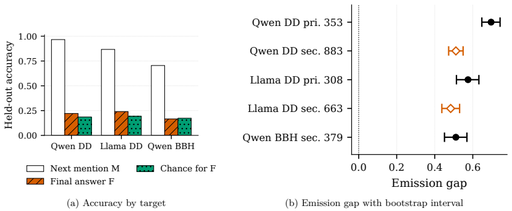
Figure 2 : Same positions and reader architecture, separately fitted to two targets. (a) Held-out accuracy for the next mentionM and the final answerF on each setting’s pre-specified decision set; the third bar is the uniform null forF. (b) Emission gap∆emit with nominal 95% within-seed item-bootstrap intervals from the median-gap seed (training-seed variation is not included); filled markers are decision sets, open markers the other set. The BBH primary set (n= 61) is below the pre-specified 150-item floor and is omitted.
出典 · CC BY 4.0 · Han, Hyojung, Kim, Jongmin, Jeon, Seung-Hun · When Answer Decodability Is Not a Decision: Separating Final-Answer and Imminent-Emission Signals in Chain-of-Thought · 論文の図を引用 · 元のPDFの6ページ目から図の部分を抽出しています。層・planted信号・容量の統制
層の分析では、Qwen3.5-4Bは層20以降、次の言及候補が.906から.966まで読み取られる一方、最終回答はすべての層でz=3の閾値を下回ったままにとどまっています。ただし、これは選んだ方向と容量に対する感度であり、最終回答の信号がないことを証明するものではありません。別の容量の研究では、学習精度は.300から.959まで上がりますが、held-out精度は.157から.193の間にとどまりました。
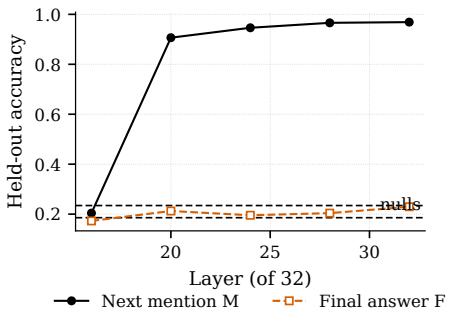
Figure 4 : Readout by layer at the primary positions (Qwen3.5-4B, DD; medians over three reader seeds). Dashed lines are the nulls forM (upper) andF (lower). The next mention becomes readable from layer 20; the final answer stays below thez= 3threshold at every layer.
出典 · CC BY 4.0 · Han, Hyojung, Kim, Jongmin, Jeon, Seung-Hun · When Answer Decodability Is Not a Decision: Separating Final-Answer and Imminent-Emission Signals in Chain-of-Thought · 論文の図を引用 · 元のPDFの8ページ目から図の部分を抽出しています。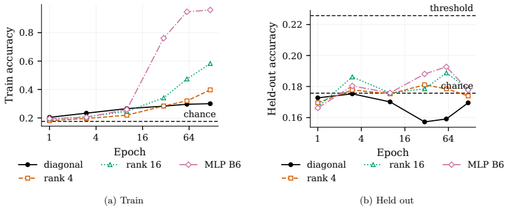
Figure 6 : Readers from a diagonal scorer to a 6.3M-parameter MLP trained to convergence without early stopping (median of three seeds). Training accuracy grows with capacity, while held-out accuracy stays between .157 and .193 and never reaches the pre-specified hidden-signal threshold in any reader-by-checkpoint cell.
出典 · CC BY 4.0 · Han, Hyojung, Kim, Jongmin, Jeon, Seung-Hun · When Answer Decodability Is Not a Decision: Separating Final-Answer and Imminent-Emission Signals in Chain-of-Thought · 論文の図を引用 · 元のPDFの9ページ目から図の部分を抽出しています。Qwen3-8Bの反例と最終回答の優位
事前指定されたQwen3-8BのMMLU評価では、full-prefix attention readerがすべてのthinking位置で両方の目標を読み取り、最終回答のほうが強く読み取られました。層22では、Mt−Fの差は−.398 [−.459, −.336]で、Mtのliftは.230、Fのliftは.628でした。この評価ではモデル、課題、位置、readerが同時に変わるため、DecisionDepthの結果で順序が逆転した原因を切り分けられません。位置0のマスキングは主readerで適用されましたが、attention sinkの仕組みを検証したものではありません。
マッチさせた交差比較が未完成であること
モデルと課題を交差させる試みでは、Qwen3.5-4BとQwen3-8BのDDのセルで、imminent mention probeが安定して学習されず、有効な統計量が得られませんでした。Qwen3-8BのDDでは、あるseedの学習損失が開始時より高くなったため、事前の規則に従い統計量はありません。したがって、どの要因が順序を逆転させているのかは確認できていません。学習の失敗は情報がないことの証拠ではなく、このreaderと学習手順が目標を安定して取り出せなかったことを意味します。

Table 3 : Outcome of each cell of the attempted matched comparison. C2x is the Qwen3.5-4B MMLU cell scored under a protocol written after the training checks that gated its main run failed; that failure is retained.
出典 · CC BY 4.0 · Han, Hyojung, Kim, Jongmin, Jeon, Seung-Hun · When Answer Decodability Is Not a Decision: Separating Final-Answer and Imminent-Emission Signals in Chain-of-Thought · 論文の図を引用 · 元のPDFの20ページ目から図の部分を抽出しています。因果的介入の試みの限界
Gradient steeringは、apparatus検査で答えを変えられなかったため、因果判定は不可能でした。その後、探索的に行ったfull-state interchangeでは、層20の状態を別の候補の状態に置き換えたとき、次の言及がC′に変わった割合は.700でした。一方、最終回答は置き換えた項目で.005しか変わりませんでした。この観察は、事前に定めた同等性の境界がないため、最終回答が置き換えられた状態に鈍感だという証明ではありません。
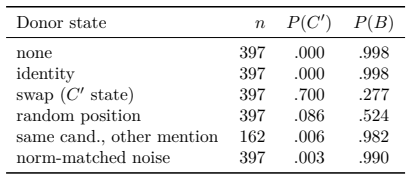
Table 2 : Exploratory full-state interchange at layer 20 (Qwen3.5-4B, DD). The state at the position before a mention ofB is replaced by a donor state from the same trajectory; columns give the probability that the next mention isC ′ or B. The same-candidate control is defined only for items with a second mention ofB.
出典 · CC BY 4.0 · Han, Hyojung, Kim, Jongmin, Jeon, Seung-Hun · When Answer Decodability Is Not a Decision: Separating Final-Answer and Imminent-Emission Signals in Chain-of-Thought · 論文の図を引用 · 元のPDFの14ページ目から図の部分を抽出しています。適用範囲とエビデンスの等級
この結果は、正解ロールアウト、4B~8Bの4つのモデル、合成のDecisionDepthと公開の選択式課題に限られます。DDの対称な候補構造は自然な課題における順序バイアスを反映しないため、自然な課題には順序を考慮したnullが必要です。複数のエビデンス等級のうち、主要な結果、限定的な結果、探索的な結果、支持しない結果が区別されています。したがって、高い回答readoutを決定時点の証拠と断定することはできず、主な結論は、同じ位置の競合する目標を一緒に測定すべきだという点です。
論文情報
- 著者
- Han, Hyojung, Kim, Jongmin, Jeon, Seung-Hun
- 学会・ジャーナル
- arXiv · プレプリント
- 公開日
- 2026年11月9日
- 登録日
- 2026年11月10日
- 更新日
- 2026年11月9日
- バージョン
- v1
- arXiv
- 2611.11892
- カテゴリ
- cs.LG · cs.CL
- ライセンス
- CC BY 4.0
- 掲載内容
- 論文情報・解説・論文の図
この解説は、Refivuの韓国語解説をAIで翻訳したものです。不正確な翻訳や誤りが含まれる可能性があります。論文と図の利用条件は各出典に従います。
アブストラクト
Answer probes applied to chain-of-thought hidden states are often read as evidence that a language model has already decided its final response. This reading overlooks a competing signal, the candidate the model is about to mention. We introduce emission-controlled dual-target probing (ECDP), which fits the same low-rank reader family separately to the imminent mention and to the final answer at identical positions, with target-specific nulls and thresholds fixed before any fit. On correct DecisionDepth (DD) rollouts in which a distractor is mentioned before the final answer, Qwen3.5-4B decodes the next mention at .966 (null .234) but the final answer only at .221 (null .186), an emission gap of .696 [.648, .744]; Llama-3.1-8B gives .575 [.514, .632]. This pattern is not universal. In a pre-specified evaluation of Qwen3-8B with thinking enabled on held-out MMLU questions, using a full-prefix attention reader over every thinking position, both targets are decodable and the final answer is read far more strongly (mention-minus-answer lift -.398 [-.459, -.336] at layer 22 over 467 questions). Model, task, positions, and reader change together between these settings, and an attempted matched comparison on DD produced no valid statistics because the imminent-mention probe did not train reliably, so we do not identify what reverses the order. On DD, planted-signal controls show that the reader recovers an injected final-answer signal at one tenth of full dose. Answer-candidate decodability is therefore target-relative and protocol-dependent: a strong answer readout does not by itself establish when a model commits, and a probe that fails to train is not evidence that the information is absent. ECDP is a practical control for distinguishing imminent text emission from evidence of a settled decision.
この論文を引用
Han, Hyojung, Kim, Jongmin, Jeon, Seung-Hun (2026). When Answer Decodability Is Not a Decision: Separating Final-Answer and Imminent-Emission Signals in Chain-of-Thought. arXiv:2611.11892v1. https://arxiv.org/abs/2611.11892v1
BibTeX
@misc{hyojung2026when,
  title = {{When Answer Decodability Is Not a Decision: Separating Final-Answer and Imminent-Emission Signals in Chain-of-Thought}},
  author = {Han, Hyojung and Kim, Jongmin and Jeon, Seung-Hun},
  year = {2026},
  eprint = {2611.11892},
  archivePrefix = {arXiv},
  url = {https://arxiv.org/abs/2611.11892v1}
}