論文解説
ToolDex: An Ego-Exo Human Demonstration Dataset for Creative Physical Tool Use
ToolDex:創造的な物理的道具使用のためのEgo-Exo人間デモンストレーションデータセット
- 課題 創造的な物理的道具使用を学習・評価するには、人が実際に道具を持ち替えて使う手と道具と対象の相互作用を捉えた大規模なデータが必要です。しかし既存のデータセットやベンチマークは、規模、忠実度、対象物体の役割の表示の面で不足しています。
- 手法 TOOLDEXは、8台のexocentric RGB-Dカメラと egocentricステレオカメラで同期させた人間の実演を収集し、6-DoF道具姿勢、MANO手姿勢、対象のセグメンテーションマスクを注釈として提供します。このデータをもとに、VLMによる道具推論、疎視点3DGS・4DGS再構成、人間の実演に基づくロボット方策学習の3つのベンチマークを構成します。
創造的な道具使用のためのデータの空白
創造的な道具使用とは、標準的な道具がないときに周囲の物を道具として使う能力のことで、物体のアフォーダンス(affordance)と物理的制約を推論する必要があります。既存のロボットの道具使用ベンチマークは、シミュレーションに基づくものか、単純な物体相互作用にとどまるものが多くあります。また既存のegocentricな手と物体のデータセットは、道具と対象物体の役割を分けて表示していないため、道具が対象に働きかける相互作用を十分に捉えられていません。この論文は、この欠けている部分を埋めるために、実際の人間の実演によるデータセットTOOLDEXを提案しています。

Table 1 : Comparison of TOOLDEXwith recent hand–object-interaction datasets. Only TOOLDEXex- plicitly separatestoolandtargetobject roles (Section 3.1). For prior datasets the dash in #Target Obj. indicates a single combined object inventory rather than the absence of targets.
出典 · CC BY 4.0 · Mohamed Elmoghany, Kehan Li, Ruoqu Chen, Tarun Chiruvolu, Shutong Zhang, Ryan Wang, Stephen Tian, Yaru Niu, Michelle Guo, Ding Zhao, Weiyu Liu, Mengdi Xu, Li Fei-Fei, Jiajun Wu · ToolDex: An Ego-Exo Human Demonstration Dataset for Creative Physical Tool Use · 論文の図を引用 · 元のPDFの3ページ目から図の部分を抽出しています。手・道具・対象の相互作用を捉えるデータセット設計
TOOLDEXは、手、道具、対象物体の3つの役割を分けて扱い、道具と対象のあいだの相互作用が作業の成否を決めると考えています。データは、8台の較正済みIntel RealSense RGB-D exocentricカメラと、Apple Vision Proに取り付けたZED Miniのステレオegocentricカメラで同期して記録されています。各実演には、6-DoF道具姿勢、MANO手姿勢、対象物体の多視点セグメンテーションマスクが注釈として付けられています。データセットには10,853個のtrialsが含まれ、45個の道具物体、23個の支持物体、16種類の変形可能な対象を扱っています。
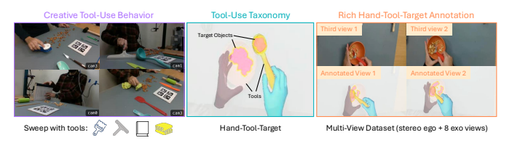
Figure 1 : TOOLDEXOverview. The dataset capturescreative physical tool-use behaviorsin everyday tabletop scenarios, where humans repurpose available objects as tools for manipulation (left). It explicitly models fullhand–tool–target-objectinteractions, including for challenging deformable tar- gets (middle). Using synchronized ego-exo multi-view capture, TOOLDEXprovides rich annotations across views, including hand pose, tool, and target-object segmentation (right). A major obstacle isthe lack of datasets and benchmarks that capture human physical tool-use capabilities at sufficient scale, fidelity, and diversity. Existing robot tool-use benchmarks are often simulation-based or focus on simplified object interactions, making it difficult to evaluate the com- plexity of real-world manipulation (Xu et al., 2023; Gao et al., 2026; Bakhtin et al., 2019; Zhang et al., 2025). Meanwhile, recent egocentric human manipulation datasets have greatly expanded the coverage of hand-object interactions (Hoque et al., 2026; Punamiya et al., 2026; Li et al., 2026; Liu et al., 2024). Among them, TACO explicitly captures tool-action-object compositions for hand-object manipulation (Liu et al., 2024). However, it does not explicitly model the target objects manipulated by the tools, such as cakes to be cut or water to be stirred. As a result, existing datasets either contain limited tool-use instances or lack the full hand–tool–target-object interactions and annotations needed to study physical tool use.
出典 · CC BY 4.0 · Mohamed Elmoghany, Kehan Li, Ruoqu Chen, Tarun Chiruvolu, Shutong Zhang, Ryan Wang, Stephen Tian, Yaru Niu, Michelle Guo, Ding Zhao, Weiyu Liu, Mengdi Xu, Li Fei-Fei, Jiajun Wu · ToolDex: An Ego-Exo Human Demonstration Dataset for Creative Physical Tool Use · 論文の図を引用 · 元のPDFの2ページ目から図の部分を抽出しています。データ構成と分割による評価条件
TOOLDEXの各(道具、行動、対象)の組み合わせは60分間収集され、初期姿勢を変え、4–5個の妨害道具を配置しています。言語条件のもとで使う道具を視覚的に見つけなければならないよう設計されています。この構成をもとに著者らは、未見の道具、対象、行動を評価するゼロショット分割と、各構成要素は見ているが組み合わせは見ていない組み合わせ汎化分割を一緒に作成しています。この分割はデータの組み合わせ構造を生かした評価設計であり、ベンチマークの結果はこの条件のもとで解釈する必要があります。
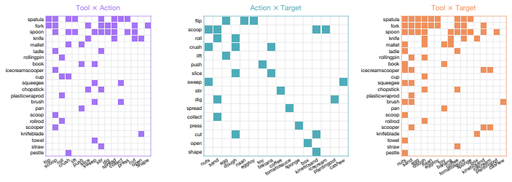
Figure 2 :Combinatorial coverage of TOOLDEX.Binary heatmaps of the(tool, action, target) combinations in the dataset, with each axis sorted from most to least frequent.
出典 · CC BY 4.0 · Mohamed Elmoghany, Kehan Li, Ruoqu Chen, Tarun Chiruvolu, Shutong Zhang, Ryan Wang, Stephen Tian, Yaru Niu, Michelle Guo, Ding Zhao, Weiyu Liu, Mengdi Xu, Li Fei-Fei, Jiajun Wu · ToolDex: An Ego-Exo Human Demonstration Dataset for Creative Physical Tool Use · 論文の図を引用 · 元のPDFの4ページ目から図の部分を抽出しています。疎視点3DGSと4DGSの再構成パイプライン
疎視点の再構成実験では、InstantSplatをバックボーンとして使い、静的な3DGSと、視点ごとに適用した動的な4DGS(IS-4D)を比較しています。1段階目では、MASt3Rによる視点間の密な点の事前情報で初期化し、InstantSplatの姿勢とGaussianを同時に最適化します。2段階目では、レンダリングした視点を単一段階の拡散モデルで補正します。静的な設定ではDifix3Dを使い、4DGSの設定ではDifix3Dの後ろにGSFix3Dをつなぎます。著者らは、この2段階の構成を、再構成の誤りが主に現れるレンダリング視点単位の補正として説明しています。
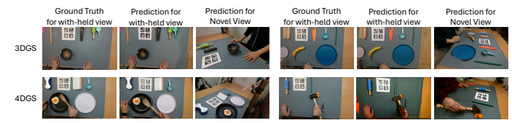
Figure 4 : 3DGS and 4DGS prediction for camera view withheld during training and prediction of novel views using InstantSplat + Difix3D. Additional visualizations are available on our website.
出典 · CC BY 4.0 · Mohamed Elmoghany, Kehan Li, Ruoqu Chen, Tarun Chiruvolu, Shutong Zhang, Ryan Wang, Stephen Tian, Yaru Niu, Michelle Guo, Ding Zhao, Weiyu Liu, Mengdi Xu, Li Fei-Fei, Jiajun Wu · ToolDex: An Ego-Exo Human Demonstration Dataset for Creative Physical Tool Use · 論文の図を引用 · 元のPDFの7ページ目から図の部分を抽出しています。cam6を除いた条件でのnovel-view結果
動的な4DGSでは、IS-4D + Difix3D + GSFix3DのMUSIQは69.92で、IS-4Dより18.92高くなっています。一方、同じ設定のPSNRは15.97 dBに下がっています。この結果は、参照ベースの忠実度と参照なしの知覚品質とのトレードオフを測定した例であり、この組み合わせはcam6を除いた実行と、8台のカメラを使った実行の条件で評価されています。

Table 2 : Novel-view synthesis results for data captured by 8 sparse cameras, for both static (3DGS) and dynamic (4DGS) settings. PSNR is computed against a held-out camera view (cam6); MUSIQ scores are computed after training with all 8 cameras (no ground truth required). Methods: Splat- Former (Chen et al., 2025), InstantSplat (IS) (Fan et al., 2024), Difix3D (Wu et al., 2025), GS- Fix3D (Yin et al., 2026); MUSIQ (Ke et al., 2021).
出典 · CC BY 4.0 · Mohamed Elmoghany, Kehan Li, Ruoqu Chen, Tarun Chiruvolu, Shutong Zhang, Ryan Wang, Stephen Tian, Yaru Niu, Michelle Guo, Ding Zhao, Weiyu Liu, Mengdi Xu, Li Fei-Fei, Jiajun Wu · ToolDex: An Ego-Exo Human Demonstration Dataset for Creative Physical Tool Use · 論文の図を引用 · 元のPDFの7ページ目から図の部分を抽出しています。VLMの道具選択と空間グラウンディングの評価
VLMの評価は、道具選択、空間グラウンディング、行動計画の3つのレベルで構成されています。道具選択は、予測した道具のうち1つでも実演の正解道具と一致すれば正解として計算します。空間グラウンディングは、意味的に正しい道具の予測に対してのみIoUを計算します。行動計画では、自然言語の指示と最初のフレームを入力とし、180個の軌道からなる評価部分集合でMean L2とChamfer-L2により軌道の距離を測定します。この評価パイプラインは、複数の妥当な道具を認めるように、意図的に寛容に設計されています。
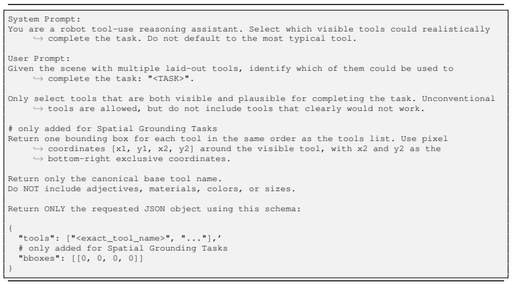
Table 9 : Prompt used for evaluating tool selection and localization capabilities of VLMs.
出典 · CC BY 4.0 · Mohamed Elmoghany, Kehan Li, Ruoqu Chen, Tarun Chiruvolu, Shutong Zhang, Ryan Wang, Stephen Tian, Yaru Niu, Michelle Guo, Ding Zhao, Weiyu Liu, Mengdi Xu, Li Fei-Fei, Jiajun Wu · ToolDex: An Ego-Exo Human Demonstration Dataset for Creative Physical Tool Use · 論文の図を引用 · 元のPDFの18ページ目から図の部分を抽出しています。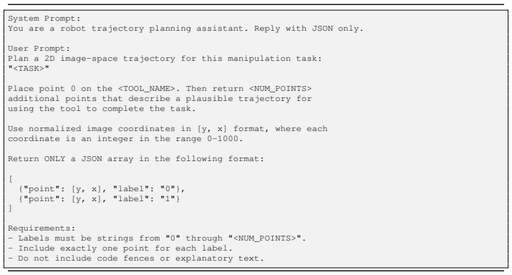
Table 10 : Prompt used for behavioral planning and trajectory prediction.
出典 · CC BY 4.0 · Mohamed Elmoghany, Kehan Li, Ruoqu Chen, Tarun Chiruvolu, Shutong Zhang, Ryan Wang, Stephen Tian, Yaru Niu, Michelle Guo, Ding Zhao, Weiyu Liu, Mengdi Xu, Li Fei-Fei, Jiajun Wu · ToolDex: An Ego-Exo Human Demonstration Dataset for Creative Physical Tool Use · 論文の図を引用 · 元のPDFの18ページ目から図の部分を抽出しています。VLM結果の強みと限界
行動計画では、GPT-6-Astraが評価での成功率89.4%を記録しました。一方、評価に成功した軌道のうちでは、Gemini Robotics ERの軌道誤差が最も小さい結果でした。これは出力の信頼度と空間認識のトレードオフとされています。
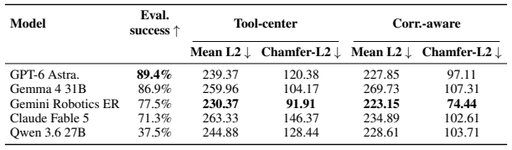
Table 4 : Behavioral-planning results across all 160 trajectories for GPT-6-Astra (OpenAI, 2026), Gemma 4 31B (Google DeepMind, 2026), Gemini Robotics ER (Gemini Robotics Team, 2025), Claude Fable 5 (Anthropic, 2026), and Qwen 3.6 27B (Qwen Team, 2026). All distance metrics are reported in pixels and computed over successfully evaluated outputs.
出典 · CC BY 4.0 · Mohamed Elmoghany, Kehan Li, Ruoqu Chen, Tarun Chiruvolu, Shutong Zhang, Ryan Wang, Stephen Tian, Yaru Niu, Michelle Guo, Ding Zhao, Weiyu Liu, Mengdi Xu, Li Fei-Fei, Jiajun Wu · ToolDex: An Ego-Exo Human Demonstration Dataset for Creative Physical Tool Use · 論文の図を引用 · 元のPDFの8ページ目から図の部分を抽出しています。人間の実演に基づくロボット方策への移行結果
ロボット方策の実験では、人間の道具使用の実演をdexterousなロボット方策へ移すための複数の手法を比較しています。Kinematic Retargetは、リターゲットされた動きをそのまま実行し、平均成功率は14.0%でした。BC(Retarget)は4.6%でした。強化学習ベースのManipTransは40.5%、Dex-X(RL)は55.1%でした。接触の多い作業で差が特に大きく、すり潰し作業は16.8%から46.7%に、掃き集め作業は12.6%から57.5%に向上しました。著者らは、接触の多い相互作用、道具の形状、embodimentの不一致が移行の難しさの主な原因だと解釈しています。
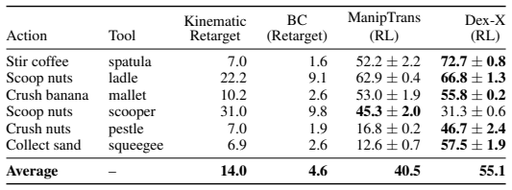
Table 5 : Task success rates (%) on the benchmark. Higher is better.
出典 · CC BY 4.0 · Mohamed Elmoghany, Kehan Li, Ruoqu Chen, Tarun Chiruvolu, Shutong Zhang, Ryan Wang, Stephen Tian, Yaru Niu, Michelle Guo, Ding Zhao, Weiyu Liu, Mengdi Xu, Li Fei-Fei, Jiajun Wu · ToolDex: An Ego-Exo Human Demonstration Dataset for Creative Physical Tool Use · 論文の図を引用 · 元のPDFの9ページ目から図の部分を抽出しています。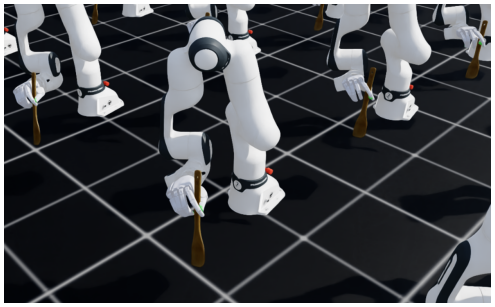
Figure 12 : Visualization of the tool retargeting.
出典 · CC BY 4.0 · Mohamed Elmoghany, Kehan Li, Ruoqu Chen, Tarun Chiruvolu, Shutong Zhang, Ryan Wang, Stephen Tian, Yaru Niu, Michelle Guo, Ding Zhao, Weiyu Liu, Mengdi Xu, Li Fei-Fei, Jiajun Wu · ToolDex: An Ego-Exo Human Demonstration Dataset for Creative Physical Tool Use · 論文の図を引用 · 元のPDFの21ページ目から図の部分を抽出しています。対象範囲と限界
著者らは、データセットは主に屋内のtabletop環境に焦点を当てており、大規模な屋外や移動型の人間による道具使用の行動は含まれていないと述べています。材料と相互作用の力学の物理的範囲も完全ではなく、occlusionや接触の場面では一部の注釈にノイズが含まれることがあります。VLMのパイプラインは複数の妥当な道具を認めるように寛容に設計されているため、人が検証した許容道具の集合は今後の課題として残されています。
論文情報
- 著者
- Mohamed Elmoghany, Kehan Li, Ruoqu Chen, Tarun Chiruvolu, Shutong Zhang, Ryan Wang, Stephen Tian, Yaru Niu, Michelle Guo, Ding Zhao, Weiyu Liu, Mengdi Xu, Li Fei-Fei, Jiajun Wu
- 学会・ジャーナル
- arXiv · プレプリント
- 公開日
- 2026年11月6日
- 登録日
- 2026年11月9日
- 更新日
- 2026年11月6日
- バージョン
- v1
- arXiv
- 2611.09036
- カテゴリ
- cs.RO · cs.AI
- ライセンス
- CC BY 4.0
- 掲載内容
- 論文情報・解説・論文の図
この解説は、Refivuの韓国語解説をAIで翻訳したものです。不正確な翻訳や誤りが含まれる可能性があります。論文と図の利用条件は各出典に従います。
アブストラクト
Creative tool use is a fundamental human capability and an important step toward general-purpose embodied intelligence. It requires agents to reason about object affordances, physical constraints, and manipulation strategies, especially when standard tools are unavailable. However, progress in this area is limited by the lack of real-world datasets that capture human tool-use behavior with sufficient scale, fidelity, and diversity. Existing benchmarks are often simulation-based, focus on simplified interactions, or lack detailed observations and annotations. We introduce ToolDex, a large-scale egocentric-exocentric (ego-exo) human demonstration dataset for creative physical tool use. ToolDex captures scenarios in which humans select, adapt, and repurpose available objects as tools. Using synchronized egocentric cameras and eight exocentric cameras, the dataset provides high-fidelity multi-view observations and rich annotations for hands, tools, target objects, and their deformable interactions. Beyond data collection, we establish a benchmark suite characterizing three core capabilities: physical tool-use reasoning, sparse-view 3D and 4D reconstruction, and robot policy learning. ToolDex provides a foundation for studying human tool-use behavior and developing embodied agents that can adaptively use tools in complex real-world environments. Dataset visualizations and benchmarking results are available at https://tooluse-dataset.github.io/.
この論文を引用
Mohamed Elmoghany, Kehan Li, Ruoqu Chen, Tarun Chiruvolu, Shutong Zhang, Ryan Wang, Stephen Tian, Yaru Niu, Michelle Guo, Ding Zhao, Weiyu Liu, Mengdi Xu, Li Fei-Fei, Jiajun Wu (2026). ToolDex: An Ego-Exo Human Demonstration Dataset for Creative Physical Tool Use. arXiv:2611.09036v1. https://arxiv.org/abs/2611.09036v1
BibTeX
@misc{elmoghany2026tooldex,
  title = {{ToolDex: An Ego-Exo Human Demonstration Dataset for Creative Physical Tool Use}},
  author = {Mohamed Elmoghany and Kehan Li and Ruoqu Chen and Tarun Chiruvolu and Shutong Zhang and Ryan Wang and Stephen Tian and Yaru Niu and Michelle Guo and Ding Zhao and Weiyu Liu and Mengdi Xu and Li Fei-Fei and Jiajun Wu},
  year = {2026},
  eprint = {2611.09036},
  archivePrefix = {arXiv},
  url = {https://arxiv.org/abs/2611.09036v1}
}