논문 해설
Reinforcement Learning via Self-Distillation
자기 증류를 통한 강화학습
- 연구 문제 스칼라 결과 보상만 받는 RLVR은 실패 원인을 알려 주지 않아 신용 할당이 어렵고, 외부 교사 없이 풍부한 환경 피드백을 학습 신호로 바꾸는 방법이 필요합니다.
- 연구 방법 SDPO는 같은 정책을 피드백이 포함된 self-teacher로 사용해 학생의 원래 응답 토큰 분포를 로짓 수준으로 증류하며, 그 기울기는 정책 기울기와 같은 형태로 해석됩니다.
- 주요 결과 LiveCodeBench v6에서 SDPO는 최종 정확도 48.8%로 GRPO의 41.2%보다 높고, 테스트 시간 자기 증류는 매우 어려운 질문에서 발견 속도를 높였다고 보고됩니다.
스칼라 보상의 정보 병목
강화학습으로 대규모 언어 모델을 후학습할 때 흔히 쓰는 RLVR은 질문당 하나의 스칼라 결과 보상만 받습니다. 이 보상은 시도가 맞았는지는 알려 주지만 어디가 어떻게 틀렸는지는 알려 주지 않습니다. 원문은 이를 심각한 신용 할당 병목으로 규정합니다. 그룹 안의 모든 롤아웃이 같은 보상을 받으면 GRPO의 이점 추정이 0으로 붕괴하고 학습이 멈춘다고 설명합니다. 한편 코드 실행 환경은 런타임 오류나 실패한 단위 테스트처럼 풍부한 토큰화 피드백을 제공합니다. 저자들은 이 피드백을 활용하는 설정을 RLRF로 정식화하고, 강한 외부 교사 없이 이 피드백을 밀집된 신용 신호로 바꿀 수 있는지를 질문으로 삼습니다.
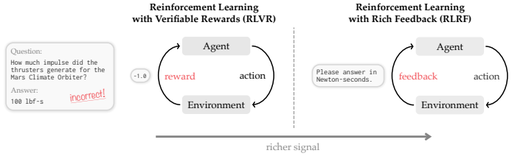
Figure 2 :Comparison of RLVR and RLRF settings.In Reinforcement Learning with Verifiable Rewards (RLVR), the agent learns from a scalar reward r, which often acts as an information bottleneck by masking the underlying environment state. In contrast, Reinforcement Learning with Rich Feedback (RLRF) utilizes tokenized feedback. This provides a significantly richer signal than a scalar reward, as the feedback can encapsulate both the reward as well as detailed observations of the state (such as runtime errors from a code environment or feedback from an LLM judge).
원문 · CC BY 4.0 · Jonas Hübotter, Frederike Lübeck, Lejs Behric, Anton Baumann, Marco Bagatella, Daniel Marta, Ido Hakimi, Idan Shenfeld, Thomas Kleine Buening, Carlos Guestrin, Andreas Krause · Reinforcement Learning via Self-Distillation · 원문 그림 인용 · 원본 PDF 2쪽에서 그림 영역을 추출했습니다.피드백 조건부 self-teacher와 로짓 수준 증류
SDPO는 같은 모델을 두 역할로 씁니다. 학생은 질문 x에 대해 응답 y를 샘플링한 정책 πθ(·|x)이고, self-teacher는 같은 정책에 피드백 f를 문맥으로 덧붙인 πθ(·|x,f)입니다. 학생의 원래 응답 y를 교사 문맥에서 다시 평가하여 토큰별 로그확률을 얻고, 두 분포 사이의 KL을 토큰마다 최소화합니다. 손실은 LSDPO(θ)=Σt KL(πθ(·|x,y<t) ∥ stopgrad(πθ(·|x,f,y<t)))로 정의되며, stopgrad는 교사 쪽 기울기가 학생 방향으로 흐르지 않게 막아 교사가 학생을 따라 퇴행하지 않도록 합니다. 이 손실의 기울기는 교사 분포와 학생 분포의 로그 비를 이점으로 쓰는 로짓 수준 정책 기울기와 같은 형태를 가지므로, 기존 RLVR 구현에서 이점만 바꾸어 적용할 수 있다고 설명합니다.
추가 비용은 교사의 로그확률 재계산이며 샘플링은 늘지 않습니다.
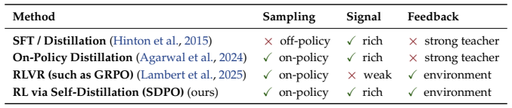
Table 1 : Comparison of self-distillation to alternative methods for post-training LLMs.
원문 · CC BY 4.0 · Jonas Hübotter, Frederike Lübeck, Lejs Behric, Anton Baumann, Marco Bagatella, Daniel Marta, Ido Hakimi, Idan Shenfeld, Thomas Kleine Buening, Carlos Guestrin, Andreas Krause · Reinforcement Learning via Self-Distillation · 원문 그림 인용 · 원본 PDF 3쪽에서 그림 영역을 추출했습니다.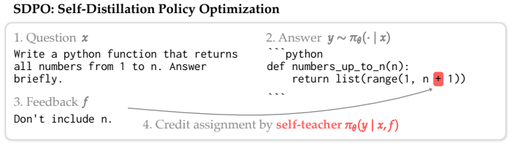
Figure 4 : Example of self-teaching with Qwen3-8B. The answer is generated by the model before seeing the feedback. Then, we re-evaluate the log-probs of the original attempt with theself-teacherafter seeing the feedback. We show the per-token log(P(self-teacher)/P(student)), with red indicating negative values (self-teacher disagrees) and white indicating values around zero. Notably, in this example, Qwen3-8B identifies the error through retrospection without an explicit solution. Further, the activation is sparse, identifying where mistakes happen and adjusting to the students’ response distribution.
원문 · CC BY 4.0 · Jonas Hübotter, Frederike Lübeck, Lejs Behric, Anton Baumann, Marco Bagatella, Daniel Marta, Ido Hakimi, Idan Shenfeld, Thomas Kleine Buening, Carlos Guestrin, Andreas Krause · Reinforcement Learning via Self-Distillation · 원문 그림 인용 · 원본 PDF 4쪽에서 그림 영역을 추출했습니다.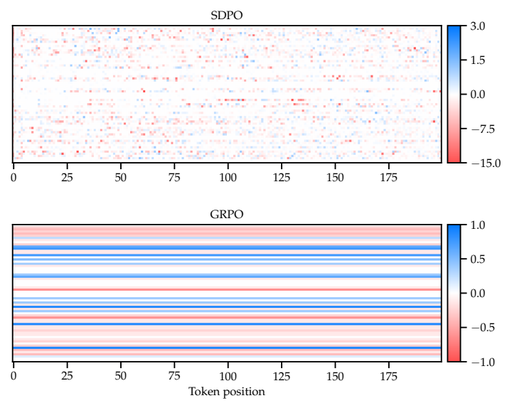
Figure 21 : Visualization of advantages in SDPO and GRPO with Olmo3-7B-Instruct in a batch from the Chemistry task of Section 3. Each row corresponds to the beginning of a response. The color indicates the advantage value at that token position, with positive advantages shown in blue and negative advantages shown in red.
원문 · CC BY 4.0 · Jonas Hübotter, Frederike Lübeck, Lejs Behric, Anton Baumann, Marco Bagatella, Daniel Marta, Ido Hakimi, Idan Shenfeld, Thomas Kleine Buening, Carlos Guestrin, Andreas Krause · Reinforcement Learning via Self-Distillation · 원문 그림 인용 · 원본 PDF 46쪽에서 그림 영역을 추출했습니다.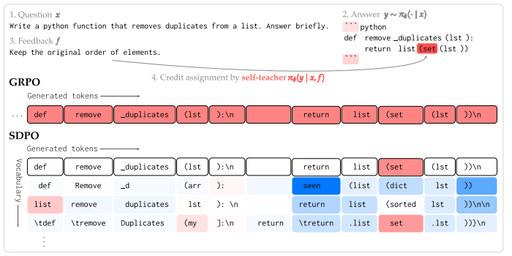
Figure 22 :Dense credit assignment through self-teaching in SDPO.The answer is gen- erated by then model (Qwen3-8B) before seeing the feedback. Then, we re-evaluate the log-probs of the original attempt with the self-teacher after seeing the feedback. We show the per-token log(P(self-teacher)/P(student)), with red indicating negative values (self-teacher disagrees), blue indicating positive values (teacher reinforces), and white indicating values around zero. Using binary rewards, GRPO would assign the same, negative advantage to all tokens in the sequence. In contrast, SDPO turns the feedback into dense credit assignment across the sequence. The first row shows the tokens of the generated response. The 3 other rows show the top-k logits of the self-teacher that are used during self-distillation, suggest- ing alternative tokens. Notably, in this example, the self-teacher identifies the error through retrospection without an explicit solution. The credit assignment on the generated sequence, and the alternative top-k logits correctly show that replacing set with dict maintains the order of elements. Further, in the seventh shown position, the model also identifies an alternative solution path which starts with the seen token, instead of directly returning the output. The activation is sparse, identifying where mistakes happen and adjusting to the students’ response distribution for specifically these few tokens.
원문 · CC BY 4.0 · Jonas Hübotter, Frederike Lübeck, Lejs Behric, Anton Baumann, Marco Bagatella, Daniel Marta, Ido Hakimi, Idan Shenfeld, Thomas Kleine Buening, Carlos Guestrin, Andreas Krause · Reinforcement Learning via Self-Distillation · 원문 그림 인용 · 원본 PDF 50쪽에서 그림 영역을 추출했습니다.top-K 근사와 정규화된 교사
전체 어휘에 대해 두 모델의 로짓을 메모리에 함께 올리면 비용이 크므로, 저자들은 학생의 상위 K개 토큰에 대해서만 증류하고 나머지는 꼬리 항으로 묶는 top-K 근사를 씁니다. 원문은 K=100 같은 선택에서 메모리 부담을 거의 없애면서 대부분의 정보를 포착한다고 설명합니다. 안정화를 위해서는 두 가지를 씁니다. 첫째, 교사를 학생 파라미터의 지수이동평균으로 두거나 현재 교사와 초기 교사를 보간하는 정규화된 교사를 씁니다. 둘째, 증류 발산으로 대칭인 Jensen–Shannon 발산을 씁니다. 다만 이들 설정의 세부 값은 실험별로 달랐으므로 한 값을 전체 방법의 고정 설정으로 보지 않아야 합니다.
피드백이 없는 RLVR 환경에서의 검증
첫 번째 검증은 피드백이 스칼라 보상뿐인 표준 RLVR 환경입니다. 여기서 SDPO는 같은 배치에서 성공한 시도를 같은 질문의 실패 시도에 대한 피드백으로 사용합니다. 과학 추론(화학, 물리, 생물, 재료)과 도구 사용 과제에서 Qwen3-8B와 Olmo3-7B-Instruct를 시작점으로 학습했으며, 보고된 집계 최종 정확도는 SDPO 70.2%, 개선된 GRPO 기준선 66.6%입니다. 원문은 SDPO가 최대 11배 짧은 생성 길이로 더 높은 정확도를 낸다고 보고하며, 긴 GRPO 응답에는 'Hmm'과 'Wait' 같은 채움 표현과 순환 추론이 나타난다고 관찰합니다. 이 결과는 해당 과제와 모델, 그리고 wall-clock 기준의 설정에서 얻은 것입니다.
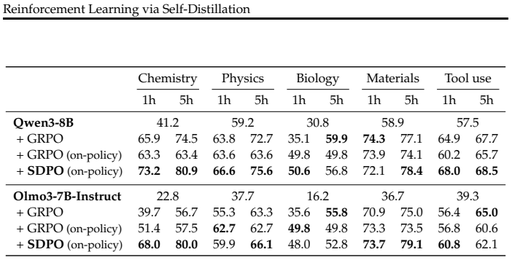
Table 3 :Comparison of SDPO and GRPO on reasoning-related benchmarks.We report the highest achieved avg@16 within 1 hour and 5 hours of wall-clock training time, respectively. Both SDPO and on-policy GRPO perform one gradient step per generation batch, while GRPO performs 4 off-policy mini batch steps. We select optimal hyperparameters for SDPO and baselines based on 5h accuracy. Each run is performed on a node with 4 NVIDIA GH200 GPUs. Together with initialization and validation, each run takes approximately 6 hours.
원문 · CC BY 4.0 · Jonas Hübotter, Frederike Lübeck, Lejs Behric, Anton Baumann, Marco Bagatella, Daniel Marta, Ido Hakimi, Idan Shenfeld, Thomas Kleine Buening, Carlos Guestrin, Andreas Krause · Reinforcement Learning via Self-Distillation · 원문 그림 인용 · 원본 PDF 7쪽에서 그림 영역을 추출했습니다.
Table 8 : Average response lengths of SDPO and GRPO (averaged across tasks from Section 3). Both algorithms are evaluated in the on-policy setting.
원문 · CC BY 4.0 · Jonas Hübotter, Frederike Lübeck, Lejs Behric, Anton Baumann, Marco Bagatella, Daniel Marta, Ido Hakimi, Idan Shenfeld, Thomas Kleine Buening, Carlos Guestrin, Andreas Krause · Reinforcement Learning via Self-Distillation · 원문 그림 인용 · 원본 PDF 36쪽에서 그림 영역을 추출했습니다.LiveCodeBench에서 풍부한 피드백의 효과
두 번째 검증은 LiveCodeBench v6의 최신 131개 질문 부분집합입니다. 공개 테스트는 학습 중 평가에, 비공개 테스트는 검증에 쓰며 피드백에는 LeetCode 스타일의 실행 결과가 포함됩니다. 기본 모델 Qwen3-8B에서 SDPO는 최종 정확도 48.8%를 보고하고 GRPO의 41.2%보다 높습니다. 같은 비교에서 SDPO는 GRPO의 최종 정확도를 4배 적은 생성 수로 달성한다고 보고합니다. 이 결과의 기준선은 같은 GRPO 설정이며, 공개 리더보드의 다른 모델 점수는 외부 인용 값이므로 같은 조건의 통제 실험으로 읽지 않습니다.
모델 규모와 신용 할당 세분도
SDPO의 개선은 기반 모델의 문맥 내 학습 능력에 따라 달라집니다. Qwen3 규모를 바꾼 스케일링에서 SDPO는 큰 모델에서 GRPO를 크게 앞서지만 작은 모델에서는 소폭 개선에 그칩니다. 원문은 Qwen2.5-1.5B에서는 SDPO가 GRPO보다 낮다고 보고하며, 이는 방법의 명시된 한계로 제시됩니다. 세분도 절제에서는 로짓 수준(상위 100개 토큰), 토큰 수준(가장 가능성 높은 토큰), 시퀀스 수준(평균된 단일 이점) 변형을 비교합니다. 로짓 수준이 가장 높고, 시퀀스 수준 SDPO도 GRPO를 앞서므로 풍부한 피드백과 밀집 신용 할당이 각각 기여한다고 해석합니다. 이는 학습 예산 안의 비교이며 모든 구성요소가 항상 유익하다는 증명은 아닙니다.
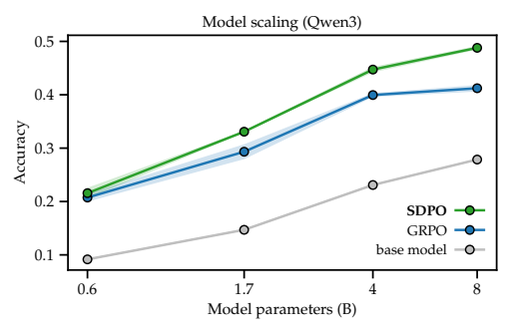
Figure 8 :SDPO improves with model size.We compare the final LCBv6 validation accuracy of SDPO and GRPO at train step 80, across model sizes from Qwen3. The ability of SDPO’s teacher to perform accurate retrospection appears to be an emergent phenomenon with scale. We include an additional scaling study with Qwen2.5-Instruct in the appendix (cf. Figure 17) which further supports this finding. Error bars indicate the standard error across 3 seeds.
원문 · CC BY 4.0 · Jonas Hübotter, Frederike Lübeck, Lejs Behric, Anton Baumann, Marco Bagatella, Daniel Marta, Ido Hakimi, Idan Shenfeld, Thomas Kleine Buening, Carlos Guestrin, Andreas Krause · Reinforcement Learning via Self-Distillation · 원문 그림 인용 · 원본 PDF 9쪽에서 그림 영역을 추출했습니다.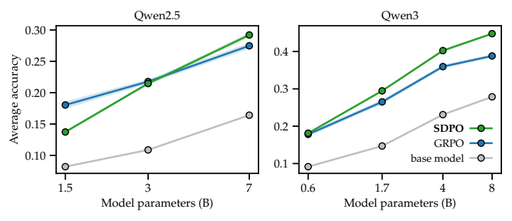
Figure 17 : Average validation accuracy by model size, ± std across 3 seeds. With Qwen2.5- Instruct (Qwen et al., 2024) and Qwen3 (Yang et al., 2025a) on LCBv6. Until step 65 for Qwen2.5 and until step 80 for Qwen3.
원문 · CC BY 4.0 · Jonas Hübotter, Frederike Lübeck, Lejs Behric, Anton Baumann, Marco Bagatella, Daniel Marta, Ido Hakimi, Idan Shenfeld, Thomas Kleine Buening, Carlos Guestrin, Andreas Krause · Reinforcement Learning via Self-Distillation · 원문 그림 인용 · 원본 PDF 38쪽에서 그림 영역을 추출했습니다.테스트 시간 자기 증류와 발견 확률
세 번째 검증은 단일 어려운 이진 보상 질문에서 해를 빨리 찾는 문제입니다. 발견 지표 discovery@k는 k번 시도 안에 최소 한 번 해를 찾을 확률입니다. RLVR은 첫 해를 찾기 전에는 보상 신호가 없어 기본 모델의 best-of-k 샘플링을 넘지 못한다고 설명합니다. 반면 SDPO는 각 시도 뒤 풍부한 피드백을 받아 가중치를 갱신하므로 해를 찾기 전에도 학습이 이어집니다. 매우 어려운 질문(pass@64<0.03) 9개와 어려운 질문(pass@64<0.5) 19개를 대상으로 한 결과, 원문은 매우 어려운 질문에서 SDPO가 22% 발견 확률에 도달하는 데 대략 3배 적은 생성 수를 요구한다고 보고합니다.
저자들은 이 결과를 특정 질문 집합과 Qwen3-8B 설정에서의 관찰로 제시합니다.

Figure 12 :Compressing context into model weights via self-distillation.We illustrate the process of distilling the interaction history (context c) into the model parameters θ. The model πθ repeatedly attempts a fixed hard question x, generating an answer y and receiving feedback f . Rather than appending this history to the context window, the model updates its weights θt →θ t+1 with SDPO (batch size 1) based on the feedback, effectively “fixing” mistakes by encodingπ θ(· |x,c)directly into the policyπ θ′ (· |x).
원문 · CC BY 4.0 · Jonas Hübotter, Frederike Lübeck, Lejs Behric, Anton Baumann, Marco Bagatella, Daniel Marta, Ido Hakimi, Idan Shenfeld, Thomas Kleine Buening, Carlos Guestrin, Andreas Krause · Reinforcement Learning via Self-Distillation · 원문 그림 인용 · 원본 PDF 14쪽에서 그림 영역을 추출했습니다.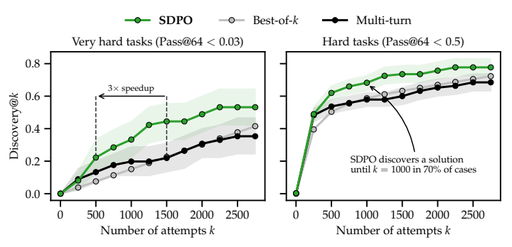
Figure 13 :Self-distillation at test-time solves LiveCodeBench questions that neither the base model nor multi-turn conversations can solve. Left:Very hard questions (9 total) from LCBv6 where the base model achieves pass@64 < 0.03, i.e., in less than 3% cases, sampling 64 responses yields any success.Right:Hard questions (19 total) from LCBv6 where the base model achieves pass@64 < 0.5. We report the discovery@k metric, representing the probability of discovering at least one solution within k total generations. Across both difficulty levels, SDPO achieves higher discovery@k rates at almost all generation budgets, compared to the base model and a multi-turn conversation baseline that receives the feedback in-context. We report the mean and bootstrapped 90% confidence intervals of the mean across 5 random seeds per question.
원문 · CC BY 4.0 · Jonas Hübotter, Frederike Lübeck, Lejs Behric, Anton Baumann, Marco Bagatella, Daniel Marta, Ido Hakimi, Idan Shenfeld, Thomas Kleine Buening, Carlos Guestrin, Andreas Krause · Reinforcement Learning via Self-Distillation · 원문 그림 인용 · 원본 PDF 15쪽에서 그림 영역을 추출했습니다.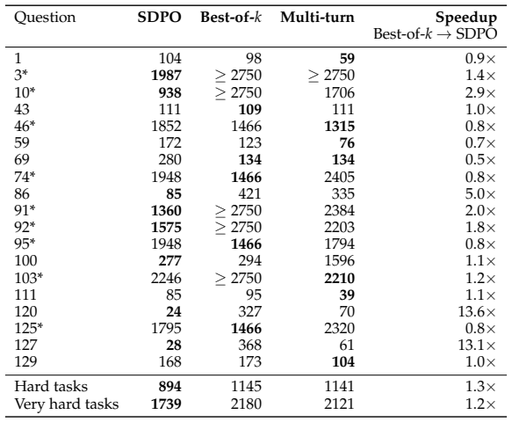
Table 10 : Mean number of generations until first success per question for SDPO, best-of-k sampling, and the multi-turn sampling. For the mean calculation, values are truncated at the maximum budget of 2750 generations. Very hard tasks (pass@64 < 0.03) are marked with an asterisk (*). Averaged over all questions, SDPO achieves successes faster than the baselines, reaching a speedup of up to 13.6× on individual questions compared to best-of-k sampling.
원문 · CC BY 4.0 · Jonas Hübotter, Frederike Lübeck, Lejs Behric, Anton Baumann, Marco Bagatella, Daniel Marta, Ido Hakimi, Idan Shenfeld, Thomas Kleine Buening, Carlos Guestrin, Andreas Krause · Reinforcement Learning via Self-Distillation · 원문 그림 인용 · 원본 PDF 39쪽에서 그림 영역을 추출했습니다.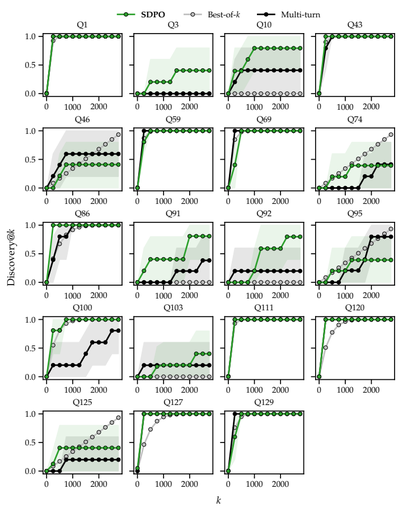
Figure 20 :Individual task results self-distillation at test-time. Discovery@k for each of the 19 questions evaluated in Section 5. In most cases, SDPO finds a successful solution significantly earlier than both the base model and the multi-turn baseline. Notably, for one question (Q3) where the base model and the multi-turn baseline maintain a discovery@k of zero for the entire budget up to 2750 , SDPO discovers a solution after 321 attempts. Curves represent the mean and 90% confidence intervals across 5 random seeds per question.
원문 · CC BY 4.0 · Jonas Hübotter, Frederike Lübeck, Lejs Behric, Anton Baumann, Marco Bagatella, Daniel Marta, Ido Hakimi, Idan Shenfeld, Thomas Kleine Buening, Carlos Guestrin, Andreas Krause · Reinforcement Learning via Self-Distillation · 원문 그림 인용 · 원본 PDF 41쪽에서 그림 영역을 추출했습니다.교사 갱신, 망각, 피드백 조합의 분석
교사를 고정하면 정규화되지 않은 교사는 학습이 불안정해지며, 신뢰영역과 EMA 교사는 고정된 초기 교사보다 높은 최고·평균 정확도를 보입니다. 원문은 교사가 학생과 파라미터를 공유하며 개선되고, 고정 교사만으로도 SDPO가 잘 작동한다고 보고합니다. 망각 평가에서는 SDPO의 LCBv6 정확도 48.8%와 함께 IFEval, ArenaHard-v2, MMLU-Pro 보유 과제 평균 42.4를 보고하며, 같은 자리의 SFT 교사 모방은 평균 41.4입니다. 피드백 종류 분석에서는 환경 출력과 샘플 해답이 서로 보완적이라고 해석합니다. 이들 결과의 기준선과 분석 조건은 각 표가 보고한 설정에 한정됩니다.
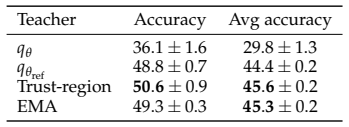
Table 4 : Best/average accuracy until step 90 of various methods for teacher regularization. Trust-region and EMA teachers use α= 0.01. Training of the qθ eventually diverges. Error ranges indicate standard errors across 3 seeds.
원문 · CC BY 4.0 · Jonas Hübotter, Frederike Lübeck, Lejs Behric, Anton Baumann, Marco Bagatella, Daniel Marta, Ido Hakimi, Idan Shenfeld, Thomas Kleine Buening, Carlos Guestrin, Andreas Krause · Reinforcement Learning via Self-Distillation · 원문 그림 인용 · 원본 PDF 10쪽에서 그림 영역을 추출했습니다.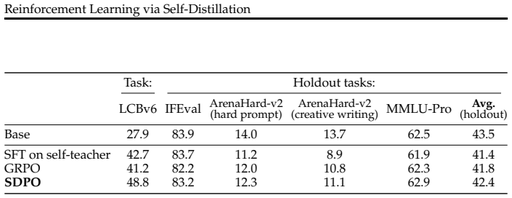
Table 5 :On-policy methods do not suffer from catastrophic forgetting.We compare the accuracy of the final checkpoint on the training task LCBv6 and on holdout tasks IFEval, ArenaHard-v2, and MMLU-Pro. We compare to a baseline that trains directly on responses generated by the initial self-teacher with SFT. Overall, SDPO achieves the best performance– forgetting tradeoff. We include additional baseline results in Table 9 in the appendix.
원문 · CC BY 4.0 · Jonas Hübotter, Frederike Lübeck, Lejs Behric, Anton Baumann, Marco Bagatella, Daniel Marta, Ido Hakimi, Idan Shenfeld, Thomas Kleine Buening, Carlos Guestrin, Andreas Krause · Reinforcement Learning via Self-Distillation · 원문 그림 인용 · 원본 PDF 12쪽에서 그림 영역을 추출했습니다.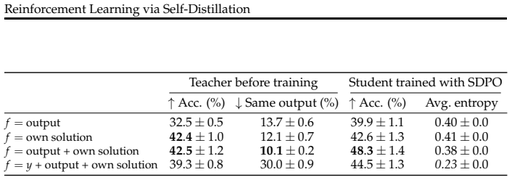
Table 6 :Performance of varying kinds of feedback.We evaluate informativeness of feed- back based on SDPO training (until step 60) as well as the direct impact on the self-teacher. “Same output” measures the percentage of cases where the teacher receives the same envi- ronment output as the student’s initial attempt (i.e., not exploring alternative approaches). We observe that environment output and sample solutions are complementary and each provide informative feedback. Naively including only solutions or initial attempts y signifi- cantly reduces diversity in the teacher and student. We remark that the sample solutions are generated by the student, enabling similar group-relative advantage estimation to GRPO. Error bars indicate standard deviation across 3 seeds.
원문 · CC BY 4.0 · Jonas Hübotter, Frederike Lübeck, Lejs Behric, Anton Baumann, Marco Bagatella, Daniel Marta, Ido Hakimi, Idan Shenfeld, Thomas Kleine Buening, Carlos Guestrin, Andreas Krause · Reinforcement Learning via Self-Distillation · 원문 그림 인용 · 원본 PDF 13쪽에서 그림 영역을 추출했습니다.적용 범위와 한계
저자들이 밝힌 한계는 SDPO의 성능이 기반 모델의 문맥 내 학습 능력에 달려 있으며, 약한 모델에서는 GRPO보다 낮을 수 있다는 점입니다. 또한 피드백의 품질이 낮거나 오도하는 경우 모델이 그 정보로부터 학습하지 못할 수 있습니다. 계산 측면에서는 교사의 로그확률 계산이 추가되므로 생성 시간이 짧은 작은 모델에서는 오버헤드가 상대적으로 클 수 있습니다. 원문의 실험은 주로 LiveCodeBench와 특정 과학·도구 과제에 한정되어 있으며, 에이전트 환경, 대규모 다중 과제 학습, 검증자가 없는 개방형 생성은 향후 과제로 남겨졌습니다.
논문 정보
- 저자
- Jonas Hübotter, Frederike Lübeck, Lejs Behric, Anton Baumann, Marco Bagatella, Daniel Marta, Ido Hakimi, Idan Shenfeld, Thomas Kleine Buening, Carlos Guestrin, Andreas Krause
- 학회·저널
- arXiv · 프리프린트
- 최초 공개일
- 2026년 1월 28일
- 등록일
- 2026년 10월 29일
- 수정일
- 2026년 2월 16일
- 버전
- v2
- arXiv
- 2601.20802
- 분류
- cs.LG · cs.AI
- 원문 이용 조건
- CC BY 4.0
- 제공 범위
- 논문 정보, 해설, 허용된 원문 그림
AI 해설은 논문 원문과 별개의 설명이며 오류가 있을 수 있습니다. 원문과 그림은 각 출처의 이용 조건과 따로 표시된 권리를 따릅니다.
초록
Large language models are increasingly post-trained with reinforcement learning in verifiable domains such as code and math. Yet, current methods for reinforcement learning with verifiable rewards (RLVR) learn only from a scalar outcome reward per attempt, creating a severe credit-assignment bottleneck. Many verifiable environments actually provide rich textual feedback, such as runtime errors or judge evaluations, that explain why an attempt failed. We formalize this setting as reinforcement learning with rich feedback and introduce Self-Distillation Policy Optimization (SDPO), which converts tokenized feedback into a dense learning signal without any external teacher or explicit reward model. SDPO treats the current model conditioned on feedback as a self-teacher and distills its feedback-informed next-token predictions back into the policy. In this way, SDPO leverages the model's ability to retrospectively identify its own mistakes in-context. Across scientific reasoning, tool use, and competitive programming on LiveCodeBench v6, SDPO improves sample efficiency and final accuracy over strong RLVR baselines. Notably, SDPO also outperforms baselines in standard RLVR environments that only return scalar feedback by using successful rollouts as implicit feedback for failed attempts. Finally, applying SDPO to individual questions at test time accelerates discovery on difficult binary-reward tasks, achieving the same discovery probability as best-of-k sampling or multi-turn conversations with 3x fewer attempts.
원문 인용
Jonas Hübotter, Frederike Lübeck, Lejs Behric, Anton Baumann, Marco Bagatella, Daniel Marta, Ido Hakimi, Idan Shenfeld, Thomas Kleine Buening, Carlos Guestrin, Andreas Krause (2026). Reinforcement Learning via Self-Distillation. arXiv:2601.20802v2. https://arxiv.org/abs/2601.20802v2
BibTeX
@misc{hbotter2026reinforcement,
  title = {{Reinforcement Learning via Self-Distillation}},
  author = {Jonas Hübotter and Frederike Lübeck and Lejs Behric and Anton Baumann and Marco Bagatella and Daniel Marta and Ido Hakimi and Idan Shenfeld and Thomas Kleine Buening and Carlos Guestrin and Andreas Krause},
  year = {2026},
  eprint = {2601.20802},
  archivePrefix = {arXiv},
  url = {https://arxiv.org/abs/2601.20802v2}
}