논문 해설
Where is My Mug? Training-Free Framework for Personalized Image Segmentation
내 머그컵은 어디에? 개인화된 이미지 segmentation을 위한 학습 없는 프레임워크
- 연구 문제 기존 개인화 분할 방법은 같은 카테고리의 유사 객체가 여럿 있을 때 정답 인스턴스를 제안 단계에서 놓쳐 실패합니다.
- 연구 방법 범주 비의존 박스 제안, 기반 모델 특징 매칭, SAM 정제를 학습 없이 결합하고 패치 매칭에 상위 K 절단 Sinkhorn 거리를 씁니다.
다중 인스턴스 장면의 개인화 분할 문제
개인화 이미지 분할(PIS)은 사용자가 제공한 참조 이미지와 같은 물체를 대상 이미지에서 찾아 분할하는 과제입니다. 기존 PIS 벤치마크는 대상 이미지마다 같은 카테고리의 객체가 하나만 있는 경우가 많아, 여러 유사 객체가 함께 있을 때의 성능을 제대로 드러내지 못합니다. 이 논문은 기존 방법들이 보고한 높은 mIoU가 단일 인스턴스 벤치마크에 의한 결과일 가능성을 제기하며, 다중 인스턴스 장면에서 점 프롬프트 기반 방법들이 정답 인스턴스를 제안 단계에서 놓치는 재현율 병목 때문에 무너진다고 설명합니다.
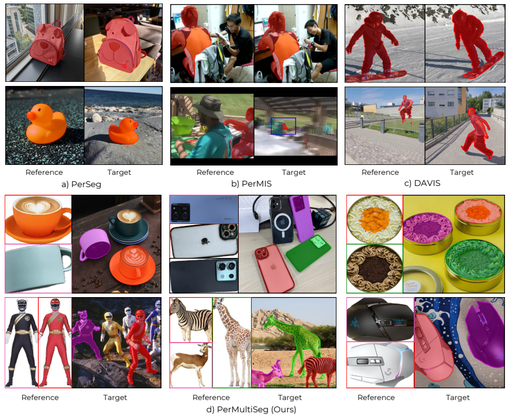
Figure 2 . Examples of existing PIS benchmarks (left: reference, right: target). PerSeg has only one instance per target image; PerMIS [42] suffers from low-quality and near-duplicate frames (blue rectangle: targets too small to identify); DA VIS [37] exhibits minimal frame-to- frame variation. PerMultiSeg provides multiple same-category instances per target image (e.g., three mugs, three smartphones).
원문 · CC BY 4.0 · Quang Qui-Vinh Nguyen, Hung Nguyen, Rang Nguyen, Khoi Nguyen · Where is My Mug? Training-Free Framework for Personalized Image Segmentation · 원문 그림 인용 · 원본 PDF 4쪽에서 그림 영역을 추출했습니다.학습 없는 제안-매칭-정제 파이프라인
제안된 시스템은 세 단계로 구성됩니다. 먼저 범주 라벨 없이 대상 이미지의 모든 잠재 객체 박스를 YOLOv11 같은 탐지기로 얻습니다. 다음으로 BLIP-2 같은 기반 모델 인코더로 참조와 각 후보의 특징을 추출하고, 전역 특징의 코사인 거리와 패치 수준 거리를 가중 합산해 가장 잘 맞는 후보를 고릅니다. 마지막으로 선택된 박스를 SAM에 프롬프트로 주어 최종 마스크를 만듭니다. 이 구조에서는 각 모듈을 재학습 없이 교체할 수 있습니다.
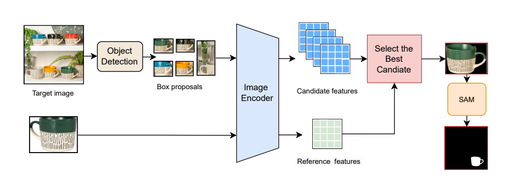
Figure 3 . Given a reference and target image, we first use an object detector to identify all potential object candidates in the target image. These candidates, along with the reference image, are then passed through an image encoder to extract feature representations. Next, we determine the best-matching candidate by computing the distance between each candidate’s features and the reference features. Finally, the selected candidate’s bounding box is fed into SAM, which generates the final segmentation mask.
원문 · CC BY 4.0 · Quang Qui-Vinh Nguyen, Hung Nguyen, Rang Nguyen, Khoi Nguyen · Where is My Mug? Training-Free Framework for Personalized Image Segmentation · 원문 그림 인용 · 원본 PDF 6쪽에서 그림 영역을 추출했습니다.상위 K 절단 Sinkhorn 거리의 계산
패치 수준 거리로 엔트로픽 정규화 최적 수송 비용의 교차항을 쓰며, 자기 수송 항은 기본 방법에서 제외합니다. Sinkhorn 해에서 얻은 쌍대 포텐셜 f⋆, g⋆에 uniform 질량 a, b를 곱한 패치별 수송 기여도를 오름차순으로 정렬하고, 각 쪽에서 keep-ratio K만큼 가장 작은 M = ⌊KN⌋개의 기여도만 합산합니다. 저자들은 이 절단이 부분 최적 수송의 정확한 해법이 아니라 쌍대 포텐셜을 사후에 잘라 얻는 대체 점수라고 명시하며, 기본값은 K = 1/3입니다. 이 절단은 Sinkhorn 반복을 바꾸지 않고 정렬 한 번을 추가하는 연산입니다.
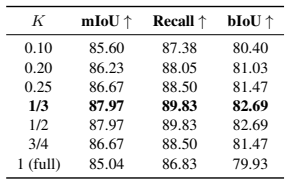
Table 8 . Study on the trim ratioKin top-KSinkhorn (BLIP-2, α
원문 · CC BY 4.0 · Quang Qui-Vinh Nguyen, Hung Nguyen, Rang Nguyen, Khoi Nguyen · Where is My Mug? Training-Free Framework for Personalized Image Segmentation · 원문 그림 인용 · 원본 PDF 15쪽에서 그림 영역을 추출했습니다.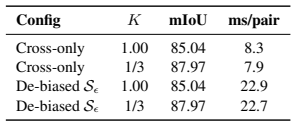
Table 11 . Self-term ablation: cross-only vs. de-biasedS ϵ.
원문 · CC BY 4.0 · Quang Qui-Vinh Nguyen, Hung Nguyen, Rang Nguyen, Khoi Nguyen · Where is My Mug? Training-Free Framework for Personalized Image Segmentation · 원문 그림 인용 · 원본 PDF 16쪽에서 그림 영역을 추출했습니다.다중 인스턴스 벤치마크 비교 결과
같은 표에서 P2SAM은 mIoU 31.58, PerSAM은 21.65를 기록했으므로, 제안 방법의 P2SAM 대비 mIoU 차이는 45 이상입니다. 다만 이 수치들은 저자들이 동일한 SAM 체크포인트와 기본 설정으로 실행한 결과이며, 기존 방법의 프롬프트 방식이 점 입력이라는 차이도 함께 고려해야 합니다. 같은 비교에서 SAM3와 Qwen2.5-VL을 결합한 캡션 설정은 70.11을 기록했습니다.
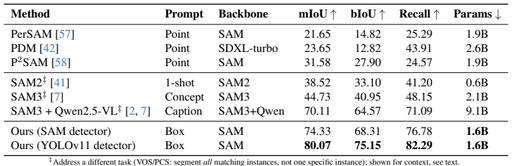
Table 3 . Comparison on the PerMultiSeg dataset. Recall is measured at the final-prediction stage: a method is counted as a hit if its output mask has IoU>0.5 with the ground-truth mask (applied uniformly to all methods, regardless of prompt type). “Box Prompt” refers to using bounding box inputs for SAM, while “Point Prompt” denotes using point-based inputs.
원문 · CC BY 4.0 · Quang Qui-Vinh Nguyen, Hung Nguyen, Rang Nguyen, Khoi Nguyen · Where is My Mug? Training-Free Framework for Personalized Image Segmentation · 원문 그림 인용 · 원본 PDF 7쪽에서 그림 영역을 추출했습니다.매칭 방식 절제 실험
PerMultiSeg 검증 세트 135쌍에서 모든 행은 같은 동결 제안과 BLIP-2 인코더를 공유하고 패치 거리만 바꾸었습니다. 평균 특징 맵은 mIoU 65.29, [CLS] 토큰만 쓰면 83.86, full Sinkhorn은 85.04였습니다. top-KSinkhorn은 mIoU 87.97을 기록해 full Sinkhorn보다 2.93 높았습니다. 부분 OT 해법(m=1/3)도 같은 87.97을 보였으며, 두 방법은 모든 135쌍에서 같은 후보를 골랐습니다. 지연 시간은 top-KSinkhorn이 쌍당 8 ms, 부분 OT가 848 ms로 보고됩니다.
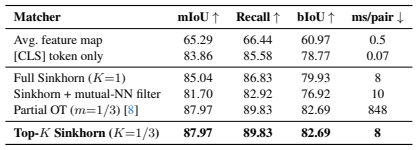
Table 5 . Matcher ablation on the PerMultiSegvalidationsplit (135 pairs). All rows use BLIP-2 +α p = 0.75+ the same frozen pro- posals (paper default). Top-KSinkhorn is indistinguishable from the partial-OT solver at this sample size, at a fraction of its latency.
원문 · CC BY 4.0 · Quang Qui-Vinh Nguyen, Hung Nguyen, Rang Nguyen, Khoi Nguyen · Where is My Mug? Training-Free Framework for Personalized Image Segmentation · 원문 그림 인용 · 원본 PDF 7쪽에서 그림 영역을 추출했습니다.PerMultiSeg 데이터셋 구성
PerMultiSeg는 45개 카테고리에서 대상 이미지 1,079장, 참조 이미지 2,147장, 주석 인스턴스 3,964개를 포함합니다. 대상 이미지당 평균 3.67개의 같은 카테고리 객체가 있으며, 방해 객체는 같은 제품과 같은 색상으로 골라 범주나 색상만으로는 구별되지 않게 했습니다. 이 선택 기준 때문에 카테고리는 휴대용 제조 소비재에, 장면은 실내에 치우쳐 있으며 변형 가능하거나 유기적인 객체에 대한 일반화는 확인되지 않았습니다.
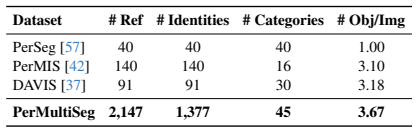
Table 1 . Comparison of PerMultiSeg with prior PIS datasets.
원문 · CC BY 4.0 · Quang Qui-Vinh Nguyen, Hung Nguyen, Rang Nguyen, Khoi Nguyen · Where is My Mug? Training-Free Framework for Personalized Image Segmentation · 원문 그림 인용 · 원본 PDF 4쪽에서 그림 영역을 추출했습니다.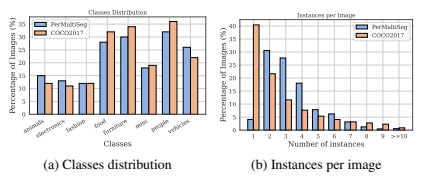
Figure 5 . Analysis of our PerMultiSeg dataset vs. MS COCO. (a) Class distribution (% of images per category). (b) Instances per image. PerMultiSeg shows a more balanced class distribution and a higher frequency of multi-object scenes than COCO.
원문 · CC BY 4.0 · Quang Qui-Vinh Nguyen, Hung Nguyen, Rang Nguyen, Khoi Nguyen · Where is My Mug? Training-Free Framework for Personalized Image Segmentation · 원문 그림 인용 · 원본 PDF 14쪽에서 그림 영역을 추출했습니다.제안 단계 누락과 치우친 데이터의 한계
제안 단계에서 정답 객체가 누락되면 이후 단계가 이를 복구하지 못합니다. 저자들의 오류 분해에서 제안 재현율 상한은 91.58%였고, 제안이 누락된 경우 mIoU는 14.26으로 떨어졌습니다. 또한 PerMultiSeg는 제조 소비재와 실내 장면에 치우쳐 있어 이 논문이 보인 결과를 변형 가능한 객체나 야외 장면으로 넓히지 않았습니다.
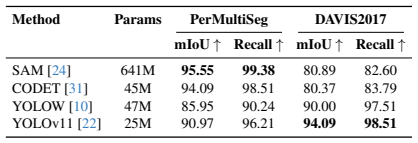
Table 9 . Ablation on object proposal methods. Recall is proposal- level (box IoU>0.5) on the validation set.
원문 · CC BY 4.0 · Quang Qui-Vinh Nguyen, Hung Nguyen, Rang Nguyen, Khoi Nguyen · Where is My Mug? Training-Free Framework for Personalized Image Segmentation · 원문 그림 인용 · 원본 PDF 15쪽에서 그림 영역을 추출했습니다.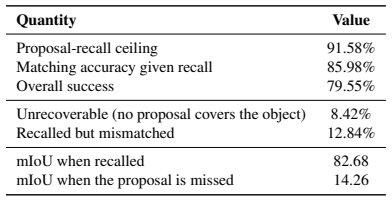
Table 17 . Error decomposition on PerMultiSeg test (1,971pairs).
원문 · CC BY 4.0 · Quang Qui-Vinh Nguyen, Hung Nguyen, Rang Nguyen, Khoi Nguyen · Where is My Mug? Training-Free Framework for Personalized Image Segmentation · 원문 그림 인용 · 원본 PDF 18쪽에서 그림 영역을 추출했습니다.논문 정보
- 저자
- Quang Qui-Vinh Nguyen, Hung Nguyen, Rang Nguyen, Khoi Nguyen
- 학회·저널
- arXiv · 프리프린트
- 최초 공개일
- 2026년 11월 11일
- 등록일
- 2026년 11월 13일
- 수정일
- 2026년 11월 11일
- 버전
- v1
- arXiv
- 2611.15216
- 분류
- cs.CV · cs.AI
- 원문 이용 조건
- CC BY 4.0
- 제공 범위
- 논문 정보, 해설, 허용된 원문 그림
AI 해설은 논문 원문과 별개의 설명이며 오류가 있을 수 있습니다. 원문과 그림은 각 출처의 이용 조건과 따로 표시된 권리를 따릅니다.
초록
\textbf{Personalized Image Segmentation (PIS)} aims to segment the specific object in a target image that matches a user-provided reference. Unlike category-based segmentation or few-shot segmentation, PIS must discriminate between multiple visually similar instances, a requirement central to deployed applications such as augmented reality, personalized content editing, robotics manipulation, inventory tracking, and fine-grained visual retrieval. We show that the strong numbers reported by existing PIS methods are largely an artifact of single-instance benchmarks: when evaluated on realistic scenes with several same-category look-alikes, prior point-prompt methods collapse, because the correct instance is frequently never surfaced as a prompt. We trace this to a recall bottleneck rather than a mask-quality one, and address it with a training-free, modular system. The pipeline first generates high-recall object proposals using an off-the-shelf class-agnostic detector, then matches each proposal to the reference using foundation-model features (e.g., BLIP-2), and finally refines the selected box with SAM. For robust matching we propose \textbf{top-$K$ Sinkhorn}, a patch-level distance that scores each candidate only on its most confidently matched patches; trimming the Sinkhorn dual potentials recovers the robustness of partial optimal transport at more than $100\times$ lower cost, keeping it inside the per-proposal candidate loop. To evaluate this regime, we introduce \textbf{\datasetname}, a realistic multi-instance benchmark. Across \datasetname, PerSeg, PerMIS, and DAVIS, our system surpasses PerSAM, $\mathrm{P}^2\mathrm{SAM}$, and PDM by up to $\sim\!48$ mIoU while matching their runtime and using fewer parameters, establishing a strong, deployable training-free baseline for real-world personalized segmentation.
원문 인용
Quang Qui-Vinh Nguyen, Hung Nguyen, Rang Nguyen, Khoi Nguyen (2026). Where is My Mug? Training-Free Framework for Personalized Image Segmentation. arXiv:2611.15216v1. https://arxiv.org/abs/2611.15216v1
BibTeX
@misc{nguyen2026where,
  title = {{Where is My Mug? Training-Free Framework for Personalized Image Segmentation}},
  author = {Quang Qui-Vinh Nguyen and Hung Nguyen and Rang Nguyen and Khoi Nguyen},
  year = {2026},
  eprint = {2611.15216},
  archivePrefix = {arXiv},
  url = {https://arxiv.org/abs/2611.15216v1}
}