논문 해설
CoilStellaration: A Dataset and Benchmark for Engineering-Aware Stellarator Coilset Generation
CoilStellaration: 공학 고려형 스텔러레이터 코일셋 생성을 위한 데이터셋 및 벤치마크
- 연구 문제 스텔러레이터의 코일셋을 목표 플라즈마 경계와 공학 요구조건으로부터 설계하는 일은 역문제이며 최적화에 크게 의존합니다. CoilStellaration은 이를 학습 모델로 다루기 위한 데이터셋과 벤치마크입니다.
- 연구 방법 목표 경계와 요구조건을 입력받아 코일셋을 단일 순전파로 예측하고, 예측을 DESC 파이프라인으로 재평가하여 soft-feasibility 점수로 채점합니다.
- 주요 결과 기준 모델은 엄격 실현 가능성이 낮고 자기장 정확도가 주된 실패 원인입니다. 학습된 코일셋은 제한된 예산의 최적화에서 초기 진행을 가속하는 결과를 보입니다.
연구 문제와 기존 한계
스텔러레이터의 코일셋은 목표 플라즈마 평형의 자기장을 재현하면서 공학 제약을 만족해야 하지만, 목표 자기장에서 코일 기하를 역으로 찾는 문제는 비선형 역문제이며 해가 닫힌 형태로 주어지지 않습니다. 따라서 기존에는 최적화를 반복하는 방식이 주로 쓰였고, 이는 설계 공간을 빠르게 탐색하기 어렵게 만듭니다. CoilStellaration은 ConStellaration의 플라즈마 경계를 고정 목표로 삼아 177,000개의 최적화된 필라멘트 코일셋과 공학 요구조건을 함께 제공하고, 단일 순전파로 코일셋을 예측하는 벤치마크를 제안합니다. 이 연구의 범위는 목표 경계에서의 필라멘트 코일 생성이며, 자유 경계 평형 검증은 포함하지 않습니다.
데이터셋 구축 파이프라인
각 목표 경계에 대해 공학 요구조건을 미리 정한 범위에서 샘플링합니다. 최소 코일-플라즈마 거리, 최소 코일-코일 거리, 최대 곡률이 그 범위에 포함됩니다. 초기 코일셋은 REGCOIL로 표면 전류 포텐셜을 정규화해 만들고, 이후 DESC의 제약 최적화로 정제합니다. 이 최적화에서 코일-코일, 코일-플라즈마, 곡률 제약은 명시적 제약으로 걸리며, 목적함수는 코일 길이와 정규화된 법선 자기장 잔차의 가중 결합입니다. 정제 후 코일셋은 주반경 1 m로 정규화되고, 전류는 평균 축상 자기장이 1 T가 되도록 재조정됩니다. 최종 데이터셋에는 266,549개 샘플 중 177,341개의 DESC 코일셋이 포함되며, 품질 필터는 코일-플라즈마 오차, 코일-코일 오차, 곡률 오차에 대해 적용되고 자기장 오차에는 적용되지 않습니다.
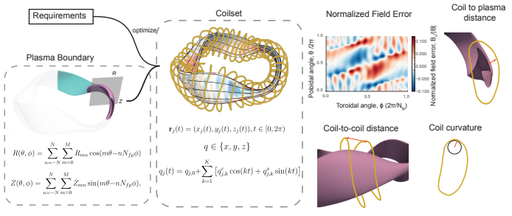
Figure 1 : Left: The target plasma boundary, parameterized as a truncated Fourier surface in θ and ϕ. Center: The generated coilset. Each filamentary coil is modeled as a closed 3D curve using a Fourier series int, a parameter that runs along the curve. Solid black lines on the stellarator surface trace the equilibrium magnetic field lines, which are tangent to the boundary. Right: Key evaluation metrics. The heatmap displays the normalized magnetic field error across one plasma field period. The diagrams below illustrate the three physical engineering constraints used in this work: minimum coil-to-plasma distance, coil-to-coil spacing, and maximum coil curvature.
원문 · CC BY 4.0 · Jan-Hendrik Ewers, Santiago A. Cadena, Nicolò Foppiani, Andrea Merlo · CoilStellaration: A Dataset and Benchmark for Engineering-Aware Stellarator Coilset Generation · 원문 그림 인용 · 원본 PDF 3쪽에서 그림 영역을 추출했습니다.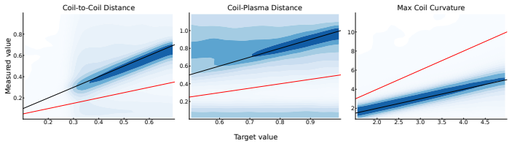
Figure 3 : Measured vs. target values for the three geometric constraints. Colour scale is logarithmic. Black line: requirement equals measured. Red line: selection cut threshold.
원문 · CC BY 4.0 · Jan-Hendrik Ewers, Santiago A. Cadena, Nicolò Foppiani, Andrea Merlo · CoilStellaration: A Dataset and Benchmark for Engineering-Aware Stellarator Coilset Generation · 원문 그림 인용 · 원본 PDF 6쪽에서 그림 영역을 추출했습니다.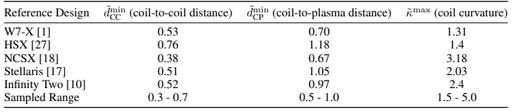
Table 6 : Reference stellarators from which the requirements sampling range was informed.
원문 · CC BY 4.0 · Jan-Hendrik Ewers, Santiago A. Cadena, Nicolò Foppiani, Andrea Merlo · CoilStellaration: A Dataset and Benchmark for Engineering-Aware Stellarator Coilset Generation · 원문 그림 인용 · 원본 PDF 16쪽에서 그림 영역을 추출했습니다.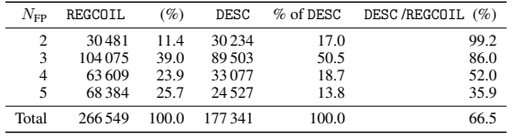
Table 7 : Dataset composition by number of field periods (NFP). DESC % ofDESC is the fraction of each NFP group within all DESC coilsets. DESC /REGCOIL is the completion rate of the DESC opti- mization perN FP.
원문 · CC BY 4.0 · Jan-Hendrik Ewers, Santiago A. Cadena, Nicolò Foppiani, Andrea Merlo · CoilStellaration: A Dataset and Benchmark for Engineering-Aware Stellarator Coilset Generation · 원문 그림 인용 · 원본 PDF 16쪽에서 그림 영역을 추출했습니다.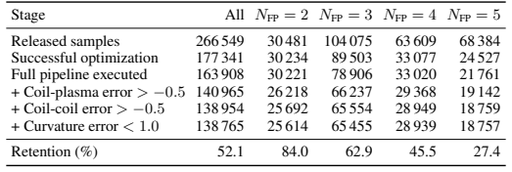
Table 8 : Cumulative selection cut flow, overall and by field periods. Retention is relative to the released samples in each column at the time of submission.
원문 · CC BY 4.0 · Jan-Hendrik Ewers, Santiago A. Cadena, Nicolò Foppiani, Andrea Merlo · CoilStellaration: A Dataset and Benchmark for Engineering-Aware Stellarator Coilset Generation · 원문 그림 인용 · 원본 PDF 17쪽에서 그림 영역을 추출했습니다.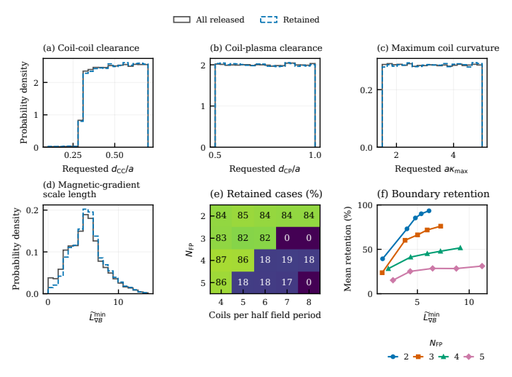
Figure 9 : Selection effects. (a–c) Probability densities of requested coil–coil clearance, coil–plasma clearance, and maximum coil curvature for released and retained samples. Maximum absolute differences between the corresponding empirical cumulative distribution functions (CDFs) are 0.61, 0.38, and 0.40 percentage points, respectively. (d) Probability density of the minimum normalized magnetic-gradient scale length over unique boundaries; a retained boundary has at least one retained coilset. Panels (a–d) use 20 shared equal-width bins per panel and unit-area normalization for each population. (e) Retained fraction of released samples for each NFP and coil count. (f) Mean per-boundary retention in five scale-length quantile bins per NFP, with equal weight per boundary and points at the mean scale length of each bin.
원문 · CC BY 4.0 · Jan-Hendrik Ewers, Santiago A. Cadena, Nicolò Foppiani, Andrea Merlo · CoilStellaration: A Dataset and Benchmark for Engineering-Aware Stellarator Coilset Generation · 원문 그림 인용 · 원본 PDF 18쪽에서 그림 영역을 추출했습니다.벤치마크 과제와 점수 체계
벤치마크는 목표 플라즈마 경계 b와 요구조건 벡터 r=(최소 코일-코일 거리, 최소 코일-플라즈마 거리, 최대 곡률, 최대 필드 오차)를 입력받아 모델 f(b,r)이 코일셋을 한 번의 순전파로 출력하도록 요구합니다. 예측 코일셋은 DESC 필라멘트 파이프라인으로 재평가되며, 앞의 두 요구조건은 하한, 뒤의 두 요구조건은 상한으로 적용됩니다. 각 지표의 정규화된 위반량 v_i는 0 이상이며, 허용치 α_i를 기준으로 s_i=exp(-v_i/α_i)로 변환됩니다. 네 지표의 점수는 기하 평균 S=(∏ s_i)^(1/4)로 합쳐지므로, 한 지표의 점수가 0에 가까우면 전체 점수가 함께 떨어집니다.
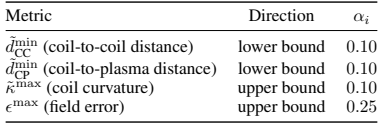
Table 9 : Per-metric tolerances αi in the soft-feasibility score (Eq. 4). A relative violation of αi reduces si to 1/e ≈ 0.37; a 2αi violation reduces it to ≈ 0.14.
원문 · CC BY 4.0 · Jan-Hendrik Ewers, Santiago A. Cadena, Nicolò Foppiani, Andrea Merlo · CoilStellaration: A Dataset and Benchmark for Engineering-Aware Stellarator Coilset Generation · 원문 그림 인용 · 원본 PDF 20쪽에서 그림 영역을 추출했습니다.기준 모델과 고정 형상 결과
기준 모델은 MLP와 ResMLP, 그리고 각각의 다섯 멤버 앙상블입니다. ResMLP는 사전 정규화 잔차 블록과 분리된 기하 출력 헤드 및 전류 헤드를 사용합니다. 이 최고값은 대부분 가장 느슨한 요구조건 구간에서 나오며, tight 구간에서는 어떤 기준 모델도 엄격 실현 가능한 코일셋을 만들지 못했습니다. 실패 원인은 주로 정규화된 필드 오차 항이며, 두 앙상블은 코일-플라즈마 거리와 곡률에서 중앙값 점수가 1에 가깝지만 모든 모델이 코일-코일 간격에서 양의 위반을 보였습니다.
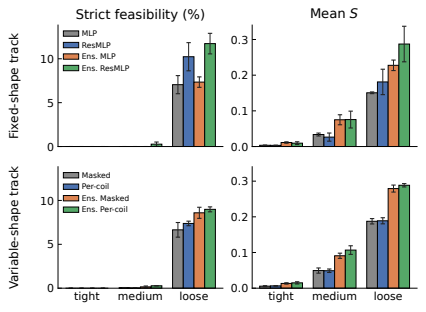
Figure 5 : Strict feasibility (%) and mean score S by require- ment tier (tight / medium / loose), for the fixed-shape track (top) and the variable-shape track (bottom). Each track shows its own four architectures. Bars are the mean over three train- ing seeds with ±1σ error bars. Across both tracks and all architectures, strict feasibility is 0% on the tight tier and near- zero on the medium tier: nearly all strictly feasible coilsets fall in the loose tier. Strict feasibility uses the benchmark tolerancev i ≤1×10 −3.
원문 · CC BY 4.0 · Jan-Hendrik Ewers, Santiago A. Cadena, Nicolò Foppiani, Andrea Merlo · CoilStellaration: A Dataset and Benchmark for Engineering-Aware Stellarator Coilset Generation · 원문 그림 인용 · 원본 PDF 8쪽에서 그림 영역을 추출했습니다.가변 형상 트랙
가변 형상 트랙은 NFP∈{2,3,4,5}, NC∈{4,...,8}의 전체 분포를 한 모델이 다루는지 확인합니다. MaskedMLP는 최대 여덟 개의 코일 슬롯을 한 번에 출력하고 요청된 NC를 넘는 슬롯을 마스킹하며, PerCoilMLP는 가중치를 공유하는 MLP를 각 코일 슬롯에 적용하고 슬롯 인덱스와 상대 위치를 조건으로 넣습니다. 8,058개 인스턴스에서 EnsemblePerCoilMLP는 평균 점수 0.137과 엄격 실현 가능성 3.1%를 기록했습니다. 같은 모델을 고정 형상 부분집합에서 평가하면 NFP=3, NC=5에서 평균 점수 0.18로 전용 고정 형상 기준 모델과 같거나 높았다는 점을 저자들이 보고하지만, 이는 이 부분집합에서의 관찰입니다.
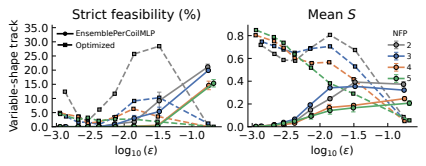
Figure 6 : Strict feasibility (left) and mean score S (right), grouped by reference mean normalized field error and field periods. Solid: EnsemblePerCoilMLP, mean ± one standard deviation across three training seeds. Dashed: DESC coilsets. DESC uses the three original geometric bounds; the model uses all four reference-achieved requirements.
원문 · CC BY 4.0 · Jan-Hendrik Ewers, Santiago A. Cadena, Nicolò Foppiani, Andrea Merlo · CoilStellaration: A Dataset and Benchmark for Engineering-Aware Stellarator Coilset Generation · 원문 그림 인용 · 원본 PDF 9쪽에서 그림 영역을 추출했습니다.
Table 11 : Spearman correlations between reference-coilset metrics and prediction performance for EnsemblePerCoilMLP on the variable-shape evaluation set. Values are the mean correlation ± one standard deviation across three independently trained seeds.
원문 · CC BY 4.0 · Jan-Hendrik Ewers, Santiago A. Cadena, Nicolò Foppiani, Andrea Merlo · CoilStellaration: A Dataset and Benchmark for Engineering-Aware Stellarator Coilset Generation · 원문 그림 인용 · 원본 PDF 20쪽에서 그림 영역을 추출했습니다.학습된 코일셋의 최적화 웜 스타트
학습된 EnsemblePerCoilMLP의 단일 순전파 예측을 DESC 최적화의 시작점으로 사용하고, 같은 최적화를 REGCOIL 시작점에서 실행하여 비교합니다. 대상은 가변 형상 평가 분할의 tight 계층 1,289개 인스턴스입니다. 300 반복까지는 학습된 시작점이 더 높은 평균 점수를 보이며 대부분의 인스턴스에서 이겼습니다. 100 반복에서의 학습 시작점 평균 점수는 REGCOIL 시작점의 200 반복 점수를 넘었고, 200 반복에서는 엄격 실현 가능성이 22%로 REGCOIL의 500 반복 값 18%보다 높았습니다. 500 반복에서는 REGCOIL 시작점의 평균 점수가 더 높았고(0.83 대 0.76), 1000 반복에서는 엄격 실현 가능성 차이가 유의하지 않았습니다(26% 대 25%).
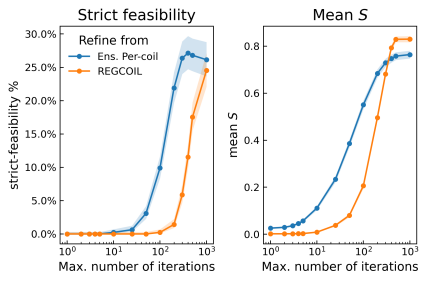
Figure 7 : Strict-feasibility rate (left) and mean scoreS (right) against the iteration budget, for the REGCOIL and learned (per-coil ensemble) starts. Each instance uses its dataset metrics as targets; the instances comprise up to 100 per (NFP, NC) pair. Markers show the tested budgets. Shaded bands are instance-level 95% confidence intervals (Wilson for feasibility, Student- t for S); they do not account for shared boundaries.
원문 · CC BY 4.0 · Jan-Hendrik Ewers, Santiago A. Cadena, Nicolò Foppiani, Andrea Merlo · CoilStellaration: A Dataset and Benchmark for Engineering-Aware Stellarator Coilset Generation · 원문 그림 인용 · 원본 PDF 10쪽에서 그림 영역을 추출했습니다.적용 범위와 남은 한계
현재 데이터셋은 필라멘트 코일과 제한된 공학 제약을 사용하며, 평가는 목표 경계에서 이루어집니다. 따라서 결과가 자유 경계 평형이나 실제 설계 완성도를 직접 보장하지는 않습니다. 생성된 코일셋은 최적화와 검증을 위한 출발점이며 최종 설계로 쓰지 않아야 합니다. 또한 학습된 시작점은 제한된 예산에서 유리하지만, 코일-코일 간격은 반복이 늘어날수록 REGCOIL 시작점에 뒤처지는 요구조건으로 남아 있습니다. 자기장 정확도는 여전히 가장 큰 장애로 보고되며, 이 결과는 본 논문이 평가한 모델과 설정의 범위에 한정됩니다.
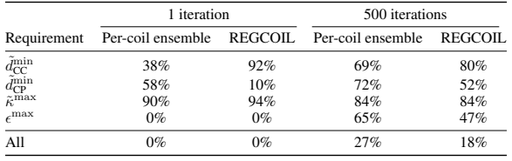
Table 4 : Fraction of runs meeting each requirement, and all of them (strict feasibility), after 1 and 500 iterations, over the instances with results from both starts. At 500 iterations, every difference except curvature is significant (exact McNemar test,p <10 −8; curvaturep= 0.88).
원문 · CC BY 4.0 · Jan-Hendrik Ewers, Santiago A. Cadena, Nicolò Foppiani, Andrea Merlo · CoilStellaration: A Dataset and Benchmark for Engineering-Aware Stellarator Coilset Generation · 원문 그림 인용 · 원본 PDF 14쪽에서 그림 영역을 추출했습니다.논문 정보
- 저자
- Jan-Hendrik Ewers, Santiago A. Cadena, Nicolò Foppiani, Andrea Merlo
- 학회·저널
- arXiv · 프리프린트
- 최초 공개일
- 2026년 11월 9일
- 등록일
- 2026년 11월 11일
- 수정일
- 2026년 11월 9일
- 버전
- v1
- arXiv
- 2611.12689
- 분류
- cs.LG · physics.plasm-ph
- 원문 이용 조건
- CC BY 4.0
- 제공 범위
- 논문 정보, 해설, 허용된 원문 그림
AI 해설은 논문 원문과 별개의 설명이며 오류가 있을 수 있습니다. 원문과 그림은 각 출처의 이용 조건과 따로 표시된 권리를 따릅니다.
초록
Stellarators are fusion devices that use externally generated, three-dimensional magnetic fields to confine hot plasma and offer a promising route to commercial fusion. Their electromagnetic coils pose a challenging design problem: they must reproduce the target magnetic field while satisfying engineering constraints and remaining practical and cost-effective to manufacture. Finding suitable geometries is a highly nonlinear inverse problem that generally has neither a closed-form nor a unique solution. This problem lies at the heart of stellarator design. We introduce CoilStellaration, a dataset and benchmark for learning the mapping between coil geometries from target plasma magnetic fields and engineering requirements. The dataset contains 177,000 optimized filamentary coilsets targeting plasma equilibria from ConStellaration, with sampled engineering requirements and achieved geometric and magnetic-field metrics. It spans multiple coil counts and field-period numbers, supporting studies of both specialized and shared models across configurations. The benchmark asks models to predict coils conditioned on a target equilibrium and requirements on coil-coil and coil-plasma spacing, curvature, and magnetic-field error. We show that magnetic-field accuracy remains the main challenge, with learned models rarely satisfying all requirements simultaneously. However, using learned predictions to initialize conventional coil optimization can accelerate early progress. We release baseline models and evaluation code to support reproducible research on both direct coil generation and learned optimization initializations. By lowering the barrier for machine learning and optimization researchers to engage with stellarator coil design, we aim to accelerate progress toward practical, cost-effective stellarator power plants.
원문 인용
Jan-Hendrik Ewers, Santiago A. Cadena, Nicolò Foppiani, Andrea Merlo (2026). CoilStellaration: A Dataset and Benchmark for Engineering-Aware Stellarator Coilset Generation. arXiv:2611.12689v1. https://arxiv.org/abs/2611.12689v1
BibTeX
@misc{ewers2026coilstellaration,
  title = {{CoilStellaration: A Dataset and Benchmark for Engineering-Aware Stellarator Coilset Generation}},
  author = {Jan-Hendrik Ewers and Santiago A. Cadena and Nicolò Foppiani and Andrea Merlo},
  year = {2026},
  eprint = {2611.12689},
  archivePrefix = {arXiv},
  url = {https://arxiv.org/abs/2611.12689v1}
}