논문 해설
Autonomous AI Agents Systematically Diverge From Human Preferences in Proof Formalization
자율 AI 에이전트는 증명 형식화에서 체계적으로 인간의 선호에서 벗어난다
- 연구 문제 AI 에이전트가 사람이 정하지 않은 다음 단계를 고를 때 사람과 어떻게 다른지 Lean 형식화 저장소의 커밋 이력으로 측정합니다.
- 연구 방법 사람의 부모 커밋 상태에서 에이전트에게 다음 단계를 맡기고 사람의 자식 상태와 비교하는 시뮬레이티드 협업 방법입니다.
- 주요 결과 에이전트 수정의 59–92%가 sorry를 포함한 정의에 해당하며 사람은 19%였고, 에이전트는 높은 놀람도의 본문을 선호해 그 놀람도를 기준선 쪽으로 낮춥니다.
사람과 AI 에이전트의 다음 단계 선택 차이
AI 시스템이 형식 증명을 만들 때 어떤 부분을 먼저 건드리는지는 사람 협업자와 같은지 명확하지 않습니다. 기존 평가는 사람이 미리 고른 문제에서 성능을 재기 때문에, 무엇을 할지까지 에이전트에게 맡긴 상황에서의 선호는 잘 드러나지 않습니다. 이 논문은 Lean 형식화 저장소의 실제 커밋 이력을 이용해 이 공백을 다룹니다.
핵심 질문은 두 가지입니다. 첫째, 에이전트가 표면 구문(sorry 표지 등)과 기저 의미(증명 네트워크 위치, 놀람도) 중 어디에 더 주목하는지입니다. 둘째, 그 선호가 사람 전문가의 선호와 어떻게 일치하거나 어긋나는지입니다.
시뮬레이티드 협업 설계
방법은 시뮬레이티드 협업(simulated collaboration)입니다. 아홉 개의 Lean 저장소에서 병합 커밋과 Lean 파일을 수정하지 않은 커밋을 제외한 뒤, 각 사람 부모 상태 H_{t-1}에 에이전트를 실행해 자식 상태 A_t를 만듭니다. 에이전트에게 주는 프롬프트는 "take the next step towards completing the project"라는 최소 지시이며, 종료 조건은 두지 않았습니다. 이후 사람의 자식 상태 H_t와 에이전트 상태 A_t를 같은 부모에서 비교합니다.
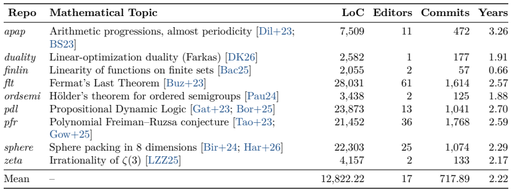
Table 2 :Overview of the nine Lean formalization repositories we analyze. The columnLoCshows the lines of code measured across all files of the final commit of the project, excluding external dependencies. The columnEditors shows the total number of contributors to the repository. The columnCommitscounts the number of commits in the repository, andYearsshows the age of the repository in years. All data were taken from the projects’ GitHub repositories on 15 June 2026.
원문 · CC BY 4.0 · Bálint Gyevnár, Simon DeDeo · Autonomous AI Agents Systematically Diverge From Human Preferences in Proof Formalization · 원문 그림 인용 · 원본 PDF 16쪽에서 그림 영역을 추출했습니다.각 정의는 타입 시그니처와 본문으로 나뉘며, 정의가 참조하는 다른 정의를 간선으로 하는 의존 그래프가 만들어집니다. 편집 여부는 정의 식별자의 추가·제거·수정으로 판정합니다. sorry는 증명 공백을 표시하는 Lean 키워드이며, 본문에서 sorry가 몇 번 나오는지 세어 구문 특징으로 씁니다.
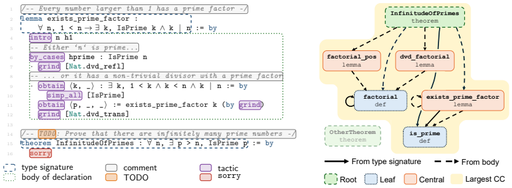
Figure 5 :Lean 4 syntax (a) and dependency graph (b) based on the proof that infinitely many primes exist.
원문 · CC BY 4.0 · Bálint Gyevnár, Simon DeDeo · Autonomous AI Agents Systematically Diverge From Human Preferences in Proof Formalization · 원문 그림 인용 · 원본 PDF 17쪽에서 그림 영역을 추출했습니다.위치와 놀람도 특징
의미 특징은 의존 그래프에서 계산됩니다. Max leaf는 정의에서 도달 가능한 리프까지의 최단 경로들 중 가장 긴 거리이며, 리프 자체나 리프 순환에서는 0입니다. Root distance는 선별된 주요 루트 노드까지의 무방향 최단 거리입니다. 주요 루트는 가장 큰 전이적 폐포를 가진 루트부터 greedy하게 추가하되, 전체 폐포 크기 증가가 5% 미만이 되면 멈춥니다.
놀람도(surprise)는 Lean 4로 미세 조정된 언어 모델 아래에서 정의의 타입 시그니처와 본문 각각에 대해 주석이 아닌 토큰의 평균 음의 로그확률로 계산합니다. 주 회귀에는 DeepSeek-Prover-V2-7B를 사용했으며, 다른 두 모델에서도 결론이 본질적으로 같다고 보고됩니다.
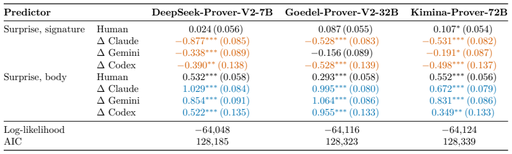
Table 4 :Sensitivity of the coefficients for surprise in Figure 2 to the language model used to score surprise. Each column refits the same model, but with surprise ranks computed under different LLMs. Log-likelihoods are comparable across columns.
원문 · CC BY 4.0 · Bálint Gyevnár, Simon DeDeo · Autonomous AI Agents Systematically Diverge From Human Preferences in Proof Formalization · 원문 그림 인용 · 원본 PDF 23쪽에서 그림 영역을 추출했습니다.sorry 표지에 대한 편향
에이전트 편집은 sorry를 포함한 정의에 강하게 쏠립니다. 원문에 따르면 Claude, Gemini, Codex의 수정 중 최소 59%가 sorry를 포함한 정의였고(Claude 92%, Gemini 80%, Codex 59%), 사람의 수정은 19%였습니다. 이 수치는 이 논문의 커밋 집합에서 측정된 비율이며, 에이전트 수정 대상이 sorry 정의로 집중된다는 관찰입니다.
정의 길이에서도 차이가 있습니다. 사람은 긴 정의를 수정하는 경향이 강하지만, 에이전트의 편차는 음수이며 크기가 큽니다. 저자들은 이를 에이전트가 짧고 명시적으로 미완성인 조각을 찾는 경향으로 해석합니다.
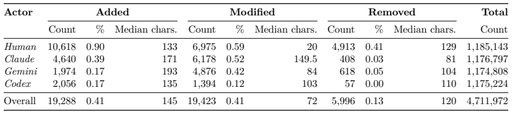
Table 1 :The number and per-actor percentage of definitions that wereAdded,Modified, orRemoved, aggregated across all commits we consider. The three categories are mutually exclusive, with the remaining definitions left unchanged.Median chars.gives the median number of characters inserted plus deleted across the signature and body.Totalis the number of definitions for the actor across all commits, including unchanged definitions.
원문 · CC BY 4.0 · Bálint Gyevnár, Simon DeDeo · Autonomous AI Agents Systematically Diverge From Human Preferences in Proof Formalization · 원문 그림 인용 · 원본 PDF 4쪽에서 그림 영역을 추출했습니다.주변부 편향과 놀람도 정규화
위치 특징에서 에이전트는 사람과 다른 U자형 패턴을 보입니다. 사람은 리프 근처를 선호하는 쪽이 약하지만, 에이전트는 리프에서 한두 단계 떨어진 정의나 주요 루트에서 약 세 단계 떨어진 정의에서 편집 확률이 최소가 되고 양쪽으로 올라갑니다. 따라서 에이전트는 그래프의 가장자리를 선호하고 조밀한 중간부를 피하는 것으로 나타납니다.
놀람도에서는 에이전트가 높은 놀람도의 증명 본문을 선호하고, 그 수정이 본문 놀람도를 기준선 쪽으로 낮춥니다. 원문 표 5에 따르면 sorry를 포함한 정의에서 Claude의 본문 놀람도 변화는 DeepSeek-Prover-V2-7B 기준 -1.157 nats/token으로 보고됩니다. 이 값은 모델과 sorry 여부에 따라 달라지므로 모든 조건에 일반화하지 않습니다.
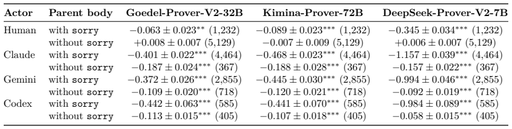
Table 5 :Change in surprise over definition body after a modification (nats per token), split by whether the definition contained asorry in the parent commit, and by each language model used to score surprise. Errors are cluster-bootstrapped standard errors over commits, with the number of definitions shown in parentheses.
원문 · CC BY 4.0 · Bálint Gyevnár, Simon DeDeo · Autonomous AI Agents Systematically Diverge From Human Preferences in Proof Formalization · 원문 그림 인용 · 원본 PDF 23쪽에서 그림 영역을 추출했습니다.회귀 분석과 파서 검증의 범위
회귀 분석은 부모 상태의 정의가 자식 상태에서 수정되는지를 예측하는 혼합효과 로지스틱 모델입니다. 예측 변수는 sorry 포함 여부, Max leaf와 Root distance 및 제곱항, 두 놀람도, 정의 크기, 이전 수정 여부이며, 모든 예측 변수는 행위자와 상호작용합니다. 표본은 부모 상태의 가장 큰 약연결 성분 안의 정의로 제한합니다.
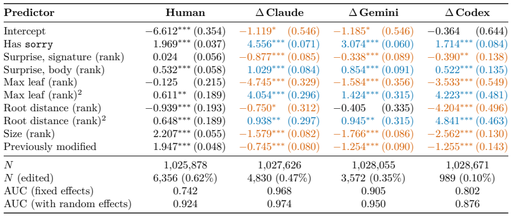
Table 6 :Fixed-effect coefficients corresponding to Figure 2, main text.
원문 · CC BY 4.0 · Bálint Gyevnár, Simon DeDeo · Autonomous AI Agents Systematically Diverge From Human Preferences in Proof Formalization · 원문 그림 인용 · 원본 PDF 23쪽에서 그림 영역을 추출했습니다.의존 그래프는 컴파일러가 아니라 휴리스틱 렉시컬 파서에서 얻습니다. 정의 식별은 F1 0.999로 거의 정확하지만, 간선 재현율은 0.614이고 정밀도는 0.862입니다. 따라서 파서가 의존 관계를 체계적으로 덜 세는 한계를 함께 읽어야 합니다.
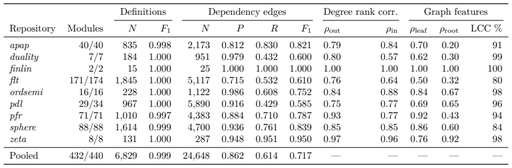
Table 3 :Our parser’s accuracy compared against the Lean 4 compiler ground truth. N shows the number of definitions or dependency edges. F1 measures the recovery of named definitions or the edges between them.P and R measure the precision and recall of the recovery of edges between definitions.ρout/ρin are the Spearman rank-correlations between our parser’s and the compiler’s dependency graph out/in-degrees,ρleaf/ρroot the correlations with Max leaf and Root distance, and LCC the fraction of the largest weakly connected component recovered.
원문 · CC BY 4.0 · Bálint Gyevnár, Simon DeDeo · Autonomous AI Agents Systematically Diverge From Human Preferences in Proof Formalization · 원문 그림 인용 · 원본 PDF 22쪽에서 그림 영역을 추출했습니다.한계와 적용 범위
회귀 분석은 상관적 분석입니다. sorry 표지를 직접 넣거나 제거하는 인과 실험은 수행하지 않았으며, 그런 개입은 자연스럽지 않은 자극을 만들 수 있다고 저자들은 설명합니다. 또한 저장소는 공개되어 있고 모델보다 이전에 만들어졌기 때문에 학습 데이터에 포함되었을 가능성이 있습니다. 사람 집단은 한 명의 행위자로 취급되어 개별 기여자의 차이는 평균 속에 포함됩니다.
병합 커밋을 제외한 것도 한계입니다. 병합은 여러 작업이 모여 하나의 결정과 다르므로 제외했습니다. 따라서 결과는 이 아홉 저장소와 이 프롬프트 조건, 그리고 이 세 에이전트 설정에서 관찰된 상관으로 읽어야 합니다.
논문 정보
- 저자
- Bálint Gyevnár, Simon DeDeo
- 학회·저널
- arXiv · 프리프린트
- 최초 공개일
- 2026년 11월 4일
- 등록일
- 2026년 11월 6일
- 수정일
- 2026년 11월 4일
- 버전
- v1
- arXiv
- 2611.06995
- 분류
- cs.AI · cs.HC
- 원문 이용 조건
- CC BY 4.0
- 제공 범위
- 논문 정보, 해설, 허용된 원문 그림
AI 해설은 논문 원문과 별개의 설명이며 오류가 있을 수 있습니다. 원문과 그림은 각 출처의 이용 조건과 따로 표시된 권리를 따릅니다.
초록
Artificial intelligence (AI) systems have ushered in a new age of proof abundance, but helping humans understand these proofs requires new attention to the differences in how AI agents and humans pursue a proof-making task. We present "simulated collaboration", a methodology that allows us to examine two key questions: (1) the relative attention AI agents pay to surface syntax or, conversely, deeper underlying semantics, and (2) how and where AI agent preferences for what to do next diverge from human preferences. On a set of nine major human collaborations in Lean with 4.7M definitions across more than 6K commits, we find that, over the course of proof construction, AI agents (1) are far more strongly drawn than humans to explicitly marked gaps; (2) show a relative aversion to densely connected proof centers and to complex or surprising proof goals; and (3) are relatively attracted to surprising proof bodies, which they tend to regularize toward baseline. Our results highlight important blind spots and potential interventions for future human-AI collaboration in mathematics.
원문 인용
Bálint Gyevnár, Simon DeDeo (2026). Autonomous AI Agents Systematically Diverge From Human Preferences in Proof Formalization. arXiv:2611.06995v1. https://arxiv.org/abs/2611.06995v1
BibTeX
@misc{gyevnr2026autonomous,
  title = {{Autonomous AI Agents Systematically Diverge From Human Preferences in Proof Formalization}},
  author = {Bálint Gyevnár and Simon DeDeo},
  year = {2026},
  eprint = {2611.06995},
  archivePrefix = {arXiv},
  url = {https://arxiv.org/abs/2611.06995v1}
}