논문 해설
DyGEnc: Encoding a Sequence of Textual Scene Graphs to Reason and Answer Questions in Dynamic Scenes
DyGEnc: 동적 장면에서 추론하고 질문에 답하기 위한 텍스트 장면 그래프 시퀀스 인코딩
- 연구 문제 동적 장면의 객체 관계 이력을 LLM에 전달할 때 텍스트 전체를 넣으면 정보량이 커지고 시각 모델은 표현이 암묵적입니다.
- 연구 방법 텍스트 장면 그래프를 GraphTransformer와 Q-Former로 고정 길이 토큰에 압축하고 LoRA로 미세조정된 LLM에 소프트 프롬프트로 입력합니다.
- 주요 결과 STAR QA 검증 분할에서 DyGEnc(Llama3.2-3B)의 평균 Accuracy는 0.89, DyGEnc(Llama3.1-8B)는 0.88로 보고되었습니다.
연구 문제: 동적 장면의 텍스트 그래프를 어떻게 LLM에 전달할 것인가
동적 장면을 이해하려면 시간에 따라 바뀌는 객체와 관계를 다뤄야 합니다. 기존 시각 모델은 이미지에서 정보를 암묵적으로 추출하기 때문에 객체 표현과 공간-시간 관계를 해석 가능한 형태로 드러내기 어렵습니다. 반대로 장면 그래프 시퀀스를 전부 텍스트로 LLM 문맥에 넣으면 정보량이 급격히 늘어나 환각 위험이 커집니다. 이 논문은 이 문제를 다루기 위해 텍스트 장면 그래프의 시퀀스를 소수의 압축된 토큰으로 인코딩하는 DyGEnc를 제안합니다. 평가는 STAR와 AGQA 벤치마크의 질의응답과 로봇 실험으로 이루어집니다.
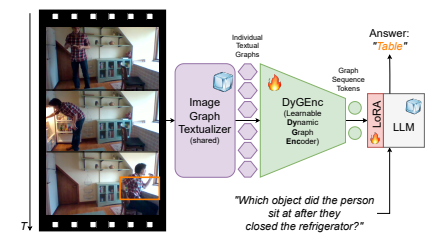
Fig. 1 . DyGEnc compactly encodes a dynamic graph (sequence of textual scene graphs) of a changing environment in a few tokens. The resulting representation is then utilized by an aligned large language model for situated logical reasoning and question answering.
원문 · CC BY 4.0 · Sergey Linok, Vadim Semenov, Anastasia Trunova, Oleg Bulichev, Dmitry Yudin · DyGEnc: Encoding a Sequence of Textual Scene Graphs to Reason and Answer Questions in Dynamic Scenes · 원문 그림 인용 · 원본 PDF 1쪽에서 그림 영역을 추출했습니다.DyGEnc의 인코딩 구조
DyGEnc는 먼저 각 텍스트 장면 그래프의 노드와 간선 속성을 pre-training 텍스트 인코더 ModernBert로 임베딩합니다. 이어서 그래프 신경망인 GraphTransformer로 그래프 구조를 인코딩하고 평균 풀링으로 그래프별 토큰을 얻습니다. 시퀀스 단계에서는 각 그래프 토큰에 Rotary 위치 인코딩을 더한 뒤 Q-Former의 교차 주의로 학습 가능한 질의 토큰에 시퀀스 정보를 모읍니다. 질의 토큰 수 k는 입력 그래프 수 m과 무관하게 고정되므로 시퀀스 길이가 달라져도 LLM 문맥 크기가 일정하게 유지됩니다. 마지막으로 MLP가 압축 토큰을 LLM 임베딩 공간에 투영하고, 이 토큰은 질문과 함께 고정된 LLM의 자기 주의 층에 입력됩니다.
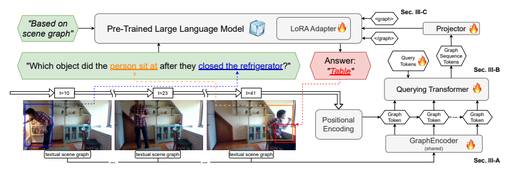
Fig. 2 . Overview of the DyGEnc pipeline. Given a dynamic scene graph - a sequence of textual scene graphs, where nodes and edges carry attributes encoded by a pre-trained text encoder, we first pass each encoded graph through a graph neural network to generate an aggregated graph token. To preserve temporal information, each graph token is enriched with a positional encoding. Then Q-Former module is applied to capture temporal relations, producing a compact sequence representation in query tokens. Finally, a multilayer perceptron projects these tokens into a large language model’s embedding space, with special tokens marking the start and end of the graph soft prompt. Thus LLM can ground its reasoning based on sensory input.
원문 · CC BY 4.0 · Sergey Linok, Vadim Semenov, Anastasia Trunova, Oleg Bulichev, Dmitry Yudin · DyGEnc: Encoding a Sequence of Textual Scene Graphs to Reason and Answer Questions in Dynamic Scenes · 원문 그림 인용 · 원본 PDF 3쪽에서 그림 영역을 추출했습니다.학습 범위와 fine-tuning 설정
LLM의 대부분 파라미터 θ4는 고정되고, 그중 일부 가중치만 파라미터 효율적 학습으로 갱신됩니다. 이 설정에서 투영 층 θ3, Q-Former θ2, 그래프 인코더 θ1은 역전파로 함께 학습됩니다. LoRA 어댑터는 r=8, alpha=16, dropout 0.05로 설정되며 LLM 주의 모듈의 q proj와 v proj에 적용됩니다. 실험에는 Llama 3.1-8B와 Llama3.2-3B가 사용됩니다. 학습률은 2e-5로 시작하고 1 epoch 워밍업 뒤 코사인 감쇠를 사용하며, 이 값은 본 논문의 STAR 및 AGQA 학습 설정에 해당합니다.
STAR 벤치마크에서의 검증
STAR는 9K 실제 비디오에서 나온 situated reasoning 벤치마크이며 질문 유형은 interaction, sequence, prediction, feasibility의 네 가지입니다. 주 지표는 Accuracy이며 정답 라벨에 모델 응답이 포함되면 정답으로 처리합니다. 절제 실험에서는 시간 위치 인코딩 방식과 Q-Former 질의 토큰 수를 비교했습니다. 시간 인코딩 비교에서는 RoPE가 기본값으로 선택되었고, 질의 토큰 수 비교에서는 Interaction과 Sequence 범주의 하락이 작아 질의 토큰 수 1이 선택되었습니다. 구성요소 절제에서는 GE와 SE만 쓰면 Zero-shot 대비 압축률이 0.03x까지 줄지만 Prediction과 Feasibility 점수가 낮아지는 결과가 함께 보고됩니다.
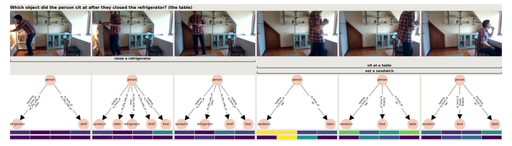
Fig. 3 . Example of cross-attention visualization from Q-Former sequence encoder on STAR benchmark for the text query “Which object did the person sit at after they closed the refrigerator?” . We draw cross-attention of 1 Q-Former latent query token to each input graph embedding where 8 blocks represent 2 layer with 4 heads in each. Brighter color represents more model attention.
원문 · CC BY 4.0 · Sergey Linok, Vadim Semenov, Anastasia Trunova, Oleg Bulichev, Dmitry Yudin · DyGEnc: Encoding a Sequence of Textual Scene Graphs to Reason and Answer Questions in Dynamic Scenes · 원문 그림 인용 · 원본 PDF 5쪽에서 그림 영역을 추출했습니다.기존 방법과의 비교 결과
STAR QA 검증 분할에서 DyGEnc(Llama3.2-3B)의 평균 Accuracy는 0.89이고 DyGEnc(Llama3.1-8B)는 0.88입니다. 같은 표에 실린 기존 방법들은 STEP 0.4, Q-ViD 0.46, MIST 0.51, SeViLA 0.65, ViLA 0.67, VidF4 0.68, LRR 0.71입니다. 이 값들은 원문 표에 보고된 수치이며, 비교 대상은 각 방법의 원문 설정을 따른 결과입니다. AGQA 2.0 테스트 분할에서는 DyGEnc(Llama3.2-3B)의 All 평균 Accuracy가 0.73이고 Open 질문에서 강점을 보였다고 저자들은 해석합니다. 이 결과는 대상 데이터셋과 질문 유형에 한정된 것입니다.
DRobot 로봇 실험과 DSG 구성 비교
실제 로봇 실험에서는 DSG를 만드는 방식을 세 가지로 비교했습니다. 첫 번째는 Nvila로 캡션을 만들고 Factual 모델로 삼중항을 추출하는 방식이며 Accuracy는 0.3입니다. 두 번째는 같은 캡션을 GPT로 삼중항화하는 방식이며 Accuracy는 0.34입니다. 세 번째는 GPT(v)가 이미지를 직접 보고 설명하는 방식이며 Accuracy는 0.34입니다. 이 실험은 사전학습된 DyGenc-3B를 사용하고 10개 장면의 DRobot 벤치마크에서 50개 질문으로 수행되었습니다. 주 지표는 Accuracy이고 BLEU, METEOR, BERTScore는 생성 답변의 의미적 근접성을 보기 위해 함께 사용되었습니다.
저자들은 GPT 기반 장면 그래프가 더 높은 지표를 보였지만 오픈소스 방식도 큰 폭의 하락 없이 결과를 낸다고 해석합니다.
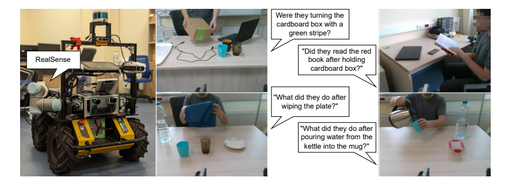
Fig. 5 . Illustration for a robotic experiment setup - to the left: mobile platform Husky with UR5 manipulator equipped to perform MOVE-AND-PICK task based on DyGEnc output, to the right - general scene overviews from our DRobot benchmark.
원문 · CC BY 4.0 · Sergey Linok, Vadim Semenov, Anastasia Trunova, Oleg Bulichev, Dmitry Yudin · DyGEnc: Encoding a Sequence of Textual Scene Graphs to Reason and Answer Questions in Dynamic Scenes · 원문 그림 인용 · 원본 PDF 6쪽에서 그림 영역을 추출했습니다.적용 범위와 한계
DyGEnc를 적용하려면 키프레임을 먼저 추출해야 합니다. 로봇 실험에서는 비디오를 1초 간격으로 균일 샘플링했으며, 희소한 핵심 사건을 포착하는 장기 이해 방법은 이 논문의 범위 밖에 있습니다. 저자들은 Q-Former의 임의 길이 입력 처리와 부분 그래프 검색이 장기 모드의 기반이 될 수 있다고 설명하지만, 이를 장기 이해 문제의 해결로 보지는 않습니다. 또한 STAR와 AGQA에서 최고 수준의 결과를 보였더라도 장면 그래프 주석 데이터의 양과 다양성이 제한되어 있으므로 기반 언어 모델이라고 볼 수는 없습니다. 3D 장면 그래프로의 확장은 향후 과제로 남아 있습니다.
논문 정보
- 저자
- Sergey Linok, Vadim Semenov, Anastasia Trunova, Oleg Bulichev, Dmitry Yudin
- 학회·저널
- arXiv · 프리프린트
- 최초 공개일
- 2025년 5월 6일
- 등록일
- 2026년 11월 6일
- 수정일
- 2025년 5월 6일
- 버전
- v1
- arXiv
- 2505.03581
- 분류
- cs.CV
- 원문 이용 조건
- CC BY 4.0
- 제공 범위
- 논문 정보, 해설, 허용된 원문 그림
AI 해설은 논문 원문과 별개의 설명이며 오류가 있을 수 있습니다. 원문과 그림은 각 출처의 이용 조건과 따로 표시된 권리를 따릅니다.
초록
The analysis of events in dynamic environments poses a fundamental challenge in the development of intelligent agents and robots capable of interacting with humans. Current approaches predominantly utilize visual models. However, these methods often capture information implicitly from images, lacking interpretable spatial-temporal object representations. To address this issue we introduce DyGEnc - a novel method for Encoding a Dynamic Graph. This method integrates compressed spatial-temporal structural observation representation with the cognitive capabilities of large language models. The purpose of this integration is to enable advanced question answering based on a sequence of textual scene graphs. Extended evaluations on the STAR and AGQA datasets indicate that DyGEnc outperforms existing visual methods by a large margin of 15-25% in addressing queries regarding the history of human-to-object interactions. Furthermore, the proposed method can be seamlessly extended to process raw input images utilizing foundational models for extracting explicit textual scene graphs, as substantiated by the results of a robotic experiment conducted with a wheeled manipulator platform. We hope that these findings will contribute to the implementation of robust and compressed graph-based robotic memory for long-horizon reasoning. Code is available at github.com/linukc/DyGEnc.
원문 인용
Sergey Linok, Vadim Semenov, Anastasia Trunova, Oleg Bulichev, Dmitry Yudin (2025). DyGEnc: Encoding a Sequence of Textual Scene Graphs to Reason and Answer Questions in Dynamic Scenes. arXiv:2505.03581v1. https://arxiv.org/abs/2505.03581v1
BibTeX
@misc{linok2025dygenc,
  title = {{DyGEnc: Encoding a Sequence of Textual Scene Graphs to Reason and Answer Questions in Dynamic Scenes}},
  author = {Sergey Linok and Vadim Semenov and Anastasia Trunova and Oleg Bulichev and Dmitry Yudin},
  year = {2025},
  eprint = {2505.03581},
  archivePrefix = {arXiv},
  url = {https://arxiv.org/abs/2505.03581v1}
}