논문 해설
An Evaluation of Estimative Uncertainty in Large Language Models
대규모 언어 모델의 추정적 불확실성 평가
- 연구 문제 대형 언어 모델이 확률 표현 WEP를 인간과 비슷한 수치 확률로 옮기는지, 그리고 통계적 불확실성을 담은 숫자 자료를 WEP 선택으로 일관되게 옮길 수 있는지 평가합니다.
- 연구 방법 17개 WEP와 여러 문맥 템플릿으로 LLM의 확률 응답을 받고, 인간 설문 분포와 KL 발산 및 Mann-Whitney U 검정으로 비교합니다. 이어 GPT-4에 숫자 표본과 신뢰구간 기반 구간을 주고 네 가지 일관성 지표로 WEP 선택을 채점합니다.
- 주요 결과 GPT-3.5와 GPT-4는 인간 분포와 각각 11개와 12개 WEP에서 차이를 보였고, 높은 긍정 확실성 WEP에서는 가까운 결과가 나타났습니다. GPT-4는 네 지표에서 무작위 기준선보다 높았지만 일관성은 대부분 100%보다 낮았으며, CoT는 empirical consistency에서만 유의미한 향상을 보였습니다.
확률 표현을 수치로 맞춰 보는 문제
‘아마도’, ‘거의 확실하다’처럼 추정적 불확실성을 자연어로 표현하는 단어를 WEP(Words of Estimative Probability)라고 합니다. 사람은 이런 표현을 숫자 확률로 대략 옮겨 이해하지만, 이 대응은 사람마다 다를 수 있습니다. 이 논문은 대형 언어 모델(LLM)이 WEP를 얼마나 사람과 비슷한 수치 확률로 옮기는지 묻습니다. 또한 같은 모델이 통계적 불확실성을 담은 숫자 자료를 받았을 때, 그 결과를 WEP 선택으로 일관되게 옮길 수 있는지도 함께 다룹니다.
두 질문은 서로 다른 연구 축을 가집니다. 첫째 질문은 인간 설문에서 얻은 확률 분포와 LLM의 응답 분포를 비교하는 것입니다. 둘째 질문은 GPT-4에게 숫자 표본과 구간을 주고 적절한 WEP를 고르게 하여, 그 선택이 실제 표본의 비율과 맞는지 보는 것입니다. 이 글은 두 질문을 차례로 따라가며, 각 결과가 어떤 조건에서만 성립하는지 구분합니다.
17개 WEP와 문맥 템플릿으로 만든 프롬프트
연구는 인간 설문에서 사용된 17개 WEP를 그대로 사용합니다. 이 목록에는 almost certain, highly likely, probable, likely, we doubt, unlikely, little chance, almost no chance 등이 포함됩니다. 각 WEP는 네 가지 문맥 설정 가운데 하나의 템플릿 안에 들어갑니다. 간결한 서사 문맥(CNC)은 짧은 사건 문장이고, 확장 서사 문맥(ENC)은 더 긴 설명을 담습니다. 여성 중심(FCNC)과 남성 중심(MCNC) 문맥은 주어를 She 또는 He로 바꾸어 성별 조건을 만듭니다.
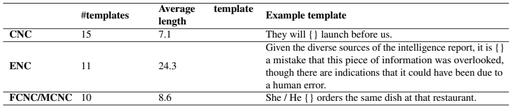
Table 1 . An overview of four context settings that are compatible with different WEPs. Note that {} in Example columns represents a placeholder for any WEP. Tables 2, 3, and 4 provide the full list.
원문 · CC BY 4.0 · Zhisheng Tang, Ke Shen, Mayank Kejriwal · An Evaluation of Estimative Uncertainty in Large Language Models · 원문 그림 인용 · 원본 PDF 10쪽에서 그림 영역을 추출했습니다.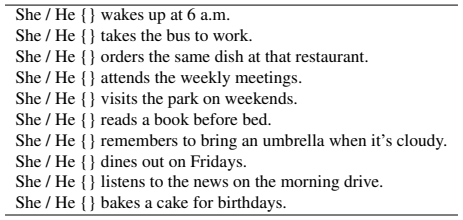
Table 3 . The full list of Extended Narrative Context (ENC) templates. {} represents a placeholder for possible WEPs.
원문 · CC BY 4.0 · Zhisheng Tang, Ke Shen, Mayank Kejriwal · An Evaluation of Estimative Uncertainty in Large Language Models · 원문 그림 인용 · 원본 PDF 11쪽에서 그림 영역을 추출했습니다.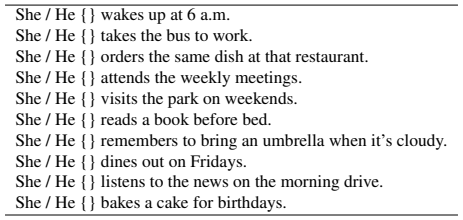
Table 4 . The full list of Female-Centric Narrative Context (FCNC) and Male-Centric Narrative Context (MCNC) templates. “/” represent a choice between “She" and “He”. The FCNC templates choose “She" as the subject and the MCNC templates choose “He” as the subject. {} represents a placeholder for possible WEPs.
원문 · CC BY 4.0 · Zhisheng Tang, Ke Shen, Mayank Kejriwal · An Evaluation of Estimative Uncertainty in Large Language Models · 원문 그림 인용 · 원본 PDF 11쪽에서 그림 영역을 추출했습니다.프롬프트는 WEP를 넣은 문맥 문장과 WEP를 뺀 같은 문장을 함께 사용합니다. 모델에게는 0에서 1 사이의 실수로 확률을 답하라고 요청합니다. 중국어 실험에서는 CNC 템플릿을 중국어로 옮겨 같은 방식으로 질문합니다. 이렇게 만든 17개 WEP 기반 프롬프트는 영어와 중국어 CNC를 포함하여 총 776개입니다. 이 구성은 같은 WEP를 문맥과 언어만 바꿔 반복 측정하는 설계입니다.
인간 분포와 LLM 응답 분포의 비교
인간과 LLM의 응답은 0에서 100까지의 확률 값입니다. 분포 비교를 위해 응답을 폭 5의 20개 구간으로 나눈 뒤, Kullback-Leibler (KL) divergence로 이산 분포의 차이를 계산합니다. KL 발산은 \(D_{KL}(P\|Q)=\sum_i P(i)\log\left(\frac{P(i)}{Q(i)}\right)\)로 정의되며, 한 분포로 다른 분포를 근사할 때 잃는 정보량으로 읽습니다. 여기서 P와 Q는 두 응답 분포이며, 방향이 바뀌면 값도 달라질 수 있습니다.
분포 차이의 유의성은 Mann-Whitney U test로 확인합니다. 이 검정은 정규성과 분산 동질성을 가정하지 않으며, 두 독립 표본 중 한쪽이 더 크거나 작은 경향이 있는지를 봅니다. 결과에서 GPT-3.5는 11개, GPT-4는 12개 WEP에서 인간 분포와 차이를 보였습니다. 예를 들어 probable에서 GPT-3.5와 인간의 절대 중앙값 차이는 5%, GPT-4와 인간의 차이는 10%였습니다. 반면 almost certain과 highly likely에서는 GPT-4와 인간의 절대 중앙값 차이가 0으로 보고되어 통계적으로 구별되지 않았습니다. 따라서 높은 긍정 확실성 영역에서는 가까운 응답이 나타났지만, 전체 WEP에서 일치한다고 보기는 어렵습니다.
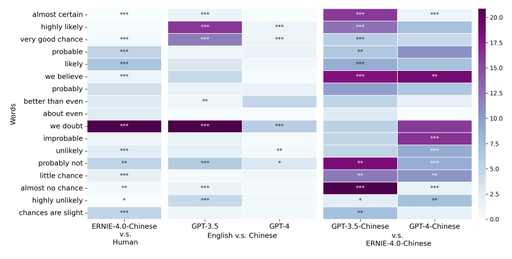
Figure 4 . A heat map displaying the Kullback-Leibler (KL) divergence between various comparison pairs on 17 words of estimative probability. These pairs are (1) ERNIE-4.0 (prompted in Chinese) and humans, (2) GPT-3.5 or GPT-4 which is prompted using English and Chinese, (3) GPT-3.5 or GPT-4 compared with ERNIE-4.0 (all prompted in Chinese). The intensity of the color within each cell corresponds to the KL divergence values, with darker colors indicating higher divergence. *, **, and *** represent significant statistical significance for the Mann-Whitney U test at confidence levels of 90%, 95%, and 99% levels, respectively. Supplementary Information Figures S19-S21 contain the precise Kolmogorov–Smirnov (KS) statistics used to assess the significance of these divergences.
원문 · CC BY 4.0 · Zhisheng Tang, Ke Shen, Mayank Kejriwal · An Evaluation of Estimative Uncertainty in Large Language Models · 원문 그림 인용 · 원본 PDF 6쪽에서 그림 영역을 추출했습니다.저자들은 KL 발산이 낮은 경우에도 중앙값 차이에 민감한 Mann-Whitney U 검정에서는 차이가 남을 수 있다고 해석합니다. 이는 전체 정보량의 유사성과 중앙값 위치의 차이가 서로 다른 측면일 수 있음을 보여 줍니다.
성별 문맥과 중국어 프롬프트의 영향
성별 문맥에서 GPT 모델의 응답 분포는 인간 분포보다 변동이 작았으며, ‘highly unlikely’, ‘improbable’, ‘highly likely’처럼 일부 WEP에서는 분포가 한 점으로 모이기도 했습니다. 개별 모델 안에서 주어의 성별 차이는 대부분 유의하지 않았고, GPT-4의 probably에서만 예외가 보고되었습니다. 다만 GPT-3.5의 almost no chance와 little chance에서는 남성 문맥과 중립 CNC 사이의 차이가 나타났습니다.
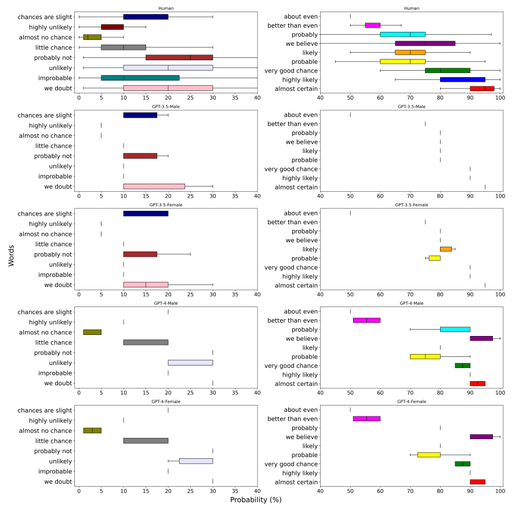
Figure 2 . Distributions of probabilities (expressed as percentages on the x-axis) on 17 words of estimative probability (WEPs) elicited from five sources: human, GPT-3.5-Male, GPT-3.5-Female, GPT-4-Male,and GPT-4-Female. The graphs on the left feature an x-axis range of 0 to 40 and include 8 WEPs on the y-axis, while the graphs on the right have an x-axis range of 40 to 100 and present the other 9 words on the y-axis. Outliers are omitted from the box-and-whisker plots, and there is zero variability in the cases where only - is indicated.
원문 · CC BY 4.0 · Zhisheng Tang, Ke Shen, Mayank Kejriwal · An Evaluation of Estimative Uncertainty in Large Language Models · 원문 그림 인용 · 원본 PDF 4쪽에서 그림 영역을 추출했습니다.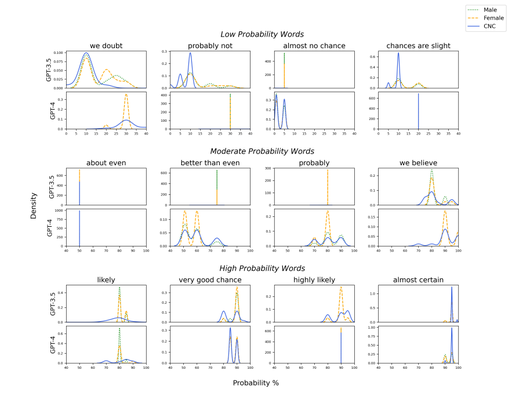
Figure 3 . Distributions of probability estimations on 12 WEPs (divided into three categories: low, moderate, high probability WEPs) by GPT-3.5 and 4. Each graph shows the estimations given under Male, Female, and Concise Narrative Context (CNC) context settings. The last of these is gender-neutral and serves as a reference. The graphs with low probability words feature an x-axis range of 0 to 40, while the other graphs have an x-axis range of 40 to 100.
원문 · CC BY 4.0 · Zhisheng Tang, Ke Shen, Mayank Kejriwal · An Evaluation of Estimative Uncertainty in Large Language Models · 원문 그림 인용 · 원본 PDF 5쪽에서 그림 영역을 추출했습니다.언어 조건에서는 GPT-3.5와 GPT-4의 영어와 중국어 응답 차이가 대체로 작았습니다. 그러나 ERNIE-4.0은 주로 중국어 텍스트로 사전학습된 모델로서, 같은 중국어 프롬프트에서도 GPT-3.5와 다른 추정 분포를 보였습니다. 특히 we doubt에서 ERNIE-4.0과 인간 사이의 KL 발산은 다른 WEP보다 크게 나타났습니다. 이 결과는 중국어 입력만으로 차이가 설명되지 않는다는 근거로 제시됩니다. 따라서 언어 차이는 모델의 학습 데이터 구성과 함께 해석해야 합니다.
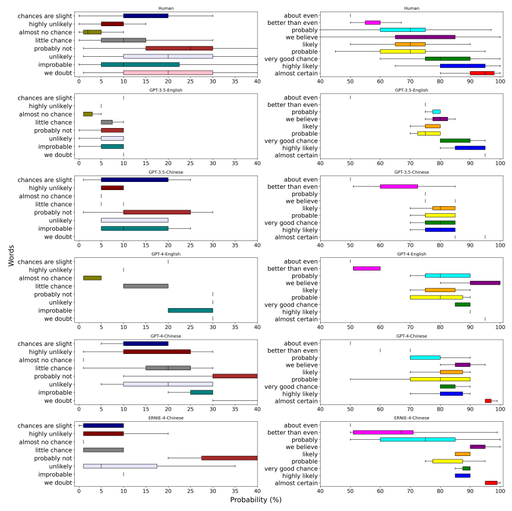
Figure 1 . Distributions of probabilities (expressed as percentages on the x-axis) on 17 words of estimative probability (WEPs) elicited from six sources: human, GPT-3.5-English, GPT-3.5-Chinese, GPT-4-English, GPT-4-Chinese,and ERNIE-4-Chinese. The graphs on the left feature an x-axis range of 0 to 40 and include 8 WEPs on the y-axis, while the graphs on the right have an x-axis range of 40 to 100 and present the other 9 words on the y-axis. Outliers are omitted from the box-and-whisker plots, and there is zero variability in the cases where only - is indicated.
원문 · CC BY 4.0 · Zhisheng Tang, Ke Shen, Mayank Kejriwal · An Evaluation of Estimative Uncertainty in Large Language Models · 원문 그림 인용 · 원본 PDF 3쪽에서 그림 영역을 추출했습니다.통계적 불확실성 과제의 구성
두 번째 질문은 GPT-4가 숫자 표본을 보고 WEP를 고를 수 있는지입니다. 과제는 Height, Score, Sound의 세 시나리오로 구성됩니다. 각 시나리오는 선택지 집합(CHOICES), 정규분포에서 생성한 숫자 집합(NUMBERS), 신뢰구간에 기반한 구간(INTERVALS)의 조합으로 만들어집니다. NUMBERS는 평균 100에 표준편차 10인 좁은 분포와 표준편차 40인 넓은 분포 두 가지입니다. INTERVALS는 여섯 종류의 구간이며, 신뢰수준 0.05, 0.275, 0.5, 0.725, 0.95의 경계점을 사용합니다.
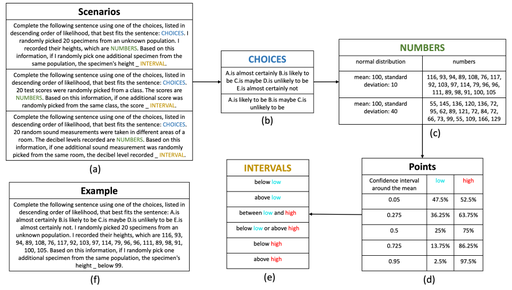
Figure 7 . The pipeline for constructing the dataset. Three scenario templates (Height, Score, and Sound) are shown in part (a). Each template comes with three controls: CHOICES (b), NUMBERS (c), and INTERV ALS (e). Each control offers some possible values. Points (d) contain values that are being used by INTERV ALS. One fully constructed example is shown in (f).
원문 · CC BY 4.0 · Zhisheng Tang, Ke Shen, Mayank Kejriwal · An Evaluation of Estimative Uncertainty in Large Language Models · 원문 그림 인용 · 원본 PDF 13쪽에서 그림 영역을 추출했습니다.이 조합은 3 × 2 × 2 × 5 × 6 = 360개의 표준 프롬프트를 만듭니다. 같은 구성에 zero-shot CoT 문장을 덧붙인 프롬프트도 360개를 만듭니다. 모델은 gpt-4-0613이며, 시스템 메시지 없이 user 역할로 호출하고 temperature는 0으로 설정합니다. 무작위 기준선은 선택지를 무작위로 고른 결과를 10회 반복하여 평균한 값입니다.
정답은 숫자 표본에서 계산한 실제 비율이 어떤 WEP 확률 범위에 들어가는지로 정합니다. 예를 들어 3개 선택지 설정에서 likely는 (0.61, 1], maybe는 [0.41, 0.61], unlikely는 [0, 0.41)에 대응합니다. 이 방식은 실제 표본 비율과 WEP 범위를 연결하는 경험적 정답 규칙입니다.
네 가지 일관성 지표의 정의
pair-wise consistency는 같은 선택지, 같은 숫자 집합, 같은 신뢰수준 경계에서 구간만 상보적으로 다른 두 프롬프트를 비교합니다. 모델이 상보적인 선택지 쌍, 예를 들어 almost certainly와 almost certainly not을 고르면 정답입니다. 이 지표는 180개 프롬프트 쌍에서 평균을 계산합니다.
monotonicity consistency는 신뢰수준이 0.05에서 0.95로 점차 커지는 다섯 프롬프트 순서에서 선택지 확률이 증가하거나 감소하는지 봅니다. 구간의 종류에 따라 감소 또는 증가가 올바른 방향으로 정해집니다. 이 지표는 72개 순서에서 평균합니다.
empirical consistency는 표본에서 실제로 계산한 비율과 선택지 확률 범위를 비교합니다. 다른 세 지표가 논리적 관계를 보는 것과 달리, 이 지표는 숫자 표본의 경험적 정답에 기대어 모델의 선택을 채점합니다. 360개 프롬프트 전체에서 평균을 계산합니다.
empirical monotonicity consistency는 인접한 두 신뢰수준 경계에서 경험적 정답의 증가, 감소 또는 동일 순서를 모델이 따르는지 봅니다. 이 지표는 288개 프롬프트 쌍에서 평균을 계산합니다. 여러 지표의 분모가 다르므로 점수를 직접 같은 단위의 성능 차이로 읽지 않아야 합니다.
GPT-4의 통계적 불확실성 과제 결과
GPT-4는 네 가지 지표 모두에서 무작위 기준선보다 높은 점수를 보였습니다. 다만 이 결과는 GPT-4가 전체 조건에서 충분히 일관된다는 뜻이 아닙니다. 대부분의 지표와 시나리오에서 일관성 점수는 100%보다 낮았습니다. 이는 확률 정렬 문제가 이 설정에서 해결되었다고 보기 어렵다는 저자들의 해석과 맞습니다.
CoT 프롬프팅은 네 지표 중 empirical consistency에서만 유의미한 향상을 보였습니다. Height에서 t(59)=−4.15, p<0.01, Cohen의 d=−0.358이었고, Score와 Sound에서도 작은 향상이 있었습니다. 반대로 monotonicity consistency에서는 모델이 증가 조건에서도 같은 선택지를 반복하는 경향이 나타났습니다. 이 때문에 점수가 높아 보이지만 실제 구간 변화에 맞는 보정은 확인되지 않았습니다. empirical monotonicity consistency에서는 이런 단순 선택 조합이 인정되지 않아 점수가 크게 떨어졌습니다.
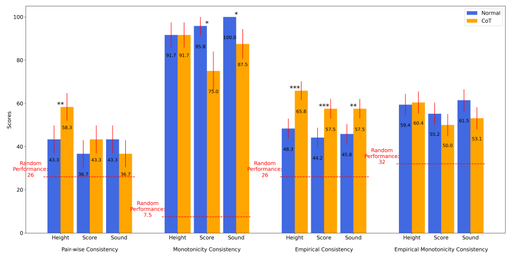
Figure 5 . A bar graph illustrating the performance of GPT-4 on answering questions about the outcome of statistically uncertain events using words of estimating probability (WEPs). The graphs compare scores using four metrics: pair-wise consistency, monotonicity consistency, empirical consistency, and empirical monotonicity consistency, for both standard and Chain-Of-Thought (CoT) prompting methods. Results for each metric are further divided based on different scenarios. The random performance is shown as a red dashed line for each metric. The standard error is shown as a vertical red line, and the numerical value corresponding to each bar is displayed. *, **, and *** represent statistical significance between normal and CoT prompting, using the paired t-test, at the 90%, 95%, and 99% confidence levels, respectively.
원문 · CC BY 4.0 · Zhisheng Tang, Ke Shen, Mayank Kejriwal · An Evaluation of Estimative Uncertainty in Large Language Models · 원문 그림 인용 · 원본 PDF 7쪽에서 그림 영역을 추출했습니다.선택지 수를 5개에서 3개로 바꾼 조건에서는 pair-wise consistency가 5개 설정에서 더 높았습니다(t(179)=6.48, p<0.01, d=0.673). 반면 empirical consistency와 empirical monotonicity consistency는 3개 설정에서 더 높았습니다. 따라서 선택지 수의 효과는 지표에 따라 방향이 달랐습니다. 구간 범위의 넓고 좁음에 따른 차이는 대부분 통계적으로 비슷하게 나타났습니다.
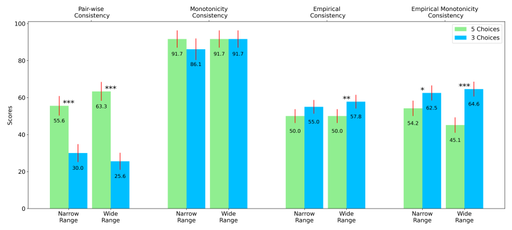
Figure 6 . A bar graph comparing the performance of GPT-4 on answering questions about the outcome of statistically uncertain events using words of estimating probability (WEPs) across two settings based on the number of WEPs choices provided: one setting offers five choices, while the other offers three. The model is evaluated using four metrics: pair-wise consistency, monotonicity consistency, empirical consistency, and empirical monotonicity consistency. For each metric, we also control for the range of statistically uncertain outcomes, with a setup with a narrow or less statistically uncertain range (left), and a wide or more statistically uncertain range (right). The standard error is shown as a red line, and the numerical value corresponding to each bar is displayed. *, **, and *** represent statistically significant differences between the 5-choices and 3-choices settings, using the paired t-test, at the 90%, 95%, and 99% confidence levels, respectively. Supplementary Information Figure S23 also presents a similar comparison controlling for either the number of WEPs choices provided, or the range of statistically uncertain outcomes.
원문 · CC BY 4.0 · Zhisheng Tang, Ke Shen, Mayank Kejriwal · An Evaluation of Estimative Uncertainty in Large Language Models · 원문 그림 인용 · 원본 PDF 8쪽에서 그림 영역을 추출했습니다.해석의 한계와 남은 질문
인간 추정치는 대학생 표본의 설문에서 얻었습니다. 저자들은 이 설문이 신뢰할 만하다는 선행 근거가 있지만, 더 넓은 모집단의 WEP 이해를 대표하는지는 확정되지 않았다고 밝힙니다. 따라서 인간과 LLM의 차이는 이 표본의 응답과 비교한 결과로 읽어야 합니다.
통계 과제의 숫자 자료는 인공적으로 생성되었습니다. 이 설정은 조건을 통제하기 좋지만, 실제 과학 문장이나 보고서의 복잡한 통계 맥락을 충분히 대표하지 않을 수 있습니다. 또한 연구는 설문에 쓰인 17개 WEP에 집중했고, 다른 확률 표현이나 대화 맥락의 동적 변화는 다루지 않았습니다. 중국어 실험도 한 언어쌍과 몇 개 모델에 한정됩니다.
논문 정보
- 저자
- Zhisheng Tang, Ke Shen, Mayank Kejriwal
- 학회·저널
- arXiv · 프리프린트
- 최초 공개일
- 2024년 5월 24일
- 등록일
- 2026년 11월 6일
- 수정일
- 2024년 5월 24일
- 버전
- v1
- arXiv
- 2405.15185
- 분류
- cs.CL · cs.AI · cs.HC
- 원문 이용 조건
- CC BY 4.0
- 제공 범위
- 논문 정보, 해설, 허용된 원문 그림
AI 해설은 논문 원문과 별개의 설명이며 오류가 있을 수 있습니다. 원문과 그림은 각 출처의 이용 조건과 따로 표시된 권리를 따릅니다.
초록
Words of estimative probability (WEPs), such as ''maybe'' or ''probably not'' are ubiquitous in natural language for communicating estimative uncertainty, compared with direct statements involving numerical probability. Human estimative uncertainty, and its calibration with numerical estimates, has long been an area of study -- including by intelligence agencies like the CIA. This study compares estimative uncertainty in commonly used large language models (LLMs) like GPT-4 and ERNIE-4 to that of humans, and to each other. Here we show that LLMs like GPT-3.5 and GPT-4 align with human estimates for some, but not all, WEPs presented in English. Divergence is also observed when the LLM is presented with gendered roles and Chinese contexts. Further study shows that an advanced LLM like GPT-4 can consistently map between statistical and estimative uncertainty, but a significant performance gap remains. The results contribute to a growing body of research on human-LLM alignment.
원문 인용
Zhisheng Tang, Ke Shen, Mayank Kejriwal (2024). An Evaluation of Estimative Uncertainty in Large Language Models. arXiv:2405.15185v1. https://arxiv.org/abs/2405.15185v1
BibTeX
@misc{tang2024evaluation,
  title = {{An Evaluation of Estimative Uncertainty in Large Language Models}},
  author = {Zhisheng Tang and Ke Shen and Mayank Kejriwal},
  year = {2024},
  eprint = {2405.15185},
  archivePrefix = {arXiv},
  url = {https://arxiv.org/abs/2405.15185v1}
}