논문 해설
Spectral Bias and Task-Model Alignment Explain Generalization in Kernel Regression and Infinitely Wide Neural Networks
스펙트럼 편향과 과제-모델 정렬이 커널 회귀와 무한 폭 신경망의 일반화를 설명한다
- 연구 문제 커널 회귀의 일반화 오차를 임의의 커널과 데이터 분포에 대해 해석적으로 예측하는 문제를 다룹니다.
- 연구 방법 커널을 Mercer 고유분해로 나누고 레플리카 방법으로 평균 일반화 오차 식을 유도합니다.
- 주요 결과 큰 고유값 모드가 먼저 학습되고, 목표 함수 전력이 상위 모드에 모일수록 오차가 낮아지며, 잡음이나 RKHS 밖 성분은 비단조 학습 곡선을 만듭니다.
커널 회귀의 일반화 문제
커널 회귀는 재생 커널 힐베르트 공간(RKHS)에서 정규화된 최소제곱 문제를 풀어 함수를 추정하는 방법입니다. 이 논문은 학습에 쓰이지 않은 데이터까지 포함한 분포에서 추정 함수와 목표 함수의 평균제곱오차로 정의되는 일반화 오차를 분석합니다. 기존 학습이론의 최악의 경우 상한은 실제 데이터에서 과도하게 느슨하거나 부정확한 추정을 주기 쉬우므로, 저자들은 임의의 커널과 데이터 분포에 적용되는 전형적(typical) 일반화 오차의 해석적 식을 목표로 합니다. 이 식은 커널 회귀가 과매개변수화된 무한 폭 신경망의 학습과 연결되는 점에서도 의미를 가집니다.
고유분해와 레플리카 기반 일반화 오차 식
이 논문은 커널을 Mercer 분해로 나누어 직교 고유함수 φρ와 고유값 ηρ를 얻고, 이를 이용해 목표 함수의 계수 wρ를 표현합니다. 일반화 오차는 레플리카 방법으로 데이터셋 평균 자유 에너지를 계산하여 유도되며, 그 결과 식은 고유값과 목표 계수, 표본 수 P, 잡음 σ²로 정해지는 Eg 식으로 주어집니다. 이 식은 임의의 커널과 데이터 분포에 적용되지만, 유도에는 가우시안 근사와 레플리카 대칭 가정이 사용됩니다. 저자들은 이 가정들이 실험과의 적합으로 검증되었다고 보고하면서도, 그 완화가 새 통찰을 줄 수 있는지는 향후 과제로 남깁니다.
스펙트럼 편향과 과제-모델 정렬
큰 고유값에 대응하는 커널 고유함수는 더 적은 표본으로 추정할 수 있다는 것이 스펙트럼 편향입니다. 논문은 일반화 오차를 모드별 오차의 합으로 분해하고, 고유값이 큰 모드일수록 표본이 늘 때 오차가 더 빨리 줄어든다는 순서를 보입니다. 이어서 목표 함수의 전력이 상위 모드에 얼마나 모이는지를 누적 전력 분포 C(ρ)로 정의하고, 이를 과제-모델 정렬의 지표로 사용합니다. 저자들은 같은 커널과 데이터 분포에서 C(ρ)가 더 큰 목표 함수일수록 정규화된 일반화 오차가 낮다고 설명합니다.
MNIST와 CIFAR-10에서의 검증
MNIST의 0 대 1 분류는 8 대 9 분류보다 학습 곡선이 더 빠르게 떨어집니다. 저자들은 2층 NTK의 상위 두 주성분에서 0과 1의 분리가 더 뚜렷하고, 0 대 1 과제의 누적 전력 분포 C(ρ)가 더 빠르게 증가한다는 점을 이 차이의 근거로 제시합니다. Gaussian RBF 커널 실험에서는 MNIST와 CIFAR-10에서 이론 곡선과 실험 점이 잘 맞는다고 보고됩니다. 다만 두 데이터셋의 커널 고유값은 비슷하지만 누적 전력 분포는 크게 다르며, 이는 빠른 학습의 차이가 고유값보다 과제 정렬에서 온다는 해석을 뒷받침합니다.
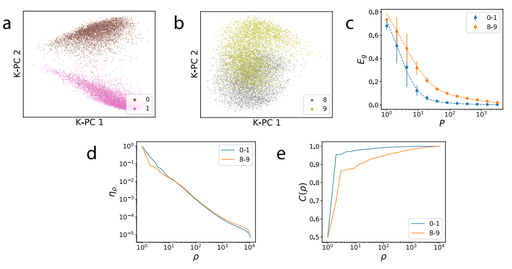
Fig. 1 :Effect of task-model alignment on the generalization of kernel regression. a, b.Projec- tions of digits from MNIST along the top two (uncentered) kernel principal components of 2-layer NTK for 0s vs. 1s and 8s vs. 9s, respectively.c. Learning curves for both tasks. The theoretical learning curves (Eq. (4), dashed lines) show strong agreement with experiment (dots).d. The kernel eigenspectra for the respective datasets. e. The cumulative power distributionsC(ρ). Error bars show the standard deviation over 50 trials.
원문 · CC BY 4.0 · Abdulkadir Canatar, Blake Bordelon, Cengiz Pehlevan · Spectral Bias and Task-Model Alignment Explain Generalization in Kernel Regression and Infinitely Wide Neural Networks · 원문 그림 인용 · 원본 PDF 5쪽에서 그림 영역을 추출했습니다.잡음과 비단조 학습 곡선
라벨에 잡음이 있거나 목표 함수의 일부가 커널의 RKHS 밖에 있으면 일반화 오차가 표본 수에 대해 비단조적으로 변할 수 있습니다. 논문은 이를 편향-분산 분해로 설명하며, 편향은 단조 감소하고 비단조성은 분산 항에서만 생긴다고 밝힙니다. CIFAR-10 실험에서 잡음 분산이 0.5인 경우 일반화 오차가 극대값을 가지며, 편향과 분산 분해에서 이 비단조성이 분산 항에서 비롯된다고 보고됩니다. 백색 대역제한 모델에서는 정규화 λ가 λ=σ²일 때 최적이 된다는 조건도 제시됩니다.
계산 비용과 적용 범위
이 이론은 데이터셋 전체에 대한 커널의 고유분해를 필요로 하므로 계산 비용이 큽니다. 또한 최신 신경망이 커널 영역 밖에서 보이는 여러 현상은 이 이론의 설명 범위를 벗어난다고 저자들은 밝힙니다. 무한 폭 신경망과의 대응은 커널 회귀 영역에 한정되며, 유한 폭 네트워크에서는 NTK 회귀와의 대응이 깨질 수 있다는 점도 함께 확인됩니다.
논문 정보
- 저자
- Abdulkadir Canatar, Blake Bordelon, Cengiz Pehlevan
- 학회·저널
- arXiv · 프리프린트
- 최초 공개일
- 2020년 6월 23일
- 등록일
- 2026년 11월 6일
- 수정일
- 2022년 2월 4일
- 버전
- v6
- arXiv
- 2006.13198
- DOI
- 10.1038/s41467-021-23103-1
- 분류
- stat.ML · cond-mat.dis-nn · cs.LG
- 원문 이용 조건
- CC BY 4.0
- 제공 범위
- 논문 정보, 해설, 허용된 원문 그림
AI 해설은 논문 원문과 별개의 설명이며 오류가 있을 수 있습니다. 원문과 그림은 각 출처의 이용 조건과 따로 표시된 권리를 따릅니다.
초록
Generalization beyond a training dataset is a main goal of machine learning, but theoretical understanding of generalization remains an open problem for many models. The need for a new theory is exacerbated by recent observations in deep neural networks where overparameterization leads to better performance, contradicting the conventional wisdom from classical statistics. In this paper, we investigate generalization error for kernel regression, which, besides being a popular machine learning method, also includes infinitely overparameterized neural networks trained with gradient descent. We use techniques from statistical mechanics to derive an analytical expression for generalization error applicable to any kernel or data distribution. We present applications of our theory to real and synthetic datasets, and for many kernels including those that arise from training deep neural networks in the infinite-width limit. We elucidate an inductive bias of kernel regression to explain data with "simple functions", which are identified by solving a kernel eigenfunction problem on the data distribution. This notion of simplicity allows us to characterize whether a kernel is compatible with a learning task, facilitating good generalization performance from a small number of training examples. We show that more data may impair generalization when noisy or not expressible by the kernel, leading to non-monotonic learning curves with possibly many peaks. To further understand these phenomena, we turn to the broad class of rotation invariant kernels, which is relevant to training deep neural networks in the infinite-width limit, and present a detailed mathematical analysis of them when data is drawn from a spherically symmetric distribution and the number of input dimensions is large.
원문 인용
Abdulkadir Canatar, Blake Bordelon, Cengiz Pehlevan (2020). Spectral Bias and Task-Model Alignment Explain Generalization in Kernel Regression and Infinitely Wide Neural Networks. arXiv:2006.13198v6. https://doi.org/10.1038/s41467-021-23103-1
BibTeX
@article{canatar2020spectral,
  title = {{Spectral Bias and Task-Model Alignment Explain Generalization in Kernel Regression and Infinitely Wide Neural Networks}},
  author = {Abdulkadir Canatar and Blake Bordelon and Cengiz Pehlevan},
  year = {2020},
  eprint = {2006.13198},
  archivePrefix = {arXiv},
  doi = {10.1038/s41467-021-23103-1},
  url = {https://arxiv.org/abs/2006.13198v6}
}