논문 해설
Guiding future global temperature distributions with simulations and observations
시뮬레이션과 관측을 활용한 미래 전지구 기온 분포 전망
- 연구 문제 기후모델은 비싸고 편향되어 있으며, 관측 보정은 모델 간 차이를 지울 위험이 있습니다.
- 연구 방법 단일 조건부 확산 에뮬레이터와 γ 가중 기하평균 가이던스를 사용해 기후모델 분포를 관측 쪽으로 추론 시 유도합니다.
- 주요 결과 MIROC6 합성 관측 실험에서 궤적 오차를 41–62% 줄였습니다. 반면 MVT와 QDM은 8–16%만 줄였습니다.
기후 위험 평가와 기존 보정의 한계
극端 기온의 공간적으로 넓은 동시 발생을 평가하려면 일별 온도장의 대규모 앙상블이 필요하지만, 기후 시뮬레이션은 비싸고 편향되어 있습니다. 관측자료로 편향을 보정하면 모델 간 차이와 미래 온난화에 대한 구조적 불확실성이 지워질 수 있습니다. 이 논문은 관측을 얼마나 강하게 반영해야 하는지를 관측 없이 미래를 검증할 수 있는 방식으로 정하는 문제를 다룹니다. 기존 편향 보정은 과거 기간에 맞춰져 미래에 그대로 적용되며, 이 연구는 그 한계를 완전 모델 실험으로 평가합니다.
조건-대-조건 가이던스의 기하평균 샘플링
이 방법은 기후모델 i의 분포 p_i와 ERA5 목표 분포 p_tgt를 가중 기하평균으로 결합합니다. 가이던스 강도 γ는 추론 시 설정되며 γ=0은 기후모델, γ=1은 관측만 사용하는 끝점입니다. 샘플링에서는 같은 파라미터를 가진 확산 모델로 두 점수를 각각 평가하고, (1−γ)∇log p_i + γ∇log p_tgt의 가중 합을 확률흐름 상미분방정식으로 적분합니다. 이 방식은 별도 분류기를 학습하지 않으며, 두 분포가 모두 높은 확률을 가지는 장만 선호하는 공통 가능성을 반영합니다.
완전 모델 실험으로 가이던스 강도 선택
이 실험은 합성 대상의 보류된 2025–2100 미래를 참값으로 사용해 9개 후보 γ 중 1·99 백분위 편향이 최소인 값을 선택합니다. 이 값은 미래로 갈수록 관측 가중치가 줄어드는 패턴을 보여 주지만, 실제 ERA5 미래에 대한 직접 검증은 아닙니다.
MIROC6 합성 관측 비교 결과
MIROC6를 합성 관측으로 둔 실험에서 조건-대-조건 가이던스는 가이드 없는 CMIP6 궤적의 오차를 41–62% 줄였습니다. 같은 실험에서 MVT와 QDM은 8–16%만 줄였습니다. 따라서 이 수치는 ERA5의 실제 미래에 대한 성능이 아니라, 합성 관측 조건에서의 상대적 개선으로 읽어야 합니다.
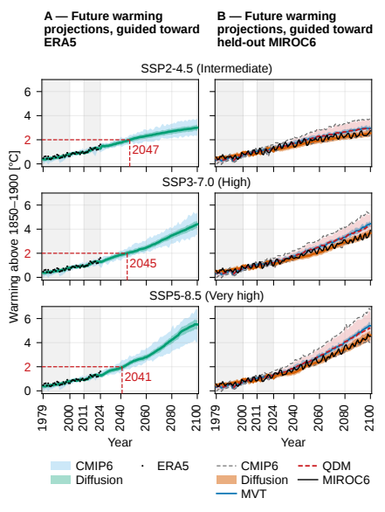
Fig. 2 . Guided projections constrain future warming and recover a known synthetic future.Annual global-mean warming above 1850–1900 under SSP2-4.5, SSP3-7.0, and SSP5-8.5; shaded bands show the 5–95% range of each ensemble. (A) Projections guided toward ERA5: the emulator reproduces the observational record through 2024 and yields a narrower range of future warming than raw CMIP6 while retaining inter-model spread. (B) Corresponding perfect-model experiment with MIROC6 as a synthetic observational target, whose future, withheld after 2024, serves as ground truth: guided projections follow the MIROC6 trajectory more closely than raw CMIP6 and the MVT and QDM bias corrections. Gray shading marks the training period.
원문 · CC BY 4.0 · Francesco Immorlano, Elijah Tavares, Felix Draxler, Juan Nathaniel, Violette Launeau, Duncan Watson-Parris, Padhraic Smyth, Pierre Gentine, Stephan Mandt · Guiding future global temperature distributions with simulations and observations · 원문 그림 인용 · 원본 PDF 3쪽에서 그림 영역을 추출했습니다.독립 일별 샘플링과 perfect-model 검증의 범위
이 방법은 일별 장을 독립적으로 샘플링하므로 다일 열파 지속시간, 사건 순서, 시간적으로 연속된 복합 위험은 직접 추정할 수 없습니다. 또한 완전 모델 실험은 CMIP6 아카이브 안에서 외부 모델로의 일반화만 평가하므로, 여러 모델이 공유하는 편향이나 실제 관측과의 보정은 확인할 수 없습니다.
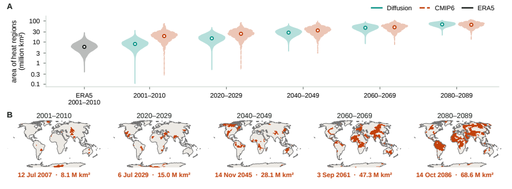
Fig. 4 . Extreme heat affects an increasing share of global land.Total land area contained in contiguous regions of extreme heat under SSP3-7.0. A land grid cell is extreme when its daily mean temperature exceeds the ERA5 1979–2024 95th percentile for that day of year; the same thresholds are applied to all datasets, and only regions of at least two adjacent cells are counted. (A) Distribution of daily affected area for ERA5, the guided diffusion ensemble, and raw CMIP6; circles mark the medians. In the 2001–2010 validation decade, the emulator, which replicates ERA5 before 2025, substantially reduces the CMIP6 overestimate of observed extreme-heat area; the projected distribution then shifts toward much larger affected areas through the century. (B) Representative guided fields for each decade, chosen to have total affected area closest to the median in panel A, each labeled with its date and total area.
원문 · CC BY 4.0 · Francesco Immorlano, Elijah Tavares, Felix Draxler, Juan Nathaniel, Violette Launeau, Duncan Watson-Parris, Padhraic Smyth, Pierre Gentine, Stephan Mandt · Guiding future global temperature distributions with simulations and observations · 원문 그림 인용 · 원본 PDF 5쪽에서 그림 영역을 추출했습니다.논문 정보
- 저자
- Francesco Immorlano, Elijah Tavares, Felix Draxler, Juan Nathaniel, Violette Launeau, Duncan Watson-Parris, Padhraic Smyth, Pierre Gentine, Stephan Mandt
- 학회·저널
- arXiv · 프리프린트
- 최초 공개일
- 2026년 11월 7일
- 등록일
- 2026년 11월 10일
- 수정일
- 2026년 11월 7일
- 버전
- v1
- arXiv
- 2611.10882
- 분류
- physics.ao-ph · cs.LG
- 원문 이용 조건
- CC BY 4.0
- 제공 범위
- 논문 정보, 해설, 허용된 원문 그림
AI 해설은 논문 원문과 별개의 설명이며 오류가 있을 수 있습니다. 원문과 그림은 각 출처의 이용 조건과 따로 표시된 권리를 따릅니다.
초록
Assessing climate risks requires projections of daily temperature distributions, including rare and spatially widespread extremes. Climate simulations are costly and biased, while correcting them toward observations risks suppressing inter-model differences. We train a single machine-learning emulator, a conditional diffusion model, on seventeen CMIP6 models and ERA5 reanalysis to generate spatially coherent daily temperature fields conditioned on model identity, date, and CO2-equivalent concentration. At sampling time, diffusion guidance reduces model biases by steering each emulated climate-model distribution toward observations, with its strength selected through perfect-model experiments using withheld simulated futures. Observational influence decreases with projection horizon and forcing. Across seventeen synthetic targets, guidance more than halves median biases in the 1st and 99th percentiles of daily temperature, improves probabilistic scores and reliability, and reduces median annual global-mean temperature RMSE by 32-57% across three emission scenarios. In a detailed benchmark, guidance also outperforms established bias corrections on daily-field probabilistic scores. Efficient sampling generates large ensembles without further climate simulations. For example, our framework corrects CMIP6's roughly threefold historical overestimate of extreme-heat coverage, yet projects that concurrent extremes will affect nearly half of global land on a typical day in the 2080s under SSP3-7.0.
원문 인용
Francesco Immorlano, Elijah Tavares, Felix Draxler, Juan Nathaniel, Violette Launeau, Duncan Watson-Parris, Padhraic Smyth, Pierre Gentine, Stephan Mandt (2026). Guiding future global temperature distributions with simulations and observations. arXiv:2611.10882v1. https://arxiv.org/abs/2611.10882v1
BibTeX
@misc{immorlano2026guiding,
  title = {{Guiding future global temperature distributions with simulations and observations}},
  author = {Francesco Immorlano and Elijah Tavares and Felix Draxler and Juan Nathaniel and Violette Launeau and Duncan Watson-Parris and Padhraic Smyth and Pierre Gentine and Stephan Mandt},
  year = {2026},
  eprint = {2611.10882},
  archivePrefix = {arXiv},
  url = {https://arxiv.org/abs/2611.10882v1}
}