논문 해설
Quantitative Assessment of Crystal Structure Prediction
결정 구조 예측의 정량적 평가
- 연구 문제 결정 구조 예측(CSP) 평가는 허용오차에 민감한 Match Rate와 방법마다 다른 부분집합에서 계산된 RMSE, 단일 참조 비교 때문에 방법 간 공정한 비교가 어렵습니다.
- 연구 방법 OPAL-Bench는 동일 조성의 모든 알려진 다형체를 참조로 삼고, 원자 종을 보존하는 SE(3) 정렬 후 기하 지표를 계산하며, 물리 지표를 함께 사용하는 임계값 없는 벤치마크입니다.
- 주요 결과 OPAL-CSP는 여러 지표에서 경쟁력 있는 결과를 보였지만 모든 지표에서 지배적이지는 않았습니다.
기존 CSP 평가의 한계
결정 구조 예측(CSP)은 화학 조성으로부터 물질의 3차원 원자 배열을 예측하는 과제입니다. 최근에는 확산 모델과 flow matching 기반의 생성 모델이 주류가 되었지만, 이들을 평가하는 기존 프로토콜은 생성 품질을 충분히 포착하지 못합니다. 기존 Match Rate는 허용오차 설정에 민감하며, 같은 조건에서도 방법 간 순위가 허용오차에 따라 뒤바뀝니다. RMSE는 각 방법이 자신이 맞춘 서로 다른 부분집합에서 계산되므로 방법 간 직접 비교가 어렵습니다. 또한 동일 조성의 여러 다형체가 존재하는데도 하나의 고정 참조 구조와만 비교하는 경우가 많습니다. 이 논문은 이 세 가지 문제와 함께 기하 지표만 쓰고 물리적 타당성을 보지 않는 점, 그리고 추론 시 대칭 템플릿을 받는 SICSP와 일반 CSP를 같은 표에서 비교하는 점을 문제로 제기합니다.
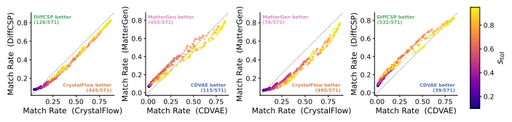
Figure 3 :Pairwise comparison of Match Rate across 571 tolerance configurations on MPTS-52. We sample 571 tolerance configurations uniformly from stol ∈[0.1,0.95] , θtol ∈[5 ◦,85 ◦], and ltol ∈[0.1,0.95] . Each point corresponds to one configuration, colored by stol. Points above the dashed diagonal indicate that the y-axis method achieves higher Match Rate than the x-axis method under that configuration; points below favor the x-axis method. Annotations report the number of configurations favoring each method out of 571. No method dominates among the pairs shown, and the standard tolerance setting ( stol = 0.5, θtol = 10◦, ltol = 0.3) sits in regions where small perturbations flip rankings. Table 3 reports the only two pairs in which one method dominates across all configurations.
원문 · CC BY 4.0 · Sergio Rincón, Gabriel González, Nicolás Andrade, Rafael Velásquez, Sebastián Ojeda, Juanita Puentes, Nicolás Aparicio, Paula Cárdenas, Pablo Arbeláez · Quantitative Assessment of Crystal Structure Prediction · 원문 그림 인용 · 원본 PDF 15쪽에서 그림 영역을 추출했습니다.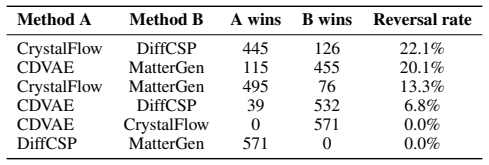
Table 3 :Pairwise Match Rate comparison across 571 tolerance configurations on MPTS-52. Each row compares two methods and reports how many tolerance configurations favor each one, where a method is favored when it achieves the higher Match Rate. The reversal rate is the fraction of configurations in which the less frequently favored method wins, indicating how sensitive the pairwise ranking is to the tolerance choice.
원문 · CC BY 4.0 · Sergio Rincón, Gabriel González, Nicolás Andrade, Rafael Velásquez, Sebastián Ojeda, Juanita Puentes, Nicolás Aparicio, Paula Cárdenas, Pablo Arbeláez · Quantitative Assessment of Crystal Structure Prediction · 원문 그림 인용 · 원본 PDF 15쪽에서 그림 영역을 추출했습니다.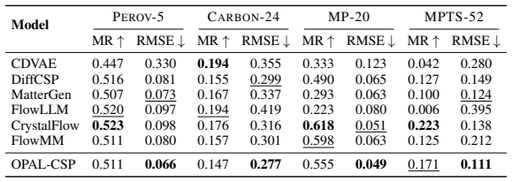
Table 4 :Conventional Match Rate and RMSE results for CSP methods.We report the standard threshold-based metrics used by prior CSP methods on Perov-5, Carbon-24, MP-20, and MPTS-52, using (stol = 0.5, θtol = 10, ltol = 0.3). Match Rate (MR; higher is better) measures the fraction of predictions that match a reference structure under these tolerances, while RMSE (lower is better) is computed only over matched predictions.Boldmarks the best value and underline marks the second-best value for each dataset and metric.
원문 · CC BY 4.0 · Sergio Rincón, Gabriel González, Nicolás Andrade, Rafael Velásquez, Sebastián Ojeda, Juanita Puentes, Nicolás Aparicio, Paula Cárdenas, Pablo Arbeláez · Quantitative Assessment of Crystal Structure Prediction · 원문 그림 인용 · 원본 PDF 16쪽에서 그림 영역을 추출했습니다.OPAL-Bench의 평가 절차
OPAL-Bench는 각 테스트 조성마다 모델이 하나의 예측 구조를 생성하게 하고, 그 예측을 같은 조성의 모든 알려진 다형체와 비교합니다. 지표별로 최소 거리를 가진 참조 구조를 선택하며, 선택된 참조가 지표마다 달라질 수 있습니다. 기하 지표를 계산하기 전에는 원자 종을 보존하는 SE(3) 정렬을 수행합니다. 이 정렬은 회전과 평행이동을 최적화하면서 헝가리안 알고리즘으로 같은 종의 원자끼리만 대응시키는 방식입니다. 정렬 후에는 종별 부분 점군에서 Chamfer, Hausdorff, Sinkhorn, RMSE를 계산하고 원자 수 가중 평균으로 집계합니다. 물리 지표로는 생성 에너지, 완화 후 생성 에너지, SOAP, XRD, 밀도를 사용하며, 이들은 회전과 평행이동에 불변이므로 정렬 없이 계산합니다.
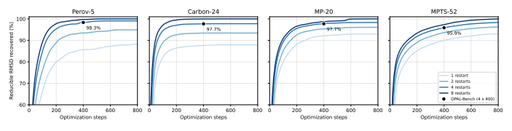
Figure 5 :Convergence of the species-aware alignment.Fraction of the reduction from the unaligned RMSE to the lowest RMSE found with 8 initializations of 800 steps that each budget recovers, averaged over 300 pairs per dataset. Each line corresponds to a number of random initializations, and the black point marks the setting that OPAL-Bench uses (4 initializations of 400 steps).
원문 · CC BY 4.0 · Sergio Rincón, Gabriel González, Nicolás Andrade, Rafael Velásquez, Sebastián Ojeda, Juanita Puentes, Nicolás Aparicio, Paula Cárdenas, Pablo Arbeláez · Quantitative Assessment of Crystal Structure Prediction · 원문 그림 인용 · 원본 PDF 21쪽에서 그림 영역을 추출했습니다.기하 지표와 물리 지표의 비교 결과
기하 지표에서는 flow 기반 방법들이 상대적으로 강했지만, 데이터셋에 따라 순위가 크게 바뀌었습니다. 물리 지표에서는 OPAL-CSP와 DiffCSP가 두드러졌고, 기하 지표에서 좋은 FlowLLM은 MPTS-52에서 생성 에너지 오차가 3264 eV/atom으로 매우 커졌습니다. 저자들은 이 결과를 기하 거리와 물리 거리가 여러 데이터셋에서 약하게만 상관된다는 증거로 제시합니다. 다만 OPAL-CSP는 Perov-5와 MP-20에서 최고 기하 점수를 얻고 MPTS-52에서 모든 물리 지표 최고 점수를 얻는 등, 두 측면이 한 모델에서 함께 나타날 수 있음도 보고합니다. Carbon-24는 조성당 다형체가 많아 결론이 제한적이라고 명시됩니다.
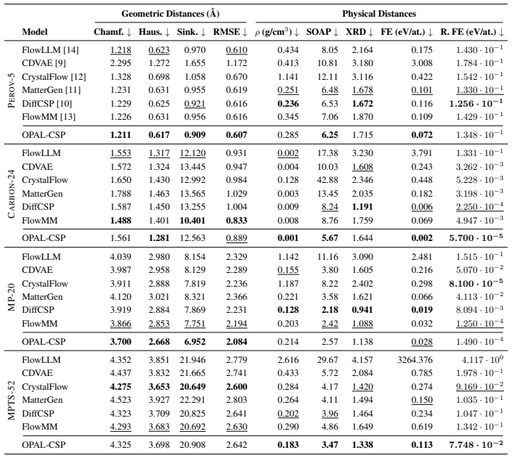
Table 1 :CSP Results.For each geometric and physical metric, we report the minimum distance from each prediction to the known polymorphs of the same composition and take the median across test compositions on the four standard datasets. Lower is better for all metrics.Boldmarks the best method per dataset and metric; underline marks the second best. Carbon-24 results should be read with caution, as its large number of polymorphs per composition makes comparisons less conclusive.
원문 · CC BY 4.0 · Sergio Rincón, Gabriel González, Nicolás Andrade, Rafael Velásquez, Sebastián Ojeda, Juanita Puentes, Nicolás Aparicio, Paula Cárdenas, Pablo Arbeláez · Quantitative Assessment of Crystal Structure Prediction · 원문 그림 인용 · 원본 PDF 8쪽에서 그림 영역을 추출했습니다.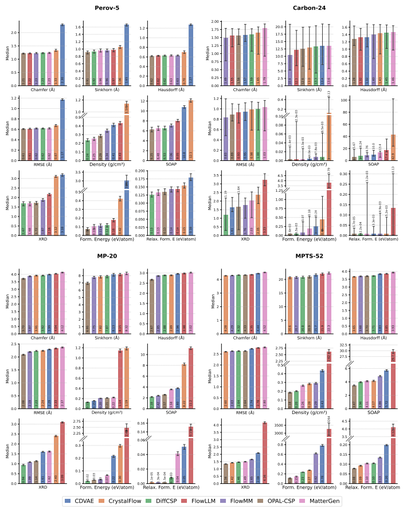
Figure 7 :Full CSP results across all four datasets and nine metrics.Bars report the median over test compositions and error bars are 95% bootstrap confidence intervals from 10,000 resampling iterations. Lower is better for all metrics. Physical metrics reveal rankings that differ substantially from geometric metrics, confirming that geometric performance does not reliably imply physical plausibility.
원문 · CC BY 4.0 · Sergio Rincón, Gabriel González, Nicolás Andrade, Rafael Velásquez, Sebastián Ojeda, Juanita Puentes, Nicolás Aparicio, Paula Cárdenas, Pablo Arbeláez · Quantitative Assessment of Crystal Structure Prediction · 원문 그림 인용 · 원본 PDF 25쪽에서 그림 영역을 추출했습니다.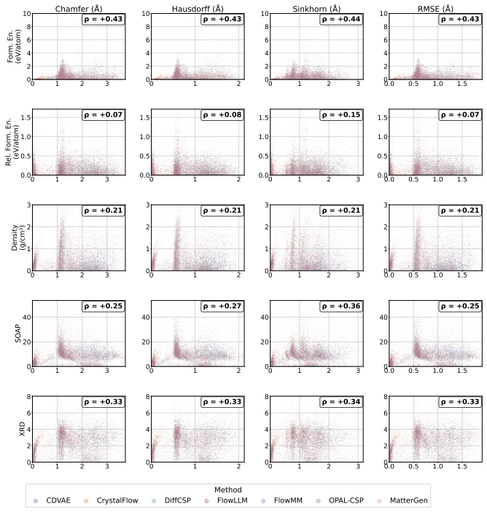
Figure 18 :Spearman correlation between geometric metrics (columns) and physical metrics (rows) across all CSP predictions in Perov-5.Each point is a single prediction, colored by method, restricted to the 3,033 test structures with no polymorph in the test split (i.e., a unique reference per prediction). The low correlation coefficients ρ confirm that geometric performance is weakly correlated to physical plausibility, motivating the inclusion of physical metrics in OPAL-Bench.
원문 · CC BY 4.0 · Sergio Rincón, Gabriel González, Nicolás Andrade, Rafael Velásquez, Sebastián Ojeda, Juanita Puentes, Nicolás Aparicio, Paula Cárdenas, Pablo Arbeláez · Quantitative Assessment of Crystal Structure Prediction · 원문 그림 인용 · 원본 PDF 32쪽에서 그림 영역을 추출했습니다.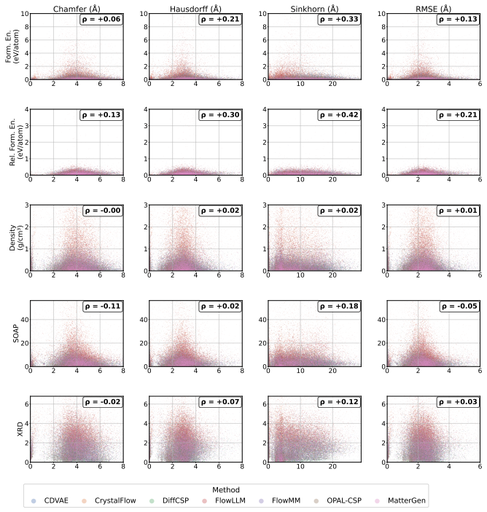
Figure 19 :Spearman correlation between geometric metrics (columns) and physical metrics (rows) across all CSP predictions in MP-20.Each point is a single prediction, colored by method, restricted to the 8,472 test structures with no polymorph in the test split (i.e., a unique reference per prediction). The low correlation coefficients ρ confirm that geometric performance is weakly correlated to physical plausibility, motivating the inclusion of physical metrics in OPAL-Bench.
원문 · CC BY 4.0 · Sergio Rincón, Gabriel González, Nicolás Andrade, Rafael Velásquez, Sebastián Ojeda, Juanita Puentes, Nicolás Aparicio, Paula Cárdenas, Pablo Arbeláez · Quantitative Assessment of Crystal Structure Prediction · 원문 그림 인용 · 원본 PDF 33쪽에서 그림 영역을 추출했습니다.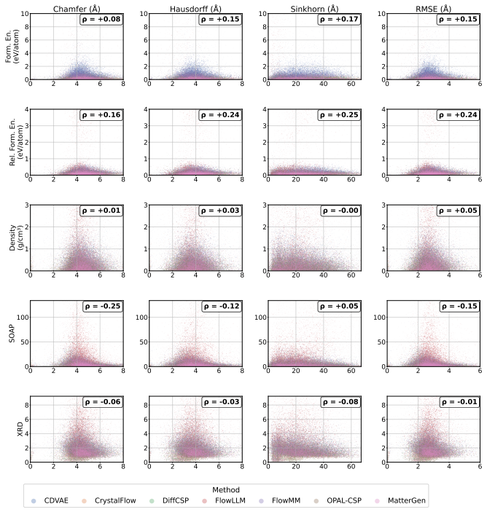
Figure 20 :Spearman correlation between geometric metrics (columns) and physical metrics (rows) across all CSP predictions in MPTS-52.Each point is a single prediction, colored by method, restricted to the 7,688 test structures with no polymorph in the test split (i.e., a unique reference per prediction). The low correlation coefficients ρ confirm that geometric performance is weakly correlated to physical plausibility, motivating the inclusion of physical metrics in OPAL-Bench.
원문 · CC BY 4.0 · Sergio Rincón, Gabriel González, Nicolás Andrade, Rafael Velásquez, Sebastián Ojeda, Juanita Puentes, Nicolás Aparicio, Paula Cárdenas, Pablo Arbeláez · Quantitative Assessment of Crystal Structure Prediction · 원문 그림 인용 · 원본 PDF 34쪽에서 그림 영역을 추출했습니다.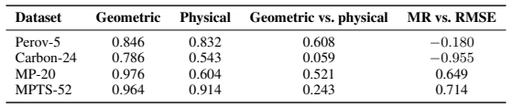
Table 17 :Agreement between the method rankings of different metrics.Mean Spearman correla- tion between the rankings of the seven CSP methods under pairs of metrics, averaged within each group of pairs. The last column reports the correlation between the rankings under the conventional Match Rate and RMSE.
원문 · CC BY 4.0 · Sergio Rincón, Gabriel González, Nicolás Andrade, Rafael Velásquez, Sebastián Ojeda, Juanita Puentes, Nicolás Aparicio, Paula Cárdenas, Pablo Arbeláez · Quantitative Assessment of Crystal Structure Prediction · 원문 그림 인용 · 원본 PDF 41쪽에서 그림 영역을 추출했습니다.적용 범위와 남은 한계
이 프로토콜은 참조 데이터셋에 있는 다형체에 대해서만 거리를 계산하므로, 아직 데이터셋에 없는 유효한 다형체는 큰 거리로 처리될 수 있습니다. 최소값을 취하는 방식은 참조 구조가 많은 조성에 유리하며, Carbon-24에서 이 효과가 가장 크게 나타납니다. 물리 지표는 사용한 MLIP 앙상블과 완화 설정에 의존하며, 조성마다 한 개의 예측만 평가하므로 생성 다양성은 포착하지 못합니다. 따라서 이 결과는 MP-20과 MPTS-52처럼 다형체가 적은 데이터셋에서는 대체로 안정적이지만, Carbon-24에서는 방법 간 차이를 확정하기 어렵다는 조건을 함께 봐야 합니다.
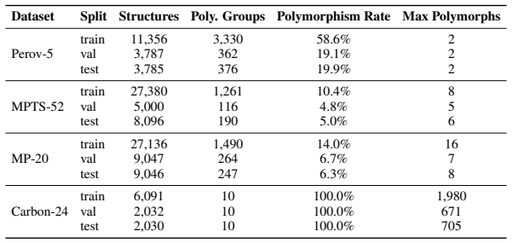
Table 6 :Polymorphism statistics across the four benchmark datasets, computed independently within each split.Structures are grouped by shared chemical formula and unit-cell atom count. Poly. Groups counts groups containing more than one structure, Polymorphism Rate is the fraction of structures in such groups, and Max Polymorphs is the largest number of structures observed in a single group.
원문 · CC BY 4.0 · Sergio Rincón, Gabriel González, Nicolás Andrade, Rafael Velásquez, Sebastián Ojeda, Juanita Puentes, Nicolás Aparicio, Paula Cárdenas, Pablo Arbeláez · Quantitative Assessment of Crystal Structure Prediction · 원문 그림 인용 · 원본 PDF 19쪽에서 그림 영역을 추출했습니다.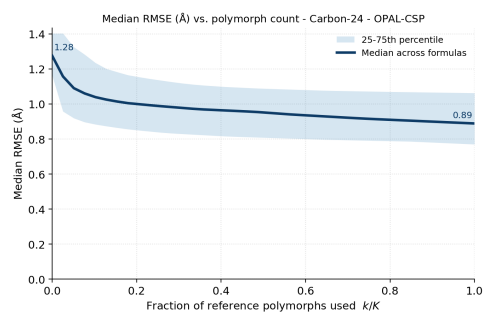
Figure 21 :Median minimum RMSE of OPAL-CSP on Carbon-24 as a function of the fraction of known polymorphs used as references.For each composition, we recompute the minimum RMSE against random subsets of k of its K known polymorphs. The line shows the median across compositions and the shaded band the 25th to 75th percentiles.
원문 · CC BY 4.0 · Sergio Rincón, Gabriel González, Nicolás Andrade, Rafael Velásquez, Sebastián Ojeda, Juanita Puentes, Nicolás Aparicio, Paula Cárdenas, Pablo Arbeláez · Quantitative Assessment of Crystal Structure Prediction · 원문 그림 인용 · 원본 PDF 38쪽에서 그림 영역을 추출했습니다.논문 정보
- 저자
- Sergio Rincón, Gabriel González, Nicolás Andrade, Rafael Velásquez, Sebastián Ojeda, Juanita Puentes, Nicolás Aparicio, Paula Cárdenas, Pablo Arbeláez
- 학회·저널
- arXiv · 프리프린트
- 최초 공개일
- 2026년 11월 7일
- 등록일
- 2026년 11월 10일
- 수정일
- 2026년 11월 7일
- 버전
- v1
- arXiv
- 2611.10380
- 분류
- cs.LG · cond-mat.mtrl-sci · cs.AI
- 원문 이용 조건
- CC BY 4.0
- 제공 범위
- 논문 정보, 해설, 허용된 원문 그림
AI 해설은 논문 원문과 별개의 설명이며 오류가 있을 수 있습니다. 원문과 그림은 각 출처의 이용 조건과 따로 표시된 권리를 따릅니다.
초록
Crystal Structure Prediction (CSP) aims to predict a material's 3D structure from its chemical composition, with applications from energy storage to biomedical devices. Despite its importance, existing evaluation frameworks suffer from key limitations: they rely on threshold-sensitive or incomparable metrics, focus predominantly on geometric performance while overlooking physical plausibility, and fail to account for polymorphism, where a chemical composition can crystallize into multiple stable structures. In parallel, recent Symmetry-Informed CSP (SICSP) methods often report results alongside standard CSP baselines while receiving crystallographic templates at inference, which constrain the search space and make SICSP a fundamentally different task. To address these limitations, we introduce an Orientation-invariant, Polymorph-Aware, Large Benchmark (OPAL-Bench) that evaluates CSP and SICSP as separate tasks. We evaluate 7 CSP and 2 SICSP methods under OPAL-Bench across 4 datasets using threshold-free geometric and physical distance metrics. Our results show that no method dominates across all metrics, and that geometric performance is not strongly correlated with physical plausibility. We also release OPAL-CSP, an SE(3)-equivariant flow-matching baseline for the CSP track that performs competitively on geometric metrics and ranks among the best on physical ones. By unifying geometric and physical metrics under a polymorph-aware protocol, OPAL-Bench enables a more comprehensive assessment of generative quality in CSP.
원문 인용
Sergio Rincón, Gabriel González, Nicolás Andrade, Rafael Velásquez, Sebastián Ojeda, Juanita Puentes, Nicolás Aparicio, Paula Cárdenas, Pablo Arbeláez (2026). Quantitative Assessment of Crystal Structure Prediction. arXiv:2611.10380v1. https://arxiv.org/abs/2611.10380v1
BibTeX
@misc{rincn2026quantitative,
  title = {{Quantitative Assessment of Crystal Structure Prediction}},
  author = {Sergio Rincón and Gabriel González and Nicolás Andrade and Rafael Velásquez and Sebastián Ojeda and Juanita Puentes and Nicolás Aparicio and Paula Cárdenas and Pablo Arbeláez},
  year = {2026},
  eprint = {2611.10380},
  archivePrefix = {arXiv},
  url = {https://arxiv.org/abs/2611.10380v1}
}