논문 해설
Deploying Physically and Epistemically Compliant Agents by Distilling Belief-Space Task and Motion Planners
신념 공간 작업 및 동작 계획기를 증류하여 물리적·인식적으로 규정을 준수하는 에이전트 배포하기
- 연구 문제 행동이 belief에 의존하는 규칙을 지켜야 하는 에이전트를 오프라인 belief-space 계획의 증류로 학습하는 문제입니다.
- 연구 방법 계획은 시뮬레이터에서 오프라인으로 생성하고, 이력 기반 정책은 Dual Averaging 손실과 ρ-Optimal Reinforcement 피드백으로 증류합니다.
- 주요 결과 Scavenger에서 증류된 정책은 90%를 넘는 성공률을 보였고 RL 기준선은 최대 5%였습니다.
문제: 규칙을 지키는 정책을 어떻게 얻는가
이 논문은 행동이 belief에 따라 달라지는 규칙을 지키는 에이전트를 학습하는 문제를 다룹니다. 예를 들어 로봇은 사용자가 필요한 물건을 갖고 떠나도록 보장해야 하며, 이는 물리적 안전 제약과 함께 지켜야 하는 인식적 제약입니다. 강화학습은 이런 규칙을 보상으로 인코딩할 수 있지만, 실제로는 보상을 완벽히 최적화하지 못해 규칙을 벗어난 행동을 학습하기 쉽습니다. 반대로 belief-space 계획기는 구성 방식상 명세에 맞는 행동을 만들지만, 온라인 belief 추정과 저지연 재계획을 직접 구현해야 하므로 공학적 부담이 큽니다.
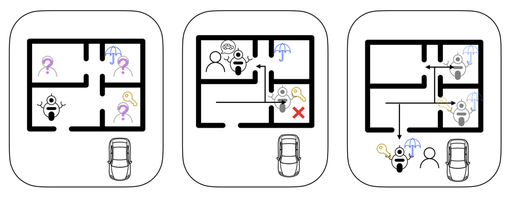
Fig. 1 : A worked example, where the robot must obey the epistemic rule: “ensure the user leaves their home, and has what they need when they leave”, while being physically safe. The robot should be confident that the user has what they need before they leave the house.Left:The robot must first search for the user in the house, who may be in one of three locations. Middle:After finding the user, the robot asks them about what they might need for the day.Right:The robot hears the user is planning to go on a drive to see friends on a rainy day, and then brings them their keys and umbrella.
원문 · CC BY 4.0 · Phillip J. K. Christoffersen, Rachel Ma, Patrick Barragán, Dylan Hadfield-Menell · Deploying Physically and Epistemically Compliant Agents by Distilling Belief-Space Task and Motion Planners · 원문 그림 인용 · 원본 PDF 2쪽에서 그림 영역을 추출했습니다.저자들은 이 간극을 메우기 위해 계획은 시뮬레이터에서 오프라인으로 생성하고, 그 계획 궤적을 원시 관측에 직접 작용하는 정책으로 증류합니다. 다만 기존 계획 모방 방법은 완전 관측 영역을 전제로 했기 때문에, 전체 관측-행동 이력에 의존하는 정책에서는 분포 이동이 더 심해집니다. 따라서 이 연구의 핵심 질문은 이력 기반 정책을 belief-space 계획으로 증류할 때 학습을 안정시키는 두 가지 변경이 실제로 효과가 있는지입니다.
Dual Averaging: 행동 전환 시점에 가중을 두는 손실
기존 계획 증류 연구는 행동 예측에 표준 교차 엔트로피와 행동 복제를 사용했습니다. 이 논문의 설정에서는 궤적마다 고수준 행동 수와 저수준 제어 수가 크게 달라지고, 이력 전체에 의존하는 고수준 정책 π_H의 예측은 자기상관을 띱니다. 그 결과 π_H는 현재 행동을 계속 유지하는 쪽으로 기울어 행동을 바꾸는 예측에 불리해집니다.
Dual Averaging은 이 문제를 궤적마다 두 평균을 결합하는 손실로 보정합니다. 전체 timestep에 대한 평균 손실과, 계획기가 행동을 바꾸는 timestep에 대한 평균 손실을 각각 구한 뒤 가중치 α와 β로 더합니다. 원문 식은 L_dual(τ) = α(L(τ)/|τ|) + β(L(τ[t:a[t]≠a[t−1]]) / |{t : a[t]≠a[t−1]}|)입니다. 두 번째 항의 분모는 행동 전환 횟수이므로, 전환이 적은 궤적에서도 전환 시점의 손실이 과도하게 희석되지 않도록 평균을 취합니다. 이 손실은 π_H에 적용되며, π_L의 제어 학습은 같은 식의 대상이 아닙니다. 실험에서는 α=β=1을 사용했다고 밝혀져 있습니다.
ρ-Optimal Reinforcement: 성공한 정책 rollout의 재사용
기존 피드백 메커니즘인 Task Exploration Node는 불법적인 고수준 행동을 줄이는 데 맞춰져 있었습니다. 그러나 부분 관측 문제에서 실패한 정책 행동은 대부분 합법적이지만 비효율적인 경우가 많습니다. 예를 들어 방을 더 찾을 수 있지만 그 탐색이 효과적이지 않은 경우입니다. 이 연구는 이러한 최적성 차이를 직접 탐지하지 않고, 성공한 정책 rollout을 같은 초기 상태에서 계획기가 만든 성공 궤적과 비교하는 방식을 택합니다.
정책 rollout이 성공하고 그 길이가 계획 길이의 ρ배 이하이면, 그 정책 rollout을 학습 데이터 버퍼에 넣습니다. 그렇지 않고 계획이 성공했다면 계획 궤적을 넣습니다. ρ가 1보다 크므로 정책이 이미 수행할 수 있는 약간 비효율적인 행동도 강화되며, 정책은 학습에 더 많은 유연성을 얻습니다. 이 방식은 Task Exploration Node의 불법 행동 중심 피드백을 대체하는 간단한 대안으로 제시됩니다.
정적 탐색에서 δ-prior-efficient 계획기의 완전성
이 연구는 방법의 설계 근거로 belief-space 계획기의 재계획 횟수를 분석합니다. 정리 1은 상태를 관측 가능한 부분 S_obs와 관측 불가능한 부분 S_unobs로 나누고, 어떤 행동도 S_unobs를 바꾸지 않는 상황을 가정합니다. 관측 모델은 관측된 값이 A(s_obs)에 속할 때만 s_unobs를 주고, 그렇지 않으면 null을 준다고 가정합니다. 이 noiseless 설정에서 δ-prior-efficient 계획기는 재계획할 때마다 B_0 확률 δ 이상의 미탐색 후보를 제거하거나 불확실성을 해소해야 합니다. 이 성질의 결과로, 불확실성이 해소되기 전까지 재계획 횟수는 최대 ⌈1/δ⌉+1이며 점근적으로 O(1/δ)입니다.
따름정리 1은 이 상한으로부터 noiseless 정적 탐색에서 δ-prior-efficient 계획기가 유한 시간 안에 종료하므로 완전하다는 결론을 냅니다. 따름정리 2는 연속 사전분포 B_0에서 최대우도 관측 계획기가 유효한 재계획을 항상 만들 수 있으면, δ=1의 δ-prior-efficient 성질을 가지므로 완전하다는 결론을 냅니다. 따라서 이 결론은 정적 탐색과 noiseless 관측이라는 조건부 결과이며, 모든 belief-space 계획 문제에 대한 일반 성질이 아닙니다. 저자들은 이 성질이 행동의 되돌릴 수 없음을 암묵적으로 포함한다고 밝히며, 이 점도 적용 범위의 한계로 남깁니다.
Scavenger에서 증류 플래너와 RL 기준선 비교
실험은 절차적으로 생성된 다방 평면도에서 힌트를 찾고 올바른 마커에 추측하는 Scavenger 과제에서 수행되었습니다. 같은 과제에서 flat RL과 hierarchical RL 기준선은 최대 5%의 성공률을 보였습니다. 이 기준선들은 24시간 이상의 벽시계 계산 시간과 밀집 보상을 받았다고 원문이 밝힙니다. 따라서 이 비교는 기준선의 보상 설계와 학습 시간을 충분히 준 조건에서의 결과입니다.
세 방법 중 ρ=1.1 설정의 증류 플래너가 시각 힌트와 언어 힌트 모두에서 가장 높은 성공률을 보였습니다. 절제 실험에서는 피드백을 제거한 No Feedback, 비율 상한을 제거한 No Ratio Cap, 작업 변경 항을 제거한 No Task-Change를 같은 벽시계 시간 예산으로 비교했습니다. No Task-Change는 α=1, β=0으로 학습되었습니다. 원문은 이 절제 변형들이 기준선 RL보다 훨씬 강하지만 언어 힌트 파싱에서 더 어려움을 겪는다고 보고합니다. 이 결과는 각 구성요소를 유지하는 효용을 보여주며, 모든 변형에서 같은 크기의 이득이 나타난다는 뜻은 아닙니다. 또한 모든 방법은 단일 시드로 실행되었습니다.
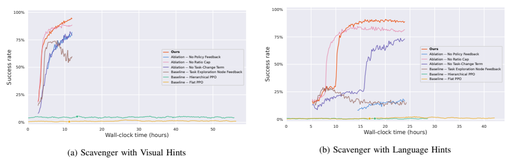
Fig. 3 : Success rates vs. wall-clock time on Scavenger. The dots on the baseline runs refer to the point in baseline runs where as many simulation timesteps are used for training the policies as our method. In all cases, our method attains at least18 timesthe success rate of the baseline RL policies, even while giving the baseline RL policies access to at least 50% more simulator steps for training. Our method attains the highest success rate among the ablations for our feedback mechanism. Note: our method and ablations do not all start at 0 wall-clock time, because there is an initial phase of data generation without policy training for each, longer for the No Feedback ablation since it does not get further policy / planner feedback afterward. The ablations attain much stronger performance than the RL baselines, but start to struggle more with parsing language hints. All methods are run with a single seed.
원문 · CC BY 4.0 · Phillip J. K. Christoffersen, Rachel Ma, Patrick Barragán, Dylan Hadfield-Menell · Deploying Physically and Epistemically Compliant Agents by Distilling Belief-Space Task and Motion Planners · 원문 그림 인용 · 원본 PDF 7쪽에서 그림 영역을 추출했습니다.학습 밖 명령과 더 많은 방으로의 일반화
이 평가는 언어 힌트 정책을 학습 때 쓰지 않은 명령과 의도적으로 모호한 명령에서 각각 50 에피소드씩 실행한 실험입니다. 학습 때 보지 못한 같은 방식의 명령에서는 원래 도메인 94%에서 92%로 거의 낮아지지 않았습니다. 반면 간접 설명이나 모호한 명령에서는 62%였습니다. 따라서 이 결과는 간접 설명에서도 60%를 넘는 성공률이 있었다는 뜻이며, 모호한 명령 전체에서 높은 성공률이 보장된다는 뜻은 아닙니다.
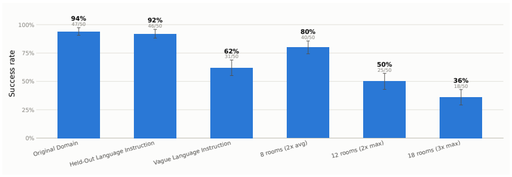
Fig. 4 : Results of the generalization study. The policy from our method, trained in Figure 3b, transfers to unseen language commands, to intentionally vague commands, and to problems with vastly more rooms than was seen in training. This shows that our policy learns to comply with physical and epistemic constraints reliably, even in floorplans and given language hints that were unseen in training. Each success rate is calculated based on 50 episodes, and the error bars are binomial standard errors.
원문 · CC BY 4.0 · Phillip J. K. Christoffersen, Rachel Ma, Patrick Barragán, Dylan Hadfield-Menell · Deploying Physically and Epistemically Compliant Agents by Distilling Belief-Space Task and Motion Planners · 원문 그림 인용 · 원본 PDF 8쪽에서 그림 영역을 추출했습니다.평면도 크기 일반화에서는 학습 때 3~6방을 사용했고, 평가에서는 8방, 12방, 18방을 사용했습니다. 성공률은 8방에서 80%, 12방에서 50%, 18방에서 36%였습니다. 원문 초록의 학습 때보다 많은 방을 가진 평면도에서 75%를 넘는다는 문장은 8방 결과에만 맞으며, 12방과 18방 결과는 그보다 낮습니다. 따라서 방 수가 늘수록 성공률이 떨어지는 경향이 확인되며, 18방은 학습 최대치의 세 배입니다.

Fig. 5 : We evaluate transfer from the 3-6 room problems seen in training, to 18 room problems like those shown above, three times the maximum number of rooms seen in training.
원문 · CC BY 4.0 · Phillip J. K. Christoffersen, Rachel Ma, Patrick Barragán, Dylan Hadfield-Menell · Deploying Physically and Epistemically Compliant Agents by Distilling Belief-Space Task and Motion Planners · 원문 그림 인용 · 원본 PDF 8쪽에서 그림 영역을 추출했습니다.적용 범위와 남은 질문
이 방법은 belief-space 계획 모델을 실제로 작성할 수 있다는 가정에 의존합니다. 저자들은 로봇 설정에서 시뮬레이터로 문제를 모델링하기 쉬운 경우에 이 가정이 합리적이라고 보며, 비로봇 안전 제약과 같은 영역으로 확장하는 것은 향후 과제로 남깁니다. 또한 이론 결과는 noiseless 관측과 정적 탐색을 가정하며, 이 가정을 완화하는 것도 남은 질문입니다.
실험 측면에서는 모든 방법이 단일 시드로 실행되었고, 주된 평가는 Scavenger라는 새 과제에 한정됩니다. 따라서 결과를 다른 로봇 과제나 실제 환경으로 바로 옮기는 것은 근거가 부족합니다. 저자들은 ρ-Optimal Reinforcement와 belief-space 계획기 선택이 실현 가능한 목표를 학습자에게 제공한다고 해석하며, 이 해석의 일반성도 추가 연구가 필요합니다.
논문 정보
- 저자
- Phillip J. K. Christoffersen, Rachel Ma, Patrick Barragán, Dylan Hadfield-Menell
- 학회·저널
- arXiv · 프리프린트
- 최초 공개일
- 2026년 11월 7일
- 등록일
- 2026년 11월 10일
- 수정일
- 2026년 11월 7일
- 버전
- v1
- arXiv
- 2611.10430
- 분류
- cs.RO · cs.AI
- 원문 이용 조건
- CC BY 4.0
- 제공 범위
- 논문 정보, 해설, 허용된 원문 그림
AI 해설은 논문 원문과 별개의 설명이며 오류가 있을 수 있습니다. 원문과 그림은 각 출처의 이용 조건과 따로 표시된 권리를 따릅니다.
초록
In this work, we train agents to act under uncertainty according to specified, belief-dependent rules. Deep reinforcement learning (RL) can in theory train agents to follow rules if encoded into well-designed rewards, but in practice, RL fails to perfectly optimize these rewards, leading to ineffective or noncompliant agent behavior. Belief-space planners by construction produce behavior in line with developer specification, but require hand-programming online planners and belief-state estimators, adding significant engineering complexity at scale. We combine the two: we plan offline to generate a dataset of sample trajectories and then distill the plans into a policy that acts on raw observations. We propose two changes to planner distillation that address problems specific to history-based policies: Dual Averaging, a loss that combines per-timestep predictive loss and average loss on task changes, and $ρ$-Optimal Reinforcement, a feedback mechanism that reinforces the policy's own successful rollouts when these are near-optimal. We provide a sufficient condition under which static search problems with noiseless observation models is complete, and show that maximum-likelihood-observation planning implies this condition in static search with continuous beliefs. We create a challenging new domain, Scavenger, where an agent needs to gain information in order to succeed. We evaluate our distilled policy in two versions of Scavenger, one where information is provided visually and one where it is provided as a command in natural language. In either case, the learned policy attains a success rate above 90% in Scavenger, compared with at most 5% for RL. We also find that distilled planners transfer with greater than 60% success to following unseen and intentionally vague commands and greater than 75% success to following floorplans larger than those seen in training.
원문 인용
Phillip J. K. Christoffersen, Rachel Ma, Patrick Barragán, Dylan Hadfield-Menell (2026). Deploying Physically and Epistemically Compliant Agents by Distilling Belief-Space Task and Motion Planners. arXiv:2611.10430v1. https://arxiv.org/abs/2611.10430v1
BibTeX
@misc{christoffersen2026deploying,
  title = {{Deploying Physically and Epistemically Compliant Agents by Distilling Belief-Space Task and Motion Planners}},
  author = {Phillip J. K. Christoffersen and Rachel Ma and Patrick Barragán and Dylan Hadfield-Menell},
  year = {2026},
  eprint = {2611.10430},
  archivePrefix = {arXiv},
  url = {https://arxiv.org/abs/2611.10430v1}
}