논문 해설
WINNet: Wavelet-inspired Invertible Network for Image Denoising
WINNet: 이미지 노이즈 제거를 위한 웨이블릿 기반 가역 네트워크
- 연구 문제 잡음 제거 방법은 모델 기반의 해석 가능성과 일반화 능력, 학습 기반의 높은 성능 사이에서 균형을 맞추기 어렵습니다. WINNet은 웨이블릿 리프팅 구조를 가역 비선형 중복 변환으로 확장하여 이 간극을 다룹니다.
- 연구 방법 WINNet은 K개 스케일의 LINN으로 입력을 coarse와 detail 부분으로 나누고, detail 부분에 CLISTA 기반 희소성 디노이징을 적용한 뒤 역변환으로 복원합니다. 잡음 추정 네트워크는 soft-threshold를 잡음 수준에 맞춰 조정합니다.
- 주요 결과 Set12와 BSD68의 비-블라인드 비교에서 WINNet (1-scale)은 DnCNN-S와 비슷하거나 더 나은 PSNR을 보이며 모델 크기는 DnCNN의 약 30%입니다. 블라인드 비교에서는 σ = 25를 제외하고 다른 방법들보다 지속적으로 높으며, 디블러링에서도 경쟁력 있는 결과를 보고합니다.
문제 설정: 모델 기반과 학습 기반 디노이징의 간극
영상 디노이징은 잡음이 섞인 관측 영상 y로부터 깨끗한 영상 x를 복원하는 역문제입니다. 이 논문은 잡음을 가법적이고 백색이며 가우시안인 것으로 가정하고, y = x + n 형태의 관측 모델을 사용합니다. 모델 기반 방법은 웨이블릿 임계화나 희소성 같은 사전 지식을 사용하여 해석 가능성과 다양한 잡음 수준에 대한 일반화 능력을 얻습니다. 반면 학습 기반 방법은 더 좋은 성능을 보이지만 블랙박스로 작동하여 미지의 잡음 수준에서 일반화가 약한 경우가 많습니다. WINNet은 이 두 흐름의 장점을 결합하려는 시도입니다.
웨이블릿 변환은 희소 표현과 다중 해상도 분석, 완전 복원 성질을 제공하지만 고정된 선형 변환입니다. 학습된 사전도 선형 변환이라는 한계가 있습니다. 따라서 완전 복원 성질을 유지하면서 데이터에 맞게 학습되는 비선형 변환이 필요하다는 것이 이 논문의 출발점입니다.
핵심 아이디어: 리프팅 구조의 가역 네트워크
WINNet은 K개 스케일의 리프팅 영감 가역 신경망(LINN)과 희소성 기반 디노이징 네트워크, 잡음 추정 네트워크로 구성됩니다. 각 스케일의 LINN은 입력을 분할 연산으로 1채널의 coarse 부분과 나머지 detail 부분으로 나눕니다. 이때 분할은 중복 표현을 만들며, tight frame 조건을 만족하도록 splitting 커널과 merging 커널을 전치 관계로 두어 가역성을 확보합니다.
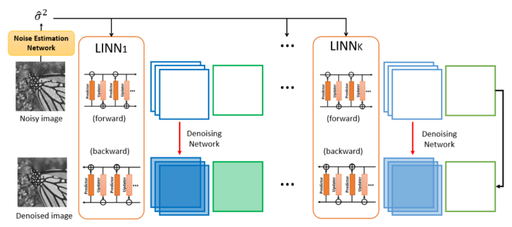
Fig. 2 . Overview of the proposed wavelet-inspired invertible network (WINNet). It consists of K levels of lifting inspired invertible neural networks (LINN) and denoising network. The forward transform of LINN non-linearly converts the input noisy image into coarse part (green) and detail parts (blue). Denoising network will perform denoising operation on the detail part while the coarse version is decomposed again using a second level and the decomposition and denoising step are repeated K times . The backward transform of the LINN will reconstruct the denoised image using the denoised detail parts and the original coarse part. The estimated noise level from the noise estimation network will be used to adjust the soft-thresholds of the soft-thresholding non-linearity to make the WINNet to adapt well to the current noise level.
원문 · CC BY 4.0 · Jun-Jie Huang, Pier Luigi Dragotti · WINNet: Wavelet-inspired Invertible Network for Image Denoising · 원문 그림 인용 · 원본 PDF 4쪽에서 그림 영역을 추출했습니다.LINN 내부에서는 Predict 네트워크가 coarse 부분을 조건으로 detail 부분을 예측하여 잔차를 희소하게 만들고, Update 네트워크가 detail 부분을 조건으로 coarse 부분을 갱신합니다. 역변환은 같은 네트워크를 부호와 방향을 바꿔 사용하므로, 잡음 제거를 하지 않으면 입력을 완전히 복원합니다. 따라서 가역성은 Predict와 Update 네트워크의 구조와 무관하게 유지됩니다.
희소성 기반 디노이징과 잡음 적응 임계값
잡음 제거는 LINN 순방향 변환 뒤 detail 부분에만 적용되는 비가역 연산입니다. 이 논문은 디노이징 네트워크를 CLISTA로 구성합니다. CLISTA는 ISTA의 반복을 학습 가능한 합성곱 사전으로 펼친 구조이며, 각 층은 soft-thresholding 연산자를 포함합니다. 마지막 층의 합성 합성곱은 희소 특징 gT로부터 디노이즈된 detail 채널을 재구성합니다.
잡음 추정 네트워크(NENet)는 입력 잡음 영상을 패치로 나누고 SENet이 각 패치에 가중치를 부여한 뒤, 가중된 공분산 행렬의 최소 특이값으로 잡음 분산을 추정합니다. 추정된 잡음 수준은 PUNets와 CLISTA의 soft-threshold를 조정하는 데 사용됩니다. 이 설계는 모델 기반 방법에서 임계값이 잡음 수준에 따라 변하는 방식과 같은 방향의 적응을 학습 네트워크에 도입한 것입니다.
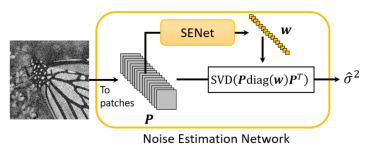
Fig. 7 . The proposed noise estimation network. The input noisy image is first divided into patches. For each patch, a scalar weight will be estimated using the SENet. The noise level is estimated as the smallest singular value of the weighted covariance matrix.
원문 · CC BY 4.0 · Jun-Jie Huang, Pier Luigi Dragotti · WINNet: Wavelet-inspired Invertible Network for Image Denoising · 원문 그림 인용 · 원본 PDF 7쪽에서 그림 영역을 추출했습니다.비-블라인드 디노이징 비교
비-블라인드 설정에서 WINNet은 잡음 수준 σ = 15, 25, 50에서 Set12와 BSD68의 평균 PSNR로 비교됩니다. 학습 기반 방법은 모두 올바른 잡음 수준의 학습 샘플로 학습되었습니다. 이 결과에서 WINNet (1-scale)의 모델 크기는 DnCNN 모델 크기의 약 30%이며, DnCNN-S와 비슷하거나 더 나은 결과를 보고합니다. 2-scale 모델은 1-scale 모델보다 소폭 개선됩니다.
이 비교는 고정된 잡음 수준에서 학습한 모델들의 결과입니다. 따라서 여기서 확인되는 우위는 해당 데이터셋과 세 잡음 수준에 한정됩니다.
블라인드 디노이징과 미지 잡음 수준
블라인드 디노이징 실험에서 WINNet은 BSD400에서 잡음 수준 σ ∈ [0, 55]로 학습되고, BSD68과 Set12에서 σ ∈ [5, 145] 범위로 테스트됩니다. 비교 대상은 DnCNN-B, BUIFD, BF-CNN입니다. DnCNN-B는 학습 범위 안에서는 경쟁력이 있으나 범위를 벗어나면 급격히 악화됩니다. WINNet은 σ = 25를 제외하고 다른 방법들보다 지속적으로 높은 PSNR을 보고합니다.
잡음 수준이 학습 범위를 넘어가도 WINNet이 견고한 이유는 추정된 잡음 수준에 따라 임계값을 조정하기 때문입니다. 원문은 학습 범위 밖 결과의 개선을 보고하지만, 이 결과는 측정된 잡음 범위와 두 데이터셋에 대한 것입니다.
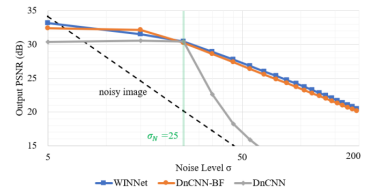
Fig. 11 . The noise robustness of different methods which are trained on noise levelσN = 25 and tested on Set12 with noise level σT∈ [5, 200].
원문 · CC BY 4.0 · Jun-Jie Huang, Pier Luigi Dragotti · WINNet: Wavelet-inspired Invertible Network for Image Denoising · 원문 그림 인용 · 원본 PDF 10쪽에서 그림 영역을 추출했습니다.이미지 디블러링 확장
WINNet은 plug-and-play 방식으로 디블러링에도 적용됩니다. 흐림과 잡음이 있는 관측 y = k⊗x + n에 대해 반분할 이차 분할(half-quadratic splitting)로 두 부문제를 번갈아 풉니다. x 부문제는 닫힌 형태의 해로 풀리고, z 부문제는 블라인드 WINNet이 잡음 수준 2βk로 디노이징하는 것으로 대체됩니다. 잡음 수준 βk는 NENet으로 추정됩니다.
Set12에서 [58]의 8개 커널과 잡음 수준 2.55(1%)로 평가한 결과 제안 방법은 EPLL, IRCNN과 경쟁력 있는 평균 PSNR을 보입니다. 이 실험은 디블러링 과제에 대한 확장 평가이며, 디노이징 결과와 별도의 과제 조건으로 읽어야 합니다.
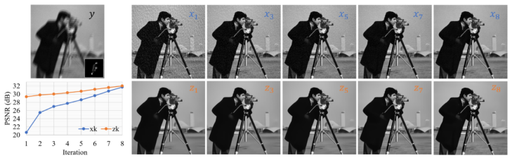
Fig. 13 . The input blurred image y with the blurring kernel k, the convergence curve and the visualization results of xk and zk at different iterations. The blurring kernel is the first kernel of size 19× 19 from [58] and the noise level is 2.55 (1%).
원문 · CC BY 4.0 · Jun-Jie Huang, Pier Luigi Dragotti · WINNet: Wavelet-inspired Invertible Network for Image Denoising · 원문 그림 인용 · 원본 PDF 12쪽에서 그림 영역을 추출했습니다.적용 범위와 남은 질문
이 논문의 결과는 AWGN 가정, BSD400으로 학습한 블라인드 설정, Set12와 BSD68 테스트, 그리고 Set12 디블러링 평가에 기반합니다. 잡음 추정 네트워크와 디노이징 네트워크는 해석 가능성을 강조하지만, 그 해석 자체를 독립적으로 증명하는 실험이 모든 구성요소에 대해 제시되지는 않습니다. 따라서 다른 잡음 분포나 다른 백본에서의 일반화는 이 논문의 결과로 확정할 수 없습니다.
논문 정보
- 저자
- Jun-Jie Huang, Pier Luigi Dragotti
- 학회·저널
- arXiv · 프리프린트
- 최초 공개일
- 2021년 9월 14일
- 등록일
- 2026년 11월 6일
- 수정일
- 2021년 9월 14일
- 버전
- v1
- arXiv
- 2109.06381
- DOI
- 10.1109/tip.2022.3184845
- 분류
- eess.IV
- 원문 이용 조건
- CC BY 4.0
- 제공 범위
- 논문 정보, 해설, 허용된 원문 그림
AI 해설은 논문 원문과 별개의 설명이며 오류가 있을 수 있습니다. 원문과 그림은 각 출처의 이용 조건과 따로 표시된 권리를 따릅니다.
초록
Image denoising aims to restore a clean image from an observed noisy image. The model-based image denoising approaches can achieve good generalization ability over different noise levels and are with high interpretability. Learning-based approaches are able to achieve better results, but usually with weaker generalization ability and interpretability. In this paper, we propose a wavelet-inspired invertible network (WINNet) to combine the merits of the wavelet-based approaches and learningbased approaches. The proposed WINNet consists of K-scale of lifting inspired invertible neural networks (LINNs) and sparsity-driven denoising networks together with a noise estimation network. The network architecture of LINNs is inspired by the lifting scheme in wavelets. LINNs are used to learn a non-linear redundant transform with perfect reconstruction property to facilitate noise removal. The denoising network implements a sparse coding process for denoising. The noise estimation network estimates the noise level from the input image which will be used to adaptively adjust the soft-thresholds in LINNs. The forward transform of LINNs produce a redundant multi-scale representation for denoising. The denoised image is reconstructed using the inverse transform of LINNs with the denoised detail channels and the original coarse channel. The simulation results show that the proposed WINNet method is highly interpretable and has strong generalization ability to unseen noise levels. It also achieves competitive results in the non-blind/blind image denoising and in image deblurring.
원문 인용
Jun-Jie Huang, Pier Luigi Dragotti (2021). WINNet: Wavelet-inspired Invertible Network for Image Denoising. arXiv:2109.06381v1. https://doi.org/10.1109/tip.2022.3184845
BibTeX
@article{huang2021winnet,
  title = {{WINNet: Wavelet-inspired Invertible Network for Image Denoising}},
  author = {Jun-Jie Huang and Pier Luigi Dragotti},
  year = {2021},
  eprint = {2109.06381},
  archivePrefix = {arXiv},
  doi = {10.1109/tip.2022.3184845},
  url = {https://arxiv.org/abs/2109.06381v1}
}