논문 해설
Object Detection Using Sim2Real Domain Randomization for Robotic Applications
로봇 응용을 위한 Sim2Real 도메인 랜덤화를 이용한 객체 탐지
- 연구 문제 산업 로봇의 객체 검출에는 도메인 특이적 라벨 데이터가 필요하지만 실제 데이터 수집과 주석 작업은 비용이 큽니다.
- 연구 방법 PyBullet으로 도메인 랜덤화와 후처리를 적용한 합성 데이터를 생성하고 이를 사용해 YOLOv4를 학습합니다.
- 주요 결과 영점 전이 최고 모델은 잘린 테스트 세트에서 86.32% mAP50, 단일 실제 이미지 전이 최고 모델은 97.38% mAP50을 기록했습니다.
로봇 현장 객체 검출의 데이터 부족 문제
산업 로봇이 비정형 환경에서 물체를 인식하려면 도메인 특이적인 라벨링 데이터가 필요합니다. 그러나 실제 데이터를 수집하고 주석을 다는 과정은 많은 자원과 시간을 요구합니다. 저자들은 이 문제를 해결하기 위해 시뮬레이션에서 합성 데이터를 자동 생성하고, 그 데이터로 학습한 모델을 현실 이미지에 전이하는 sim2real 방식을 다룹니다. 합성 데이터로 학습한 모델은 실제 영상에서 성능이 떨어지는 현상, 즉 reality gap이 생기므로 이를 줄이는 것이 핵심 과제입니다. 본 논문은 특히 서로 비슷한 산업 부품을 구분하는 문제에 주목합니다.
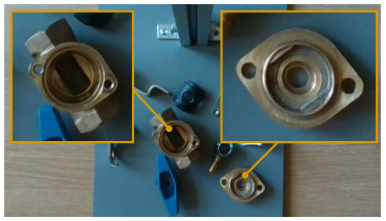
Fig. 7 . Similarity of the body and the bonnet objects.
원문 · CC BY 4.0 · Dániel Horváth, Gábor Erdős, Zoltán Istenes, Tomáš Horváth, Sándor Földi · Object Detection Using Sim2Real Domain Randomization for Robotic Applications · 원문 그림 인용 · 원본 PDF 10쪽에서 그림 영역을 추출했습니다.도메인 랜덤화 기반 합성 데이터 생성과 학습
제안 방법은 PyBullet에서 3차원 모델을 평면 격자 위에 배치하고 렌더링하여 라벨이 있는 합성 이미지를 만듭니다. 객체의 위치와 회전, 텍스처, 카메라 자세와 조명 등을 무작위로 바꾸며, 렌더링 후에는 다색 점 잡음, 가우시안 블러 같은 후처리를 적용합니다. 경계 상자는 객체의 축 정렬 경계 상자 여덟 꼭짓점만 변환하는 방식과 모든 점을 변환하는 방식 중 하나로 계산되며, 저자들은 후자가 더 촘촘한 상자를 얻는다고 보고합니다. 이렇게 생성한 데이터로 사전 학습된 분류기를 특징 추출기로 쓰는 YOLOv4를 학습합니다. 실제 이미지는 테스트에만 쓰며, 단일 실제 이미지 전이에서는 그 한 장을 합성 이미지와 섞어 학습에 사용합니다.
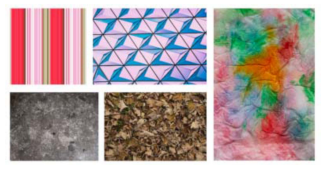
Fig. 3 . Some examples of the textures used [62], [63], [64].
원문 · CC BY 4.0 · Dániel Horváth, Gábor Erdős, Zoltán Istenes, Tomáš Horváth, Sándor Földi · Object Detection Using Sim2Real Domain Randomization for Robotic Applications · 원문 그림 인용 · 원본 PDF 7쪽에서 그림 영역을 추출했습니다.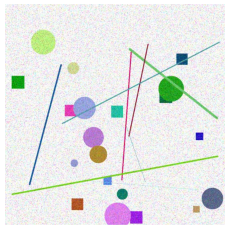
Fig. 4 . Postprocess transformation on a blank image.
원문 · CC BY 4.0 · Dániel Horváth, Gábor Erdős, Zoltán Istenes, Tomáš Horváth, Sándor Földi · Object Detection Using Sim2Real Domain Randomization for Robotic Applications · 원문 그림 인용 · 원본 PDF 8쪽에서 그림 영역을 추출했습니다.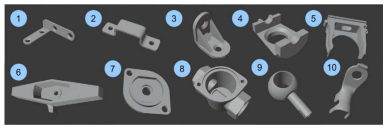
Fig. 6 . Three-dimensional models of the selected industrial parts of the dataset. Their names in order of their identifier numbers are the following: 1. L-bracket, 2. U-bracket, 3. angle bracket, 4. seat, 5. pipe clamp, 6. handle, 7. bonnet, 8. body, 9. ball, 10. cable shoe. Their scaling factors are different for better visualization.
원문 · CC BY 4.0 · Dániel Horváth, Gábor Erdős, Zoltán Istenes, Tomáš Horváth, Sándor Földi · Object Detection Using Sim2Real Domain Randomization for Robotic Applications · 원문 그림 인용 · 원본 PDF 9쪽에서 그림 영역을 추출했습니다.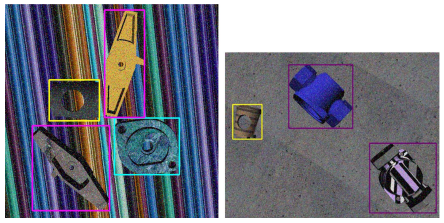
Fig. 9 . Two examples of synthetic images with the automatically generated annotations. The bounding boxes are shown here for illustration purpose only. (a) Example 1. (b) Example 2.
원문 · CC BY 4.0 · Dániel Horváth, Gábor Erdős, Zoltán Istenes, Tomáš Horváth, Sándor Földi · Object Detection Using Sim2Real Domain Randomization for Robotic Applications · 원문 그림 인용 · 원본 PDF 11쪽에서 그림 영역을 추출했습니다.영점 전이와 단일 실제 이미지 전이 결과
실제 학습 이미지를 쓰지 않는 영점 전이 설정에서 최고 모델은 원본이 아닌 잘린 테스트 세트에서 86.32% mAP50을 기록했습니다. 이 설정은 2×2 격자와 격자 간격의 ±10% 배치 교란을 사용했습니다. 실제 이미지 한 장을 합성 이미지와 함께 쓴 단일 실제 이미지 전이에서는 최고 모델이 잘린 이미지에서 97.38% mAP50을 기록했습니다. 두 결과는 같은 데이터셋의 서로 다른 전이 설정에서 얻은 값이며, 저자들은 이 차이가 유사한 클래스 구분 문제를 완화했다고 해석합니다. 결과는 본 논문의 190장 실제 테스트 세트와 설정에서 확인된 것입니다.
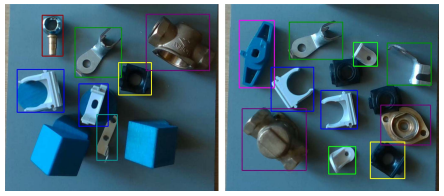
Fig. 15 . Accurate (a) and an inaccurate (b) prediction of the ZST_BEST1 model with the threshold set to 0.8. The color-coding follows Fig. 8. (a) Accurate example. (b) Inaccurate example.
원문 · CC BY 4.0 · Dániel Horváth, Gábor Erdős, Zoltán Istenes, Tomáš Horváth, Sándor Földi · Object Detection Using Sim2Real Domain Randomization for Robotic Applications · 원문 그림 인용 · 원본 PDF 13쪽에서 그림 영역을 추출했습니다.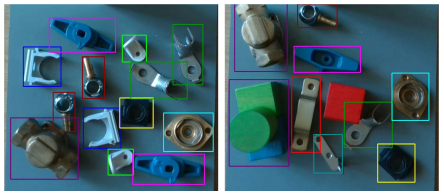
Fig. 21 . Accurate (a) and an inaccurate (b) prediction of the OST_BEST3 model with the threshold set to 0.8. The color-coding follows Fig. 8. (a) Accurate example. (b) Inaccurate example.
원문 · CC BY 4.0 · Dániel Horváth, Gábor Erdős, Zoltán Istenes, Tomáš Horváth, Sándor Földi · Object Detection Using Sim2Real Domain Randomization for Robotic Applications · 원문 그림 인용 · 원본 PDF 14쪽에서 그림 영역을 추출했습니다.텍스처와 후처리 절제 실험
절제 실험은 무작위 텍스처와 후처리가 성능에 얼마나 기여하는지 확인합니다. 텍스처를 제거한 변형은 원본 이미지에서 63.50% mAP50, 후처리를 제거한 변형은 55.87% mAP50을 기록했습니다. 두 요소를 모두 제거하면 원본 이미지에서 10.83% mAP50으로 떨어졌습니다. 이 결과는 텍스처와 후처리를 유지하는 것이 성능에 유익함을 보여 주며, 원문은 이 두 요소를 방법의 핵심 구성으로 설명합니다. 다만 절제 결과는 본 논문의 설정에서 얻은 것입니다.
데이터셋 기여와 적용 범위
본 논문은 실제 이미지 190장, 920개 객체 인스턴스, 10개 클래스로 구성된 수동 주석 데이터셋을 제시합니다. 이 데이터셋은 객체 간 유사성을 검증하는 목적으로 설계되었습니다. 원문은 이 데이터셋이 객체 검출 벤치마크로 활용될 수 있다고 주장합니다. 한편 결과는 산업 부품과 이 데이터셋의 조건에서 얻은 것이므로, 다른 과제나 모델로 바로 일반화하기 어렵습니다. 또한 저자들은 객체 간 유사성이 주된 성능 손실 원인이라고 해석하며, 혼동행렬은 이를 정량화하는 도구로 쓰입니다.
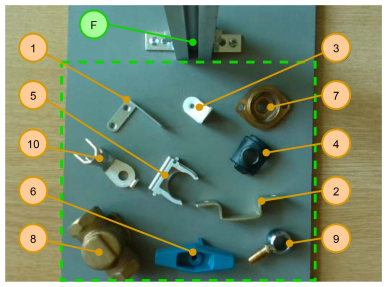
Fig. 5 . Selected industrial parts for the dataset. Their names in order of their identifier numbers are the following: 1. L-bracket, 2. U-bracket, 3. angle bracket, 4. seat, 5. pipe clamp, 6. handle, 7. bonnet, 8. body, 9. ball, 10. cable shoe. The letter “F” designates the camera holder frame. The green dashed lines show the borders of the cropped images.
원문 · CC BY 4.0 · Dániel Horváth, Gábor Erdős, Zoltán Istenes, Tomáš Horváth, Sándor Földi · Object Detection Using Sim2Real Domain Randomization for Robotic Applications · 원문 그림 인용 · 원본 PDF 9쪽에서 그림 영역을 추출했습니다.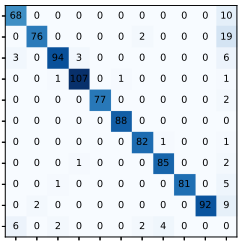
Fig. 20 . Confusion matrix of the OST_BEST3 model on the cropped images with the threshold set to 0.8.
원문 · CC BY 4.0 · Dániel Horváth, Gábor Erdős, Zoltán Istenes, Tomáš Horváth, Sándor Földi · Object Detection Using Sim2Real Domain Randomization for Robotic Applications · 원문 그림 인용 · 원본 PDF 14쪽에서 그림 영역을 추출했습니다.논문 정보
- 저자
- Dániel Horváth, Gábor Erdős, Zoltán Istenes, Tomáš Horváth, Sándor Földi
- 학회·저널
- arXiv · 프리프린트
- 최초 공개일
- 2022년 8월 8일
- 등록일
- 2026년 11월 6일
- 수정일
- 2022년 10월 25일
- 버전
- v2
- arXiv
- 2208.04171
- DOI
- 10.1109/tro.2022.3207619
- 분류
- cs.RO · cs.CV
- 원문 이용 조건
- CC BY 4.0
- 제공 범위
- 논문 정보, 해설, 허용된 원문 그림
AI 해설은 논문 원문과 별개의 설명이며 오류가 있을 수 있습니다. 원문과 그림은 각 출처의 이용 조건과 따로 표시된 권리를 따릅니다.
초록
Robots working in unstructured environments must be capable of sensing and interpreting their surroundings. One of the main obstacles of deep-learning-based models in the field of robotics is the lack of domain-specific labeled data for different industrial applications. In this article, we propose a sim2real transfer learning method based on domain randomization for object detection with which labeled synthetic datasets of arbitrary size and object types can be automatically generated. Subsequently, a state-of-the-art convolutional neural network, YOLOv4, is trained to detect the different types of industrial objects. With the proposed domain randomization method, we could shrink the reality gap to a satisfactory level, achieving 86.32% and 97.38% mAP50 scores, respectively, in the case of zero-shot and one-shot transfers, on our manually annotated dataset containing 190 real images. Our solution fits for industrial use as the data generation process takes less than 0.5 s per image and the training lasts only around 12 h, on a GeForce RTX 2080 Ti GPU. Furthermore, it can reliably differentiate similar classes of objects by having access to only one real image for training. To our best knowledge, this is the only work thus far satisfying these constraints.
원문 인용
Dániel Horváth, Gábor Erdős, Zoltán Istenes, Tomáš Horváth, Sándor Földi (2022). Object Detection Using Sim2Real Domain Randomization for Robotic Applications. arXiv:2208.04171v2. https://doi.org/10.1109/tro.2022.3207619
BibTeX
@article{horvth2022object,
  title = {{Object Detection Using Sim2Real Domain Randomization for Robotic Applications}},
  author = {Dániel Horváth and Gábor Erdős and Zoltán Istenes and Tomáš Horváth and Sándor Földi},
  year = {2022},
  eprint = {2208.04171},
  archivePrefix = {arXiv},
  doi = {10.1109/tro.2022.3207619},
  url = {https://arxiv.org/abs/2208.04171v2}
}