논문 해설
Selective Prediction Intervals: Jointly Learning to Predict, Bound, and Abstain
선택적 예측 구간: 예측, 경계 설정, 판단 유보를 함께 학습하기
- 연구 문제 구간, 점 추정, 기권을 동시에 요구하는 회귀 결정에서 기존 방법은 세 요소 중 일부만 제공합니다.
- 연구 방법 SelPI는 IPIV의 구간·가치 헤드와 두 개의 선택 게이트를 단일 손실로 공동 학습하고, 두 게이트의 예산이 만드는 결합 수용률을 Fréchet 페널티로 묶습니다.
- 주요 결과 같은 예측기에서 학습된 게이트는 18개 표형 데이터셋과 확장 데이터셋에서 폭 임계값보다 선택적 구간 점수가 우수하며, IMDB-WIKI에서는 SelectiveNet 회귀가 더 낫습니다.
고위험 회귀 결정의 세 요구와 기존 방법의 공백
고위험 회귀 결정에서는 모델에 세 가지가 동시에 요구됩니다. 행동에 옮길 점 추정, 행동의 위험을 제한하는 구간, 그리고 둘 다 신뢰할 수 없을 때의 기권입니다. 예측 구간 방법은 모든 입력에 구간을 내놓고 구간 안의 값 추정을 함께 제공할 수 있지만, 기권을 학습하지 않습니다. 선택적 예측 방법은 기권을 학습하지만 점 예측에만 적용되며 참값이 추정치에서 얼마나 떨어져 있을 수 있는지를 말하지 않습니다. 이 논문은 두 계열 사이의 공백을 다룹니다. 가장 단순한 보완책은 구간을 학습한 뒤 구간이 넓을 때 기권하는 방식이지만, 저자들은 구간 폭이 기권 신호로서 어떤 실패를 놓치는지가 이 방법의 핵심 문제라고 설명합니다.
SelPI의 공동 학습 구조와 두 게이트
SelPI는 IPIV의 구간 헤드와 가치 헤드를 SelectiveNet 방식의 게이트와 함께 단일 손실 아래 학습합니다. 점 추정은 식 (3)에 따라 구간 안의 혼합으로 계산되므로 구간 폭이 점 오차의 상한 역할을 합니다. 이 때문에 저자들은 폭 임계값이 점 오차 기준으로는 강한 기준선이 되지만, 학습된 게이트가 차별화되는 지점은 구간이 목표를 놓치는 경우와 포함된 구간에서 가치가 잘못 놓이는 경우라고 봅니다. SelPI는 이 두 실패를 각각 g_PI와 g_val로 나누어 맡깁니다. 입력은 두 게이트가 모두 수용해야 답변되며, 두 게이트의 예산이 만드는 결합 수용률 하한을 Fréchet 페널티로 학습 중 묶습니다.
원문은 이 페널티가 없으면 두 게이트가 서로 다른 집합을 거부해 교집합이 두 예산 어느 쪽보다도 크게 줄어들 수 있다고 설명합니다.
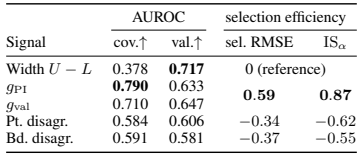
Table 3 :What each signal sees, and how well it selects.AUROC for coverage failure (cov.) and value failure (val.; captured, but error above the captured-set median), and median SE against each selector’sownpredictor’s width threshold and oracle (<0: worse than width). The SE on the gPI/gval rows is that of the Q3 gate (SelPI 1G); Pt./Bd. disagr. is the deep-ensemble baseline on its own five-model predictor. Medians over 18 tabular datasets.
원문 · CC BY 4.0 · Lidor Rubi, Gilad Katz · Selective Prediction Intervals: Jointly Learning to Predict, Bound, and Abstain · 원문 그림 인용 · 원본 PDF 8쪽에서 그림 영역을 추출했습니다.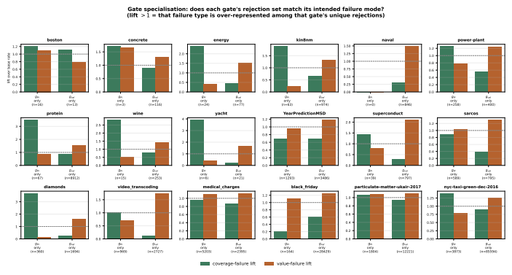
Figure 5 :Gate specialization, all 18 tabular datasets.For each dataset, the two bars show how over-represented each failure type is among the inputs thatonlyg PI rejects and the inputs thatonly gval rejects, relative to that dataset’s own base rate (dashed line at 1). The signature of successful specialization is a tall green bar on the left pair and a tall orange bar on the right pair.g val shows it on 17 of 18;g PI on a clear majority, with the exceptions discussed in §7.
원문 · CC BY 4.0 · Lidor Rubi, Gilad Katz · Selective Prediction Intervals: Jointly Learning to Predict, Bound, and Abstain · 원문 그림 인용 · 원본 PDF 20쪽에서 그림 영역을 추출했습니다.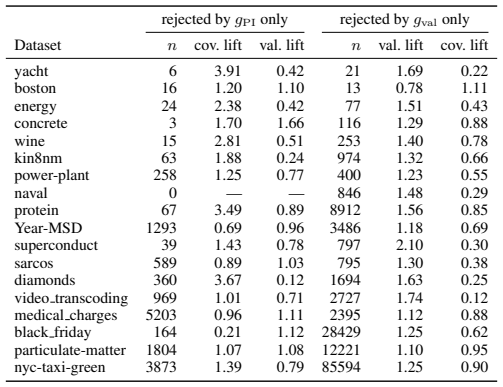
Table 11 :Each gate’s unique rejections are enriched for the failure mode it was trained on.For inputs rejected byonlyone gate, how over-represented each failure type is relative to that dataset’s base rate;1.0means no enrichment.g val’s unique rejections are enriched for value failure on 17 of 18 datasets;g PI’s are enriched for coverage failure on 13 of the 17 where it has any unique rejections at all (on naval it has none, its rejection set being a subset ofg val’s). The value gate is therefore the more consistently load-bearing of the two, which the aggregate results do not reveal.
원문 · CC BY 4.0 · Lidor Rubi, Gilad Katz · Selective Prediction Intervals: Jointly Learning to Predict, Bound, and Abstain · 원문 그림 인용 · 원본 PDF 21쪽에서 그림 영역을 추출했습니다.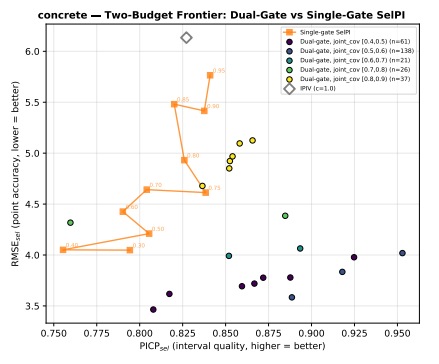
Figure 6 :The two-budget frontier, Concrete. Each dot is one dual-gate configuration, colored by the joint acceptance rate it actually realized; the orange line is the single-gate model traced over its acceptance grid. Down and to the right is better (lower selective error, higher selective interval coverage). The dual-gate cloud sits below and to the right of the single-gate curve at matched acceptance — the trade-off a single scalar gate cannot express. Per-dataset versions for all 18 tabular datasets are in Figure 13.
원문 · CC BY 4.0 · Lidor Rubi, Gilad Katz · Selective Prediction Intervals: Jointly Learning to Predict, Bound, and Abstain · 원문 그림 인용 · 원본 PDF 23쪽에서 그림 영역을 추출했습니다.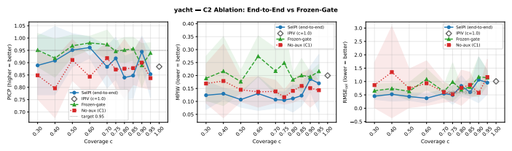
Figure 8 :Ablations on Yacht, the dataset where the effects are largest: end-to-end SelPI against a gate trained on a frozen IPIV model, and against removing the auxiliary head. SelectivePICP, MPIWand RMSE against target acceptance rate; shaded bands are±1s.d. over 5 runs. End-to- end training dominates on both interval width and selective error across the whole grid. Equivalent figures exist for all 18 tabular datasets.
원문 · CC BY 4.0 · Lidor Rubi, Gilad Katz · Selective Prediction Intervals: Jointly Learning to Predict, Bound, and Abstain · 원문 그림 인용 · 원본 PDF 24쪽에서 그림 영역을 추출했습니다.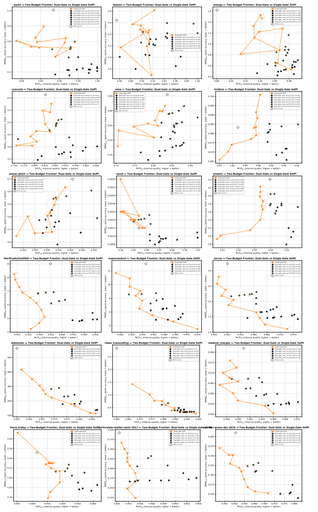
Figure 13 :Two-budget frontier: every dual-gate configuration, colored by realized joint acceptance rate, against the single-gate curve. Down and to the right is better.
원문 · CC BY 4.0 · Lidor Rubi, Gilad Katz · Selective Prediction Intervals: Jointly Learning to Predict, Bound, and Abstain · 원문 그림 인용 · 원본 PDF 28쪽에서 그림 영역을 추출했습니다.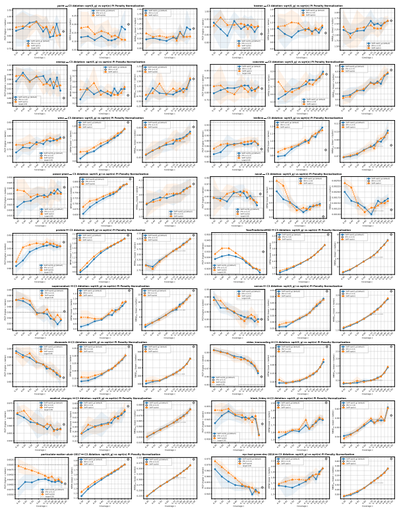
Figure 16 :Ablation: p Sg vs. √npenalty normalization.The curves track each other closely on most datasets, which is the visual form of the null result in Table 13.
원문 · CC BY 4.0 · Lidor Rubi, Gilad Katz · Selective Prediction Intervals: Jointly Learning to Predict, Bound, and Abstain · 원문 그림 인용 · 원본 PDF 31쪽에서 그림 영역을 추출했습니다.평가 설계: 세 가지 질문과 동일 예측기 비교
평가는 세 질문으로 나뉩니다. Q1은 기권을 학습하는 것이 구간 모델을 손상시키는지를 PI 분야의 기준으로 묻고, Q2는 선택적 회귀기로서 경쟁력이 있는지를 묻습니다. Q3은 같은 예측기를 고정했을 때 학습된 게이트가 모델 자체의 불확실성보다 나은지를 묻는 새 질문입니다. Q3에서는 같은 학습 모델의 테스트 점들을 게이트, 구간 폭, 오라클로 순위 매겨 차이가 선택기에서 오도록 하며, 선택적 구간 점수를 주 지표로 사용합니다. 이 점수는 놓친 목표에 대한 벌점을 포함합니다. 데이터셋은 UCI PI 묶음, 두 이미지 과제, 그리고 통계적 검정력을 위해 추가한 대형 OpenML 회귀 과제로 구성됩니다. 원문은 RSNA bone age는 200장 테스트 세트 때문에 예시적으로만 다룬다고 밝힙니다.
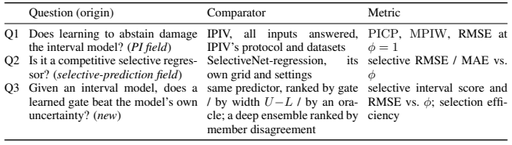
Table 1 : Evaluation design. SelPI has no like-for-like competitor, so each question is asked on the home ground of the field it comes from, with that field’s comparator and metric.
원문 · CC BY 4.0 · Lidor Rubi, Gilad Katz · Selective Prediction Intervals: Jointly Learning to Predict, Bound, and Abstain · 원문 그림 인용 · 원본 PDF 5쪽에서 그림 영역을 추출했습니다.표형 데이터에서의 결과: 구간 손상, 선택적 RMSE, 게이트 대 폭
Q1에서 기권 기능이 추가된 모델은 전체 수용 시점에서 IPIV와 거의 같은 구간을 유지합니다. 원문은 중앙값으로 PICP가 0.013 낮아지고 MPIW가 6.9% 좁아지며 RMSE는 4.4% 높아졌다고 보고하며, 수용 목표를 1로 두면 추가 헤드만으로 RMSE가 중앙값 0.6% 높아진다고 설명합니다. Q2에서는 약 0.55 수용률에서 IPIV 대비 선택적 RMSE를 18개 데이터셋 모두에서 줄이며 중앙값 31% 감소라고 보고합니다. SelectiveNet 회귀와 비교한 0.7 수용률에서는 SelPI 2G 중앙값 시도가 18개 중 14개에서 낮은 선택적 RMSE를 보입니다. Q3에서는 같은 예측기에서 학습된 게이트가 폭 임계값보다 선택적 구간 점수에서 20개 데이터셋 모두 우세하며 효율 중앙값은 0.87입니다.
이 차이는 폭 선택이 맞은 구간을 버리고 미스를 남기는 데서 생깁니다.
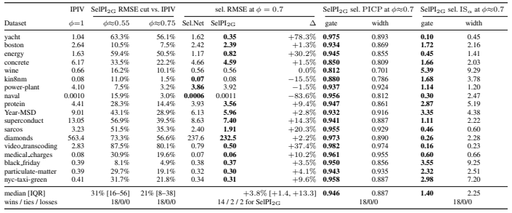
Table 2 :Per-dataset results, 18 tabular datasets,1−α= 0.95, SelPI 2G median search trial through- out.Left (Q2):RMSE of IPIV answering every query; RMSE reduction of SelPI 2G at two realized acceptance levels; SelectiveNet-regression vs. SelPI2G atϕ= 0.7(∆>0favors SelPI).Right (Q3): learned gate vs. width threshold on thesamepredictor at the realized acceptance nearest0.7; lower ISα is better.
원문 · CC BY 4.0 · Lidor Rubi, Gilad Katz · Selective Prediction Intervals: Jointly Learning to Predict, Bound, and Abstain · 원문 그림 인용 · 원본 PDF 7쪽에서 그림 영역을 추출했습니다.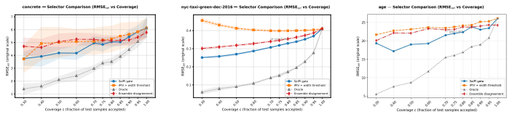
Figure 2 :Q3: selective RMSE vs. acceptance rate on a fixed predictor(single-gate SelPI 1G, one model per acceptance rate) for Concrete, NYC Taxi and bone age (illustrative only, §5). Curves: learned gate, width threshold, oracle, and deep-ensemble point disagreement on its own five-model predictor; bands:±1s.d. over runs; lower is better.
원문 · CC BY 4.0 · Lidor Rubi, Gilad Katz · Selective Prediction Intervals: Jointly Learning to Predict, Bound, and Abstain · 원문 그림 인용 · 원본 PDF 8쪽에서 그림 영역을 추출했습니다.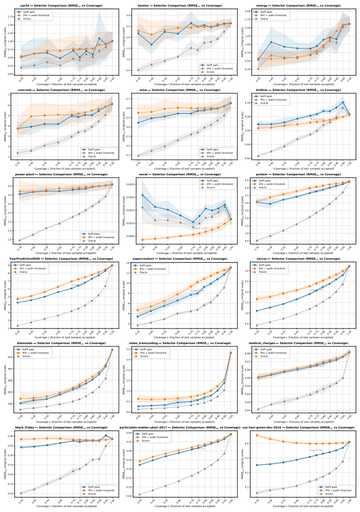
Figure 11 :Selector comparison: the learned gate against IPIV + width threshold and against an oracle ranking by realized error. The persistent oracle gap is the headroom that remains on every dataset.
원문 · CC BY 4.0 · Lidor Rubi, Gilad Katz · Selective Prediction Intervals: Jointly Learning to Predict, Bound, and Abstain · 원문 그림 인용 · 원본 PDF 26쪽에서 그림 영역을 추출했습니다.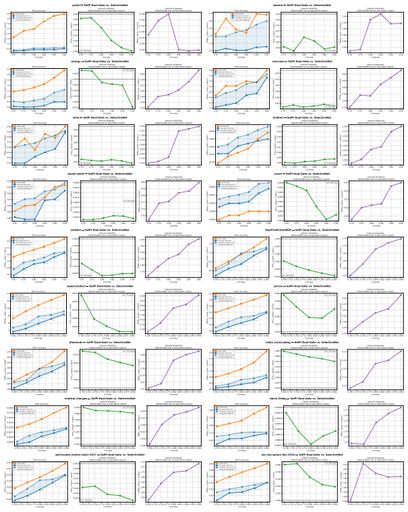
Figure 12 :Dual gate vs. SelectiveNet-regression: point accuracy, then the interval reliability and sharpness SelectiveNet cannot produce at all. Shading between best and median trial is the tuning advantage of §5.
원문 · CC BY 4.0 · Lidor Rubi, Gilad Katz · Selective Prediction Intervals: Jointly Learning to Predict, Bound, and Abstain · 원문 그림 인용 · 원본 PDF 27쪽에서 그림 영역을 추출했습니다.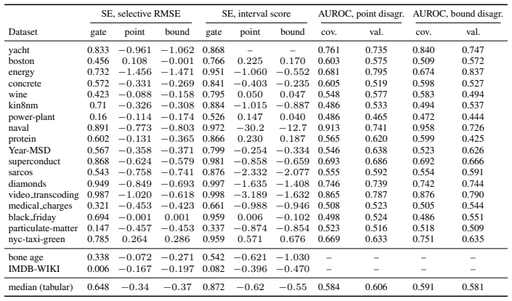
Table 15 : Per-dataset selection efficiency (SE) on selective RMSE and on the interval score for the learned gate (SelPI1G) and for the two deep-ensemble disagreement selectors, and AUROC of each disagreement signal for coverage failure (cov.) and value failure (val.). Each SE is computed against its own predictor’s width threshold and oracle; “–” marks an undefined SE (width and oracle AURC coincide).
원문 · CC BY 4.0 · Lidor Rubi, Gilad Katz · Selective Prediction Intervals: Jointly Learning to Predict, Bound, and Abstain · 원문 그림 인용 · 원본 PDF 32쪽에서 그림 영역을 추출했습니다.이미지 과제와 적용 범위의 한계
이미지 과제에서는 결과가 더 엇갈립니다. IMDB-WIKI에서는 SelectiveNet 회귀가 겹치는 수용률 구간마다 더 낮은 MAE를 보이며, 원문은 이 차이를 IPIV가 이미 정밀하고 단일 목적 손실이 남은 오차를 더 효율적으로 추출하기 때문이라는 해석으로 제시합니다. 원문에서 IMDB-WIKI는 5-fold 교차검증의 신뢰도 높은 이미지 벤치마크입니다. 또한 수용된 집합에는 유한표본 커버리지 보장이 없다고 명시되어 있으며, 조건부 수용 보정은 향후 과제로 남습니다. 대조 실험에서 게이트를 고정된 IPIV 위에 학습한 경우의 악화와 보조 헤드 제거의 효과는 표 13의 중앙값 수치로 확인되며, 보조 헤드 효과는 상대적으로 작습니다.
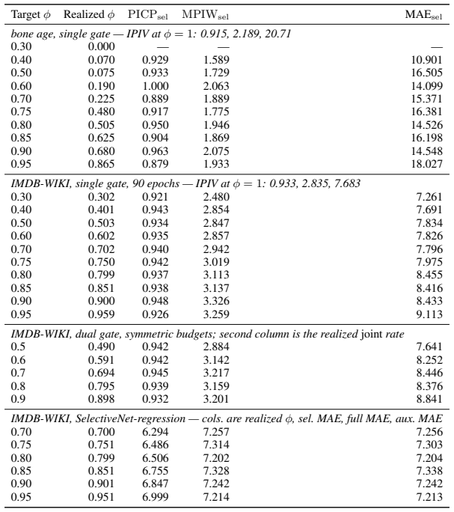
Table 6 :Full image-regression grids, every trained point rather than the three buckets of Table 7. Top: bone age, single gate, one run over 200 test images — note the severe drift between target and realized acceptance rate, which is why Table 7 is keyed by the realized rate.Middle: IMDB-WIKI, single gate then the symmetric dual-gate grid, 5-fold CV at 90 epochs.Bottom: SelectiveNet- regression on IMDB-WIKI over its own published coverage grid.
원문 · CC BY 4.0 · Lidor Rubi, Gilad Katz · Selective Prediction Intervals: Jointly Learning to Predict, Bound, and Abstain · 원문 그림 인용 · 원본 PDF 16쪽에서 그림 영역을 추출했습니다.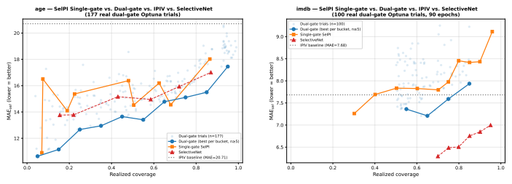
Figure 3 :All four comparisons on the two image tasks, at1−α= 0.95: single-gate SelPI (orange), dual-gate SelPI (blue: every Optuna trial faintly, best-per-bucket as the line), plain IPIV at full acceptance (gray dotted), and SelectiveNet-regression (red).Left, bone age: both SelPI variants beat IPIV everywhere and the dual gate beats SelectiveNet at every comparable acceptance rate. Right, IMDB-WIKI: the dual gate beats IPIV over the0.5–0.8range butSelectiveNet wins clearly and consistently, by0.7–1.6years of MAE. IMDB-WIKI is the largest dataset in the study and this is the paper’s clearest negative result (§6).
원문 · CC BY 4.0 · Lidor Rubi, Gilad Katz · Selective Prediction Intervals: Jointly Learning to Predict, Bound, and Abstain · 원문 그림 인용 · 원본 PDF 17쪽에서 그림 영역을 추출했습니다.
Figure 4 :Risk–coverage curves for the two image tasks: selectivePICP,MPIWand MAE against target acceptance rate, with plain IPIV at full acceptance as the hollow diamond. Note the contrast in calibration transfer: IMDB-WIKI’s realized acceptance rate tracks its target almost exactly (0.70→0.700,0.95→0.959), whereas bone age drifts severely (target0.90→realized 0.68; target0.30→realized0.00). The cause is sample size — thresholds calibrated on validation transfer cleanly to IMDB-WIKI’s∼34k-sample folds and poorly to bone age’s 200-image test set. Bone age’s “target coverage” axis should therefore be read as a training knob, not as a description of what fraction of test inputs was accepted.
원문 · CC BY 4.0 · Lidor Rubi, Gilad Katz · Selective Prediction Intervals: Jointly Learning to Predict, Bound, and Abstain · 원문 그림 인용 · 원본 PDF 18쪽에서 그림 영역을 추출했습니다.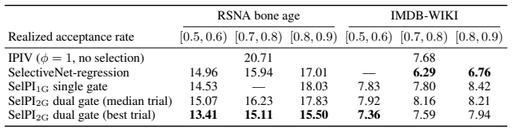
Table 7 :Image regression, selective MAE at1−α= 0.95(bone age in months, IMDB-WIKI in years), grouped byrealizedacceptance rate. Plain IPIV at full acceptance is 20.71 (bone age) and 7.68 (IMDB-WIKI). For the dual gate we give the best and the median trial in each bucket, because its budgets are tuned by search while SelectiveNet is run once at its published settings — the median is the fair comparison.Bone age: every SelPI variant beats IPIV by a wide margin, and the dual gate’s best trial beats SelectiveNet in all three buckets.IMDB-WIKI: the dual gate beats IPIV in the two lower buckets, butSelectiveNet wins decisively wherever the two overlap, by 1.3–1.5 years. Rows are keyed by realized rather than target acceptance rate, which matters most for bone age, whose drift is severe (target0.90gives realized0.68) because a threshold calibrated on validation transfers poorly to a 200-image test set; IMDB-WIKI has no such problem and is the more trustworthy of the two.
원문 · CC BY 4.0 · Lidor Rubi, Gilad Katz · Selective Prediction Intervals: Jointly Learning to Predict, Bound, and Abstain · 원문 그림 인용 · 원본 PDF 18쪽에서 그림 영역을 추출했습니다.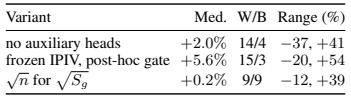
Table 13 :Ablations: change in selective RMSE atϕ= 0.5vs. the full recipe (positive: ablation is worse); 18 tabular datasets. W/B: datasets worse/better.
원문 · CC BY 4.0 · Lidor Rubi, Gilad Katz · Selective Prediction Intervals: Jointly Learning to Predict, Bound, and Abstain · 원문 그림 인용 · 원본 PDF 24쪽에서 그림 영역을 추출했습니다.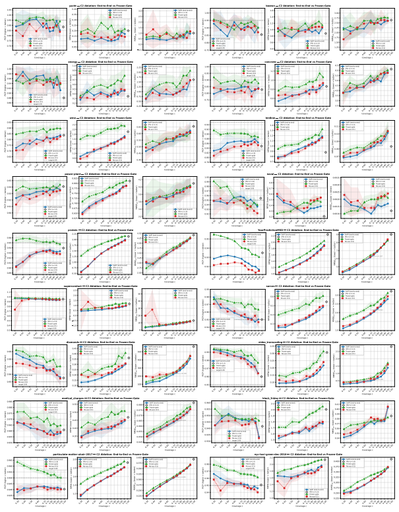
Figure 14 :Ablation: end-to-end vs. frozen-gate training, with the no-auxiliary-head variant over- laid. Frozen-gate is worse on 15 of 18 datasets (Table 13). This overlay also contains the no- auxiliary-head comparison shown on its own in Figure 15 below.
원문 · CC BY 4.0 · Lidor Rubi, Gilad Katz · Selective Prediction Intervals: Jointly Learning to Predict, Bound, and Abstain · 원문 그림 인용 · 원본 PDF 29쪽에서 그림 영역을 추출했습니다.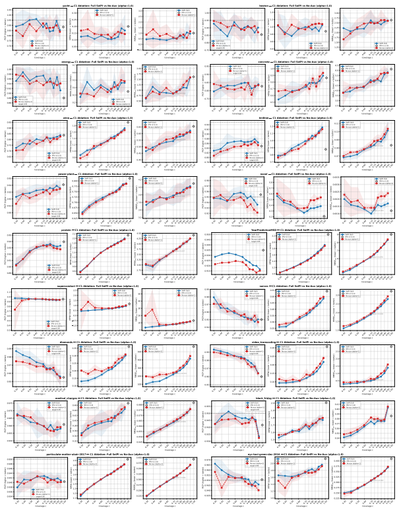
Figure 15 :Ablation: with vs. without the auxiliary head, isolated into its own panel (also visible as part of the overlay in Figure 14).
원문 · CC BY 4.0 · Lidor Rubi, Gilad Katz · Selective Prediction Intervals: Jointly Learning to Predict, Bound, and Abstain · 원문 그림 인용 · 원본 PDF 30쪽에서 그림 영역을 추출했습니다.논문 정보
- 저자
- Lidor Rubi, Gilad Katz
- 학회·저널
- arXiv · 프리프린트
- 최초 공개일
- 2026년 11월 4일
- 등록일
- 2026년 11월 6일
- 수정일
- 2026년 11월 4일
- 버전
- v1
- arXiv
- 2611.06158
- 분류
- cs.LG
- 원문 이용 조건
- CC BY 4.0
- 제공 범위
- 논문 정보, 해설, 허용된 원문 그림
AI 해설은 논문 원문과 별개의 설명이며 오류가 있을 수 있습니다. 원문과 그림은 각 출처의 이용 조건과 따로 표시된 권리를 따릅니다.
초록
Many high-stakes regression decisions ask three things of a model at once: a point estimate to act on, an interval that bounds the risk of acting, and the option to abstain when neither can be trusted. Deep learning provides these in isolation: prediction-interval methods return an interval, and at best a value estimate inside it, for every input, while selective-prediction methods learn when to abstain, but only for point predictions and with no statement of how far the truth may lie from the estimate. We introduce SelPI, which trains interval, value and abstention heads jointly under a single loss with an explicit acceptance-rate budget. A natural objection is that interval width already tells us when to abstain. We show that it does not: across 18 tabular benchmarks, width predicts large point errors well (AUROC 0.72) but is anti-correlated with interval misses (AUROC 0.38), so abstaining on wide intervals discards precisely the inputs the interval got right. SelPI therefore selects with two gates, one trained on the interval loss and one on the value loss, coupled by a Fr'echet penalty that ties their separate budgets to the joint acceptance rate they deliver. With the base predictor held fixed, the learned gate beats width thresholding on a proper interval score on all 18 tabular datasets, closing a median 87% of the gap to an oracle selector, and it also beats selection by deep-ensemble disagreement on every dataset. The advantage grows with the heteroscedasticity of the task, and we report the settings in which it disappears.
원문 인용
Lidor Rubi, Gilad Katz (2026). Selective Prediction Intervals: Jointly Learning to Predict, Bound, and Abstain. arXiv:2611.06158v1. https://arxiv.org/abs/2611.06158v1
BibTeX
@misc{rubi2026selective,
  title = {{Selective Prediction Intervals: Jointly Learning to Predict, Bound, and Abstain}},
  author = {Lidor Rubi and Gilad Katz},
  year = {2026},
  eprint = {2611.06158},
  archivePrefix = {arXiv},
  url = {https://arxiv.org/abs/2611.06158v1}
}