논문 해설
A low-rank decoder bottleneck bounds reliability in foundation-model perturbation prediction
저랭크 디코더 병목이 파운데이션 모델의 섭동 예측 신뢰성을 제한한다
- 연구 문제 대규모 섭동 예측 모델은 집계 정확도로 평가되지만, 개별 예측의 신뢰도를 알아야 실험 우선순위를 정할 수 있습니다.
- 연구 방법 STATE의 ST 디코더를 세 인코더와 네 CRISPRi 세포주에서 감사하고, 첫 어텐션 계층 출력의 저랭크 구조를 분석하며 예측 반응 기반 거리 점수를 제안합니다.
- 주요 결과 정확도는 학습 반응과의 거리에 따라 떨어지며, 첫 어텐션 계층의 소수 방향이 섭동 신호를 전달합니다. 예측 기반 거리 점수는 관측 기반 거리에 가까운 순위 성능을 보입니다.
섭동 예측기의 정확도는 어디서 오는가
섭동 반응 예측 모델은 대개 전체 평가 지표로만 비교되는데, 실험을 고를 때는 개별 예측이 얼마나 믿을 만한지를 알아야 합니다. 이 논문은 STATE에서 쓰이는 상태 전이(ST) 디코더를 세 종류의 인코더(SE-600M, scGPT, Tahoe-x1)와 네 CRISPRi 세포주에서 감사합니다. 저자들은 단순 선형 기준선이 이 모델과 비슷한 집계 성능을 보이는 이유와, 예측이 학습 섭동 반응과 얼마나 가까운지에 따라 정확도가 어떻게 달라지는지를 묻습니다. 평가 지표는 섭동별 Pearson delta 상관(PDC)이며, 예측과 관측의 대조군 대비 변화량의 유전자 간 상관으로 정의됩니다.
L0 어텐션 출력의 저랭크 분해
연구는 학습된 ST 디코더의 첫 번째 어텐션 계층 L0의 출력 X_p를 특이값 분해로 잘라내어 작동을 봅니다. 한 섭동의 출력은 대조 세포 S개에 대한 행렬이며, 상위 k개 특이 성분만 남기고 행마다 원래 노름으로 재조정하여 디코더 뒤쪽 계층에 넣습니다. 상위 한 성분만 유지해도 평균 PDC 변화는 SE+ST와 Tahoe+ST에서 0.003 이하입니다. 여기에 학습 활성화로 추정한 고정 부분공간을 쓰면, 여러 섭동이 공유하는 4~32개의 방향만으로도 PDC가 유지되고 같은 수의 무작위 방향은 그렇지 않습니다. 이 결과는 섭동 신호가 첫 계층의 작은 공유 부분공간을 통해 전달된다는 해석을 뒷받침합니다.
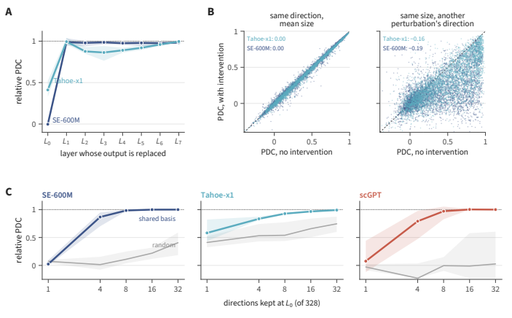
Figure 2 :How the decoder reads the perturbation.(A) PDC after replacing the output of one attention layer with a single random direction, relative to the decoder without the intervention (mean over the four cell lines; band, range). (B) Per-perturbation PDC with and without an intervention on the top L0 component, which keeps its direction and sets its size to the mean over perturbations (left), or keeps its size and takes the direction of another perturbation (right). Numbers give the mean change. (C) PDC after projecting the L0 output onto k directions shared by all perturbations and estimated from training activations, or onto k random directions, relative to the decoder without the intervention. For scGPT +ST one direction is too few even for each perturbation’s own top direction (Table 1). The perturbation enters at L0 as a direction in a small shared subspace, and the perturbation-specific signal lies in this direction.
원문 · CC BY 4.0 · Zheyu Zhang, Yuanhao Huang, Fan Feng, Jie Liu · A low-rank decoder bottleneck bounds reliability in foundation-model perturbation prediction · 원문 그림 인용 · 원본 PDF 7쪽에서 그림 영역을 추출했습니다.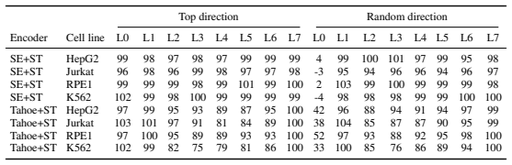
Table 6 : PDC at each layer when the attention output of that layer is reduced to one direction, as a percentage of the PDC without the intervention.Top direction: the top singular direction of the layer’s output.Random direction: a random direction outside the top 32, with each row rescaled to its original norm. Values near 100 mean that the layer’s output can be reduced this way with little loss. The largest losses are for the random direction atL 0.
원문 · CC BY 4.0 · Zheyu Zhang, Yuanhao Huang, Fan Feng, Jie Liu · A low-rank decoder bottleneck bounds reliability in foundation-model perturbation prediction · 원문 그림 인용 · 원본 PDF 24쪽에서 그림 영역을 추출했습니다.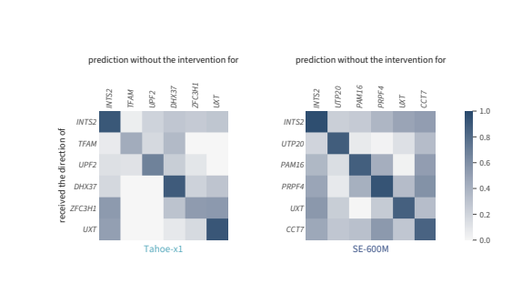
Figure 7 : Direction swap in K562. Each row is the prediction for a perturbation that received the L0 direction of the perturbation named on the row, and each column is the prediction without the intervention for the perturbation named on the column. Entries are correlations of the responses. Six pairs per encoder that are both predicted well and have dissimilar observed responses, chosen so that the column perturbations differ from each other.
원문 · CC BY 4.0 · Zheyu Zhang, Yuanhao Huang, Fan Feng, Jie Liu · A low-rank decoder bottleneck bounds reliability in foundation-model perturbation prediction · 원문 그림 인용 · 원본 PDF 25쪽에서 그림 영역을 추출했습니다.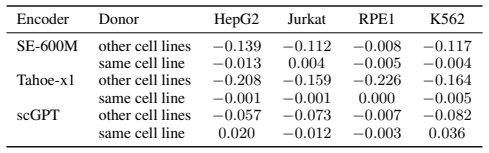
Table 7 : Change in mean PDC when the top L0 direction of each perturbation is replaced by the one the same encoder gives it in a decoder trained on another cell line (mean over the three other cell lines). “Same cell line” rows use a direction from another run on the recipient’s own cell line, as a check of the replacement itself.
원문 · CC BY 4.0 · Zheyu Zhang, Yuanhao Huang, Fan Feng, Jie Liu · A low-rank decoder bottleneck bounds reliability in foundation-model perturbation prediction · 원문 그림 인용 · 원본 PDF 25쪽에서 그림 영역을 추출했습니다.학습 전 확인하는 거리 기반 신뢰 점수
관측 반응에서 계산한 oracle distance는 학습 반응 중 가장 가까운 것과의 코사인 거리로, PDC와 강한 음의 상관을 보입니다. 그러나 이 값은 실험 뒤에야 알 수 있으므로, 논문은 예측 반응에서 같은 거리를 계산한 predicted-NN-distance를 제안합니다. 점수가 작은 예측만 수락하는 선택적 예측 규칙을 쓰며, 임계값은 Learn-then-Test로 유한 표본 보장을 가지도록 고를 수 있습니다. 평가는 점수와 PDC의 Spearman |ρ|로 이루어지며, 평균 0.81로 관측 기반 거리의 0.88에 가깝다고 보고됩니다. 단일 임계값 τ≈0.10은 모든 인코더와 세포주 구성에서 사용됩니다.
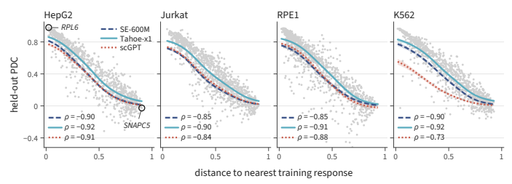
Figure 5 :Reliability-distance relationship across all four cell lines.Each panel plots held-out per-perturbation PDC against cosine distance to the nearest training perturbation in 2,000-HVG gene-expression space. Gray dots in the background are individual perturbations under Tahoe-x1+ST. Lines are kernel-smoothed trends per encoder with 95% bootstrap bands, and the lower-left key of each panel gives the per-encoder Spearman ρ.RPL6andSNAPC5are annotated on the HepG2 panel as the running example (§1). Every panel shows the HepG2 pattern: PDC falls smoothly with distance and the three encoders agree. The weakest configuration is scGPT/K562, withρ=−0.73.
원문 · CC BY 4.0 · Zheyu Zhang, Yuanhao Huang, Fan Feng, Jie Liu · A low-rank decoder bottleneck bounds reliability in foundation-model perturbation prediction · 원문 그림 인용 · 원본 PDF 22쪽에서 그림 영역을 추출했습니다.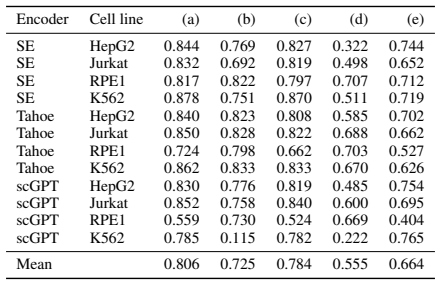
Table 15 : Spearman |ρ| between each score and PDC on the held-out perturbations. (a) predicted- NN-distance (cosine, nearest training response); (b) norm of the predicted response; (c) mean cosine distance to the ten nearest training responses; (d) Euclidean distance to the nearest training response; (e) alignment of the predicted response with the leading axis of the training responses.
원문 · CC BY 4.0 · Zheyu Zhang, Yuanhao Huang, Fan Feng, Jie Liu · A low-rank decoder bottleneck bounds reliability in foundation-model perturbation prediction · 원문 그림 인용 · 원본 PDF 31쪽에서 그림 영역을 추출했습니다.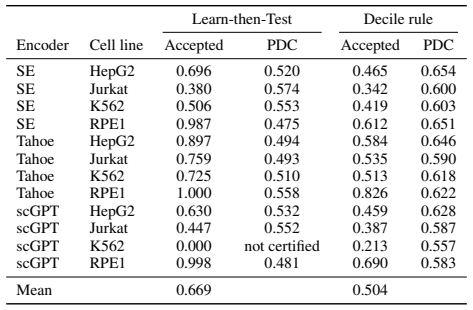
Table 19 : Learn-then-Test and the decile rule over 200 random calibration/deployment splits: share of predictions accepted and mean PDC of accepted predictions.
원문 · CC BY 4.0 · Zheyu Zhang, Yuanhao Huang, Fan Feng, Jie Liu · A low-rank decoder bottleneck bounds reliability in foundation-model perturbation prediction · 원문 그림 인용 · 원본 PDF 34쪽에서 그림 영역을 추출했습니다.기준선 비교와 신뢰 점수의 검증
Table 1의 비교에서 디코더 전체 모델과 리지 회귀 프로브는 모든 섭동에서 0.04 PDC 안에 있습니다. 그러나 학습 반응에서 멀리 떨어진 섭동에서는 디코더가 0.07~0.14 PDC로 떨어져 학습 평균 반응 수준에 가까워집니다. 이는 집계 정확도가 학습 섭동과 비슷한 섭동에서 주로 나온다는 해석을 뒷받침합니다. 신뢰 점수 검증에서는 상위 10% 예측의 평균 정확도가 평균 예측의 약 두 배로 나타나고, 임계값 τ≈0.10으로 RPL6은 수락되고 SNAPC5는 거부됩니다. 같은 결과에 대해 학습 집단과 보정 집단이 다르면 보장이 깨질 수 있다는 점도 원문에 명시됩니다.
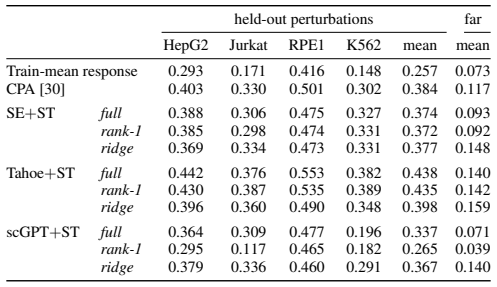
Table 1 :Comparison with simple predictors on held-out perturbations.Mean PDC (Eq. (1)) over held-out perturbations and over those far from every training response (cosine distance above 0.5). The decoders score in the range of the simple predictors, and every predictor loses most of its accuracy far from training. Per-cell-line far values, counts, and further baselines are in Appendix B.1.
원문 · CC BY 4.0 · Zheyu Zhang, Yuanhao Huang, Fan Feng, Jie Liu · A low-rank decoder bottleneck bounds reliability in foundation-model perturbation prediction · 원문 그림 인용 · 원본 PDF 6쪽에서 그림 영역을 추출했습니다.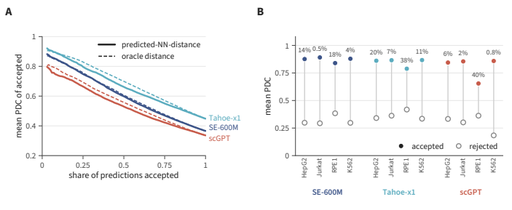
Figure 3 :Selecting predictions with predicted-NN-distance.(A) Mean PDC of the accepted predictions when held-out predictions are accepted in order of increasing distance, averaged over the four cell lines of each encoder; solid, predicted-NN-distance; dashed, the oracle distance from the observed response. At share 1 every curve reaches the mean PDC of all predictions. (B) Mean PDC of the accepted and rejected predictions under the pooled threshold τ≈0.10 in each encoder–cell configuration; numbers give the share accepted. The score selects predictions nearly as well as the oracle, and one threshold selects accurate predictions in every configuration.
원문 · CC BY 4.0 · Zheyu Zhang, Yuanhao Huang, Fan Feng, Jie Liu · A low-rank decoder bottleneck bounds reliability in foundation-model perturbation prediction · 원문 그림 인용 · 원본 PDF 8쪽에서 그림 영역을 추출했습니다.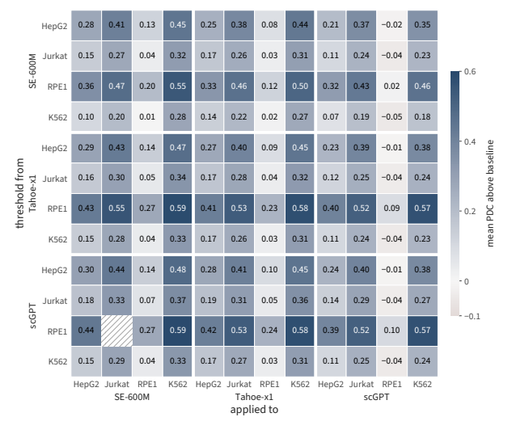
Figure 12 : Transfer of the per-configuration threshold between all 12×12 source–target pairs. Entry: mean PDC above the rank-1 SVD baseline among predictions accepted on the target (columns) using the threshold fitted on the source (rows). Hatched: fewer than five accepted predictions. White rules separate the encoder blocks.
원문 · CC BY 4.0 · Zheyu Zhang, Yuanhao Huang, Fan Feng, Jie Liu · A low-rank decoder bottleneck bounds reliability in foundation-model perturbation prediction · 원문 그림 인용 · 원본 PDF 35쪽에서 그림 영역을 추출했습니다.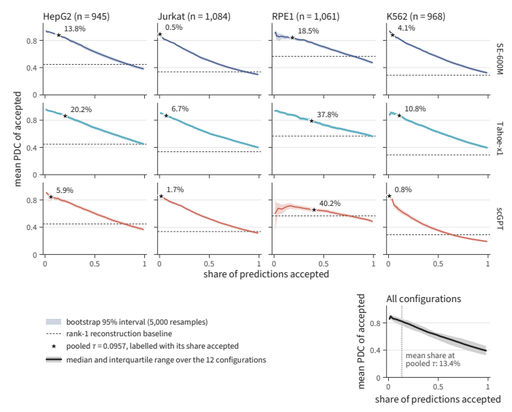
Figure 13 : Mean PDC of the accepted predictions against the share accepted, as the threshold on predicted-NN-distance is raised (rows: encoders; columns: cell lines). Shaded: bootstrap 95% interval (5,000 resamples); dashed: rank-1 SVD baseline; star: the pooled threshold, labeled with its share accepted. Lower right: median and interquartile range over the12configurations.
원문 · CC BY 4.0 · Zheyu Zhang, Yuanhao Huang, Fan Feng, Jie Liu · A low-rank decoder bottleneck bounds reliability in foundation-model perturbation prediction · 원문 그림 인용 · 원본 PDF 36쪽에서 그림 영역을 추출했습니다.적용 범위와 남은 질문
이 연구는 한 가지 디코더 구조와 세 인코더를 CRISPRi 네 세포주와 Tahoe-100M 약물 섭동에서 감사한 결과입니다. 병목은 SE+ST에서 가장 선명하며, Tahoe+ST에서는 섭동 신호의 일부가 첫 어텐션 계층을 우회합니다. 유전자 가족 전체를 학습에서 제외한 실험에서는 거리 점수와 PDC의 상관이 12개 구성 중 9개에서만 음수로 나타납니다. Learn-then-Test의 보장은 보정 섭동과 배포 섭동이 같은 집단에서 온다는 가정에 의존합니다. 또한 이 연구는 이후 MLP 계층의 개입과 각 방향의 생물학적 의미를 확립하지 않았습니다.
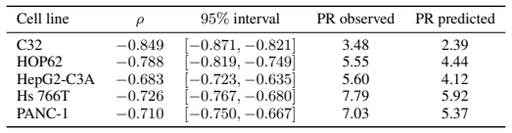
Table 21 : Tahoe-100M chemical perturbations: Spearman ρ between predicted-NN-distance and per-condition PDC with drug-clustered 95% intervals, and participation ratio (PR) of observed and predicted responses.
원문 · CC BY 4.0 · Zheyu Zhang, Yuanhao Huang, Fan Feng, Jie Liu · A low-rank decoder bottleneck bounds reliability in foundation-model perturbation prediction · 원문 그림 인용 · 원본 PDF 38쪽에서 그림 영역을 추출했습니다.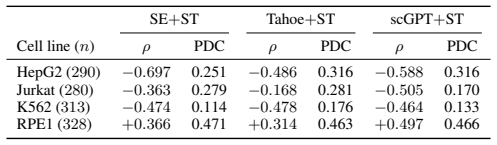
Table 23 : Strict family-held-out retraining: Spearman ρ between predicted-NN-distance and PDC on pooled held-out families (nperturbations), and mean PDC.
원문 · CC BY 4.0 · Zheyu Zhang, Yuanhao Huang, Fan Feng, Jie Liu · A low-rank decoder bottleneck bounds reliability in foundation-model perturbation prediction · 원문 그림 인용 · 원본 PDF 39쪽에서 그림 영역을 추출했습니다.논문 정보
- 저자
- Zheyu Zhang, Yuanhao Huang, Fan Feng, Jie Liu
- 학회·저널
- arXiv · 프리프린트
- 최초 공개일
- 2026년 11월 4일
- 등록일
- 2026년 11월 6일
- 수정일
- 2026년 11월 4일
- 버전
- v1
- arXiv
- 2611.05849
- 분류
- cs.LG · stat.ML
- 원문 이용 조건
- CC BY 4.0
- 제공 범위
- 논문 정보, 해설, 허용된 원문 그림
AI 해설은 논문 원문과 별개의 설명이며 오류가 있을 수 있습니다. 원문과 그림은 각 출처의 이용 조건과 따로 표시된 권리를 따릅니다.
초록
Foundation-model predictors of perturbation response are evaluated primarily by aggregate accuracy. Using their predictions to prioritize experiments requires assessing each prediction's reliability. We audit the state-transition (ST) decoder used in STATE across three encoders (SE-600M, scGPT, and Tahoe-x1) and four cell lines under CRISPRi. The decoder's first attention layer has a low-rank output. Projecting this output onto 4-32 fixed directions estimated from training activations preserves mean per-perturbation Pearson delta correlation (PDC). This low-rank attention bottleneck bounds the decoder's reliability by distance to training responses: PDC declines as the cosine distance from a perturbation's observed response to its nearest training response increases. We propose predicted-NN-distance, the cosine distance from a predicted response to its nearest training response, as a per-prediction confidence score. The score has a mean absolute Spearman correlation of 0.81 with PDC, close to the 0.88 obtained with the observed response. Thresholds calibrated on this score transfer across encoders and cell lines, and the score remains predictive of PDC for drug perturbations.
원문 인용
Zheyu Zhang, Yuanhao Huang, Fan Feng, Jie Liu (2026). A low-rank decoder bottleneck bounds reliability in foundation-model perturbation prediction. arXiv:2611.05849v1. https://arxiv.org/abs/2611.05849v1
BibTeX
@misc{zhang2026rank,
  title = {{A low-rank decoder bottleneck bounds reliability in foundation-model perturbation prediction}},
  author = {Zheyu Zhang and Yuanhao Huang and Fan Feng and Jie Liu},
  year = {2026},
  eprint = {2611.05849},
  archivePrefix = {arXiv},
  url = {https://arxiv.org/abs/2611.05849v1}
}