논문 해설
Classical training of conditional instantaneous quantum polynomial-time Born machines
조건부 순간 양자 다항식 시간 Born 기계의 고전적 학습
- 연구 문제 기존 조건부 IQP 모델은 조건을 대각 위상 층에 넣어, 입력 상태와 IQP 유니터리 자체는 조건과 무관하게 고정되어 있었습니다.
- 연구 방법 조건을 입력 상태에 인코딩하고 하나의 IQP 유니터리를 공유하는 조건부 IQP Born machine을 제안하며, 샘플링과 진폭 비율 인터페이스로 고전 MMD 학습을 가능하게 합니다.
- 주요 결과 16 큐빗 Curie–Weiss 실험에서 C-IQP (TP)의 평균 TVD는 0.046±0.004로 대각 조건화 D-IQP의 0.28±0.03보다 낮았습니다. Hamming 무게 계열의 혼합 조건에서도 입력 조건화가 더 낮은 TVD를 보였습니다.
조건부 생성을 양자 IQP 모델로 옮기는 문제
조건부 생성 모델은 온도나 클래스 같은 조건 c에 따라 달라지는 분포 p(·|c)의 계열을 하나의 모델로 근사합니다. IQP Born machine은 샘플링이 고전적으로 어렵다고 추측되는 회로 계열이면서도 Pauli-Z 기댓값을 고전적으로 추정할 수 있어 고전 학습이 가능한 양자 생성 모델입니다. 그러나 기존의 조건부 IQP 모델은 대각 층의 위상 파라미터를 조건에 따라 바꾸는 방식이어서, 고정된 입력 상태 위에서 조건을 처리합니다. 이 논문은 조건을 입력 상태에 인코딩하고 하나의 IQP 유니터리를 모든 조건에서 공유하는 조건부 IQP Born machine을 다룹니다.
입력 조건화와 고전 추정기
제안 모델은 인코더 V(c)가 조건 c를 입력 상태 |ϕ(c)⟩로 바꾸고, 파라미터 θ를 가진 IQP 유니터리 U_θ = H^{⊗n} D(θ) H^{⊗n}를 적용해 계산기저에서 측정합니다. 대각 층 D(θ)는 Pauli-Z 문자열에 대한 위상으로 이루어지며, 기준 상태 ψ_c = H^{⊗n}|ϕ(c)⟩의 진폭에 작용합니다. 고전 학습은 기준 상태에 대한 정확한 샘플 z와 진폭 비율 R_c(z,a)=ψ_c(z⊕a)/ψ_c(z)만 있으면 Pauli-Z 모멘트와 그 기울기를 추정할 수 있습니다. 이 샘플링-비율 인터페이스가 있는 한 인코더는 대각 층 바깥의 비대각 연산을 포함할 수 있습니다. 목적함수는 조건별 가우시안 커널 MMD 제곱을 조건과 대역폭에 대해 평균한 값입니다.
여기서 MMD 제곱은 Walsh–Fourier 스펙트럼의 가중 제곱거리로 표현되며, 이 표현은 p(·|c)=q_θ(·|c)일 때에만 0이 됩니다.
입력 조건화가 표현하는 조건부 계열
Proposition 1은 고정된 순수 입력을 쓰는 대각 조건화가 가질 수 있는 한계를 보입니다. 대각 층은 X 기저 분포를 바꿀 수 없으므로, 대각 조건화가 분포 p(·|c)를 정확히 재현하려면 기준 분포 |ψ(z)|^2가 그 멤버와 호환되어야 합니다. 저자들은 n≥2인 모든 고정 IQP 유니터리에 대해 공통의 호환 X 기저 분포가 없는 계열이 존재한다고 증명합니다. 이 계열은 입력 조건화로 정확히 재현할 수 있습니다. 다만 이 호환 조건은 필요조건이며 충분조건은 아닙니다. 또한 입력의 크기가 조건에 의존하지 않는 인코더는 대각 조건화로 환원됩니다.
Hamming 무게 계열에서의 조건 조합 검증
첫 번째 실험은 두 조건 좌표 u와 v를 축 위에서만 학습하고 그 조합에서 평가합니다. 입력 조건화 모델은 두 좌표를 균일 중첩 상태의 위상으로 인코딩하며, 16 큐빗 IQP 유니터리는 40개의 학습 가능한 위상을 가집니다. 대각 조건화 기준선은 같은 격자 회로를 |0⟩^{⊗16}에 적용하고 위상을 조건의 아핀 함수로 만들어 120개의 파라미터를 가집니다. 혼합 조건의 평균 전체 TVD는 입력 조건화에서 0.0216±0.0017, 대각 조건화에서 0.069±0.002로 보고됩니다. 대각 조건화는 학습 조건 중 원점이 아닌 점에서도 0.048±0.002로 더 높았으며, 이 결과는 외삽만의 효과가 아님을 보여줍니다.
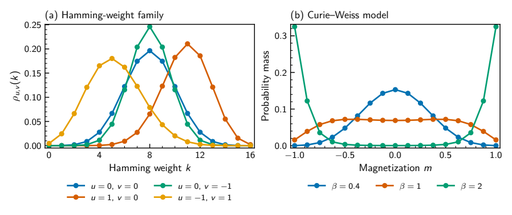
FIG. 2 . Target families. (a) Hamming-weight profilesρ u,v(k)of the two-dimensional family: the reference(u, v) = (0,0), a shift of the mean, a change of the width, and both combined. (b) Magnetization profiles of the sixteen-spin Curie–Weiss model across the crossover.
원문 · CC BY 4.0 · Oriol Balló-Gimbernat, Emiliano Tolotti, Laia Domingo, Fernando Vilariño, Adan Garriga · Classical training of conditional instantaneous quantum polynomial-time Born machines · 원문 그림 인용 · 원본 PDF 7쪽에서 그림 영역을 추출했습니다.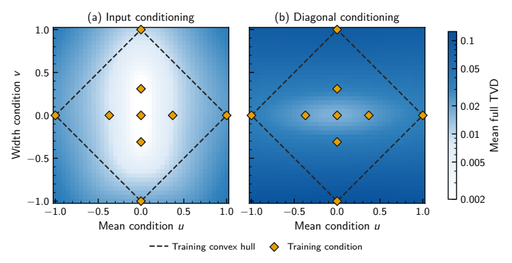
FIG. 4 . Joint conditional generation of the Hamming-weight family, (a) with input conditioning and (b) with diagonal condi- tioning of the same lattice circuit acting on|0⟩⊗16. Colors show the mean full-distribution TVD across ten seeds on a41×41 grid of conditions, on a shared logarithmic scale. Diamonds mark the nine training conditions, which lie on the two axes, and the dashed line marks their convex hull. At the origin, the target and the input-conditioned model are uniform by construction.
원문 · CC BY 4.0 · Oriol Balló-Gimbernat, Emiliano Tolotti, Laia Domingo, Fernando Vilariño, Adan Garriga · Classical training of conditional instantaneous quantum polynomial-time Born machines · 원문 그림 인용 · 원본 PDF 8쪽에서 그림 영역을 추출했습니다.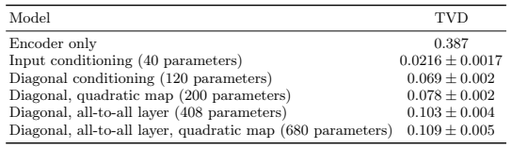
원문 그림 TABLE IV. Two-coordinate errors after axis training, evaluated on the sixteen mixed conditions. Input conditioning is the conditional IQP Born machine; diagonal conditioning makes the phases of the same lattice circuit, acting on|0⟩⊗16, an affine function of the condition, and its variants use a quadratic condition map, an all-to-all diagonal layer, or both. Values are means and standard deviations of the per-seed mean full-distribution TVD across ten seeds; the deterministic encoder-only row has no spread. Lower is better.
원문 · CC BY 4.0 · Oriol Balló-Gimbernat, Emiliano Tolotti, Laia Domingo, Fernando Vilariño, Adan Garriga · Classical training of conditional instantaneous quantum polynomial-time Born machines · 원문 그림 인용 · 원본 PDF 20쪽에서 그림 영역을 추출했습니다.Curie–Weiss 모델에서의 온도 조건 학습
두 번째 실험은 16 스핀 Curie–Weiss 모델의 자기화 분포가 온도에 따라 단봉에서 쌍봉으로 바뀌는 과정을 하나의 모델로 학습하는지 확인합니다. 학습 온도는 0.1, 0.7, 1.3, 1.95이며 평가 온도는 0.4, 1, 2입니다. 제안된 twisted parity 인코더를 쓰는 C-IQP (TP)의 평균 전체 TVD는 0.046±0.004이고, 대각 조건화 D-IQP는 0.28±0.03입니다. 이 값은 같은 프로토콜에서의 비교이며, 입력 조건화 모델이 평균 TVD에서 여섯 배 낮습니다. parity 인코더만 쓴 C-IQP (P)는 0.103±0.004로, 대각 조건화보다 약 2.7배 낮습니다.
twist를 제거한 절제 실험은 0.132±0.004로 C-IQP (P)보다 높아, 이 개선은 twist 단계에서 온다고 저자들은 보고합니다.
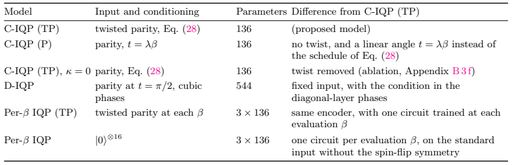
원문 그림 TABLE I. Sixteen-qubit Curie–Weiss models. All circuits use the same136one- and two-body generators. The shared models use one circuit for allβ, and the per-βmodels one circuit per evaluationβ. Parameters count all phases or weights updated by the optimizer.
원문 · CC BY 4.0 · Oriol Balló-Gimbernat, Emiliano Tolotti, Laia Domingo, Fernando Vilariño, Adan Garriga · Classical training of conditional instantaneous quantum polynomial-time Born machines · 원문 그림 인용 · 원본 PDF 10쪽에서 그림 영역을 추출했습니다.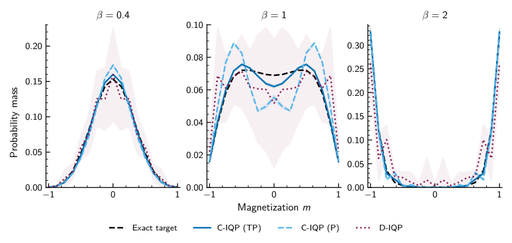
FIG. 5 . Magnetization profiles of the sixteen-qubit Curie–Weiss models at the evaluationβ, for the conditional models with the twisted parity encoder, C-IQP (TP), and with the parity encoder, C-IQP (P), and for diagonal conditioning, D-IQP. Magnetization per spin ism= (2k−16)/16, wherekis Hamming weight. Colored curves show exact probability masses averaged across ten independent fits, and shading shows one standard deviation above and below the mean. Dashed black curves show the targets. The D-IQP band is drawn lighter for readability. It is wide because most D-IQP fits alternate between high and low probability on neighboring Hamming weights, each with a different pattern, which the mean smooths out. The displayed values ofβare excluded from training and model selection. Panels use separate vertical scales.
원문 · CC BY 4.0 · Oriol Balló-Gimbernat, Emiliano Tolotti, Laia Domingo, Fernando Vilariño, Adan Garriga · Classical training of conditional instantaneous quantum polynomial-time Born machines · 원문 그림 인용 · 원본 PDF 10쪽에서 그림 영역을 추출했습니다.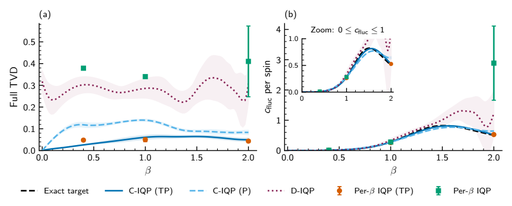
FIG. 6 . Sixteen-qubit Curie–Weiss models across temperature: (a) exact full-distribution TVD and (b) per-spin energy fluc- tuationsc fluc on the101-point evaluation grid. Curves show the models of Fig. 5, C-IQP (TP) (solid), C-IQP (P) (dashed), and D-IQP (dotted), with the target dashed black in (b); curves and bands show means and one standard deviation over ten fits. Markers show the per-βIQP (TP) (circles) and per-βIQP (squares) circuits, trained at the evaluationβ. The inset in (b) zooms into the range of the target fluctuations.
원문 · CC BY 4.0 · Oriol Balló-Gimbernat, Emiliano Tolotti, Laia Domingo, Fernando Vilariño, Adan Garriga · Classical training of conditional instantaneous quantum polynomial-time Born machines · 원문 그림 인용 · 원본 PDF 11쪽에서 그림 영역을 추출했습니다.고전 생성 모델과의 비교와 대규모 학습
같은 Curie–Weiss 과제에서 저자들은 RBM, Transformer, VAE를 학습했습니다. 학습 파라미터가 비슷한 작은 모델들 중 Transformer가 평균 TVD 0.068±0.015로 가장 가까웠고, C-IQP (TP)는 0.046±0.004를 보였습니다. 약 일곱 배 많은 파라미터를 가진 큰 Transformer는 0.052±0.005로 C-IQP (TP)에 비슷했습니다. 대규모 실험에서는 parity 인코더와 사각 격자 IQP 회로를 64부터 2048 큐빗까지 학습했습니다. 시험 MMD² 값은 같은 크기 사이에서 직접 비교할 수 없으므로, 저자들은 평균제곱 자기화 ⟨m²⟩를 정확한 값과 비교했습니다.
임계점 근처에서는 학습된 전이가 목표보다 넓게 나타난다고 보고됩니다.
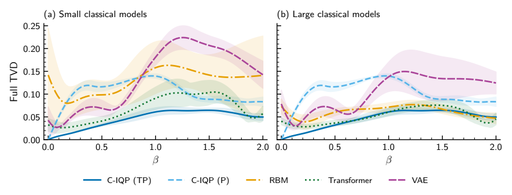
FIG. 7 . Exact full-distribution TVD of C-IQP (TP) and C-IQP (P), each with136learned parameters, and of classical conditional models on the101-point Curie–Weiss evaluation grid: (a) small models with134to140and (b) large models with 950to986learned parameters. Curves and bands show means and one standard deviation over ten fits.
원문 · CC BY 4.0 · Oriol Balló-Gimbernat, Emiliano Tolotti, Laia Domingo, Fernando Vilariño, Adan Garriga · Classical training of conditional instantaneous quantum polynomial-time Born machines · 원문 그림 인용 · 원본 PDF 12쪽에서 그림 영역을 추출했습니다.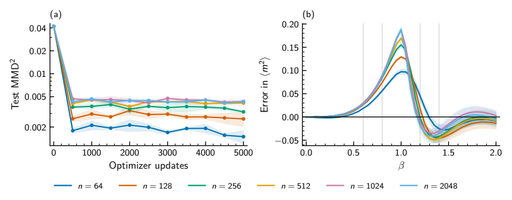
FIG. 8 . Classical training of conditional IQP Born machines with 64 to 2048 qubits. All models use the parity encoder with the saturating angle of Eq. (B6) and an open rectangular lattice of trainable one- and two-body phases. (a) Classically estimated test MMD2 during training, averaged over the test temperaturesβ∈ {0.4,0.95,1.0,1.05,1.6}and two kernel bandwidths whose average bodyness, two and four, is kept fixed as the size varies; logarithmic vertical axis. (b) Error in the classically estimated mean squared magnetization, the model estimate at the selected checkpoint of each fit minus the exact target, at41equally spaced temperatures in[0,2]. Gray vertical lines mark the training temperatures. Lines and bands show the mean and one standard deviation across three fits per size.
원문 · CC BY 4.0 · Oriol Balló-Gimbernat, Emiliano Tolotti, Laia Domingo, Fernando Vilariño, Adan Garriga · Classical training of conditional instantaneous quantum polynomial-time Born machines · 원문 그림 인용 · 원본 PDF 13쪽에서 그림 영역을 추출했습니다.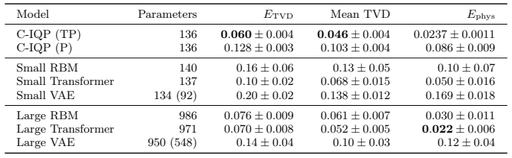
원문 그림 TABLE VI. Comparison of C-IQP models with classical conditional models on the101-point Curie–Weiss evaluation grid. All models share the training temperatures, target samples, update budget, hyperparameter search, and selection rule. C-IQP models train on the sampled MMD objective, whereas the classical models train on their native likelihood or evidence lower bound. Parameters count all learned parameters used in training; for the VAEs, parentheses give the generator parameters alone. Mean TVD is the temperature-averaged full-distribution TVD, and Appendix B3c defines the scoresETVD andE phys. Values are means±standard deviations over ten independent fits. Lower is better, and bold marks the lowest mean in each column.
원문 · CC BY 4.0 · Oriol Balló-Gimbernat, Emiliano Tolotti, Laia Domingo, Fernando Vilariño, Adan Garriga · Classical training of conditional instantaneous quantum polynomial-time Born machines · 원문 그림 인용 · 원본 PDF 22쪽에서 그림 영역을 추출했습니다.한계와 적용 범위
twisted parity 인코더는 leaf 쌍 사이의 회전을 포함하므로 모든 큐빗 쌍을 연결하며, 16 큐빗에서 105개의 two-qubit 회전이 필요합니다. 그래서 대규모 실험과 하드웨어 실험은 최근접 CNOT 트리로 구성되는 parity 인코더를 사용합니다. 16 큐빗 정확도 비교는 정확한 TVD로 모델을 선택했기 때문에, 샘플 기반 선택 절차의 성능을 직접 보여주지 않습니다. 대규모 실험에서는 저차 관측량 ⟨m²⟩를 검증하며, 이는 전체 분포를 보증하지 않습니다. 두 목표 계열은 순열 대칭이 있어 쉽게 고전 샘플링될 수 있으므로, 이 실험은 양자 우위가 아니라 표현력과 일반화를 검증합니다.
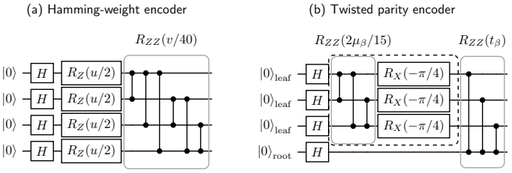
FIG. 3 . Encoder circuits, drawn for four qubits with the angles of the sixteen-qubit models, whereRZ (φ) =e −iφZ/2 and connected dots denoteRZZ (φ) =e −iφZ⊗Z/2 with the angle shown above each group. (a) Hamming-weight encoder of Eq. (25). (b) Twisted parity encoder of Eq. (27); without the dashed block, which contains the twist and the rotation, it reduces to the parity encoder of Eq. (26) with angletβ.
원문 · CC BY 4.0 · Oriol Balló-Gimbernat, Emiliano Tolotti, Laia Domingo, Fernando Vilariño, Adan Garriga · Classical training of conditional instantaneous quantum polynomial-time Born machines · 원문 그림 인용 · 원본 PDF 8쪽에서 그림 영역을 추출했습니다.논문 정보
- 저자
- Oriol Balló-Gimbernat, Emiliano Tolotti, Laia Domingo, Fernando Vilariño, Adan Garriga
- 학회·저널
- arXiv · 프리프린트
- 최초 공개일
- 2026년 11월 3일
- 등록일
- 2026년 11월 6일
- 수정일
- 2026년 11월 3일
- 버전
- v1
- arXiv
- 2611.05483
- 분류
- quant-ph · cs.LG
- 원문 이용 조건
- CC BY 4.0
- 제공 범위
- 논문 정보, 해설, 허용된 원문 그림
AI 해설은 논문 원문과 별개의 설명이며 오류가 있을 수 있습니다. 원문과 그림은 각 출처의 이용 조건과 따로 표시된 권리를 따릅니다.
초록
Instantaneous quantum polynomial-time (IQP) Born machines are attractive quantum generative models, as certain IQP circuit families are conjectured to be hard to sample, yet they can be trained classically. Previously proposed conditional IQP Born machines make the parameters of the diagonal layer condition dependent. We introduce conditional IQP Born machines, in which the condition is encoded in the input state and a single IQP unitary is shared across conditions. Efficient sampling and amplitude-ratio evaluation for the reference state entering the diagonal layer suffice to obtain unbiased classical estimates of a conditional maximum mean discrepancy objective and its gradients. We show that input conditioning can represent conditional families that no diagonally conditioned IQP model with the same number of qubits can reproduce. For the sixteen-qubit Curie-Weiss spin model, a single conditional model captures the magnetization transition at held-out temperatures. Its mean total variation distance is six times lower than that of diagonal conditioning under the same protocol and comparable to that of classical generative models with up to seven times as many parameters. We also train conditional models classically with up to 2048 qubits, which reproduce the mean squared magnetization of the target away from the crossover. These results extend classically trained IQP Born machines to conditional generation.
원문 인용
Oriol Balló-Gimbernat, Emiliano Tolotti, Laia Domingo, Fernando Vilariño, Adan Garriga (2026). Classical training of conditional instantaneous quantum polynomial-time Born machines. arXiv:2611.05483v1. https://arxiv.org/abs/2611.05483v1
BibTeX
@misc{ballgimbernat2026classical,
  title = {{Classical training of conditional instantaneous quantum polynomial-time Born machines}},
  author = {Oriol Balló-Gimbernat and Emiliano Tolotti and Laia Domingo and Fernando Vilariño and Adan Garriga},
  year = {2026},
  eprint = {2611.05483},
  archivePrefix = {arXiv},
  url = {https://arxiv.org/abs/2611.05483v1}
}