논문 해설
SlackBench: Benchmarking Agents on Collaborative Projects Grounded in Real Code Repositories
SlackBench: 실제 코드 저장소에 기반한 협업 프로젝트에서 에이전트 벤치마킹
- 연구 문제 기존 벤치마크는 실제 협업 프로젝트에서 대화·코드·문서를 함께 추론해야 하는 능력을 충분히 측정하지 못합니다.
- 연구 방법 SlackBench는 연구 프로젝트를 모사한 Slack 작업공간, GitHub 저장소, Google Docs를 결합하고 네 범주 140개 질의로 에이전트를 평가합니다.
- 주요 결과 최상위 조합은 평균 정확도 80.25%를 보였고, CLI 직접 접근은 MCP 접근보다 평균 7.85% 높은 통과율을 보였습니다.
연구 문제: 협업 작업공간에서의 에이전트 평가
실제 지식노동에서 에이전트는 Slack 대화, GitHub 저장소, 문서, 결정 기록에 흩어진 정보를 찾아 종합해야 합니다. 기존 벤치마크는 웹 탐색, 소프트웨어 공학, 장기 기억 등 일부 요소만 분리해 평가하는 경우가 많습니다. SlackBench는 이 간극을 메우기 위해 연구 프로젝트를 모사한 협업 작업공간에서 에이전트를 평가합니다. 이 벤치마크는 개인 조직의 채팅 기록을 공개하지 않고, 사람이 개입한 시뮬레이션으로 만든 다자간 대화와 GitHub 저장소, Google Docs를 연결합니다. 따라서 이 논문의 범위는 학술 연구 워크플로를 재구성한 환경에 한정됩니다.
데이터 구축과 질의 구성
SlackBench는 15개 채널, 약 3000개 메시지, 14개 GitHub 저장소, 9개 Google Docs로 구성된 작업공간을 기반으로 합니다. 각 채널은 실제 연구 아이디어에서 출발한 프로젝트에 대응하며, 사람과 코딩 에이전트가 프로젝트 리드와 연구 보조 역할을 나누어 수행한 대화를 내보낸 뒤 수동으로 정리합니다. 질의는 Agentic Search 58개, Hallucination 48개, Summarization 14개, Circumstance Inference 20개, 총 140개입니다. Hallucination 범주는 답이 없는 질문, 잘못된 전제, 시간 제한 밖의 정보를 다루며 올바른 답변은 답변을 피하고 그 이유를 밝혀야 합니다.
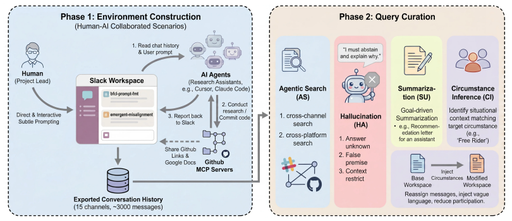
Figure 1 :Overview of the SlackBench benchmark. SlackBench evaluates coding agents on realistic Slack workspace tasks spanning agentic search, abstention, summarization, and circumstance inference in complex and heterogeneous scenarios.
원문 · CC BY 4.0 · Mingxuan Li, Huanzhi Mao, Ruitao Zheng, Jarod Stanbury James, Yunze Li, Natanya Anderson, Joseph E. Gonzalez, Alex Dimakis · SlackBench: Benchmarking Agents on Collaborative Projects Grounded in Real Code Repositories · 원문 그림 인용 · 원본 PDF 4쪽에서 그림 영역을 추출했습니다.실행 환경과 답변 판정 방식
에이전트는 Harbor 프레임워크에서 읽기 전용 Slack 도구와 GitHub 도구를 사용하며, 터미널 읽기와 bash, 웹 검색 도구를 함께 받습니다. 주요 실험에서는 reasoning effort를 medium으로 두고 질의당 20분 시간 제한을 둡니다. 답변 판정은 LLM judge가 질의, 에이전트 답변, 참조 답변, 선택적 채점 기준을 받아 수행합니다. AS, HA, CI는 이진 판정이며, SU는 항목별 체크리스트에 부분 점수를 부여하는 방식입니다.
범주별 결과와 상위 조합의 성능
표 1은 에이전트와 모델별 범주 정확도를 보고하며, 범주 정확도는 세 번 실행한 평균 통과율입니다. Antigravity와 Gemini 4 Argon 조합이 전체 평균 80.25%로 가장 높았고, 나머지 에이전트는 전체 정확도가 66% 미만이었습니다. 범주별 차이도 커서, 같은 모델이라도 Agentic Search에서 강한 결과가 Hallucination에서 반드시 강하지는 않았습니다. 이 결과는 환경과 판정 조건에서 얻은 것이며, 모든 실제 업무 환경의 성능을 보장하지는 않습니다.
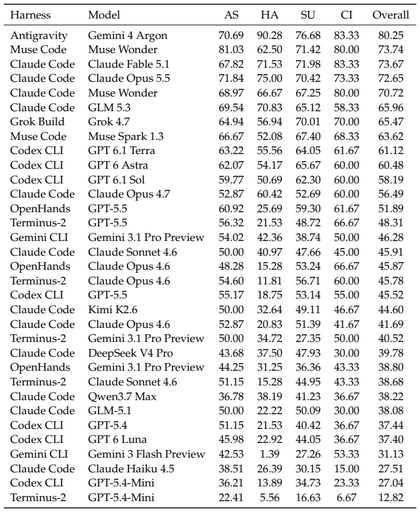
Table 1 :Agent performance on SlackBench. Different categories are defined in Section 3.2. Overall accuracy is the unweighted average of the 4 categories.
원문 · CC BY 4.0 · Mingxuan Li, Huanzhi Mao, Ruitao Zheng, Jarod Stanbury James, Yunze Li, Natanya Anderson, Joseph E. Gonzalez, Alex Dimakis · SlackBench: Benchmarking Agents on Collaborative Projects Grounded in Real Code Repositories · 원문 그림 인용 · 원본 PDF 7쪽에서 그림 영역을 추출했습니다.CLI 직접 접근과 MCP 접근의 비교
이 논문의 주요 비교 중 하나는 Slack 정보를 MCP 도구로 받는 방식과 내보낸 workspace 파일을 터미널 도구로 직접 읽는 방식의 차이입니다. 모든 평가 설정에서 CLI 접근은 MCP 접근보다 평균 7.85% 높은 통과율을 보였습니다. 표 3의 도구 호출 구성에 따르면 CLI 접근은 읽기와 추출 호출 비중이 높고, MCP 접근은 search_messages 검색 호출 비중이 높았습니다. 저자들은 이 차이가 검색 결과의 메타데이터 부피와 관련된 것으로 해석합니다.
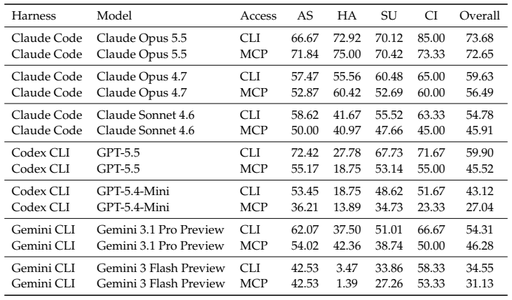
Table 2 :Performance of agents with MCP tools versus direct terminal access to the Slack workspace. All agents show improved performance with direct terminal access.
원문 · CC BY 4.0 · Mingxuan Li, Huanzhi Mao, Ruitao Zheng, Jarod Stanbury James, Yunze Li, Natanya Anderson, Joseph E. Gonzalez, Alex Dimakis · SlackBench: Benchmarking Agents on Collaborative Projects Grounded in Real Code Repositories · 원문 그림 인용 · 원본 PDF 8쪽에서 그림 영역을 추출했습니다.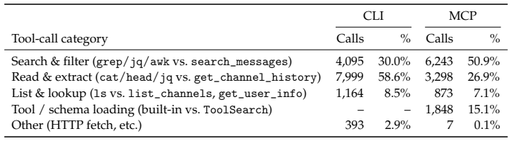
Table 3 :Tool-call composition for CLI and MCP workspace access, aggregated across runs presented in Table 2.
원문 · CC BY 4.0 · Mingxuan Li, Huanzhi Mao, Ruitao Zheng, Jarod Stanbury James, Yunze Li, Natanya Anderson, Joseph E. Gonzalez, Alex Dimakis · SlackBench: Benchmarking Agents on Collaborative Projects Grounded in Real Code Repositories · 원문 그림 인용 · 원본 PDF 8쪽에서 그림 영역을 추출했습니다.인간 평가와 LLM judge 신뢰도
인간 평가자 3명은 같은 환경과 과제를 받았고 AI 도구 사용도 허용되었습니다. 인간의 전체 정확도는 84.5%이며, 95% 부트스트랩 신뢰구간은 [77.0%, 92.0%]입니다. LLM judge 검증에서는 Codex CLI와 GPT-5.5의 판정을 수동으로 검토했으며, GPT-5.4 판정은 인간 판정과 95.8% 일치했습니다. 또한 여러 judge 사이의 쌍별 일치율은 표 6에서 모든 경우 95%를 넘었다고 보고됩니다.
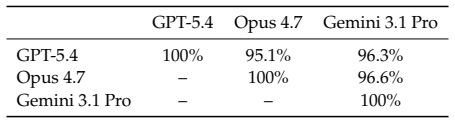
Table 6 :LLM judge pairwise agreement rate. We use the AS, HA, CI queries from the following 6 agents: Claude Code with Opus 4.7, Claude Code with Sonnet 4.6, Codex CLI with GPT-5.5, Codex CLI with GPT-5.4-Mini, Gemini CLI with Gemini-3.1-Pro-Preview, Gemini CLI with Gemini-3-Flash-Preview.
원문 · CC BY 4.0 · Mingxuan Li, Huanzhi Mao, Ruitao Zheng, Jarod Stanbury James, Yunze Li, Natanya Anderson, Joseph E. Gonzalez, Alex Dimakis · SlackBench: Benchmarking Agents on Collaborative Projects Grounded in Real Code Repositories · 원문 그림 인용 · 원본 PDF 12쪽에서 그림 영역을 추출했습니다.범위와 한계
저자들은 frontier lab의 모델과 agent harness만 평가했으며, 더 많은 에이전트를 평가하는 것은 후속 연구의 과제로 남겼습니다. 또한 다양한 prompting 전략이 성능에 미치는 영향은 검증하지 않았습니다. 개발 중 일부 에이전트가 정답 저장소에 접근한 사례가 보고되었으므로, 정답 자료의 공개 범위도 평가 해석에 영향을 줍니다. 따라서 이 결과는 특정 환경, 특정 모델군, 특정 판정 방식에서의 관찰로 읽어야 합니다.
논문 정보
- 저자
- Mingxuan Li, Huanzhi Mao, Ruitao Zheng, Jarod Stanbury James, Yunze Li, Natanya Anderson, Joseph E. Gonzalez, Alex Dimakis
- 학회·저널
- arXiv · 프리프린트
- 최초 공개일
- 2026년 11월 3일
- 등록일
- 2026년 11월 6일
- 수정일
- 2026년 11월 3일
- 버전
- v1
- arXiv
- 2611.05512
- 분류
- cs.AI · cs.CL
- 원문 이용 조건
- CC BY 4.0
- 제공 범위
- 논문 정보, 해설, 허용된 원문 그림
AI 해설은 논문 원문과 별개의 설명이며 오류가 있을 수 있습니다. 원문과 그림은 각 출처의 이용 조건과 따로 표시된 권리를 따릅니다.
초록
AI Agents are becoming digital coworkers that can browse the web, write code, run experiments, and assist humans over extended horizons. Yet existing benchmarks fall short of real knowledge work: many rely on synthetic data or isolated tasks, missing the complex, multi-party dynamics of collaborative projects, where critical information is scattered across conversations, code, and evolving decisions. Even simple workplace questions may require locating relevant channels and direct messages, recovering context from long discussions, inspecting repository state, reconciling stale or conflicting evidence, and synthesizing across sources. We introduce SlackBench, a benchmark for evaluating agents on realistic research and engineering workflows that require joint reasoning over workplace communication and evolving repository state. Grounded in privacy-preserving reenactments of real academic research projects, SlackBench provides reproducible environments with realistic multi-party dialogue, evolving decisions, and corresponding code changes grounded in GitHub repositories and Google Docs. It contains 140 queries spanning heterogeneous-source agentic search, abstention on unanswerable or false-premise questions, goal-directed summarization, and circumstance inference over long conversations. These tasks are not reducible to static corpus question answering: agents must determine which conversations matter, traverse threads, inspect repository state, and synthesize evidence across communication and code artifacts. Across 33 frontier models and agent harnesses, the best system scores around 80% and most agents score below 66%, highlighting substantial headroom for improvement. SlackBench thus provides an extensible framework for evaluating agents in collaborative work environments. The SlackBench dataset is available at https://huggingface.co/datasets/HuanzhiMao/SlackBench .
원문 인용
Mingxuan Li, Huanzhi Mao, Ruitao Zheng, Jarod Stanbury James, Yunze Li, Natanya Anderson, Joseph E. Gonzalez, Alex Dimakis (2026). SlackBench: Benchmarking Agents on Collaborative Projects Grounded in Real Code Repositories. arXiv:2611.05512v1. https://arxiv.org/abs/2611.05512v1
BibTeX
@misc{li2026slackbench,
  title = {{SlackBench: Benchmarking Agents on Collaborative Projects Grounded in Real Code Repositories}},
  author = {Mingxuan Li and Huanzhi Mao and Ruitao Zheng and Jarod Stanbury James and Yunze Li and Natanya Anderson and Joseph E. Gonzalez and Alex Dimakis},
  year = {2026},
  eprint = {2611.05512},
  archivePrefix = {arXiv},
  url = {https://arxiv.org/abs/2611.05512v1}
}