논문 해설
Who Pays for the Knowledge Models Copy? Model Collapse as Rogers' Paradox
모델이 복제하는 지식의 대가는 누가 치르는가? 로저스의 역설로 본 모델 붕괴
- 연구 문제 생성 모델을 이전 모델의 출력으로 학습하면 희귀 지식이 세대마다 사라지는데, 기존 이론은 외부 정보를 고정된 아카이브로 보고 목표 분포도 변하지 않는다고 가정합니다.
- 연구 방법 논문은 모델 붕괴를 로저스의 역설로 읽고, 합성·신선 데이터 혼합을 설명하는 단일 재귀식과 사람이 모델에게 묻는 고리의 평형 명제를 제시합니다.
- 주요 결과 합성 데이터만으로 맞춘 u는 단어 삼중어 모델에서 다른 신선 데이터 비율의 희귀 단어 보존을 0.03 이내로 예측합니다. 세계가 빨리 바뀔수록 필요한 신선 데이터가 늘고, 명제 1은 평형에서 모델 정확도가 1−c로 정해짐을 보입니다.
모델 붕괴를 로저스의 역설로 읽는 이유
생성 모델을 이전 모델의 출력으로 학습시키면 세대가 거듭될수록 분포의 꼬리가 얇아지고 희귀한 지식부터 사라집니다. 기존 붕괴 이론은 이를 막는 방법으로 외부 정보, 즉 새로운 사람의 데이터, 검증기, 큐레이션을 들여오는 방식을 다루지만, 이 외부 정보를 고정된 아카이브로 취급하고 목표 분포도 변하지 않는다고 가정합니다. 이 논문은 문화진화론의 로저스의 역설을 이 문제에 대응시킵니다. 복사가 개별 학습보다 저렴해 퍼지더라도 복사본은 시간이 지나면 낡고, 누군가는 계속 스스로 배워야 한다는 구조입니다. 저자들은 이 대응을 정량적으로 세우고 세 단계로 검증합니다. 먼저 고정된 세계에서 합성 데이터만으로 맞춘 로저스 모델이 다른 신선한 데이터 혼합 조건의 희귀 지식 보존을 예측하는지 봅니다.
다음으로 세계가 변할 때 필요한 신선한 데이터의 양을 보고, 마지막으로 사람이 모델에게 묻는 구조를 닫힌 고리로 놓고 균형을 봅니다.
로저스 연쇄 모델의 재귀식
논문은 세대 t+1이 합성 비율 ρ의 말뭉치와 나머지 1−ρ의 신선한 데이터로 학습된다고 설정합니다. 합성 부분이 담은 지식 단위는 이전 세대가 그것을 가지고 있었고 복사가 그것을 보존했을 때만 살아남으며, u는 세대당 그렇지 않을 확률입니다. 로저스의 모델에서 u는 세계가 변하는 비율이지만, 모델 연쇄에서는 이전 모델이 말뭉치를 쓸 때 희귀 항목이 샘플링되지 않는 확률도 포함합니다. 보존 비율 q_t는 q_{t+1} = (1−ρ) + ρ(1−u)q_t 를 따르며, 평형은 q* = (1−ρ)/(1−ρ(1−u))입니다. 이 식은 ρ=1이면 (1−u)^t 속도로 붕괴하고, 어떤 신선한 비율이든 평형 q*에 머문다는 것을 보여 줍니다.
식에는 모델 클래스에 대한 가정이 없고, 하나의 측정 가능한 양 u가 모든 혼합 비율을 연결하는 것이 이 식의 역할입니다.
고정된 세계에서의 단어 삼중어 실험
주요 실험은 Darwin과 Melville 텍스트로 학습한 단어 삼중어 언어 모델입니다. 각 세대는 이전 모델의 샘플과 신선한 데이터의 비율로 말뭉치를 구성하고, 12세대 동안 5개의 시드로 반복합니다. 전적으로 합성 데이터로만 학습하면 12세대에 희귀 단어의 약 4/5를 잃고, 사람 텍스트에 대한 perplexity는 Darwin에서 7.7배, Melville에서 4.1배 늘어납니다. 합성 데이터만으로 맞춘 u는 Darwin에서 0.15, Melville에서 0.16이며, 이 값을 고정한 채 10%, 30%, 50% 신선한 데이터 조건의 희귀 단어 보존 비율을 예측했을 때 두 말뭉치 모두 0.03 이내의 오차를 보입니다.
다만 과도기 구간에서는 단일 u가 최대 0.12까지 어긋나며, 12세대의 전합성 조건은 과소 예측됩니다. 저자들은 가장 오래 살아남는 단어가 덜 희귀한 단어이기 때문이라고 설명합니다.
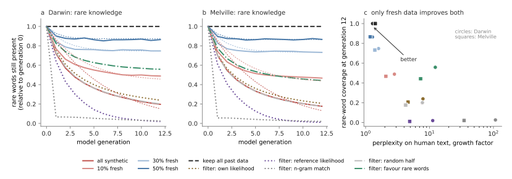
Figure 1 : Lineages of language models trained on their own output in a fixed world (word trigram models, 12 generations, mean of 5 seeds). (a, b) Rare-word coverage relative to generation 0. Thin dashed lines: Rogers’ chain (Eq. 1) withu fitted to the all-synthetic condition only and applied, unchanged, to the fresh-data conditions. (c) Every condition at generation 12, on coverage and on the growth of perplexity on held-out human text. Filters are discussed in Section 7.
원문 · CC BY 4.0 · Nam H. Le · Who Pays for the Knowledge Models Copy? Model Collapse as Rogers' Paradox · 원문 그림 인용 · 원본 PDF 4쪽에서 그림 영역을 추출했습니다.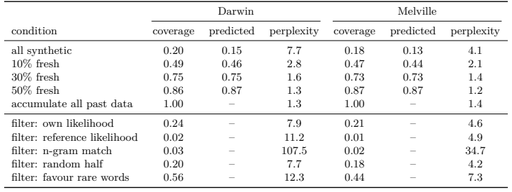
Table 1 : Generation 12, mean of 5 seeds. Coverage: rare-word coverage relative to generation 0. Predicted: Rogers’ chain withu fitted to the all-synthetic condition of the same corpus (u = 0.15Darwin,0 .16Melville). Perplexity: growth factor on held-out human text.
원문 · CC BY 4.0 · Nam H. Le · Who Pays for the Knowledge Models Copy? Model Collapse as Rogers' Paradox · 원문 그림 인용 · 원본 PDF 4쪽에서 그림 영역을 추출했습니다.신경망과 pre-training 모델로의 확장
계수 기반 모델이 아닌 경우를 확인하기 위해 저자들은 2층 문자 단위 트랜스포머를 Darwin 텍스트에서 매 세대 새로 학습했습니다. 이 실험에서는 완전 합성 학습에서 오차가 세대마다 증가하고 희귀 단어 보존은 시작값의 4%로 떨어지며, 신선한 데이터 30%를 넣으면 두 지표가 두 세대 안에 안정됩니다. 이 설정에서는 단일 u가 신선 데이터 평탄값을 0.48로 잘못 예측하고, 두 부류 지식 모델은 0.04 이내로 맞춥니다. pre-training 모델 실험에서는 OPT-125m을 pre-training 가중치에서 매 세대 미세조정하고, wikitext-2의 합성 블록으로 10세대를 반복합니다. 완전 합성 조건에서 perplexity는 47에서 102로 두 배가 되고 희귀 단어는 0.59만 남습니다.
단일 u는 평탄 구간을 놓치지만, 가중치 w=0.28, u1=0.82, u2=0.02로 완전 합성 조건에서만 맞춘 두 부류 연쇄는 10세대의 신선 블록 조건을 0.03 이내로 예측합니다.
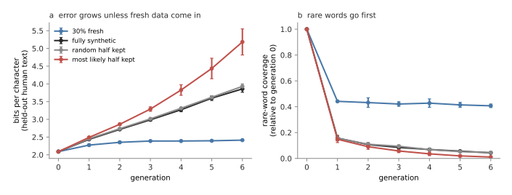
Figure 2 : Recursive training of a small character-level transformer (Darwin; 6 generations; mean± s.d. over 3 seeds). (a) Bits per character on held-out human text. (b) Rare-word coverage of the training corpus, relative to generation 0. Fresh data stop the decline; keeping the most likely half of the samples accelerates it relative to keeping a random half.
원문 · CC BY 4.0 · Nam H. Le · Who Pays for the Knowledge Models Copy? Model Collapse as Rogers' Paradox · 원문 그림 인용 · 원본 PDF 5쪽에서 그림 영역을 추출했습니다.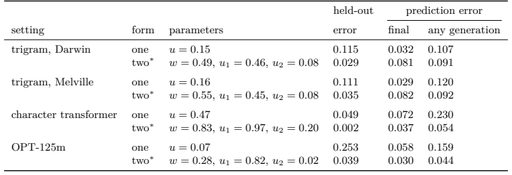
Table 2 : One-class and two-class Rogers’ chains, fitted to fully synthetic training only.∗: the form preferred by the held-out generations of the all-synthetic condition.
원문 · CC BY 4.0 · Nam H. Le · Who Pays for the Knowledge Models Copy? Model Collapse as Rogers' Paradox · 원문 그림 인용 · 원본 PDF 13쪽에서 그림 영역을 추출했습니다.변화하는 세계에서 필요한 신선한 데이터
로저스 모델에서 u는 세계가 변해 복사된 지식이 낡는 비율이므로, 세계가 빠르게 바뀌면 같은 신선 비율로는 더 많은 데이터가 필요해야 합니다. 저자들은 연속 슬라이딩 창으로 세계를 바꾸고 단어 삼중어 모델로 확인했습니다. 신선 비율 30%에서 정적 세계의 coverage 0.81은 세계가 매 세대 교체될 때 0.70으로 떨어지며, 80%의 완전 신선 coverage를 유지하는 데 필요한 신선 비율은 약 0.30에서 약 0.45로 증가합니다. 효과는 세계의 약 1/3이 세대마다 교체될 때 포화됩니다. 반면 OPT-125m을 wikitext-2의 슬라이딩 창에서 실험한 경우 세계 교체율에 따른 coverage 차이는 거의 없었습니다.
저자들은 신선 블록만으로 얻는 coverage가 pre-training 가중치에서 온다고 해석하지만, 이는 저자의 해석이며 pre-training 데이터 밖으로 세계가 벗어나는 경우는 다루지 않았습니다.
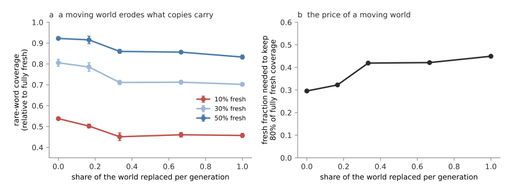
Figure 4 : Recursive training in a world that keeps changing (word trigram models; the world is a window of 3000 sentences sliding through the concatenated corpora; mean of generations 6–12 and 3 seeds; bars: s.d. over seeds). (a) Coverage of the current world’s rare words, relative to a fully fresh corpus, against the share of the world replaced per generation. (b) The fresh fraction needed to keep 80% of fully fresh coverage rises from about 0.30 in a static world to about 0.45 when the world is replaced every generation.
원문 · CC BY 4.0 · Nam H. Le · Who Pays for the Knowledge Models Copy? Model Collapse as Rogers' Paradox · 원문 그림 인용 · 원본 PDF 7쪽에서 그림 영역을 추출했습니다.사람이 모델에게 묻는 구조의 평형
이 절은 학습 데이터를 쓰는 사람이 모델에게 묻는 상황을 모델과 함께 닫힌 고리로 놓습니다. 사람의 일부 h는 자신이 배우는 데 비용 c를 들여 항상 맞게 알고, 나머지는 현재 모델에게 거의 비용 없이 물으며 그 정확도는 a_t입니다. 신선한 텍스트는 사람이 쓰므로 f=(1−s)h가 되고, s는 모델이 직접 쓴 텍스트의 비율입니다. 명제 1은 모델 정확도가 a_{t+1}=(1−u)[f+(1−f)a_t]를 따르며, 0<h*<1인 평형에서 a*=1−c, f*=u(1−c)/(c(1−u)), h*=f*/(1−s), 평균 보수는 1−c라고 정리합니다. 따라서 평형에서 모델의 정확도는 사람이 스스로 알아내는 비용에 의해 정해지고, 집단은 모델이 없을 때보다 나아지지 않습니다.
시뮬레이션은 평형 식을 확인하며, 사람이 답을 확인하고 틀리면 다시 배우는 비판적 사회 학습이 보수를 1−c보다 높게 유지한다고 보고합니다.
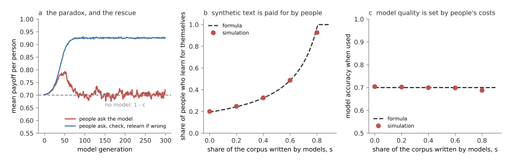
Figure 5 : The human-AI knowledge ecosystem, simulated (4000 facts, 4000 people, change rateu = 0.05, cost of finding outc = 0.3, checking cost0.05). (a) Mean payoff after a model is introduced: when people simply ask, payoff rises and then returns to the no-model baseline1−c; when they check the answer and relearn if it is wrong, it stays well above. (b) Equilibrium share of people who learn for themselves, against the shares of model-written text: simulation and Eq. 2 (corrected for the share of facts written about in each generation). (c) The model’s accuracy when used stays at1−cwhatevers.
원문 · CC BY 4.0 · Nam H. Le · Who Pays for the Knowledge Models Copy? Model Collapse as Rogers' Paradox · 원문 그림 인용 · 원본 PDF 8쪽에서 그림 영역을 추출했습니다.합성 데이터 필터의 사회 학습 분류
논문은 학습 전에 합성 데이터를 거르는 필터를 사회 학습 전략으로 분류합니다. 생성기 자체의 우도, 참조 모델의 perplexity, 사람 텍스트와의 n-gram 일치처럼 흔한 것에 맞추는 필터는 동조 필터이며, 희귀 단어를 선호하는 필터는 이와 반대 방향입니다. 단일 실험에서 생성기 자체의 우도로 거르면 trigram에서는 무작위 제거와 구별되지 않지만, 트랜스포머에서는 무작위보다 나쁘고 OPT-125m에서는 10세대 안에 거의 모든 희귀 단어를 제거합니다. 가장 가능성 높은 절반을 유지하는 필터는 OPT-125m에서 희귀 단어 coverage를 0.05로 떨어뜨리는 반면, 무작위 절반은 0.57로 필터를 두지 않은 경우와 다르지 않습니다.
따라서 필터가 얼마나 버리는지보다 기준이 정보를 어디서 얻는지가 중요하다는 것이 저자들의 결론입니다.
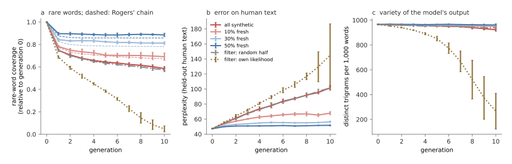
Figure 3 : Recursive fine-tuning of a pretrained language model (OPT-125m on wikitext-2; 10 generations; mean ± s.d. over 5 seeds). (a) Rare-word coverage of the training corpus, relative to generation 0. Dashed: Rogers’ chain with two classes of knowledge, fitted to the all-synthetic condition only and applied unchanged to the fresh-data conditions. (b) Perplexity on held-out human text. (c) Distinct word trigrams per 1000 words of the model’s own samples. Keeping the samples the model finds most likely collapses the lineage; keeping a random half does nothing.
원문 · CC BY 4.0 · Nam H. Le · Who Pays for the Knowledge Models Copy? Model Collapse as Rogers' Paradox · 원문 그림 인용 · 원본 PDF 6쪽에서 그림 영역을 추출했습니다.적용 범위와 한계
저자들이 밝힌 가장 큰 한계는 언어 모델이 최대 125 million 파라미터의 작은 모델이라는 점입니다. 작은 규모를 택한 이유는 지식을 정확히 셀 수 있게 하기 위함이며, 희귀 단어 coverage는 지식의 대리 지표입니다. 강한 보상 모델이나 품질 모델 아래에서도 plausibility 필터가 같은 방식으로 작동하는지는 아직 확인하지 않은 중요한 질문으로 남습니다. 또한 변화하는 세계는 고정된 텍스트의 슬라이딩 창이며 사실의 변화를 직접 모델링하지 않습니다. pre-training 모델의 경우 변화는 pre-training 데이터 안에 머무릅니다. 인구 모델은 사실을 독립적으로 취급하고 전략을 평균으로 다루므로 사람마다의 학습 비용 차이는 반영하지 않습니다.
논문 정보
- 저자
- Nam H. Le
- 학회·저널
- arXiv · 프리프린트
- 최초 공개일
- 2026년 11월 4일
- 등록일
- 2026년 11월 6일
- 수정일
- 2026년 11월 4일
- 버전
- v1
- arXiv
- 2611.06022
- 분류
- cs.LG · cs.CL · q-bio.PE
- 원문 이용 조건
- CC BY 4.0
- 제공 범위
- 논문 정보, 해설, 허용된 원문 그림
AI 해설은 논문 원문과 별개의 설명이며 오류가 있을 수 있습니다. 원문과 그림은 각 출처의 이용 조건과 따로 표시된 권리를 따릅니다.
초록
Generative models trained on the output of earlier models lose knowledge across generations, rare knowledge first. The remedies that work all bring in information from outside the loop, and the theory of model collapse treats that supply as given: a fixed archive, drawn from a fixed distribution. We argue that the supply is the problem, and that cultural evolution has the theory of it. We read model collapse as Rogers' paradox: a population that comes to rely on copying ends up no better off than one that never copied, because copies go stale unless someone keeps learning for themselves. We test the identification in three steps. First, Rogers' model, fitted only to fully synthetic training, predicts to within a few percentage points how much rare knowledge language models, from word trigrams to a pretrained transformer, retain under other mixtures of fresh data. Second, when the world itself changes, a lineage that copies its own past needs more fresh data to keep up the faster the world changes, as Rogers' model says it must and as analyses that assume a fixed target cannot; a lineage that restarts every generation from fixed pretrained weights is largely insulated, because those weights are knowledge that is never copied. Third, we close the loop: when the people who write a model's training data can ask the model instead of finding things out, the supply of fresh data becomes endogenous. At equilibrium, the model is exactly as reliable as it is costly for people to find out for themselves, the population is no better off than without the model, and every increase in the share of model-written text must be paid for by more people learning for themselves. Users who check what they are told and relearn when it is wrong break the paradox. Filters that select plausible text are conformist and accelerate collapse; only checks that carry new information act as critical learning.
원문 인용
Nam H. Le (2026). Who Pays for the Knowledge Models Copy? Model Collapse as Rogers' Paradox. arXiv:2611.06022v1. https://arxiv.org/abs/2611.06022v1
BibTeX
@misc{le2026pays,
  title = {{Who Pays for the Knowledge Models Copy? Model Collapse as Rogers' Paradox}},
  author = {Nam H. Le},
  year = {2026},
  eprint = {2611.06022},
  archivePrefix = {arXiv},
  url = {https://arxiv.org/abs/2611.06022v1}
}