논문 해설
The Behavioral Rate of Fine-Tuning: Compression as a Measure of Useful Information
미세 조정의 행동적 비율: 유용한 정보의 척도로서의 압축
- 연구 문제 LoRA fine-tuning 업데이트를 압축할 때 학습된 행동을 보존하는 데 필요한 최소 비트율이 무엇에 좌우되는지가 핵심 문제입니다.
- 연구 방법 압축된 어댑터를 고정된 기반 모델과 합성해 보존 이득을 측정하고, 이 이득이 목표 비율에 도달하는 최소 직렬화 크기를 행동 비율로 정의합니다.
- 주요 결과 행동 비율은 데이터와 고정 수신기의 조합에 따라 달라지며, 손상된 fine-tuning은 압축 후 GSM8K에서 회복됩니다. 학습된 업데이트의 축소 가능성은 사후 평가에서 행동 비율을 잘 추적합니다.
fine-tuning이 쓰는 정보량을 어떻게 재는가
LoRA는 고정된 기반 모델 위에 작은 학습 업데이트를 더하는 방법입니다. 그런데 어댑터의 랭크, 파라미터 수, 가중치 재구성 오차는 학습된 행동을 보존하는 데 실제로 필요한 비트 수를 직접 알려 주지 않습니다. 이 논문은 이 공백을 메우기 위해 압축된 어댑터를 다시 불러와 기반 모델과 합성했을 때 fine-tuning 이득의 일정 비율을 유지하는 최소 직렬화 크기를 행동 비율 R⋆로 정의합니다. 따라서 이 연구의 질문은 압축 손실이 얼마나 작은지가 아니라, 행동을 보존하는 데 필요한 정보가 무엇에 좌우되는지입니다.
압축 어댑터와 보존 이득의 계산
연구진은 학습된 어댑터를 여러 작업점에서 압축하고, 디코딩 메타데이터를 포함한 실제 파일 크기를 원래 어댑터의 스칼라 개수로 나누어 비율을 계산합니다. 압축된 어댑터는 다시 불러와 고정된 기반 모델과 합성되며, 기반 모델 손실 L0, 압축 전 어댑터 손실 Lraw, 압축 후 손실 Lr로 보존 이득 Retain(r)을 정의합니다. 이 지표는 0이면 기반 모델, 1이면 압축되지 않은 어댑터에 대응합니다. R⋆(τ)는 Retain(r)이 τ 이상이 되는 가장 작은 r이며, 논문은 대부분 τ=0.90을 사용합니다. 이 정의는 압축된 표현이 기반 모델과 결합되었을 때의 행동을 기준으로 하므로, 파라미터 공간 재구성 오차와는 다른 양을 측정합니다.
재구성 오차가 행동 보존을 보장하지 않는 사례
논문은 균일 양자화와 LoRA 가중치 재구성 오차를 최소화하는 적응형 할당기를 비교합니다. 1비트 근처에서 적응형 코드는 상대 가중치 RMSE를 0.54로 낮추어 균일 양자화의 0.56보다 낮습니다. 그러나 GSM8K 이득은 3%만 유지하며, 균일 코드는 86%를 유지합니다. 적응형 할당기는 유클리드 목적에서는 싸지만 행동상 중요한 행을 제거함으로써 낮은 오차를 얻습니다. 따라서 이 실험은 파라미터 공간의 왜곡이 작다고 행동 왜곡도 작다고 말할 수 없다는 반례로 제시됩니다. 비트율이 더 높아져 행이 제거되지 않으면 두 코덱의 차이는 좁아집니다.
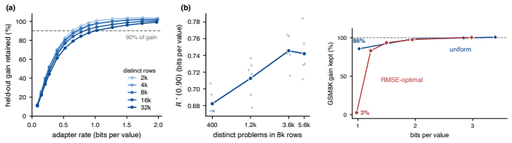
Figure 2 : Behavioral rate is not a weight-space quantity. Left:retained fine-tuning gain versus exact serialized adapter rate across 2k–32k MetaMathQA rows at fixed compute.Center:R ⋆(0.90)at 8k rows as source-problem diversity increases.Right:near one bit per value, an RMSE-optimized codec achieves lower relative weight error than uniform quantization (0.54 vs. 0.56) but retains only 3% of the GSM8K gain, versus 86%. Curves on the left show seed means; small points are individual seeds. Mistral-7B, NF4, rank-16 LoRA, three seeds.
원문 · CC BY 4.0 · Joey David, Paul Caillon, Alexandre Allauzen · The Behavioral Rate of Fine-Tuning: Compression as a Measure of Useful Information · 원문 그림 인용 · 원본 PDF 4쪽에서 그림 영역을 추출했습니다.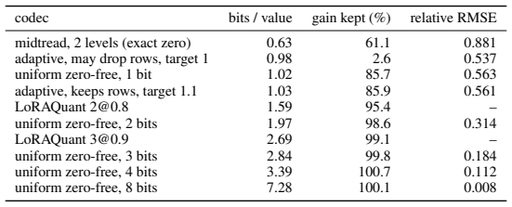
Table 2 :Realised rate and retained GSM8K gain per codec (Mistral-7B, 3 seeds, raw gain 61.5 points).
원문 · CC BY 4.0 · Joey David, Paul Caillon, Alexandre Allauzen · The Behavioral Rate of Fine-Tuning: Compression as a Measure of Useful Information · 원문 그림 인용 · 원본 PDF 15쪽에서 그림 영역을 추출했습니다.손상된 fine-tuning의 압축 회복
두 번째 실험은 MetaMathQA의 근거 풀이를 다른 문항의 풀이와 바꾸어 의도적으로 손상된 지도 신호로 어댑터를 학습합니다. Qwen2.5-7B에서 GSM8K 정확도는 프로즌 기준 77.6%에서 손상 학습 후 23.7%로 떨어지지만, 같은 어댑터를 압축하면 82.9%가 됩니다. 이 회복은 Mistral-7B-Instruct와 Llama-3.1-8B에서도 보고됩니다. 랭크와 정밀도의 조합은 단순한 파라미터 수로 설명되지 않으며, 랭크 1을 1비트로 저장한 경우가 가장 강한 회복을 보입니다. 원문은 이 현상이 축소 효과와 방향 선택 효과에 의해 일부 설명되지만 전부는 아니라고 밝힙니다.
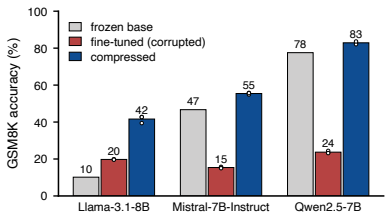
Figure 3 : Compression can repair a corrupted fine-tune.GSM8K accuracy of the frozen model, an adapter trained on permuted rationales, and the same adapter after lossy compression, across three base models.
원문 · CC BY 4.0 · Joey David, Paul Caillon, Alexandre Allauzen · The Behavioral Rate of Fine-Tuning: Compression as a Measure of Useful Information · 원문 그림 인용 · 원본 PDF 6쪽에서 그림 영역을 추출했습니다.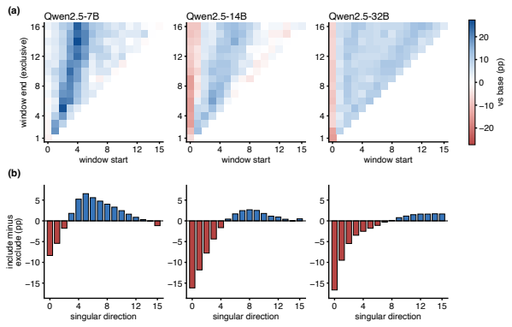
Figure 5 : Corruption is structured across singular directions.(a) Accuracy relative to the frozen model for every contiguous window[i, j)of singular directions retained at full precision. (b) Marginal contribution of each direction, computed by comparing windows that include it with those that do not.
원문 · CC BY 4.0 · Joey David, Paul Caillon, Alexandre Allauzen · The Behavioral Rate of Fine-Tuning: Compression as a Measure of Useful Information · 원문 그림 인용 · 원본 PDF 7쪽에서 그림 영역을 추출했습니다.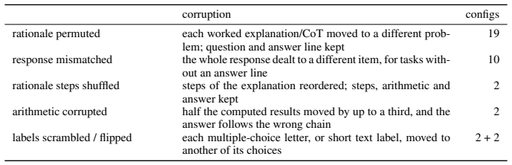
Table 1 :Corruptions used, with the number of configurations that use each.
원문 · CC BY 4.0 · Joey David, Paul Caillon, Alexandre Allauzen · The Behavioral Rate of Fine-Tuning: Compression as a Measure of Useful Information · 원문 그림 인용 · 원본 PDF 14쪽에서 그림 영역을 추출했습니다.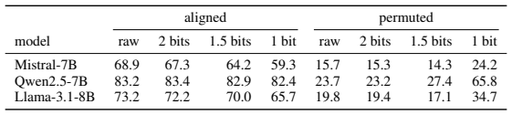
Table 7 : Uniform low-bit coding can itself recover corrupted adapters.GSM8K accuracy (%) of aligned and permuted adapters under three uniform codes, averaged over three seeds. Realized rates are 1.97, 1.50, and 1.02 bits per value.
원문 · CC BY 4.0 · Joey David, Paul Caillon, Alexandre Allauzen · The Behavioral Rate of Fine-Tuning: Compression as a Measure of Useful Information · 원문 그림 인용 · 원본 PDF 23쪽에서 그림 영역을 추출했습니다.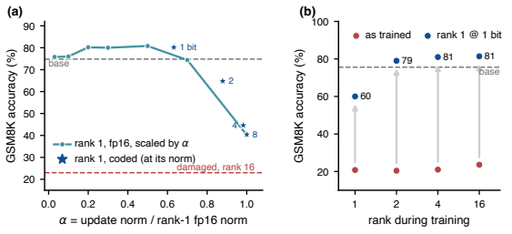
Figure 11 : Shrinkage and training-rank controls.(a) GSM8K accuracy of the full-precision rank-1 update as it is rescaled byα, compared with coded rank-1 updates at their realized norms. (b) GSM8K accuracy after corrupted adapters trained at different ranks are all compressed to the same rank-1, one-bit endpoint.
원문 · CC BY 4.0 · Joey David, Paul Caillon, Alexandre Allauzen · The Behavioral Rate of Fine-Tuning: Compression as a Measure of Useful Information · 원문 그림 인용 · 원본 PDF 24쪽에서 그림 영역을 추출했습니다.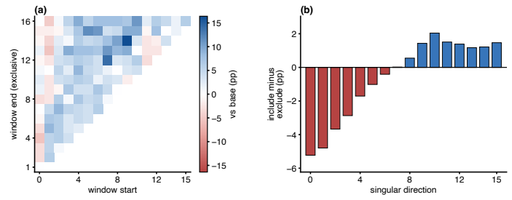
Figure 12 : Directional structure on Mistral-7B-Instruct.(a) Accuracy relative to the frozen model for every contiguous window[i, j)of singular directions retained at full precision. (b) For each direction, mean accuracy of windows containing it minus that of windows excluding it. Results use 128 reserved MetaMathQA examples.
원문 · CC BY 4.0 · Joey David, Paul Caillon, Alexandre Allauzen · The Behavioral Rate of Fine-Tuning: Compression as a Measure of Useful Information · 원문 그림 인용 · 원본 PDF 24쪽에서 그림 영역을 추출했습니다.회복의 범위와 과제 밖 행동
회복된 어댑터는 학습 과제에서만 좋아진 것이 아니라 다른 과제에서도 평가됩니다. 저자들은 72개 프로브에서 압축된 손상 어댑터가 깨끗한 fine-tuning보다 기반 모델에 더 가깝게 남아 있다고 보고합니다. 특히 더 어려운 수학 과제에서 압축된 손상 어댑터는 기반 정확도의 97%를 유지하고, 깨끗한 어댑터는 44%만 유지합니다. 이 결과는 Qwen2.5-7B 중심의 실험과 부록 D.5의 프로브 설정에서 얻어진 것이므로, 모든 모델과 과제로 일반화된 결론은 아닙니다.
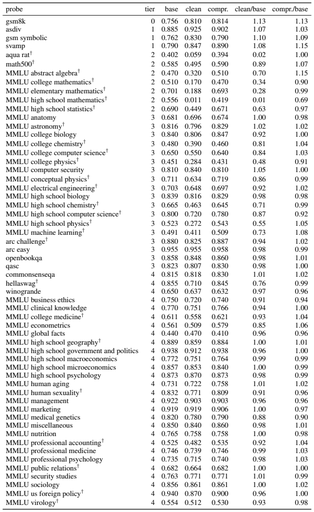
Table 4 :All 72 generalization probes. Accuracy on all rows; the last two columns are, respectively, the held-out half as a fraction of base, where†marks probes the clean adapter hurts on the first half.
원문 · CC BY 4.0 · Joey David, Paul Caillon, Alexandre Allauzen · The Behavioral Rate of Fine-Tuning: Compression as a Measure of Useful Information · 원문 그림 인용 · 원본 PDF 17쪽에서 그림 영역을 추출했습니다.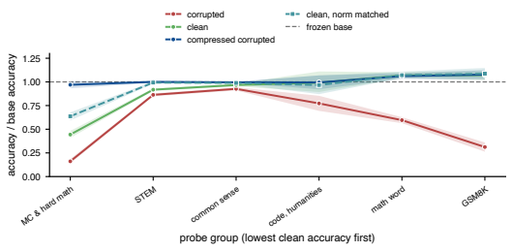
Figure 13 : Off-task behavior after compression-based recovery.Accuracy on 72 probes normalized by the frozen Qwen2.5-7B model and grouped by task proximity to GSM8K. The compressed corrupted adapter remains close to the frozen model away from its training task, unlike the clean fine-tune even under a norm- matched control.
원문 · CC BY 4.0 · Joey David, Paul Caillon, Alexandre Allauzen · The Behavioral Rate of Fine-Tuning: Compression as a Measure of Useful Information · 원문 그림 인용 · 원본 PDF 25쪽에서 그림 영역을 추출했습니다.수신기 의존성과 축소 가능성 규칙
논문은 학습 전 데이터 기반 교정 스펙트럼으로 행동 비율을 예측할 수 있는지도 검토합니다. 같은 수신기 안에서는 log-determinant 계열 통계가 순위를 잘 구분하지만, 수신기를 바꾸면 신뢰성 있게 전이되지 않습니다. 이 때문에 교정 스펙트럼은 수신기 내부의 설명자로 취급됩니다. 반면 학습된 업데이트가 주어지면 R⋆(0.90)≈α90/γ라는 축소 가능성 규칙이 제시됩니다. 여기서 γ는 1비트 코딩이 원래 방향으로 업데이트를 줄이는 정도이고, α90은 원래 업데이트를 스칼라로 축소했을 때 90% 이득을 유지하는 최소 배율입니다. 이 규칙은 다섯 개의 새 수신기에서 42개 체크포인트에 대해 RMSE 0.068 bits per value를 보고하지만, 규칙을 정한 뒤 측정된 기존 행동 비율을 사용하므로 사후 평가로 제시됩니다.
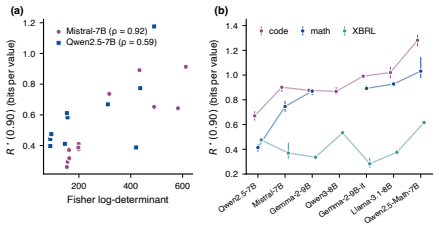
Figure 6 : Behavioral rate is receiver-relative.(a) Correction-spectrum log-determinant againstR ⋆(0.90) within the two development receivers. (b)R ⋆(0.90)for the same three corpora across seven receivers; bars span seeds. The ordering of corpora changes with the receiver.
원문 · CC BY 4.0 · Joey David, Paul Caillon, Alexandre Allauzen · The Behavioral Rate of Fine-Tuning: Compression as a Measure of Useful Information · 원문 그림 인용 · 원본 PDF 8쪽에서 그림 영역을 추출했습니다.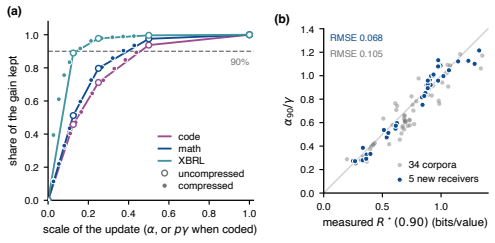
Figure 7 : Behavioral rate tracks update shrinkability.(a) Retained gain for three Llama-3.1-8B adapters when the uncompressed update is scaled byα(lines), together with compressed operating points placed at their effective scalepγ(dots). (b)α 90/γagainst measuredR ⋆(0.90)for 42 checkpoints on five receivers not used to fix the rule (blue) and 58 archived adapters spanning 34 corpora (grey). No regression coefficient is fitted.
원문 · CC BY 4.0 · Joey David, Paul Caillon, Alexandre Allauzen · The Behavioral Rate of Fine-Tuning: Compression as a Measure of Useful Information · 원문 그림 인용 · 원본 PDF 9쪽에서 그림 영역을 추출했습니다.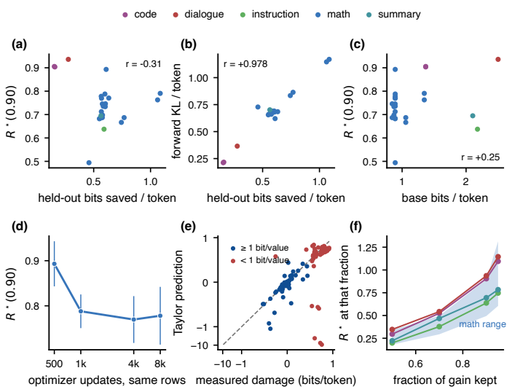
Figure 8 :Candidates for predictors ofR ⋆(0.90), one point per arm (seed means; 24 arms, Mistral-7B). (a) Held-out bits saved:r=−0.31. (b) Forward KL tracks bits saved atr= +0.978, so it is not a second measurement. (c) Base bits per token on the corpus:r= +0.25. (d) Sixteen times the optimizer updates on the same rows lowersR ⋆; bars are seed s.d. (e) Second-order Taylor prediction of the damage against measured damage, symmetric log axes: close above one bit per value, wrong in sign and size below it. (f)R ⋆ at other retention thresholds: code and dialogue sit at the top of the math range at every threshold.
원문 · CC BY 4.0 · Joey David, Paul Caillon, Alexandre Allauzen · The Behavioral Rate of Fine-Tuning: Compression as a Measure of Useful Information · 원문 그림 인용 · 원본 PDF 15쪽에서 그림 영역을 추출했습니다.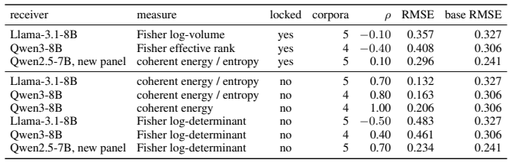
Table 3 :Correction statistics on new receivers.ρ: Spearman between measure andR ⋆(0.90)over natural corpora (seed means). RMSE: absolute prediction from the development fit, against the base-code-length fit. Gate:ρ≥0.70and lower RMSE than base code length.
원문 · CC BY 4.0 · Joey David, Paul Caillon, Alexandre Allauzen · The Behavioral Rate of Fine-Tuning: Compression as a Measure of Useful Information · 원문 그림 인용 · 원본 PDF 16쪽에서 그림 영역을 추출했습니다.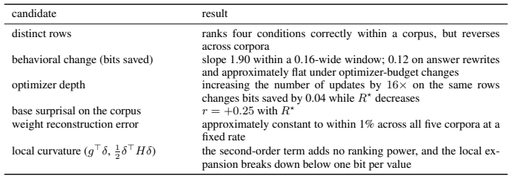
Table 5 : Alternative quantities do not determineR ⋆(0.90).Results cover 81 adapters over five corpora (MetaMathQA, Magicoder, XSum, hh-rlhf, Alpaca) on Mistral-7B and Qwen2.5-7B, together with the broader rate-law audit described in Appendix A.
원문 · CC BY 4.0 · Joey David, Paul Caillon, Alexandre Allauzen · The Behavioral Rate of Fine-Tuning: Compression as a Measure of Useful Information · 원문 그림 인용 · 원본 PDF 21쪽에서 그림 영역을 추출했습니다.결과의 적용 범위
이 연구의 R⋆는 정보 이론적 최적값이 아니라 특정 코덱과 직렬화 방식에 의존하는 운영적 비율입니다. 교정 스펙트럼 통계는 수신기 사이에서 일관되게 전이되지 않았고, 축소 규칙은 사후 평가에 머물러 있습니다. 또한 손상 실험은 의도적으로 섞은 지도 신호를 사용하므로, 자연스럽게 발생하는 fine-tuning 오류에도 같은 구조가 성립하는지는 아직 확인되지 않았습니다.
논문 정보
- 저자
- Joey David, Paul Caillon, Alexandre Allauzen
- 학회·저널
- arXiv · 프리프린트
- 최초 공개일
- 2026년 11월 4일
- 등록일
- 2026년 11월 6일
- 수정일
- 2026년 11월 4일
- 버전
- v1
- arXiv
- 2611.06598
- 분류
- cs.LG
- 원문 이용 조건
- CC BY 4.0
- 제공 범위
- 논문 정보, 해설, 허용된 원문 그림
AI 해설은 논문 원문과 별개의 설명이며 오류가 있을 수 있습니다. 원문과 그림은 각 출처의 이용 조건과 따로 표시된 권리를 따릅니다.
초록
Low-Rank Adaptation (LoRA) adapts a frozen language model through a compact learned update, making it a natural setting for asking how much information fine-tuning needs to write. Yet adapter rank, parameter count, or numerical reconstruction error do not directly tell us how many bits are required to preserve the acquired behavior. We therefore define an operational behavioral rate $R^\star$ as the smallest serialized size of a compressed adapter that, once reloaded into the frozen base model, retains a fixed fraction of its held-out fine-tuning gain. Across LoRA fine-tuning experiments, this rate increases with distinct training content at fixed optimization budgets, but is not determined by intuitive metrics like source description length, fine-tuning gain, or weight-space reconstruction error. Most importantly, the same datasets exhibit substantially different, and even reordered, rates across frozen base models, showing that fine-tuning compressibility is a property of the dataset--receiver pair rather than of the dataset alone. However, we show that correction spectra measured on the data are able to rank these rates within a receiver. Finally, we study a striking noise-reducing effect of compression: adapters trained on deliberately corrupted datasets fall far below the frozen model, yet after compression score above it (23.7% to 82.9% on GSM8K, against 77.6% for frozen Qwen2.5-7B), consistently across tested families and sizes. The damage is unevenly concentrated in the adapter's leading singular directions, which compression appears to filter. Away from its training task, the compressed corrupted adapter also generalizes better than a clean fine-tune: on harder math it retains 97% of base accuracy, versus 44% for the clean adapter.
원문 인용
Joey David, Paul Caillon, Alexandre Allauzen (2026). The Behavioral Rate of Fine-Tuning: Compression as a Measure of Useful Information. arXiv:2611.06598v1. https://arxiv.org/abs/2611.06598v1
BibTeX
@misc{david2026behavioral,
  title = {{The Behavioral Rate of Fine-Tuning: Compression as a Measure of Useful Information}},
  author = {Joey David and Paul Caillon and Alexandre Allauzen},
  year = {2026},
  eprint = {2611.06598},
  archivePrefix = {arXiv},
  url = {https://arxiv.org/abs/2611.06598v1}
}