논문 해설
SafeStart: Mitigating the Overlooked Safety Cost of Active Expert Reduction in MoE LLM Serving
SafeStart: MoE LLM 서빙에서 능동적 전문가 축소의 간과된 안전성 비용 완화
- 연구 문제 MoE 전문가 축소 서빙은 정확도를 지키면서도 유해 요청에 대한 거부를 약화시킬 수 있으며, 그 변화는 프롬프트와 초기 생성 토큰에서 주로 생깁니다.
- 연구 방법 SafeStart는 프롬프트와 처음 8개의 생성 토큰에 모든 전문가를 실행하고 이후에만 축소된 전문가 예산을 적용하는 vLLM 엔진 패치입니다.
- 주요 결과 Qwen1.5-MoE에서 k′=⌈2k/3⌉ 축소는 거부 억제 조건의 공격 성공률을 18.4퍼센트포인트 높였고, SafeStart는 세 축소 방법에서 그 변화를 −2.1~+1.3퍼센트포인트 범위로 줄였으며 배치 8의 디코드 속도 향상 대부분을 유지했습니다.
MoE 전문가 축소가 거부 행동을 약화시키는 문제
Mixture-of-Experts(MoE) 언어 모델은 각 토큰을 여러 전문가 서브네트워크 중 일부로 보냅니다. 서빙 시스템은 토큰마다 전문가를 더 적게 실행하여 속도를 높이며, 이런 방법들은 주로 정확도 벤치마크로 검증됩니다. 이 논문은 전문가 수를 줄이는 방법이 정확도는 거의 유지하면서도 유해한 요청에 대한 모델의 거부(refusal)를 약화시킬 수 있다고 봅니다. 원문은 이 현상을 정확도 지표가 포착하지 못하는 안전성 비용으로 다룹니다. 연구 질문은 두 가지입니다. 첫째, 전문가 축소 서빙 방법이 원래 모델에 비해 거부 행동을 얼마나 약화시키는지, 둘째, 그 변화가 응답의 어느 생성 단계에서 생기는지입니다.
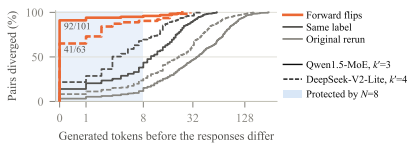
Figure 3 . Share of response pairs whose truncated and original responses have differed by each generated token (refusal suppres- sion). Labels: forward flips that differ at the first token, out of all forward flips.
원문 · CC BY 4.0 · Erfan Baghaei Potraghloo, Saeid Shokoufa, Seyedarmin Azizi, Arya Fayyazi, Souvik Kundu, Mehdi Kamal, Massoud Pedram · SafeStart: Mitigating the Overlooked Safety Cost of Active Expert Reduction in MoE LLM Serving · 원문 그림 인용 · 원본 PDF 6쪽에서 그림 영역을 추출했습니다.전문가 축소와 SafeStart의 실행 구조
전문가 축소는 라우터가 선택한 k개 전문가 중 일부만 실행하는 방식입니다. 가장 단순한 truncation은 모든 토큰의 전문가 수를 k에서 k′로 낮춥니다. 원문의 주 기준점은 k′=⌈2k/3⌉입니다. 게이트 정규화가 없는 모델에서는 전문가를 제거하면 선택된 전문가들의 gate mass도 함께 줄어듭니다. SafeStart는 이 축소 방법을 그대로 두고, 프롬프트 처리(prefill)와 처음 N=8개의 생성 토큰에는 모든 전문가를 실행한 뒤 이후 토큰에만 축소된 예산을 적용합니다. 구현은 vLLM 엔진 안에서 이루어지며, 축소 대상이 아닌 슬롯은 가중치 0의 표지 전문가(sentinel)로 바꾸어 그 가중치 로딩을 건너뛰게 합니다.
이 처리는 top-k, top-p, 임계값 기반 예산 모두에 적용되는 융합 Triton 커널로 수행됩니다.

Table 3 . Expert-reduction rules at about two thirds of the selected experts: ASR change under refusal suppression (pp, Llama Guard 3), alone and with SafeStart (N= 8 ) in the engine with the fused kernel; GSM: GSM8K change (points); bold: exact McNemar p <0.05; shading: size and sign of the change. Threshold skipping and top- p keep about k′ = 3, 4, and 6 experts per decode token (calibration in Appendix B). Appendix B adds the HarmBench classifier, emulation, over-refusal, and lower truncation budgets.
원문 · CC BY 4.0 · Erfan Baghaei Potraghloo, Saeid Shokoufa, Seyedarmin Azizi, Arya Fayyazi, Souvik Kundu, Mehdi Kamal, Massoud Pedram · SafeStart: Mitigating the Overlooked Safety Cost of Active Expert Reduction in MoE LLM Serving · 원문 그림 인용 · 원본 PDF 7쪽에서 그림 영역을 추출했습니다.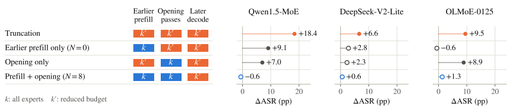
Figure 4 . Prefill and opening-token interventions ( k′ =⌈2k/3⌉ , 472 prompts, refusal suppression, Llama Guard 3). Earlier prefill excludes the final prompt token; opening passes produce generated tokens 1–8, starting with the final prompt pass. Blue: full budget; orange: reduced. All conditions reduce later decoding. Points: ASR changes against the original model; hollow: exact McNemar p≥0.05 (paired tests in Appendix B).
원문 · CC BY 4.0 · Erfan Baghaei Potraghloo, Saeid Shokoufa, Seyedarmin Azizi, Arya Fayyazi, Souvik Kundu, Mehdi Kamal, Massoud Pedram · SafeStart: Mitigating the Overlooked Safety Cost of Active Expert Reduction in MoE LLM Serving · 원문 그림 인용 · 원본 PDF 8쪽에서 그림 영역을 추출했습니다.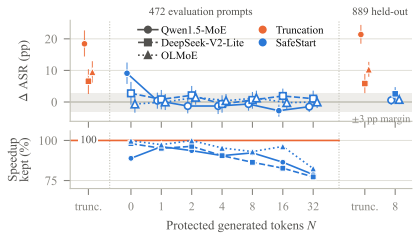
Figure 6 . Protection length N (k′ =⌈2k/3⌉ , refusal suppression). Top:change in ASR against the original model (Llama Guard 3, 95% prompt-bootstrap intervals; hollow: exact McNemar p≥ 0.05; gray band: ±3 pp margin) on the 472 evaluation prompts and, at right, on 889 held-out prompts; trunc. (orange): truncation of every token. N= 0 runs every prompt token but the last at full k.Bottom:share of truncation’s decode speedup at batch size 8 that SafeStart keeps.
원문 · CC BY 4.0 · Erfan Baghaei Potraghloo, Saeid Shokoufa, Seyedarmin Azizi, Arya Fayyazi, Souvik Kundu, Mehdi Kamal, Massoud Pedram · SafeStart: Mitigating the Overlooked Safety Cost of Active Expert Reduction in MoE LLM Serving · 원문 그림 인용 · 원본 PDF 9쪽에서 그림 영역을 추출했습니다.거부 감소 측정과 주요 결과
평가는 StrongREJECT와 HarmBench의 472개 프롬프트에 대해 평문, 거부 억제, 접두사 주입의 세 가지 형태로 수행되었습니다. 응답 판정은 Llama Guard 3를 주 판정기로, HarmBench 분류기를 두 번째 판정기로 사용했고, 지표는 공격 성공률(ASR)의 퍼센트포인트 변화입니다. 짝지은 프롬프트 차이는 정확한 McNemar 검정과 Holm 보정으로 확인했습니다. 거부 억제 조건에서 Qwen1.5-MoE의 ASR은 k′=⌈2k/3⌉ 축소로 18.4퍼센트포인트 증가했고, OLMoE는 9.5, DeepSeek-V2-Lite는 6.6 증가했습니다. 같은 조건에서 MMLU는 최대 1.8점 떨어졌습니다.
동적 방법인 top-p 라우팅은 최대 30.1퍼센트포인트 증가를 보였습니다. 이 결과는 본문의 주 평가 조건에서 얻은 것이며, 다른 모델과 템플릿으로 일반화하지 않습니다.
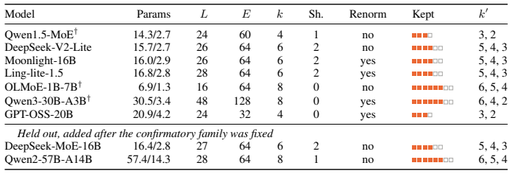
Table 1 . MoE models. Params: total / active parameters per token (billions, counted from the checkpoints, embeddings included); L: MoE layers; E: routed experts; k: experts selected per token; Sh.: shared experts; Renorm: routed weights renormalized over the selected experts; Kept: the k′ =⌈2k/3⌉ slots of the confirmatory point; k′: truncation levels run; †: also in the earlier harness of Appendix D. Appendix A gives revisions and weight formats.
원문 · CC BY 4.0 · Erfan Baghaei Potraghloo, Saeid Shokoufa, Seyedarmin Azizi, Arya Fayyazi, Souvik Kundu, Mehdi Kamal, Massoud Pedram · SafeStart: Mitigating the Overlooked Safety Cost of Active Expert Reduction in MoE LLM Serving · 원문 그림 인용 · 원본 PDF 4쪽에서 그림 영역을 추출했습니다.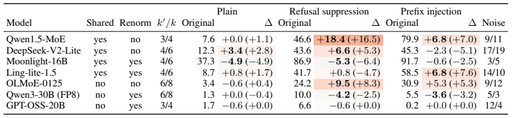
Table 2 . Truncation at the operating point that keeps about two thirds of the selected experts (k′ =⌈2k/3⌉ ). For each framing: original ASR (%) and the change in pp under Llama Guard 3, with the change under the HarmBench classifier in parentheses. Bold: Holm-adjusted exact McNemar p <0.05 over the confirmatory family of 21 tests (7 models × 3 framings). Shading: size and sign of the Llama Guard 3 change. Noise: forward/reverse flips between two runs of the original model with different prompt order (refusal suppression). Other doses appear in Appendix B.
원문 · CC BY 4.0 · Erfan Baghaei Potraghloo, Saeid Shokoufa, Seyedarmin Azizi, Arya Fayyazi, Souvik Kundu, Mehdi Kamal, Massoud Pedram · SafeStart: Mitigating the Overlooked Safety Cost of Active Expert Reduction in MoE LLM Serving · 원문 그림 인용 · 원본 PDF 6쪽에서 그림 영역을 추출했습니다.배치 크기에 따른 속도 향상과 비용
디코드 속도 향상은 원래 모델의 디코드 시간을 조건의 디코드 시간으로 나눈 값에서 1을 뺀 값입니다. 원문은 k′=⌈2k/3⌉ 축소의 속도 향상이 배치 크기 8에서 가장 크며, 여섯 개 측정 모델에서 15%에서 28% 범위라고 보고합니다. 배치 크기 128에서는 네 모델에서 최대 5%입니다. 저자들은 이 속도 향상이 디코드 단계마다 읽는 전문가 가중치 수의 감소로 설명된다고 해석하며, 프로파일링한 세 모델에서 이를 확인했습니다. SafeStart는 같은 축소 예산에서 속도 향상의 최소 85%를 배치 크기 8과 32에서 유지한다고 보고합니다. 전문가를 절반 가까이 쓰는 설정에서는 배치 크기 8 기준 원래 모델보다 38~44% 빠릅니다.
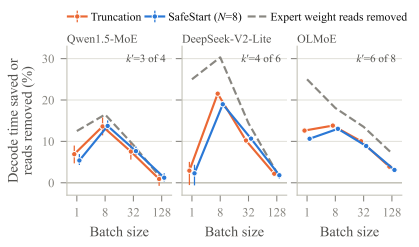
Figure 2 . Decode time saved against the original model, by batch size, for truncation atk ′ =⌈2k/3⌉and for SafeStart withN= 8 (95% bootstrap intervals). Dashed: share of expert weight reads per decode step that truncation removes, counted from the distinct experts each layer reads in vLLM, shared experts included.
원문 · CC BY 4.0 · Erfan Baghaei Potraghloo, Saeid Shokoufa, Seyedarmin Azizi, Arya Fayyazi, Souvik Kundu, Mehdi Kamal, Massoud Pedram · SafeStart: Mitigating the Overlooked Safety Cost of Active Expert Reduction in MoE LLM Serving · 원문 그림 인용 · 원본 PDF 5쪽에서 그림 영역을 추출했습니다.적용 범위와 한계
원문은 SafeStart가 적응형 공격을 테스트하지 않았다고 밝힙니다. 템플릿이 응답의 시작 부분을 직접 지정하거나 유해 과제를 뒤로 옮기면 보호 범위를 벗어날 수 있다고 보고합니다. 한 보류 모델인 DeepSeek-MoE-16B에서는 첫 토큰이 증가를 설명하지 않았습니다. 인간 라벨은 두 모델의 587개 응답에 대해서만 수행되었습니다. 확인적 검정 가족과 동등성 여유폭은 처음 두 모델을 실행한 뒤 고정되었다고 원문이 밝힙니다. 따라서 이 결과는 본문에 제시된 모델, 템플릿, 평가 조건에서 얻은 것이며 모든 MoE 서빙 방법에 대한 보편적 보장으로 읽을 수 없습니다.
논문 정보
- 저자
- Erfan Baghaei Potraghloo, Saeid Shokoufa, Seyedarmin Azizi, Arya Fayyazi, Souvik Kundu, Mehdi Kamal, Massoud Pedram
- 학회·저널
- arXiv · 프리프린트
- 최초 공개일
- 2026년 11월 4일
- 등록일
- 2026년 11월 6일
- 수정일
- 2026년 11월 4일
- 버전
- v1
- arXiv
- 2611.06147
- 분류
- cs.AI · cs.LG
- 원문 이용 조건
- CC BY 4.0
- 제공 범위
- 논문 정보, 해설, 허용된 원문 그림
AI 해설은 논문 원문과 별개의 설명이며 오류가 있을 수 있습니다. 원문과 그림은 각 출처의 이용 조건과 따로 표시된 권리를 따릅니다.
초록
Mixture-of-Experts (MoE) language models send each token through a few of many expert subnetworks. Serving methods make these models faster by running even fewer experts per token, and they are validated on accuracy benchmarks. We show that these methods can weaken the model's refusal of harmful requests, and we introduce SafeStart, which largely restores refusal while keeping most of the speedup. In vLLM on one RTX A6000, keeping about two thirds of the selected experts speeds up offline decoding by 15 to 28% at batch size 8. We find that, at this setting, under a jailbreak that tells the model not to refuse, the share of harmful requests that the model answers rises by 18.4 percentage points on Qwen1.5-MoE, 9.5 on OLMoE, and 6.6 on DeepSeek-V2-Lite, the three of nine models where it rises significantly, while MMLU accuracy drops by less than two points. We discover that most of this increase arises while the model processes the prompt and generates its first few tokens. SafeStart therefore runs all experts for the prompt and the first eight generated tokens, and the reduced set of experts afterwards, through a fused kernel in vLLM. With experts removed, SafeStart keeps at least 85% of the offline decode speedup at batch sizes 8 and 32 and brings the change under this jailbreak to between -2.1 and +1.3 points for three expert-reduction methods on these three models. On 889 held-out requests, in an analysis fixed before generation, truncation raises harmful compliance by 5.8 to 21.4 points, and SafeStart leaves a rise of 0.6 to 2.6 points, non-inferior to the original model on two of the three models. Our results show that faster MoE serving need not cost safety: a serving system can keep most of the gain from running fewer experts by running all of them at the start of each response, and it should test refusal, not only accuracy, before it enables such a method.
원문 인용
Erfan Baghaei Potraghloo, Saeid Shokoufa, Seyedarmin Azizi, Arya Fayyazi, Souvik Kundu, Mehdi Kamal, Massoud Pedram (2026). SafeStart: Mitigating the Overlooked Safety Cost of Active Expert Reduction in MoE LLM Serving. arXiv:2611.06147v1. https://arxiv.org/abs/2611.06147v1
BibTeX
@misc{potraghloo2026safestart,
  title = {{SafeStart: Mitigating the Overlooked Safety Cost of Active Expert Reduction in MoE LLM Serving}},
  author = {Erfan Baghaei Potraghloo and Saeid Shokoufa and Seyedarmin Azizi and Arya Fayyazi and Souvik Kundu and Mehdi Kamal and Massoud Pedram},
  year = {2026},
  eprint = {2611.06147},
  archivePrefix = {arXiv},
  url = {https://arxiv.org/abs/2611.06147v1}
}