논문 해설
Learning Generalized Spatial-Temporal Deep Feature Representation for No-Reference Video Quality Assessment
무참조 비디오 품질 평가를 위한 일반화된 시공간 심층 특징 표현 학습
- 연구 문제 비디오 품질 평가에서 학습 데이터와 다른 콘텐츠·해상도·프레임률의 비디오에 대해 품질을 예측하는 일반화 능력이 핵심 문제입니다.
- 연구 방법 사전 학습된 VGG16의 다중 스케일 평균·표준편차 특징에 주의 가중치를 적용하고, GRU와 적대적 학습으로 가우시안 분포 정규화를 수행한 뒤 피라미드 시간 집계로 비디오 점수를 예측합니다.
- 주요 결과 네 개의 교차 데이터셋 설정에서 개별 설정의 최고 성능을 보고하며, 인트라 데이터셋에서는 두 번째로 좋은 전체 성능을 보입니다. 분포 정규화를 제거하면 SROCC와 PLCC가 낮아집니다.
교차 도메인 비디오 품질 예측의 어려움
비디오 품질 평가(VQA)는 사람의 지각 품질을 자동으로 예측하는 과제이며, 참조 영상 없이 품질을 추정하는 NR-VQA는 실제 응용에서 특히 중요합니다. 기존의 많은 NR-VQA 방법은 학습 데이터와 테스트 데이터가 비슷한 특징 공간에 있다고 가정하고 학습합니다. 그러나 콘텐츠, 해상도, 프레임률, 촬영 기기와 압축 조건이 달라지면 학습 데이터와 테스트 데이터의 분포가 달라지고, 이때 예측 정확도가 크게 떨어질 수 있습니다. 이 논문은 이러한 일반화 문제를 중심 질문으로 삼아, 학습에 쓰지 않은 분포의 비디오에서도 품질을 잘 예측하는 특징 표현을 학습할 수 있는지 검증합니다.
공간 특징 추출과 가우시안 정규화
제안 모델은 사전 학습된 VGG16에서 여러 단계의 특징을 얻고, 각 단계에 평균과 표준편차 풀링을 적용합니다. 평균 특징은 의미 정보와 밀접하여 바로 연결하면 학습 장면에 과적합될 수 있다고 저자들은 해석합니다. 그래서 시간 축 표준편차로 계산한 주의 가중치를 표준편차 특징의 채널에 곱해 프레임별 품질 표현을 만듭니다. 이후 프레임 특징은 완전연결 층과 GRU를 거쳐 프레임 수준 특징이 되고, 이 특징의 평균 Favg는 생성기로 취급되어 사전 가우시안 분포의 표본과 구별되도록 적대적으로 학습됩니다. 학습 가능한 평균과 분산을 갖는 분포를 사용하며, 표준 가우시안으로 모든 차원을 같은 평균과 분산에 묶는 것은 강한 제약이라고 논문은 주장합니다.
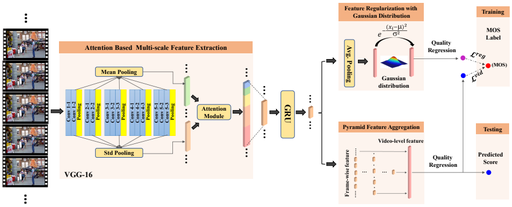
Fig. 1 : The framework of the proposed generalized NR-VQA model. For each frame of the input video, we first utilize the pre-trained VGG16 network to extract the multi-scale features with an attention module. Subsequently, the extracted features are further processed by a fully connected layer to reduce its dimension, followed by a GRU module to acquire the frame-level quality features. We further regularize the frame-level quality features by forcing the features to obey Gaussian distributions via adversarial learning. Finally, a pyramid pooling strategy is utilized for temporal quality aggregation inspired by short-term and long-term memory effects.
원문 · CC BY 4.0 · Baoliang Chen, Lingyu Zhu, Guo Li, Hongfei Fan, Shiqi Wang · Learning Generalized Spatial-Temporal Deep Feature Representation for No-Reference Video Quality Assessment · 원문 그림 인용 · 원본 PDF 4쪽에서 그림 영역을 추출했습니다.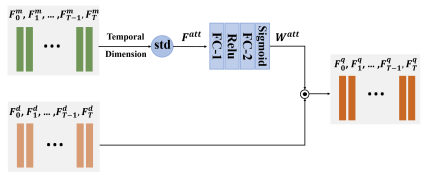
Fig. 2 : Illustration of the attention module for feature extrac- tion.
원문 · CC BY 4.0 · Baoliang Chen, Lingyu Zhu, Guo Li, Hongfei Fan, Shiqi Wang · Learning Generalized Spatial-Temporal Deep Feature Representation for No-Reference Video Quality Assessment · 원문 그림 인용 · 원본 PDF 4쪽에서 그림 영역을 추출했습니다.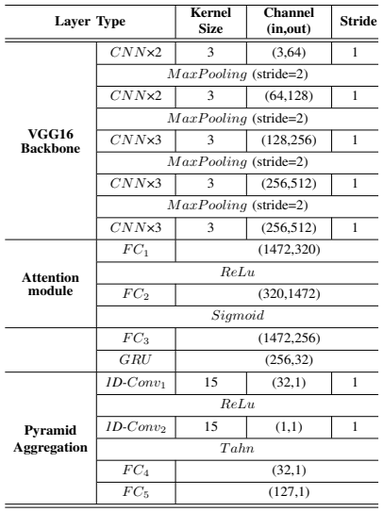
원문 그림 TABLE I: Architecture of the network in the proposed method.
원문 · CC BY 4.0 · Baoliang Chen, Lingyu Zhu, Guo Li, Hongfei Fan, Shiqi Wang · Learning Generalized Spatial-Temporal Deep Feature Representation for No-Reference Video Quality Assessment · 원문 그림 인용 · 원본 PDF 6쪽에서 그림 영역을 추출했습니다.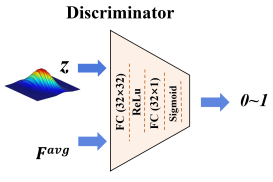
Fig. 5 : The architecture of the proposed discriminator.
원문 · CC BY 4.0 · Baoliang Chen, Lingyu Zhu, Guo Li, Hongfei Fan, Shiqi Wang · Learning Generalized Spatial-Temporal Deep Feature Representation for No-Reference Video Quality Assessment · 원문 그림 인용 · 원본 PDF 7쪽에서 그림 영역을 추출했습니다.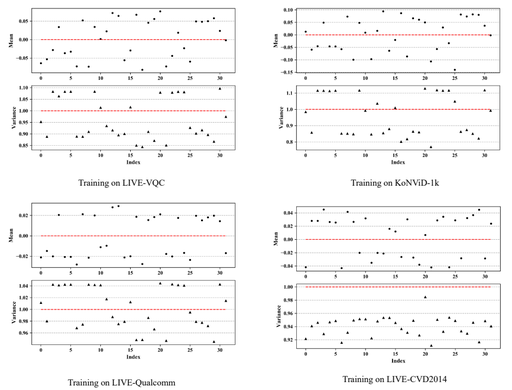
Fig. 7 : Mean and variance of each dimension of Favg in Eqn. (8). The dataset used for training is provided under each sub-figure.
원문 · CC BY 4.0 · Baoliang Chen, Lingyu Zhu, Guo Li, Hongfei Fan, Shiqi Wang · Learning Generalized Spatial-Temporal Deep Feature Representation for No-Reference Video Quality Assessment · 원문 그림 인용 · 원본 PDF 12쪽에서 그림 영역을 추출했습니다.피라미드 시간 집계
시간 축에서는 짧은 시간 구간과 긴 시간 구간의 품질 지각을 모방한 피라미드 집계를 사용합니다. 각 프레임 특징에 주변 k개 프레임을 반영한 가중치를 1D 합성곱으로 계산하고, 활성화 함수 Tanh와 ReLU를 거친 뒤 가중된 프레임 특징을 만듭니다. 이후 여러 계층에서 비디오를 2^(m-1)개의 시간 구간으로 나누어 구간별 평균을 구하고, 모든 계층의 결과를 연결하여 프레임 수와 프레임률에 독립적인 비디오 수준 특징을 얻습니다. 마지막으로 완전연결 층을 두 번 통과하여 품질 점수 Qvid를 예측합니다. 학습 손실은 비디오 수준 예측과 프레임 수준 회귀, 그리고 분포 정규화 항을 함께 사용합니다.
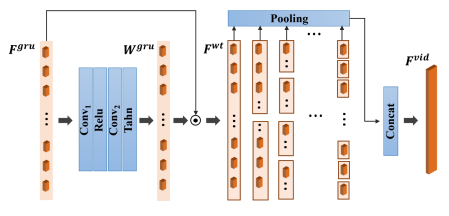
Fig. 3 : Illustration of PFA module.
원문 · CC BY 4.0 · Baoliang Chen, Lingyu Zhu, Guo Li, Hongfei Fan, Shiqi Wang · Learning Generalized Spatial-Temporal Deep Feature Representation for No-Reference Video Quality Assessment · 원문 그림 인용 · 원본 PDF 5쪽에서 그림 영역을 추출했습니다.교차 데이터셋과 인트라 데이터셋 결과
교차 데이터셋 실험은 KoNViD-1k, LIVE-Qualcomm, LIVE-VQC, CVD2014 중 하나에서 학습하고 나머지 세 데이터셋에서 테스트하는 설정입니다. 비교 대상에는 NR-IQA 방법과 NR-VQA 방법이 포함되며, 딥러닝 기반 NR-IQA 모델은 학습 비디오에서 초당 두 프레임을 추출하고 MOS를 프레임 점수로 사용합니다. 저자들은 네 설정 각각에서 개별 설정의 최고 성능을 보고합니다. 인트라 데이터셋 실험은 각 데이터셋의 80%로 학습하고 20%로 테스트하는 절차를 10회 반복하여 평균과 표준편차를 제시합니다. 이 실험에서 제안 모델은 전체 성능에서 두 번째로 좋은 결과를 보이며, LIVE-Qualcomm과 KoNViD-1k에서는 CNN-TLVQM과 비슷한 성능을 보입니다.
이 결과는 특정 데이터셋, 지표와 비교 방법의 조건에서 얻은 것입니다.
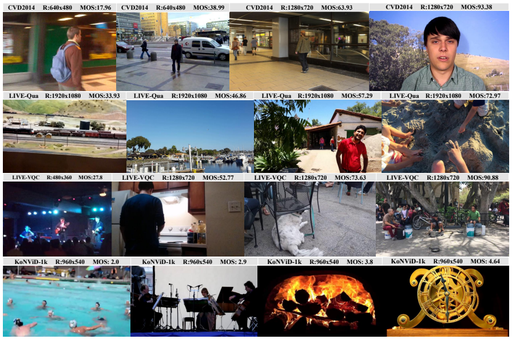
Fig. 4 : Sample frames from four video datasets. The corresponding resolution ( R) and MOS values are also provided.
원문 · CC BY 4.0 · Baoliang Chen, Lingyu Zhu, Guo Li, Hongfei Fan, Shiqi Wang · Learning Generalized Spatial-Temporal Deep Feature Representation for No-Reference Video Quality Assessment · 원문 그림 인용 · 원본 PDF 7쪽에서 그림 영역을 추출했습니다.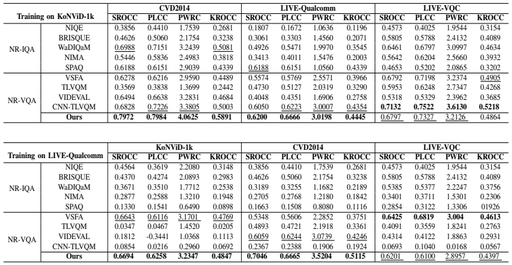
원문 그림 TABLE II: Performance comparisons on four datasets with cross-dataset settings. In each column, the best and second-best values are marked in boldface and underlined, respectively.
원문 · CC BY 4.0 · Baoliang Chen, Lingyu Zhu, Guo Li, Hongfei Fan, Shiqi Wang · Learning Generalized Spatial-Temporal Deep Feature Representation for No-Reference Video Quality Assessment · 원문 그림 인용 · 원본 PDF 8쪽에서 그림 영역을 추출했습니다.구성요소 제거 실험
절제 실험은 KoNViD-1k로 학습하고 나머지 세 데이터셋에서 테스트하는 설정에서 수행되었습니다. Concat 변형은 평균과 표준편차 특징을 주의 없이 연결하며, Ours w/o PyramidPooling은 피라미드 풀링을 제거하고, Ours w/o Distribution은 분포 정규화 모듈을 제거한 모델입니다. 분포 정규화를 제거한 모델은 원래 모델보다 SROCC와 PLCC가 낮게 보고됩니다. 이 결과는 분포 정규화를 유지하는 것이 이 설정에서 도움이 됨을 보여 주지만, 해당 설정 밖의 모든 조건에서 같은 기여가 있다는 증명은 아닙니다. 피라미드 풀링 제거 실험의 해석과 나머지 세부 수치는 해당 표의 조건에 따라 읽어야 합니다.
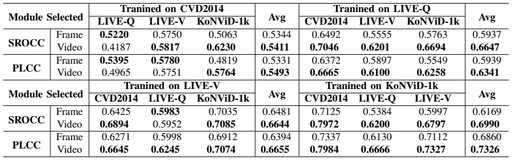
원문 그림 TABLE III: Performance comparisons on four datasets with cross-dataset settings. The “Frame” represents the output of feature regularization module and “Video” represents the output of feature aggregation module. The numbers in bold are the best results.
원문 · CC BY 4.0 · Baoliang Chen, Lingyu Zhu, Guo Li, Hongfei Fan, Shiqi Wang · Learning Generalized Spatial-Temporal Deep Feature Representation for No-Reference Video Quality Assessment · 원문 그림 인용 · 원본 PDF 9쪽에서 그림 영역을 추출했습니다.적용 범위와 한계
저자들은 CVD2014 학습 설정이 234개 비디오와 5개 장면만 포함하여 데이터가 제한적이고 과적합 문제가 발생한다고 보고합니다. 이 설정에서도 제안 모델은 두 번째로 좋은 VSFA보다 큰 차이를 보인다고 제시됩니다. 또한 LIVE-Qualcomm 데이터셋은 촬영 왜곡이 많아 주관 실험과 객관 평가 모두에 어려운 데이터로 설명됩니다. 결과는 제시된 네 개의 실제 비디오 데이터셋과 선택된 비교 방법에 한정되며, 기준 참조가 없는 품질 예측의 범위 밖 응용은 본문에서 다루지 않습니다.
논문 정보
- 저자
- Baoliang Chen, Lingyu Zhu, Guo Li, Hongfei Fan, Shiqi Wang
- 학회·저널
- arXiv · 프리프린트
- 최초 공개일
- 2020년 12월 27일
- 등록일
- 2026년 11월 6일
- 수정일
- 2021년 6월 22일
- 버전
- v2
- arXiv
- 2012.13936
- 분류
- eess.IV · cs.CV
- 원문 이용 조건
- CC BY 4.0
- 제공 범위
- 논문 정보, 해설, 허용된 원문 그림
AI 해설은 논문 원문과 별개의 설명이며 오류가 있을 수 있습니다. 원문과 그림은 각 출처의 이용 조건과 따로 표시된 권리를 따릅니다.
초록
In this work, we propose a no-reference video quality assessment method, aiming to achieve high-generalization capability in cross-content, -resolution and -frame rate quality prediction. In particular, we evaluate the quality of a video by learning effective feature representations in spatial-temporal domain. In the spatial domain, to tackle the resolution and content variations, we impose the Gaussian distribution constraints on the quality features. The unified distribution can significantly reduce the domain gap between different video samples, resulting in a more generalized quality feature representation. Along the temporal dimension, inspired by the mechanism of visual perception, we propose a pyramid temporal aggregation module by involving the short-term and long-term memory to aggregate the frame-level quality. Experiments show that our method outperforms the state-of-the-art methods on cross-dataset settings, and achieves comparable performance on intra-dataset configurations, demonstrating the high-generalization capability of the proposed method.
원문 인용
Baoliang Chen, Lingyu Zhu, Guo Li, Hongfei Fan, Shiqi Wang (2020). Learning Generalized Spatial-Temporal Deep Feature Representation for No-Reference Video Quality Assessment. arXiv:2012.13936v2. https://arxiv.org/abs/2012.13936v2
BibTeX
@misc{chen2020learning,
  title = {{Learning Generalized Spatial-Temporal Deep Feature Representation for No-Reference Video Quality Assessment}},
  author = {Baoliang Chen and Lingyu Zhu and Guo Li and Hongfei Fan and Shiqi Wang},
  year = {2020},
  eprint = {2012.13936},
  archivePrefix = {arXiv},
  url = {https://arxiv.org/abs/2012.13936v2}
}