논문 해설
DRLinFluids -- An open-source python platform of coupling Deep Reinforcement Learning and OpenFOAM
DRLinFluids -- 심층 강화학습과 OpenFOAM을 결합한 오픈소스 Python 플랫폼
- 연구 문제 DRL을 유체역학 문제에 적용하려면 CFD 환경을 직접 구성해야 하며 검증된 범용 솔버와 연결하는 데 많은 노력이 듭니다. 이 논문은 OpenFOAM을 환경으로 쓰는 오픈소스 파이썬 플랫폼 DRLinFluids를 제시합니다.
- 연구 방법 DRLinFluids는 저수준 RL-OpenFOAM 클래스와 고수준 학습 플랫폼으로 구성되며, Tensorforce의 PPO와 Tianshou의 SAC를 백엔드로 사용합니다.
- 주요 결과 Re=100의 원형 실린더 사례에서 평균 항력계수가 3.205에서 2.95로 줄어 약 8%의 감소가 보고되었고, 정사각 실린더 사례에서는 평균 항력계수가 1.549에서 1.337로 줄어 13.7%(결론부 13.6%)의 감소가 보고되었습니다.
OpenFOAM 기반 DRL 유동 제어의 진입 장벽
기존 DRL 유동 제어 연구는 대개 연구자가 직접 작성한 PDE solver를 환경으로 사용했습니다. 이 방식은 효율과 신뢰성을 갖춘 OpenFOAM 같은 범용 CFD 솔버에 비해 구현과 검증에 많은 노력이 듭니다. DRLinFluids는 OpenFOAM을 강화학습의 상호작용 환경으로 쓰고, Tensorforce 또는 Tianshou를 학습 백엔드로 연결하는 오픈소스 파이썬 플랫폼으로 제시됩니다. 이 연구의 범위는 플랫폼의 구현과 두 가지 저Reynolds 수(Re=100) 실린더 유동 제어 사례를 통한 타당성 검증입니다. 다른 CFD 문제나 3차원 문제까지 검증한 것은 아닙니다. 강화학습에서는 에이전트가 환경과 상호작용하며 누적 보상을 최대화하는 정책을 학습합니다.
제어 이론의 용어로 보면 보상은 비용 함수, 에이전트는 액추에이터, 환경은 측정 신호, 정책은 피드백 법칙에 대응합니다.
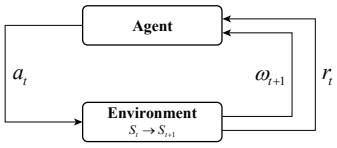
Figure 1 : Interaction of agent and environment in reinforcement learning
원문 · CC BY 4.0 · Qiulei Wang, Lei Yan, Gang Hu, Chao Li, Yiqing Xiao, Hao Xiong, Jean Rabault, Bernd R. Noack · DRLinFluids -- An open-source python platform of coupling Deep Reinforcement Learning and OpenFOAM · 원문 그림 인용 · 원본 PDF 2쪽에서 그림 영역을 추출했습니다.플랫폼의 구조와 두 계층
DRLinFluids는 저수준의 RL-OpenFOAM 클래스와 고수준의 학습·평가 플랫폼으로 나뉩니다. RL 클래스는 Gym 환경으로 정의되며 execute와 reset 멤버 함수를 제공합니다. 입력으로는 환경 파라미터, 상태 프로브의 종류와 위치, 행동의 범위와 상호작용 주기, 제트 속도 같은 학습 파라미터를 받습니다. 저수준 클래스는 OpenFOAM 설정 파일을 정규표현식과 템플릿 엔진으로 읽고 쓰며, 파일 입출력 스트림을 통해 OpenFOAM과 파이썬 백엔드 사이의 데이터를 주고받습니다. 저자들은 파일 입출력이 고속 통신 환경에서는 병목이 될 수 있다고 인정합니다. 그러나 CFD 시뮬레이션이 전체 계산 시간의 99% 이상을 차지한다는 이전 연구와 이 논문의 경험에 근거해 파일 입출력 방식이 CFD 기반 RL에 적합하다고 판단합니다.
사용자는 바닐라 OpenFOAM 케이스를 준비하고, RL 클래스를 상속하여 보상 함수를 덮어쓰고, RL 파라미터를 설정한 뒤 학습과 배포를 수행합니다.
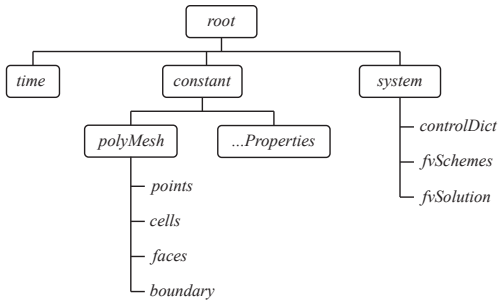
Figure 2 : Directory structure of an OpenFOAM case.
원문 · CC BY 4.0 · Qiulei Wang, Lei Yan, Gang Hu, Chao Li, Yiqing Xiao, Hao Xiong, Jean Rabault, Bernd R. Noack · DRLinFluids -- An open-source python platform of coupling Deep Reinforcement Learning and OpenFOAM · 원문 그림 인용 · 원본 PDF 4쪽에서 그림 영역을 추출했습니다.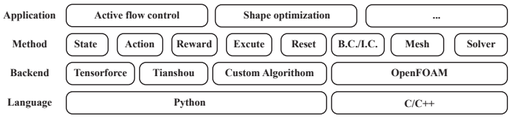
Figure 3 : Architecture of the DRLinFluids reinforcement learning platform.
원문 · CC BY 4.0 · Qiulei Wang, Lei Yan, Gang Hu, Chao Li, Yiqing Xiao, Hao Xiong, Jean Rabault, Bernd R. Noack · DRLinFluids -- An open-source python platform of coupling Deep Reinforcement Learning and OpenFOAM · 원문 그림 인용 · 원본 PDF 5쪽에서 그림 영역을 추출했습니다.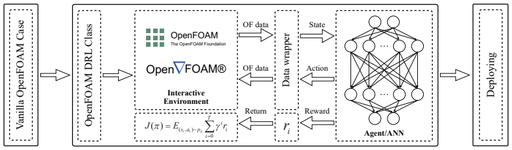
Figure 4 : Procedure of a reinforcement learning instance transferred from a vanilla OpenFOAM case in DRLinFluids.
원문 · CC BY 4.0 · Qiulei Wang, Lei Yan, Gang Hu, Chao Li, Yiqing Xiao, Hao Xiong, Jean Rabault, Bernd R. Noack · DRLinFluids -- An open-source python platform of coupling Deep Reinforcement Learning and OpenFOAM · 원문 그림 인용 · 원본 PDF 6쪽에서 그림 영역을 추출했습니다.PPO와 SAC의 학습 구성 차이
플랫폼은 두 가지 DRL 백엔드를 사용합니다. 원형 실린더 사례에서는 Tensorforce의 PPO를 사용하며, 정사각 실린더 사례에서는 Tianshou의 SAC를 사용합니다. PPO는 샘플링과 대리 목적함수 최적화를 번갈아 수행하는 정책 경사 알고리즘입니다. SAC는 최대 엔트로피 강화학습에 기반한 오프폴리시 액터-크리틱 알고리즘입니다. 두 사례 모두 상태 입력은 속도 프로브에서 얻고, 출력은 두 제트의 속도입니다. 두 제트의 속도 합은 0으로 제약됩니다. 두 사례의 신경망은 각각 512개 뉴런의 완전연결층 두 개로 구성되었습니다. 원형 실린더 사례에서는 에이전트가 50 타임스텝마다 신경망 파라미터를 갱신하고, 에피소드 기간 Tmax는 2.5입니다.
정사각 실린더 사례에서는 26 타임스텝마다 갱신하며 Tmax는 1.3이고, 5개의 병렬 환경을 사용합니다. 보상은 원형 실린더 사례에서 다음과 같이 정의됩니다.
\[ r_t = (C_D)_{T_0} - (C_D)_T - 0.1\,|(C_L)_T| \]
여기서 (C_D)_{T_0}=3.205는 제어가 없는 원형 실린더의 평균 항력계수이고, (·)_T는 한 제트 제어 주기 T 동안의 슬라이딩 평균입니다. 이 식은 항력 감소와 양력 크기를 함께 최대화하도록 구성되어 있습니다.
원형 실린더 사례의 제어 결과
원형 실린더 사례는 Rabault 등의 연구를 재현한 설정입니다. 메쉬는 16200개의 삼각형 요소로 구성되며, 149개의 속도 프로브가 상태를 측정합니다. 제어가 없는 실린더의 항력계수 평균은 3.205이고 표준편차는 0.0236입니다. DRL로 제어하면 평균 항력계수가 2.95로 줄어 약 8%의 항력 감소가 보고됩니다. 저자들은 이 값을 같은 설정에서 달성 가능한 최적 감소량으로 해석하며, 이는 Rabault 등의 결과와 비교한 해석입니다. 항력계수의 표준편차는 0.0028로 줄어 제어 없는 경우의 11.86% 수준이고, 양력계수의 표준편차는 0.74에서 0.032로 줄어 4.32% 수준입니다. 파워 스펙트럼에서 제어 없는 경우의 뚜렷한 피크는 제어 시 사라집니다.
저자들은 이를 정기적 와류 탈락이 제트 흐름에 의해 파괴되었다고 해석합니다. 학습 보상은 약 200 에포크 이후 최댓값에 가까워집니다. 이 결과는 Re=100의 한 설정에서 얻은 것입니다.
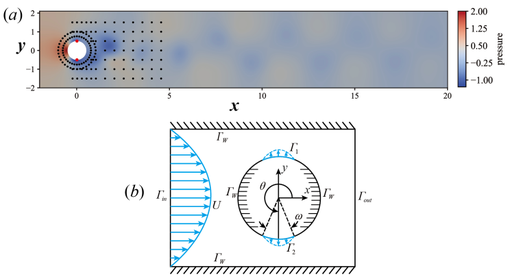
Figure 6 : Description of the numerical setup adapted from Schäfer et al. [1996]: (a) unsteady pressure field around the circular cylinder after flow initialization without active control. The locations of the 149 velocity probes are indicated by the black dots. The locations of 2 jets are indicated by the red dots; (b) details of the cylinder and the jet actuators.
원문 · CC BY 4.0 · Qiulei Wang, Lei Yan, Gang Hu, Chao Li, Yiqing Xiao, Hao Xiong, Jean Rabault, Bernd R. Noack · DRLinFluids -- An open-source python platform of coupling Deep Reinforcement Learning and OpenFOAM · 원문 그림 인용 · 원본 PDF 8쪽에서 그림 영역을 추출했습니다.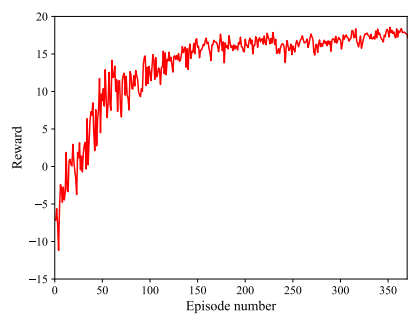
Figure 7 : Reward curve from parallel environment of DRL-based active flow control for circular cylinder.
원문 · CC BY 4.0 · Qiulei Wang, Lei Yan, Gang Hu, Chao Li, Yiqing Xiao, Hao Xiong, Jean Rabault, Bernd R. Noack · DRLinFluids -- An open-source python platform of coupling Deep Reinforcement Learning and OpenFOAM · 원문 그림 인용 · 원본 PDF 9쪽에서 그림 영역을 추출했습니다.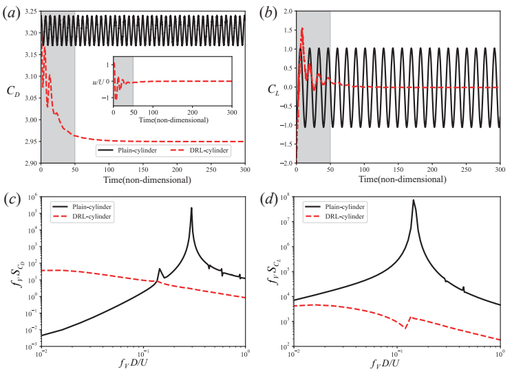
Figure 8 : (a) Time-resolved value of drag coefficient CD for the cylinder without (Plain-cylinder) and with (DRL- cylinder) active flow control, and corresponding normalized velocity flow rate of the jet flow Γ1; (b) Time-resolved value of the lift coefficientCL for the cylinder without (Plain-cylinder) and with (DRL-cylinder) active flow control; (c) power spectral density of the drag coefficientCD during the period of non-dimensional time ranging from 50 to 300; (d) power spectral density of the lift coefficientCL during the period of non-dimensional time ranging from 50 to 300.
원문 · CC BY 4.0 · Qiulei Wang, Lei Yan, Gang Hu, Chao Li, Yiqing Xiao, Hao Xiong, Jean Rabault, Bernd R. Noack · DRLinFluids -- An open-source python platform of coupling Deep Reinforcement Learning and OpenFOAM · 원문 그림 인용 · 원본 PDF 10쪽에서 그림 영역을 추출했습니다.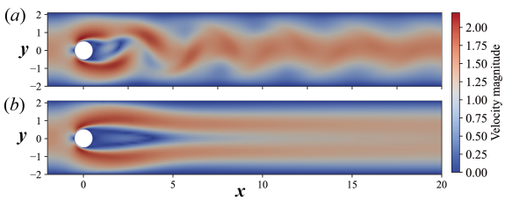
Figure 9 : Comparison of representative snapshots of the velocity field around the cylinder (a) without and (b) with active flow control.
원문 · CC BY 4.0 · Qiulei Wang, Lei Yan, Gang Hu, Chao Li, Yiqing Xiao, Hao Xiong, Jean Rabault, Bernd R. Noack · DRLinFluids -- An open-source python platform of coupling Deep Reinforcement Learning and OpenFOAM · 원문 그림 인용 · 원본 PDF 10쪽에서 그림 영역을 추출했습니다.정사각 실린더 사례와 수치 표기
정사각 실린더 사례는 트레일링 엣지의 두 면에 배치된 두 제트를 SAC로 제어합니다. 구조격자 23125개의 사각형 요소를 쓰고, 147개의 속도 프로브로 상태를 측정합니다. 제어가 없는 정사각 실린더의 평균 항력계수는 1.549이고 표준편차는 0.0073입니다. 양력계수의 표준편차는 0.227입니다. 능동 제어 시 평균 항력계수는 1.337로 줄어 13.7%의 감소가 보고됩니다. 다만 결론부에서는 같은 결과가 13.6%로 적혀 있습니다. 양력계수의 표준편차는 0.0134로, 제어 없는 경우의 5.9% 수준입니다. 제트 속도와 유입 속도의 비율은 피크 기준 3.443%로 보고됩니다. 저자들은 와류 탈락이 실린더에서 멀리 떨어진 곳에서 발생하며, 후류 연장이 평균 항력을 줄인다고 해석합니다.
이 사례도 Re=100 조건에서 수행되었습니다. 원형 실린더 사례와 달리 알고리즘과 갱신 주기, 에피소드 기간이 다르므로 두 결과를 같은 조건의 비교로 읽으면 안 됩니다.
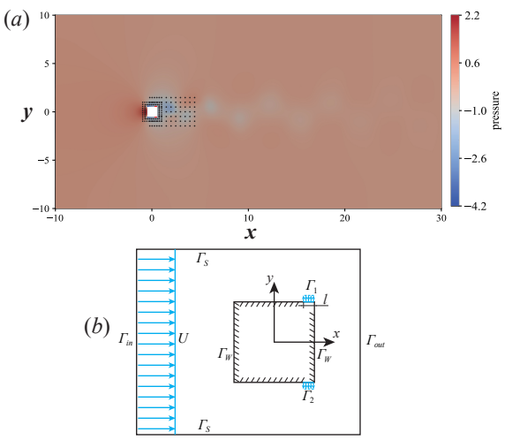
Figure 10 : Description of the numerical setup: (a) unsteady pressure field around the square cylinder after flow initialization without active control. The location of the velocity probes is indicated by the black dots. The location of the control jets is indicated by the red dots; (b) details of the square cylinder and the jet actuators.
원문 · CC BY 4.0 · Qiulei Wang, Lei Yan, Gang Hu, Chao Li, Yiqing Xiao, Hao Xiong, Jean Rabault, Bernd R. Noack · DRLinFluids -- An open-source python platform of coupling Deep Reinforcement Learning and OpenFOAM · 원문 그림 인용 · 원본 PDF 11쪽에서 그림 영역을 추출했습니다.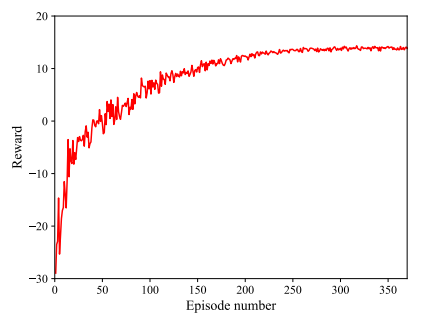
Figure 11 : Reward curve from parallel environment of DRL-based active flow control for square cylinder.
원문 · CC BY 4.0 · Qiulei Wang, Lei Yan, Gang Hu, Chao Li, Yiqing Xiao, Hao Xiong, Jean Rabault, Bernd R. Noack · DRLinFluids -- An open-source python platform of coupling Deep Reinforcement Learning and OpenFOAM · 원문 그림 인용 · 원본 PDF 12쪽에서 그림 영역을 추출했습니다.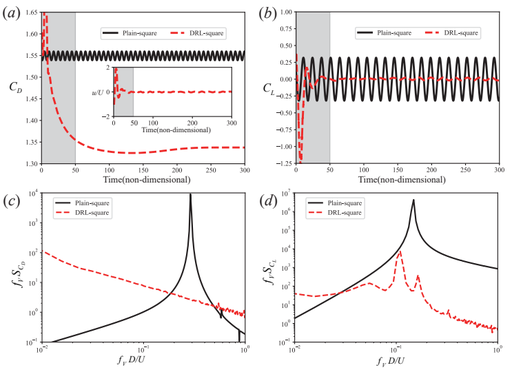
Figure 12 : (a) Time-resolved value of the drag coefficientCD of the square cylinder without (Plain-square) and with (DRL-square) active flow control, and corresponding normalized velocity flow rate of the control Γ1; (b) Time-resolved value of the lift coefficientCL of the square case without (Plain-square) and with (DRL-square) active flow control; (c) power spectral of the drag coefficientCD during the period of non-dimensional time ranging from 50 to 300. (d) power spectral of the lift coefficientCL during the period of non-dimensional time ranging from 50 to 300.
원문 · CC BY 4.0 · Qiulei Wang, Lei Yan, Gang Hu, Chao Li, Yiqing Xiao, Hao Xiong, Jean Rabault, Bernd R. Noack · DRLinFluids -- An open-source python platform of coupling Deep Reinforcement Learning and OpenFOAM · 원문 그림 인용 · 원본 PDF 13쪽에서 그림 영역을 추출했습니다.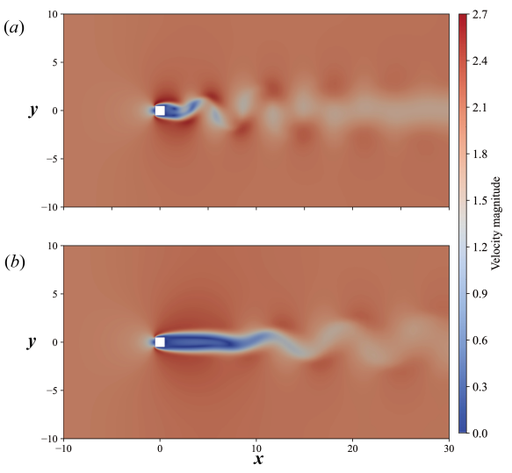
Figure 13 : Comparison of representative snapshots of the velocity field around the square cylinder (a) without and (b) with active flow control.
원문 · CC BY 4.0 · Qiulei Wang, Lei Yan, Gang Hu, Chao Li, Yiqing Xiao, Hao Xiong, Jean Rabault, Bernd R. Noack · DRLinFluids -- An open-source python platform of coupling Deep Reinforcement Learning and OpenFOAM · 원문 그림 인용 · 원본 PDF 14쪽에서 그림 영역을 추출했습니다.검증 범위와 공개 상태의 한계
이 논문의 검증은 두 가지 2차원 실린더 사례로 제한됩니다. 저자들은 3차원 제어 벤치마크, 대형 슈퍼컴퓨터 테스트, 불변성과 대칭성을 활용하는 자동화 방법은 향후 과제로 남긴다고 밝힙니다. 한 설정에서 얻은 항력 감소량을 다른 Reynolds 수나 형상에 그대로 적용할 수는 없습니다. 또한 부록의 공개 저장소 링크는 현재 자리표시자로 표시되어 있으며, 코드는 논문 게재 이후 공개될 예정입니다. 따라서 이 플랫폼을 실제로 재현하려면 공개 상태를 별도로 확인해야 합니다. 정사각 실린더 사례에서 항력 감소율이 본문에서 13.7%, 결론부에서 13.6%로 다르게 표기되어 있다는 점도 함께 고려해야 합니다.
논문 정보
- 저자
- Qiulei Wang, Lei Yan, Gang Hu, Chao Li, Yiqing Xiao, Hao Xiong, Jean Rabault, Bernd R. Noack
- 학회·저널
- arXiv · 프리프린트
- 최초 공개일
- 2022년 5월 25일
- 등록일
- 2026년 11월 6일
- 수정일
- 2022년 5월 25일
- 버전
- v1
- arXiv
- 2205.12699
- DOI
- 10.1063/5.0103113
- 분류
- physics.flu-dyn
- 원문 이용 조건
- CC BY 4.0
- 제공 범위
- 논문 정보, 해설, 허용된 원문 그림
AI 해설은 논문 원문과 별개의 설명이며 오류가 있을 수 있습니다. 원문과 그림은 각 출처의 이용 조건과 따로 표시된 권리를 따릅니다.
초록
We propose an open-source python platform for applications of Deep Reinforcement Learning (DRL) in fluid mechanics. DRL has been widely used in optimizing decision-making in nonlinear and high-dimensional problems. Here, an agent maximizes a cumulative reward with learning a feedback policy by acting in an environment. In control theory terms, the cumulative reward would correspond to the cost function, the agent to the actuator, the environment to the measured signals and the learned policy to the feedback law. Thus, DRL assumes an interactive environment or, equivalently, control plant. The setup of a numerical simulation plant with DRL is challenging and time-consuming. In this work, a novel python platform, named DRLinFluids is developed for this purpose, with DRL for flow control and optimization problems in fluid mechanics. The simulations employ OpenFOAM as popular, flexible Navier-Stokes solver in industry and academia, and Tensorforce or Tianshou as widely used versatile DRL packages. The reliability and efficiency of DRLinFluids are demonstrated for two wake stabilization benchmark problems. DRLinFluids significantly reduces the application effort of DRL in fluid mechanics and is expected to greatly accelerates academic and industrial applications.
원문 인용
Qiulei Wang, Lei Yan, Gang Hu, Chao Li, Yiqing Xiao, Hao Xiong, Jean Rabault, Bernd R. Noack (2022). DRLinFluids -- An open-source python platform of coupling Deep Reinforcement Learning and OpenFOAM. arXiv:2205.12699v1. https://doi.org/10.1063/5.0103113
BibTeX
@article{wang2022drlinfluids,
  title = {{DRLinFluids -- An open-source python platform of coupling Deep Reinforcement Learning and OpenFOAM}},
  author = {Qiulei Wang and Lei Yan and Gang Hu and Chao Li and Yiqing Xiao and Hao Xiong and Jean Rabault and Bernd R. Noack},
  year = {2022},
  eprint = {2205.12699},
  archivePrefix = {arXiv},
  doi = {10.1063/5.0103113},
  url = {https://arxiv.org/abs/2205.12699v1}
}