논문 해설
Automatic self-contained calibration of an industrial dual-arm robot with cameras using self-contact, planar constraints, and self-observation
자기 접촉, 평면 제약, 자기 관측을 이용한 카메라 탑재 산업용 듀얼암 로봇의 자동 자체 완결형 보정
- 연구 문제 산업용 이중팔 로봇의 기구학 보정을 외부 계측 없이 로봇 센서만으로 수행할 수 있는지를 검토합니다.
- 연구 방법 자기 접촉 거리, 평면 접촉 잔차, 카메라 재투영 오차를 하나의 비용 함수로 결합하여 Levenberg-Marquardt로 DH 파라미터를 추정합니다.
- 주요 결과 레이저 트래커 독립 테스트에서 고정 사전 보정 카메라를 사용한 all 변형은 RMSE 2.73 mm로 nominal 3.06 mm보다 낮았고, 카메라 보정을 포함한 설정은 3.18 mm로 높았습니다.
외부 계측 없이 로봇을 보정하는 문제
산업용 로봇의 기구학 보정은 보통 레이저 트래커 같은 외부 계측 장비에 의존합니다. 이 방식은 로봇이나 설치 현장이 자주 바뀌는 소량 생산 환경이나, 가볍고 유연하며 재보정이 잦은 협동·서비스 로봇에는 실용적이지 않습니다. 이 논문은 로봇 자체의 센서만으로 수행하는 자기 완결형(self-contained) 보정이 얼마나 정확할 수 있는지를 질문합니다. 연구 범위는 두 개의 산업용 manipulator가 공통 기저에 장착된 이중팔 플랫폼이며, 힘/토크 센서, 두 대의 카메라, ArUco 마커가 부착된 icosahedron 엔드 이펙터가 사용됩니다.
자기 접촉과 평면 제약을 거리 잔차로 바꾸는 방법
자기 접촉 보정에서는 두 팔의 엔드 이펙터가 서로 닿는 구성을 이용합니다. 엔드 이펙터를 구로 취급하면 두 중심 사이의 거리가 icosahedron 지름 2r과 같아야 하므로, 각 데이터 점에 대해 두 중심의 순운동학 거리와 2r의 차이를 잔차로 둡니다. 원문은 이 제약이 위치 파라미터 1개를 제한한다고 설명하며, 접촉 표면의 파라미터는 알려진 값으로 둡니다. 평면 제약에서는 평면 법선 n과 거리 d를 미지수로 함께 추정합니다. 접촉점들의 무게중심을 빼고 SVD로 최소 특이값에 해당하는 특이벡터를 법선으로 정하며, 잔차는 |a x + b y + c z + d| 와 반지름 r의 차이로 정의됩니다. 두 방식 모두 접촉이 있을 때 힘 센서 신호로 접촉을 검출하여 데이터를 얻습니다.
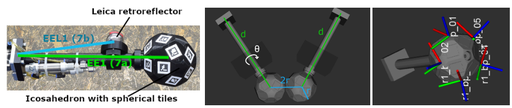
Figure 3 : Custom end effector with icosahedron and laser tracker retroreflector (left), its collision model in self-contact configuration (d and o are DH parameters of end effector and r is the radius of icosahedrons) (center), and spherical tiles used for contacts with their reference frames (right).
원문 · CC BY 4.0 · Karla Stepanova, Jakub Rozlivek, Frantisek Puciow, Pavel Krsek, Tomas Pajdla, Matej Hoffmann · Automatic self-contained calibration of an industrial dual-arm robot with cameras using self-contact, planar constraints, and self-observation · 원문 그림 인용 · 원본 PDF 5쪽에서 그림 영역을 추출했습니다.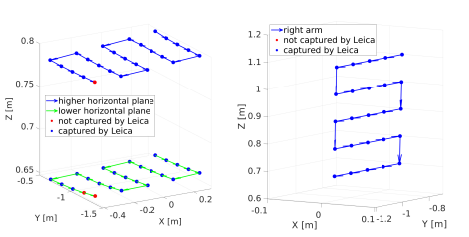
Figure 5 : Positions of end e ffector centers in the horizontal plane contact datasets (left, higher plane in blue, lower plane in green) and vertical plane contact dataset (right) with the information whether the pose was logged by laser tracker (blue) or not (red).
원문 · CC BY 4.0 · Karla Stepanova, Jakub Rozlivek, Frantisek Puciow, Pavel Krsek, Tomas Pajdla, Matej Hoffmann · Automatic self-contained calibration of an industrial dual-arm robot with cameras using self-contact, planar constraints, and self-observation · 원문 그림 인용 · 원본 PDF 7쪽에서 그림 영역을 추출했습니다.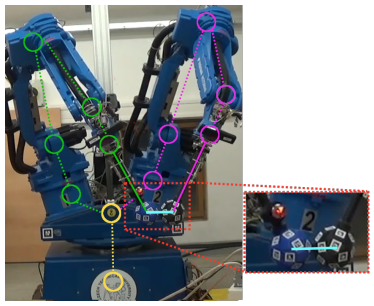
Figure 9 : Self-contact experiment. The left and right arm chains are drawn in purple and green, respectively. Cyan indicates the distance between end e ffector centers.
원문 · CC BY 4.0 · Karla Stepanova, Jakub Rozlivek, Frantisek Puciow, Pavel Krsek, Tomas Pajdla, Matej Hoffmann · Automatic self-contained calibration of an industrial dual-arm robot with cameras using self-contact, planar constraints, and self-observation · 원문 그림 인용 · 원본 PDF 9쪽에서 그림 영역을 추출했습니다.카메라 자기 관측과 결합 비용 함수
자기 관측에서는 카메라가 엔드 이펙터의 ArUco 마커를 보고, 마커 중심의 측정 좌표와 현재 운동학 모델로 예측한 재투영 좌표의 차이를 최소화합니다. 재투영은 마커를 카메라 좌표로 변환한 뒤 방사·접선 왜곡을 포함한 핀홀 모델로 영상에 투영하여 계산합니다. 자기 접촉, 평면 제약, 자기 관측은 하나의 비용 함수로 결합되며, 각 구성요소에는 스케일 계수 k가 곱해집니다. 원문은 접촉 거리 항에 마커 검출 수 등을 반영한 계수를 두고, 이 실험에서 η는 모든 방법에 대해 1로 두었다고 밝힙니다. 결합 비용은 각 항을 개별적으로 최소화하는 대신 하나의 최소제곱 문제로 풀게 해 줍니다.
Levenberg-Marquardt 최적화와 관측 가능성 지표
모든 보정은 비선형 최소제곱 문제로 풀리며, Matlab의 lsqnonlin에 Levenberg-Marquardt 옵션을 사용합니다. 이 알고리즘은 경사 하강법과 Gauss-Newton 법의 장점을 결합한 방식으로 설명됩니다. 파라미터 식별성은 식별 야코비안의 특이값으로 평가하며, 원문은 O1, O2, O3, O4 지표를 정의합니다. 이 중 O1은 특이값의 기하평균 형태로 hyperellipsoid 부피와 관련되고, O4는 σmin²/σmax로 주어집니다. 평가에서는 데이터를 약 70:30으로 나누어 학습과 테스트 RMS 오차를 비교합니다.
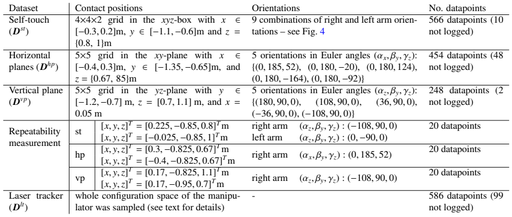
Table 3 : Dataset overview.
원문 · CC BY 4.0 · Karla Stepanova, Jakub Rozlivek, Frantisek Puciow, Pavel Krsek, Tomas Pajdla, Matej Hoffmann · Automatic self-contained calibration of an industrial dual-arm robot with cameras using self-contact, planar constraints, and self-observation · 원문 그림 인용 · 원본 PDF 7쪽에서 그림 영역을 추출했습니다.엔드 이펙터 길이 보정에서 자기 접촉의 효과
엔드 이펙터 길이 dEE1의 보정에서 자기 접촉만 사용한 방식은 카메라 없이도 평균 보정량 4.31 mm, 표준편차 0.05 mm 수준의 안정적인 추정을 보였습니다. 같은 설정에서 평면 제약 단독은 표준편차가 약 4 mm로 크게 나타났고, 카메라 정보를 더하면 평면 제약의 표준편차가 줄었습니다. 고정 카메라를 사용한 all 변형은 3.89 mm의 보정량을 보였으며, 원문은 이를 엔드 이펙터 길이 보정에 사용한 값의 근거로 삼습니다. 자기 관측만으로 얻은 추정은 데이터셋에 따라 3.11 mm에서 5.95 mm까지 달라졌습니다.
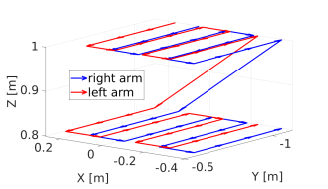
Figure 4 : Positions of end e ffector centers during the self-contact experiment. The end of each arrow denotes a position of end e ffector center in individual poses (red – left arm, blue – right arm). The distance between left and right arm position is given by two times the radius of the end effectors in contact.
원문 · CC BY 4.0 · Karla Stepanova, Jakub Rozlivek, Frantisek Puciow, Pavel Krsek, Tomas Pajdla, Matej Hoffmann · Automatic self-contained calibration of an industrial dual-arm robot with cameras using self-contact, planar constraints, and self-observation · 원문 그림 인용 · 원본 PDF 7쪽에서 그림 영역을 추출했습니다.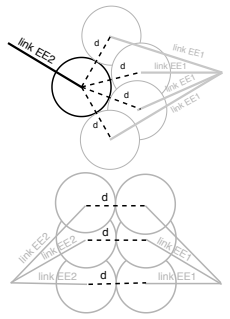
Figure 10 : Visualisation of self-contact scenario. When end e ffectors are in contact, they are separated by distance d. This can happen in multiple con- figurations. For simplicity, we visualize the case when only end e ffector link length is estimated for one arm (left) or both arms (right), with the additional assumption that the link length is the same for both arms.
원문 · CC BY 4.0 · Karla Stepanova, Jakub Rozlivek, Frantisek Puciow, Pavel Krsek, Tomas Pajdla, Matej Hoffmann · Automatic self-contained calibration of an industrial dual-arm robot with cameras using self-contact, planar constraints, and self-observation · 원문 그림 인용 · 원본 PDF 9쪽에서 그림 영역을 추출했습니다.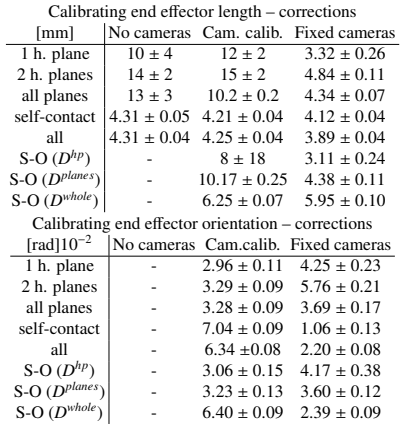
Table 5 : End e ffector length calibration (corrections to the manually acquired values). Comparing calibration using plane constraints (h. plane – 1 horizontal plane, 2 h. planes – 2 horizontal planes, all planes), self-contact calibration, combination of planar constraints and self-contact (all) with self-observation only (on di fferent datasets – e.g., S-O ( Dhp) – self-observation calibration on a dataset from touching a horizontal plane). No cameras / Cam. calib / Fixed cameras – see text. Mean and standard deviation over 20 repetitions is dis- played.
원문 · CC BY 4.0 · Karla Stepanova, Jakub Rozlivek, Frantisek Puciow, Pavel Krsek, Tomas Pajdla, Matej Hoffmann · Automatic self-contained calibration of an industrial dual-arm robot with cameras using self-contact, planar constraints, and self-observation · 원문 그림 인용 · 원본 PDF 16쪽에서 그림 영역을 추출했습니다.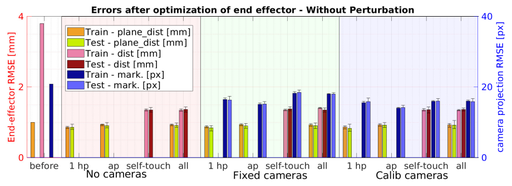
Figure 17 : RMS errors – end e ffector calibration. Distances in 3D (left y-axis, mm); camera reprojection (right y-axis, px). plane dist – Euclidean distance from a plane, dist – Eucl. distance between end effectors in self-contact, mark. – error of individual markers reprojected to cameras.No cameras – only planar constraints or self-touch; Fixed cameras – precalibrated but fixed cameras;Calib cameras – precalibrated cameras with additional optimization. Error on both training (Train) and testing (Test) dataset shown. before – nominal parameters, hp – 1 horizontal plane, ap – all planes (2 horizontal, 1 vertical), all – self-contact + planar constraints.
원문 · CC BY 4.0 · Karla Stepanova, Jakub Rozlivek, Frantisek Puciow, Pavel Krsek, Tomas Pajdla, Matej Hoffmann · Automatic self-contained calibration of an industrial dual-arm robot with cameras using self-contact, planar constraints, and self-observation · 원문 그림 인용 · 원본 PDF 17쪽에서 그림 영역을 추출했습니다.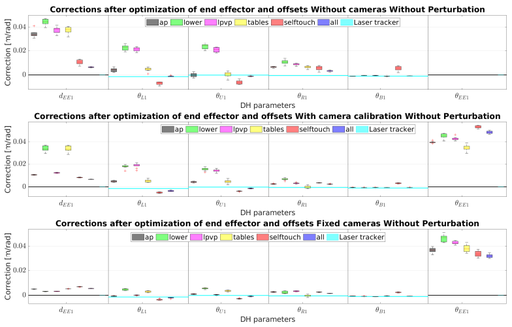
Figure 24 : Corrections of offsets and end effector parameters (dEE1, oEE1) after calibrating end effector and offsets of right arm without cameras (using only planar constraints or self-touch), with precalibrated but fixed cameras and with precalibrated cameras which are calibrated during the experiment. Offset of the end effector cannot be calibrated without cameras and nominal values are used. Laser tracker calibration (ground truth) values in turquoise.
원문 · CC BY 4.0 · Karla Stepanova, Jakub Rozlivek, Frantisek Puciow, Pavel Krsek, Tomas Pajdla, Matej Hoffmann · Automatic self-contained calibration of an industrial dual-arm robot with cameras using self-contact, planar constraints, and self-observation · 원문 그림 인용 · 원본 PDF 19쪽에서 그림 영역을 추출했습니다.레이저 트래커 독립 테스트에서의 RMSE
레이저 트래커 독립 테스트 데이터셋에서 nominal 파라미터의 RMSE는 3.06 mm로 보고되었습니다. 고정 사전 보정 카메라를 사용한 all 변형은 2.73 mm, 카메라 보정을 함께 포함한 all 변형은 3.18 mm였습니다. 따라서 카메라 보정을 포함한 설정은 nominal보다 높은 오차를 보였습니다. 원문은 레이저 트래커 기준값 2.63 mm와 비교하여 자기 완결형 보정의 위치를 설명하며, 이는 전체 작업공간 테스트 결과입니다.
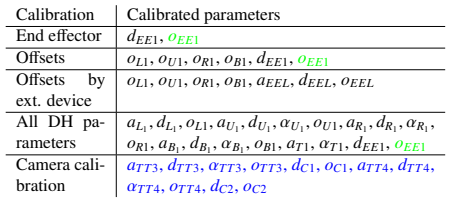
Table 4 : Overview of calibrated parameters. Parameters in green are added to the corresponding approach under fixedCameras. When using calibCameras, all the blue parameters are added. See Tables 1 and 2 for details about DH parameters.
원문 · CC BY 4.0 · Karla Stepanova, Jakub Rozlivek, Frantisek Puciow, Pavel Krsek, Tomas Pajdla, Matej Hoffmann · Automatic self-contained calibration of an industrial dual-arm robot with cameras using self-contact, planar constraints, and self-observation · 원문 그림 인용 · 원본 PDF 15쪽에서 그림 영역을 추출했습니다.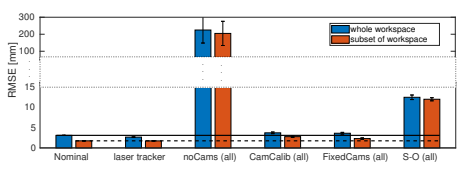
Figure 28 : Comparison of RMSE for all DH calibration on the whole laser tracker dataset (Dtracker). Results are shown for the whole laser tracker dataset (red) and for the subset of the robot workspace which corresponds to the area where other self-contact methods were trained (blue). Results for the calibra- tion by the variantall without cameras (noCams), with fixed precalibrated cam- eras (FixedCams) and cameras being calibrated (CamCalib) is compared to the self-observation approach (S-O) trained on the dataset Dwhole, Nominal param- eters and the calibration by laser tracker.
원문 · CC BY 4.0 · Karla Stepanova, Jakub Rozlivek, Frantisek Puciow, Pavel Krsek, Tomas Pajdla, Matej Hoffmann · Automatic self-contained calibration of an industrial dual-arm robot with cameras using self-contact, planar constraints, and self-observation · 원문 그림 인용 · 원본 PDF 21쪽에서 그림 영역을 추출했습니다.순차 보정과 적용 범위의 한계
원문은 자기 관측 단독 결과가 데이터셋 크기에 민감하다고 보고합니다. 자기 접촉이나 카메라 보정과 결합하지 않은 경우 전체 작업공간으로의 일반화는 제한됩니다. 또한 저자들은 카메라 외부 파라미터를 먼저 보정한 뒤 로봇 기구학을 보정하는 순차 방식이 동시 보정보다 효과적이었다고 해석합니다. 관측 가능성 분석에는 측정 잡음이 충분히 작다는 가정이 들어 있으며, 이 가정은 원문에서 명시적으로 밝혀졌습니다.
논문 정보
- 저자
- Karla Stepanova, Jakub Rozlivek, Frantisek Puciow, Pavel Krsek, Tomas Pajdla, Matej Hoffmann
- 학회·저널
- arXiv · 프리프린트
- 최초 공개일
- 2020년 12월 14일
- 등록일
- 2026년 11월 6일
- 수정일
- 2021년 9월 24일
- 버전
- v3
- arXiv
- 2012.07548
- DOI
- 10.1016/j.rcim.2021.102250
- 분류
- cs.RO
- 원문 이용 조건
- CC BY 4.0
- 제공 범위
- 논문 정보, 해설, 허용된 원문 그림
AI 해설은 논문 원문과 별개의 설명이며 오류가 있을 수 있습니다. 원문과 그림은 각 출처의 이용 조건과 따로 표시된 권리를 따릅니다.
초록
We present a robot kinematic calibration method that combines complementary calibration approaches: self-contact, planar constraints, and self-observation. We analyze the estimation of the end effector parameters, joint offsets of the manipulators, and calibration of the complete kinematic chain (DH parameters). The results are compared with ground truth measurements provided by a laser tracker. Our main findings are: (1) When applying the complementary calibration approaches in isolation, the self-contact approach yields the best and most stable results. (2) All combinations of more than one approach were always superior to using any single approach in terms of calibration errors and the observability of the estimated parameters. Combining more approaches delivers robot parameters that better generalize to the workspace parts not used for the calibration. (3) Sequential calibration, i.e. calibrating cameras first and then robot kinematics, is more effective than simultaneous calibration of all parameters. In real experiments, we employ two industrial manipulators mounted on a common base. The manipulators are equipped with force/torque sensors at their wrists, with two cameras attached to the robot base, and with special end effectors with fiducial markers. We collect a new comprehensive dataset for robot kinematic calibration and make it publicly available. The dataset and its analysis provide quantitative and qualitative insights that go beyond the specific manipulators used in this work and apply to self-contained robot kinematic calibration in general.
원문 인용
Karla Stepanova, Jakub Rozlivek, Frantisek Puciow, Pavel Krsek, Tomas Pajdla, Matej Hoffmann (2020). Automatic self-contained calibration of an industrial dual-arm robot with cameras using self-contact, planar constraints, and self-observation. arXiv:2012.07548v3. https://doi.org/10.1016/j.rcim.2021.102250
BibTeX
@article{stepanova2020automatic,
  title = {{Automatic self-contained calibration of an industrial dual-arm robot with cameras using self-contact, planar constraints, and self-observation}},
  author = {Karla Stepanova and Jakub Rozlivek and Frantisek Puciow and Pavel Krsek and Tomas Pajdla and Matej Hoffmann},
  year = {2020},
  eprint = {2012.07548},
  archivePrefix = {arXiv},
  doi = {10.1016/j.rcim.2021.102250},
  url = {https://arxiv.org/abs/2012.07548v3}
}