논문 해설
Mining experimental data from Materials Science literature with Large Language Models: an evaluation study
대규모 언어 모델을 이용한 재료과학 문헌의 실험 데이터 마이닝: 평가 연구
- 연구 문제 물질과학 문헌의 실험 데이터를 LLM으로 추출할 때 물질·물성 개체명 인식과 관계 추출이 얼마나 정확한지 평가합니다.
- 연구 방법 GPT-3.5-Turbo, GPT-4, GPT-4-Turbo를 제로샷·퓨샷·fine-tuning 설정으로 평가하고, 물질 표현 평가에는 화학식 정규화 기반 formula matching을 제안합니다.
- 주요 결과 formula matching은 GPT-3.5-Turbo 물질 NER의 F1을 17.01%에서 45.31%로 높였습니다. 미세조정된 GPT-3.5-Turbo는 SuperMat 관계 추출에서 기준선보다 약 15% 높은 F1을 보였습니다.
문제 설정: LLM으로 물질과학 실험 데이터 추출하기
물질과학 문헌에는 실험 데이터가 풍부하게 담겨 있지만, 대부분 비정형 텍스트와 표·그림에 흩어져 있어 수작업 추출에 많은 시간이 듭니다. 이 논문은 GPT-3.5-Turbo, GPT-4, GPT-4-Turbo 같은 대규모 언어 모델(LLM)이 이 과정을 얼마나 수행할 수 있는지 평가합니다. 평가 대상은 두 가지 정보 추출 과제입니다. 첫째는 물질과 물성 표현을 찾는 개체명 인식(NER)이고, 둘째는 찾은 개체들 사이의 관계를 묶는 관계 추출(RE)입니다.
논문은 두 질문을 세웁니다. Q1은 LLM이 물질과학 정보를 얼마나 효과적으로 추출하는가이고, Q2는 LLM이 추론으로 복잡한 개념 사이의 관계를 얼마나 잘 연결하는가입니다. 기존의 BERT 계열 인코더와 규칙 기반 방법이 기준선으로 쓰입니다. 평가 데이터는 초전도체 연구 논문에 주석을 단 SuperMat과 수량·측정값 추출 과제인 MeasEval입니다.
물질 표현의 평가 방법: formula matching
물질 이름은 같은 대상을 다양하게 표기하므로 문자열 일치만으로는 정확하게 평가하기 어렵습니다. 논문은 생성형 모델의 출력이 입력 문자열과 다르게 구성될 수 있다는 점을 평가의 어려움으로 제시합니다. 이에 대응하여 formula matching을 제안합니다. 이 방법은 엄격한 문자열 일치가 실패했을 때에만 적용됩니다. 두 물질 표현을 material parser로 화학식과 원소별 양을 담은 구조로 정규화한 뒤, 원소를 하나씩 쌍으로 비교합니다.
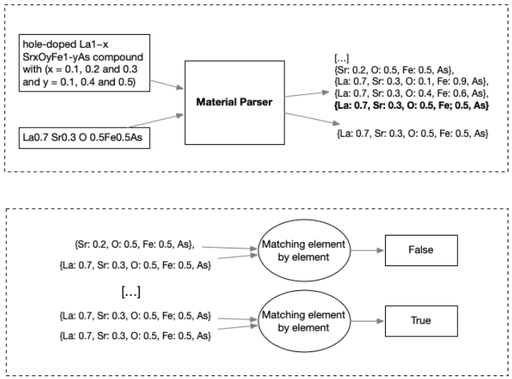
Figure 1 . Two materials that appear to have a very different composition are, in reality, overlapping. (Top) Summary of the Material Parser. More information is available in [27]. (Bottom) The pairwise comparison of each chemical formula is performed element-by-element.
원문 · CC BY 4.0 · Luca Foppiano, Guillaume Lambard, Toshiyuki Amagasa, Masashi Ishii · Mining experimental data from Materials Science literature with Large Language Models: an evaluation study · 원문 그림 인용 · 원본 PDF 18쪽에서 그림 영역을 추출했습니다.이 방법은 표기 차이를 허용하면서도 원소 구성과 양이 다른 물질은 구별하도록 설계되었습니다. 논문은 Ca와 Cr처럼 한 글자 차이로 전혀 다른 물질이 되는 사례를 들어 이러한 설계의 필요성을 설명합니다.
프롬프트 설정과 출력 형식
평가는 제로샷 프롬프팅, 퓨샷 프롬프팅, fine-tuning을 비교합니다. 제로샷 설정은 예시 없이 지시만 주고, 퓨샷 설정은 기준 모델이 찾은 힌트를 프롬프트에 포함하되 힌트가 부정확할 수 있다고 명시합니다. 시스템 프롬프트는 없는 사실을 만들지 않도록 설계되었고, 출력은 유효한 JSON 형식이어야 합니다. 저자들은 기계가 읽기 쉬운 출력이 후처리를 단순하게 만든다는 이유로 이 형식을 택했습니다.
관계 추출에서는 개체 목록을 주고 관계를 묶도록 요청합니다. 이때 모델은 프롬프트에 제공되지 않은 개체를 사용하면 안 되며, 응답에 제공되지 않은 개체가 있으면 무시하도록 규칙을 둡니다.
RE fine-tuning 데이터 전략
GPT-3.5-Turbo는 OpenAI 플랫폼에서 미세조정되었고, GPT-4와 GPT-4-Turbo는 fine-tuning을 하지 않았습니다. RE fine-tuning에서 기본 전략 FT.base는 개체 목록의 순서를 섞어 모델이 문서 등장 순서에 기대어 관계를 맞히지 않도록 합니다. FT.document order는 개체를 문서에 나타난 순서대로 유지하며, FT.augmented는 FT.base 데이터에 섞인 목록을 추가해 데이터 규모를 약 두 배로 늘린 전략입니다.
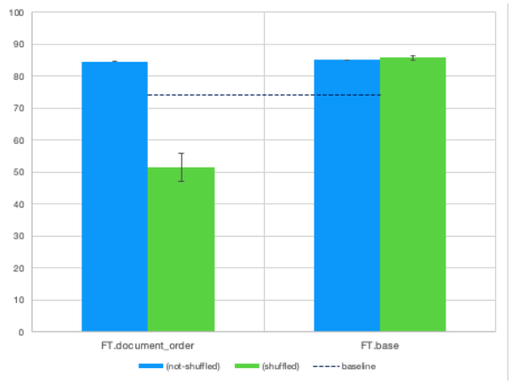
Figure 6 . Evaluation of the impact of data variability in fine-tuning GPT-3.5-Turbo. The metrics are the aggregated micro average F1-scores calculated using strict matching. The model ”FT.document order” was fine-tuned with the original data, where entities were taken of appearance. In ”FT.base”, our default strategy, the entities provided to the prompt were scrambled. The error bars are calculated over the standard deviation of three independent runs.
원문 · CC BY 4.0 · Luca Foppiano, Guillaume Lambard, Toshiyuki Amagasa, Masashi Ishii · Mining experimental data from Materials Science literature with Large Language Models: an evaluation study · 원문 그림 인용 · 원본 PDF 21쪽에서 그림 영역을 추출했습니다.저자들은 문서 순서 전략이 셔플 조건에서 성능 저하를 보일 것으로 예상합니다. 이 해석은 저자의 가설이며, 결과 절에서 그 성능 하락이 관찰된 조건과 함께 확인해야 합니다.
NER 결과: 물질 표현과 물성 추출
formula matching을 적용한 GPT-3.5-Turbo의 물질 NER 결과는 엄격한 문자열 일치보다 크게 높아졌습니다. 원문에 따르면 strict 매칭에서는 1402개의 기대 레코드 중 107개가 맞았고 F1은 17.01%였습니다. 미일치 레코드에 formula matching을 적용하자 176개가 추가로 맞았고 F1은 45.31%가 되었습니다. 저자들은 새로 맞춘 176쌍을 수작업으로 검토해 5개의 잘못된 일치를 확인했으며, 이는 2.5%의 오류율입니다.
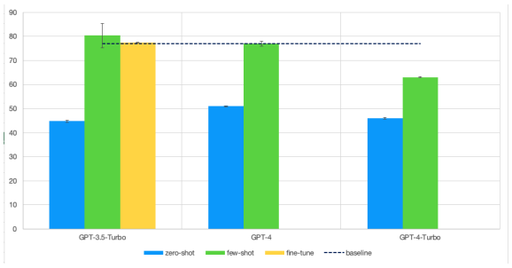
Figure 3 . Comparison scores for material extraction using NER. The metrics are the aggregations of the micro average F1-scores, calculated using formula matching. The error bars are calculated over the standard deviation of three independent runs.
원문 · CC BY 4.0 · Luca Foppiano, Guillaume Lambard, Toshiyuki Amagasa, Masashi Ishii · Mining experimental data from Materials Science literature with Large Language Models: an evaluation study · 원문 그림 인용 · 원본 PDF 19쪽에서 그림 영역을 추출했습니다.물질 추출에서 제로샷 설정의 LLM은 기준선보다 적어도 10% 낮은 점수를 보였습니다. 퓨샷 설정에서는 GPT-3.5-Turbo와 GPT-4가 기준선을 조금 웃돌았습니다. 물성 추출에서는 제로샷 설정의 어떤 모델도 grobid-quantities를 넘지 못했고, 퓨샷과 fine-tuning에서 일부 모델이 근소하게 앞섰습니다. 이 점수들은 자체 평가 조건에서 얻은 것이며 기준선과 평가 조건을 함께 읽어야 합니다.
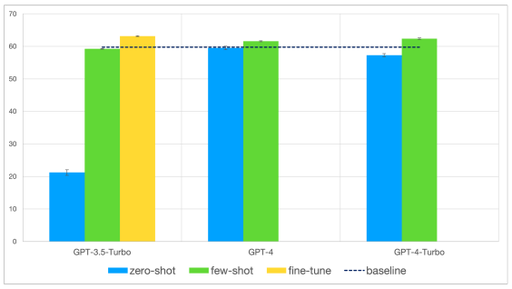
Figure 2 . Comparison scores for properties extraction using NER. The scores are the aggregations of the micro average F1 scores and are calculated using soft matching with a threshold of 0.9 similarity. The error bars are calculated over the standard deviation of three independent runs.
원문 · CC BY 4.0 · Luca Foppiano, Guillaume Lambard, Toshiyuki Amagasa, Masashi Ishii · Mining experimental data from Materials Science literature with Large Language Models: an evaluation study · 원문 그림 인용 · 원본 PDF 19쪽에서 그림 영역을 추출했습니다.RE 결과: 추론 능력과 셔플의 영향
관계 추출에서는 SuperMat 전체 데이터셋을 사용하고 strict 매칭으로 점수를 집계했습니다. 미세조정된 GPT-3.5-Turbo는 기준선보다 약 15% F1-score가 높았고, 셔플 조건에서도 큰 차이를 보이지 않았습니다. GPT-4와 GPT-4-Turbo는 fine-tuning 없이 제로샷과 퓨샷 설정에서 셔플 평가에도 비교적 안정적인 결과를 보였습니다.
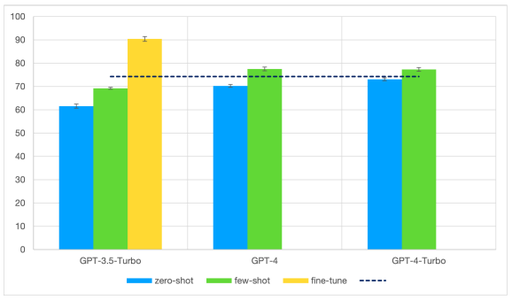
Figure 5 . Overview evaluation on shuffling the provided entities in RE on materials and properties. The met- rics are the aggregated micro average F1-scores calculated using strict matching. The error bars are calculated over the standard deviation of three independent runs.
원문 · CC BY 4.0 · Luca Foppiano, Guillaume Lambard, Toshiyuki Amagasa, Masashi Ishii · Mining experimental data from Materials Science literature with Large Language Models: an evaluation study · 원문 그림 인용 · 원본 PDF 20쪽에서 그림 영역을 추출했습니다.반면 GPT-3.5-Turbo의 제로샷과 퓨샷 설정은 셔플 평가에서 점수가 크게 떨어졌습니다. 이는 모델이 문서 순서대로 개체를 묶는 경향이 있었음을 시사하지만, 이것은 저자들의 해석입니다. FT.document order로 미세조정한 모델은 셔플 조건에서 약 30% F1 손실을 보였습니다. FT.augmented는 데이터를 두 배로 늘렸지만 FT.base보다 개선되지 않았습니다.
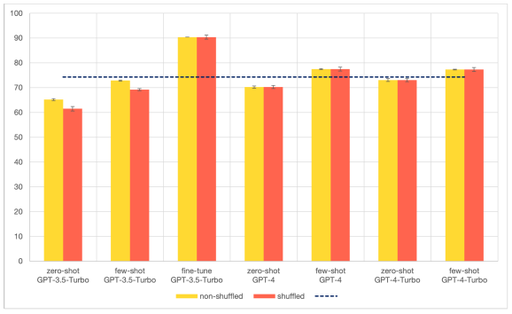
Figure 4 . Comparison of the scores of the shuffled extraction using zero-shot prompting, few-shot prompting and the fine-tuned model for RE on materials and properties. The metrics are the aggregated micro average F1-scores calculated using strict matching. The error bars are calculated over the standard deviation of three independent runs.
원문 · CC BY 4.0 · Luca Foppiano, Guillaume Lambard, Toshiyuki Amagasa, Masashi Ishii · Mining experimental data from Materials Science literature with Large Language Models: an evaluation study · 원문 그림 인용 · 원본 PDF 20쪽에서 그림 영역을 추출했습니다.적용 범위와 한계
이 연구의 평가 데이터는 초전도체 연구에 집중되어 있습니다. 저자들은 물질과학의 다른 하위 분야에서도 결과를 검증해야 한다고 밝힙니다. 다만 물질 이름 형식과 물성 표현은 여러 분야에서 비슷할 것이라는 추론을 제시하며, 이것은 검증되지 않은 가정입니다. 관계 추출은 다른 분야의 데이터셋을 더 필요로 한다고 명시됩니다.
또한 실험 결과의 여러 점수는 세 번의 실행 평균과 표준편차로 보고되었지만, 오픈소스 LLM은 JSON 출력이 충분히 안정적이지 않아 이번 비교에서 제외되었습니다. 따라서 결과는 지정된 OpenAI 모델과 지정된 프롬프트 설정에 한정해서 읽어야 합니다.
논문 정보
- 저자
- Luca Foppiano, Guillaume Lambard, Toshiyuki Amagasa, Masashi Ishii
- 학회·저널
- arXiv · 프리프린트
- 최초 공개일
- 2024년 1월 19일
- 등록일
- 2026년 11월 6일
- 수정일
- 2024년 5월 30일
- 버전
- v3
- arXiv
- 2401.11052
- DOI
- 10.1080/27660400.2024.2356506
- 분류
- cs.CL
- 원문 이용 조건
- CC BY 4.0
- 제공 범위
- 논문 정보, 해설, 허용된 원문 그림
AI 해설은 논문 원문과 별개의 설명이며 오류가 있을 수 있습니다. 원문과 그림은 각 출처의 이용 조건과 따로 표시된 권리를 따릅니다.
초록
This study is dedicated to assessing the capabilities of large language models (LLMs) such as GPT-3.5-Turbo, GPT-4, and GPT-4-Turbo in extracting structured information from scientific documents in materials science. To this end, we primarily focus on two critical tasks of information extraction: (i) a named entity recognition (NER) of studied materials and physical properties and (ii) a relation extraction (RE) between these entities. Due to the evident lack of datasets within Materials Informatics (MI), we evaluated using SuperMat, based on superconductor research, and MeasEval, a generic measurement evaluation corpus. The performance of LLMs in executing these tasks is benchmarked against traditional models based on the BERT architecture and rule-based approaches (baseline). We introduce a novel methodology for the comparative analysis of intricate material expressions, emphasising the standardisation of chemical formulas to tackle the complexities inherent in materials science information assessment. For NER, LLMs fail to outperform the baseline with zero-shot prompting and exhibit only limited improvement with few-shot prompting. However, a GPT-3.5-Turbo fine-tuned with the appropriate strategy for RE outperforms all models, including the baseline. Without any fine-tuning, GPT-4 and GPT-4-Turbo display remarkable reasoning and relationship extraction capabilities after being provided with merely a couple of examples, surpassing the baseline. Overall, the results suggest that although LLMs demonstrate relevant reasoning skills in connecting concepts, specialised models are currently a better choice for tasks requiring extracting complex domain-specific entities like materials. These insights provide initial guidance applicable to other materials science sub-domains in future work.
원문 인용
Luca Foppiano, Guillaume Lambard, Toshiyuki Amagasa, Masashi Ishii (2024). Mining experimental data from Materials Science literature with Large Language Models: an evaluation study. arXiv:2401.11052v3. https://doi.org/10.1080/27660400.2024.2356506
BibTeX
@article{foppiano2024mining,
  title = {{Mining experimental data from Materials Science literature with Large Language Models: an evaluation study}},
  author = {Luca Foppiano and Guillaume Lambard and Toshiyuki Amagasa and Masashi Ishii},
  year = {2024},
  eprint = {2401.11052},
  archivePrefix = {arXiv},
  doi = {10.1080/27660400.2024.2356506},
  url = {https://arxiv.org/abs/2401.11052v3}
}