논문 해설
On Lipschitz Explosion in Deep Neural Networks with Normalization: Consequences for Optimization and Adversarial Robustness
정규화를 적용한 심층 신경망에서의 Lipschitz 폭발: 최적화와 적대적 견고성에 미치는 영향
- 연구 문제 정규화 층을 가진 깊은 신경망은 학습을 돕지만, 최악의 경우 입력과 가중치의 작은 변화에 대한 Lipschitz 민감도가 깊이에 따라 지수적으로 커질 수 있습니다.
- 연구 방법 논문은 배치 정규화를 포함한 선형 활성화 네트워크에서 입력 Lipschitz 상수와 매개변수 Lipschitz 상수를 나누어 분석하고, 직교 가중치와 랭크 결손 입력 쌍으로 지수적 하한을 구성합니다.
- 주요 결과 직교 가중치와 고정 입력 설정에서 두 Lipschitz 상수가 깊이에 따라 지수적으로 커질 수 있음이 증명되며, 랭크를 새로 만드는 섭동이 같은 잡음 수준의 같은 부분공간 섭동보다 강하게 성능을 떨어뜨린다고 보고됩니다.
배치 정규화와 Lipschitz 상수의 문제
정규화 층은 깊은 신경망의 학습을 안정시키는 데 널리 쓰이지만, 이 논문은 같은 층이 최악의 경우 입력과 가중치에 대한 민감도를 깊이에 따라 지수적으로 키울 수 있는지를 묻습니다. 논문은 신경망의 Lipschitz 상수를 두 가지로 나눕니다. 입력 Lipschitz 상수 LipX(Fθ)는 데이터 섭동에 대한 출력 민감도이고, 매개변수 Lipschitz 상수 LipΘ(F;Xin)는 가중치 섭동에 대한 출력 민감도입니다. 저자들은 층별 노름이 ∥Wℓ∥2 ≤ 1로 제한된 경우에도 두 상수가 깊이와 함께 지수적으로 커질 수 있다고 주장합니다. 이 질문은 비매끄러운 최적화 보장, 일반화 경계, 강건성 인증서가 모두 Lipschitz 상수에 의존한다는 점에서 중요합니다.
정규화 층의 연산과 두 Lipschitz 상수
논문이 분석한 신경망은 선형 활성화를 가진 깊이 m의 망이며, 각 층은 X(ℓ) = BN(X(ℓ−1)Wℓ)로 정의됩니다. 여기서 BN은 열 단위 배치 정규화로, 각 열을 열의 노름으로 나눕니다. 따라서 정규화된 행렬의 모든 열은 단위 노름을 가지며 ∥BN(X)∥F² = k가 성립합니다. 입력 Lipschitz 상수는 입력 쌍 X, Y에 대한 출력 차이 비율의 상한이고, 매개변수 Lipschitz 상수는 고정된 입력 Xin에서 가중치 튜플 θ에 대한 출력 차이 비율의 상한입니다. 저자들은 정규화가 재조정 연산이므로 가중치 스케일에 불변이라는 점을 이용하여 두 구성을 설계합니다.
입력과 매개변수 Lipschitz 하한
입력 Lipschitz 하한인 Theorem 2.3은 직교 가중치 Wℓ ∈ O(k)를 사용해도 LipX(Fm)가 Ck,η e^{γk,η m} 이상으로 커질 수 있음을 주장합니다. 증명의 핵심은 거의 랭크 결손인 입력 쌍 X0, Y0을 정규화 단계마다 등방성 함수 I(X)를 키우도록 가중치를 골라 설계하는 것입니다. 등방성이 충분히 커지면 λmin(X⊤mXm)에 하한이 생기고, 랭크 결손 궤적과의 거리가 이 하한 아래에 머뭅니다. 반면 Theorem 2.6은 고정 입력 Ik에서 첫 층 가중치를 두 구성으로 나누어 매개변수 Lipschitz 상수 LipΘ(Fm)의 지수적 하한을 제시합니다. 두 정리 모두 선형 활성화를 사용하므로 성장이 활성화 함수 자체에서 온 것이 아니라는 점을 보여 줍니다.
구성된 증거 쌍과 무작위 쌍의 비교
실험은 Theorem 2.3의 설정 가운데 k=2를 사용하여 경험적 Lipschitz 비율을 깊이에 따라 측정합니다. 존재성 증명은 비구성적 확률 논법을 쓰므로, 실험에서는 각 층에서 등방성 함수를 최대화하는 회전을 격자 탐색으로 고릅니다. 구성된 증거 쌍 (X0, Y0)과 그 직교 회전 쌍은 지수적 증가를 보이지만, i.i.d. 가우시안 섭동으로 만든 무작위 국소 쌍의 중앙값과 95백분위수는 거의 평탄하게 남습니다. 이 결과는 구성된 쌍이 실제 최악의 불안정성을 드러낸다는 저자들의 해석을 지지하며, 무작위 국소 섭동 전반에 대한 결론으로 읽어서는 안 됩니다.
랭크 기하와 적대적 섭동의 강건성
적대적 취약성 분석은 랭크 분리 메커니즘을 제시합니다. 깨끗한 입력은 랭크 k−1이고 적대적 입력은 랭크 k이며, 둘 사이의 거리는 지수적으로 작을 수 있습니다. 이때 정규화된 궤적의 출력은 상수 거리만큼 떨어질 수 있고, 선형 판독기와 결합하면 작은 섭동으로 분류가 뒤집히는 예가 됩니다. 실험에서는 MNIST, Fashion-MNIST, CIFAR-10에서 클리핑 전 에너지를 맞춘 i.i.d. 픽셀 잡음과 같은 부분공간 잡음을 비교합니다. 랭크를 새로 만드는 섭동이 정확도, 신뢰도, 여백을 더 크게 떨어뜨렸다고 보고되며, 이 결과는 사전 학습된 ResNet56과 소규모 BatchNorm 모델의 설정 안에서 읽어야 합니다.
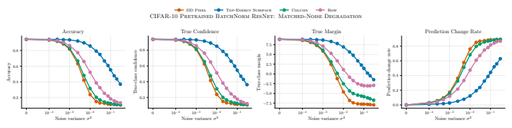
Figure 4 : Effect of noise structure on a pretrained BatchNorm ResNet56 on CIFAR-10. Same- subspace perturbations are substantially less harmful than pixel-, row-, and column-wise noise.
원문 · CC BY 4.0 · Ashkan Soleymani, Reyhaneh Hosseinpourkhoshkbari, Hadi Daneshmand, Patrick Jaillet · On Lipschitz Explosion in Deep Neural Networks with Normalization: Consequences for Optimization and Adversarial Robustness · 원문 그림 인용 · 원본 PDF 10쪽에서 그림 영역을 추출했습니다.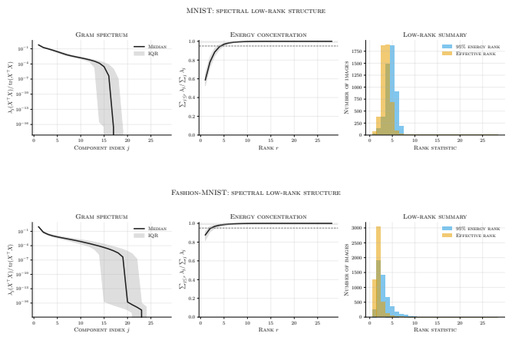
Figure 5 : Spectral evidence for approximate low-rank structure in MNIST and Fashion-MNIST. For each dataset, the left panel shows the median normalized Gram spectrum λj(X ⊤X)/tr(X ⊤X) with interquartile range, the middle panel shows cumulative spectral energy with the 90% and 95% thresholds, and the right panel reports the distributions of effective rank and the rank needed to capture 95% of the energy. In both datasets, most of the spectral energy is concentrated in a few components, indicating that typical images lie close to a low-rank set.
원문 · CC BY 4.0 · Ashkan Soleymani, Reyhaneh Hosseinpourkhoshkbari, Hadi Daneshmand, Patrick Jaillet · On Lipschitz Explosion in Deep Neural Networks with Normalization: Consequences for Optimization and Adversarial Robustness · 원문 그림 인용 · 원본 PDF 27쪽에서 그림 영역을 추출했습니다.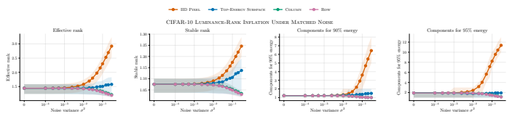
Figure 7 : Rank inflation under matched-energy perturbations on CIFAR-10 luminance images. The plots show effective rank, stable rank, and the number of components required to capture 90% and 95% of the spectral energy. IID pixel noise substantially increases all rank-based measures as σ2 grows, whereas same-subspace and structured row or column perturbations have a much milder effect.
원문 · CC BY 4.0 · Ashkan Soleymani, Reyhaneh Hosseinpourkhoshkbari, Hadi Daneshmand, Patrick Jaillet · On Lipschitz Explosion in Deep Neural Networks with Normalization: Consequences for Optimization and Adversarial Robustness · 원문 그림 인용 · 원본 PDF 28쪽에서 그림 영역을 추출했습니다.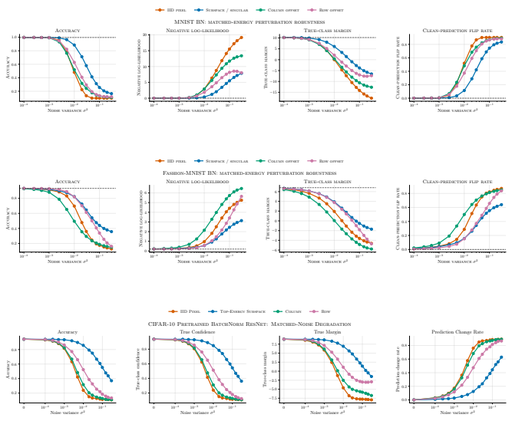
Figure 8 : Matched-energy perturbation robustness across MNIST, Fashion-MNIST, and CIFAR-10 BatchNorm models. Each row shows performance as the noise variance σ2 increases under i.i.d. pixel noise, subspace-preserving perturbations, column offsets, and row offsets. Subspace-preserving perturbations typically degrade accuracy, confidence, and margin more slowly and induce fewer prediction changes, while perturbations that move away from the image subspace cause earlier instability.
원문 · CC BY 4.0 · Ashkan Soleymani, Reyhaneh Hosseinpourkhoshkbari, Hadi Daneshmand, Patrick Jaillet · On Lipschitz Explosion in Deep Neural Networks with Normalization: Consequences for Optimization and Adversarial Robustness · 원문 그림 인용 · 원본 PDF 29쪽에서 그림 영역을 추출했습니다.적용 범위와 남은 질문
이 결과의 하한은 최악의 경우의 구성적 증명과 특정 설정의 실험에 근거합니다. 입력 증가 정리는 직교 가중치와 선형 활성화를 사용하며, 저자들은 ReLU 설정과 평균 제거 배치 정규화로의 확장을 부록에서 다룬다고 밝힙니다. 반대로 무작위 국소 섭동의 일반적 행동이나 모든 데이터셋과 모든 정규화 변형에 대한 결론은 제시되지 않습니다. 또한 Goldstein 정상성 질의 하한은 일반 Lipschitz 함수에 대한 결과이며, 이 논문이 새로 제안한 확률적 Goldstein 정상성 알고리즘은 함수값 질의만 사용하는 기준선으로 소개됩니다.
논문 정보
- 저자
- Ashkan Soleymani, Reyhaneh Hosseinpourkhoshkbari, Hadi Daneshmand, Patrick Jaillet
- 학회·저널
- arXiv · 프리프린트
- 최초 공개일
- 2026년 11월 5일
- 등록일
- 2026년 11월 9일
- 수정일
- 2026년 11월 5일
- 버전
- v1
- arXiv
- 2611.08775
- 분류
- cs.LG · cs.AI · math.OC · stat.ML
- 원문 이용 조건
- CC BY 4.0
- 제공 범위
- 논문 정보, 해설, 허용된 원문 그림
AI 해설은 논문 원문과 별개의 설명이며 오류가 있을 수 있습니다. 원문과 그림은 각 출처의 이용 조건과 따로 표시된 권리를 따릅니다.
초록
Can a network look stable at every layer and still be exponentially unstable as a whole? The Lipschitz constant of a neural network is a basic stability quantity appearing in optimization guarantees, generalization bounds, and robustness certificates. Deep networks naturally admit two such notions, input Lipschitzness, measuring sensitivity to data perturbations, and parameter Lipschitzness, measuring sensitivity to weight perturbations. We prove that, for deep networks with normalization layers, with batch normalization as the canonical example, both Lipschitz constants can grow exponentially with depth and hence with parameter dimension, even under strong per-layer norm control such as $\|W_\ell\|_2\le 1$, and already for linear activations. Thus, a mechanism widely used to stabilize training can create severe worst-case instabilities that are invisible locally, i.e., from layerwise norm bounds alone. Parameter-Lipschitz explosion turns Lipschitz-dependent nonsmooth optimization guarantees into exponential-in-dimension bounds for deep normalized networks, while input-Lipschitz explosion makes worst-case Lipschitz-based generalization and robustness certificates vacuous. The latter also yields a concrete rank-separation mechanism for adversarial vulnerability. The theory predicts that perturbations introducing new singular directions should be amplified much more strongly than perturbations at the same noise level that remain within the input's original singular subspace. Experiments on MNIST, Fashion-MNIST, and CIFAR-10 support this prediction, showing that rank-creating perturbations cause substantially sharper drops in accuracy, confidence, and margins than same-subspace perturbations.
원문 인용
Ashkan Soleymani, Reyhaneh Hosseinpourkhoshkbari, Hadi Daneshmand, Patrick Jaillet (2026). On Lipschitz Explosion in Deep Neural Networks with Normalization: Consequences for Optimization and Adversarial Robustness. arXiv:2611.08775v1. https://arxiv.org/abs/2611.08775v1
BibTeX
@misc{soleymani2026lipschitz,
  title = {{On Lipschitz Explosion in Deep Neural Networks with Normalization: Consequences for Optimization and Adversarial Robustness}},
  author = {Ashkan Soleymani and Reyhaneh Hosseinpourkhoshkbari and Hadi Daneshmand and Patrick Jaillet},
  year = {2026},
  eprint = {2611.08775},
  archivePrefix = {arXiv},
  url = {https://arxiv.org/abs/2611.08775v1}
}