논문 해설
CombiMOTS: Combinatorial Multi-Objective Tree Search for Dual-Target Molecule Generation
CombiMOTS: 이중 표적 분자 생성을 위한 조합형 다목적 트리 탐색
- 연구 문제 이중 표적 분자 생성은 두 단백질에 동시에 작용하는 화합물을 찾는 문제이며, 기존 방법은 목표를 스칼라 보상으로 단순화하고 합성 가능성을 생성 과정에 충분히 반영하지 못합니다.
- 연구 방법 CombiMOTS는 FGIB로 추출한 표적 관련 fragment를 Enamine REAL Space의 building block에 Tanimoto 임계값 0.4로 매핑하고, Pareto UCB 기반 MCTS로 벡터화된 목표의 Pareto 프런트를 탐색합니다.
- 주요 결과 GSK3β-JNK3 과제에서 CombiMOTS는 Novelty 99.96±0.01%, Diversity 88.67±0.52%를 보고하며, 같은 설정에서 scalarized 버전보다 많은 dual active 분자를 찾았다고 보고합니다.
이중 표적 분자 생성의 어려움
이중 표적 분자 생성은 하나의 화합물이 두 표적 단백질에 동시에 작용하도록 설계하는 문제입니다. 기존 FBDD 계열 방법은 여러 목표를 가중합으로 묶은 스칼라 보상을 사용하는 경우가 많아, 목표 사이의 상충 관계를 충분히 드러내지 못합니다. 또한 생성된 분자가 실제로 합성 가능한지를 생성 과정 안에서 보장하기 어렵습니다. 이 논문은 이 두 문제를 함께 다루며, 합성 가능한 fragment 공간에서 Pareto 최적화를 결합한 탐색 방법을 제안합니다.
CombiMOTS의 탐색 공간 축소와 Pareto MCTS
CombiMOTS는 먼저 FGIB로 표적 관련 fragment를 추출하고, Tanimoto 유사도 임계값 0.4를 사용해 Enamine REAL Space의 building block에 매핑하여 탐색 공간을 줄입니다. 이후 Pareto MCTS는 선택 단계에서 Pareto UCB 값을 계산하고 자식 노드의 로컬 Pareto 프런트에서 노드를 무작위로 골라 확장합니다. 탐색은 rollout 수 50,000으로 설정되며, 역전파 시 보상 벡터를 갱신합니다. 이 방식은 단일 스칼라 보상 대신 벡터화된 목표를 유지하는 것이 핵심입니다.
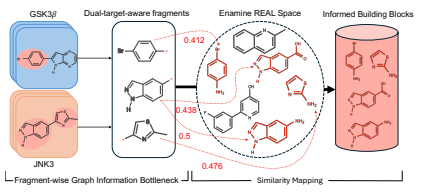
Figure 1 . Search Space Reduction. Property-aware fragments are extracted for each target using Fragment-wise Graph Information Bottleneck (Lee et al., 2023). By applying a Tanimoto similarity threshold to a synthesizable search space, we curate a final set of informed industry-ready building blocks.
원문 · CC BY 4.0 · Thibaud Southiratn, Bonil Koo, Yijingxiu Lu, Sun Kim · CombiMOTS: Combinatorial Multi-Objective Tree Search for Dual-Target Molecule Generation · 원문 그림 인용 · 원본 PDF 4쪽에서 그림 영역을 추출했습니다.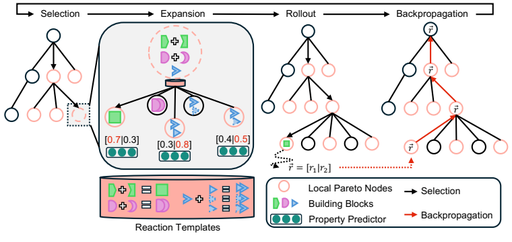
Figure 2 . One full iteration of the CombiMOTS Algorithm. (i) Selection from local Pareto fronts occurs until a leaf node to expand is found. (ii) During expansion, two types of nodes are created by consulting the reaction templates: those representing products from current building blocks and those incorporating compatible reactants. Upon creation, oracles predict properties for all child nodes to establish their local Pareto front. We illustrate property vectors with two objectives. (iii) Selection and Expansion steps iteratively occur until a reaction product is found. (iv) The property vector of the reaction product is backpropagated up the path.
원문 · CC BY 4.0 · Thibaud Southiratn, Bonil Koo, Yijingxiu Lu, Sun Kim · CombiMOTS: Combinatorial Multi-Objective Tree Search for Dual-Target Molecule Generation · 원문 그림 인용 · 원본 PDF 6쪽에서 그림 영역을 추출했습니다.GSK3β-JNK3 과제의 검증 결과
GSK3β-JNK3 과제에서 CombiMOTS는 10,000개 샘플 기준으로 Novelty 99.96±0.01%와 Diversity 88.67±0.52%를 보고합니다. 같은 과제에서 평균 R2-distance는 0.8075로, 낮을수록 좋은 Pareto 최적 집합의 이상점 거리 지표입니다. 이 결과는 해당 과제와 지표 조건에서의 수치이며, 다른 표적 쌍으로 일반화되지는 않습니다.
Tanimoto 임계값과 scalarization 대조
임계값 민감도 실험에서 0.3, 0.4, 0.5, 0.6을 비교하며, 0.4가 기본값으로 쓰였습니다. 임계값 0.6은 search space를 작게 만들어 Diversity를 78.73±1.11%로 낮췄습니다. 동일한 네 목표를 0.25 가중치로 합산한 scalarized 버전은 같은 탐색 설정에서 1,488개의 dual active 분자를 찾았고, Pareto 최적화 버전은 3,662개를 찾았습니다. 이 대조는 GSK3β-JNK3 과제에 한정됩니다.
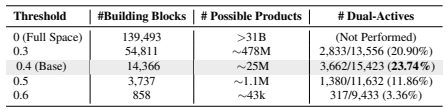
Table 4 . Search space size and dual-actives candidates over all generations using different similarity threshold values.
원문 · CC BY 4.0 · Thibaud Southiratn, Bonil Koo, Yijingxiu Lu, Sun Kim · CombiMOTS: Combinatorial Multi-Objective Tree Search for Dual-Target Molecule Generation · 원문 그림 인용 · 원본 PDF 8쪽에서 그림 영역을 추출했습니다.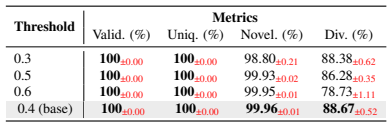
Table 6 . Performance comparison across different threshold values based on 10,000 sampled molecules on the GSK3β-JNK3 task for three independent runs. Note the drop in Diversity for a threshold value of 0.6, reflecting redundancy related to a limited search space.
원문 · CC BY 4.0 · Thibaud Southiratn, Bonil Koo, Yijingxiu Lu, Sun Kim · CombiMOTS: Combinatorial Multi-Objective Tree Search for Dual-Target Molecule Generation · 원문 그림 인용 · 원본 PDF 16쪽에서 그림 영역을 추출했습니다.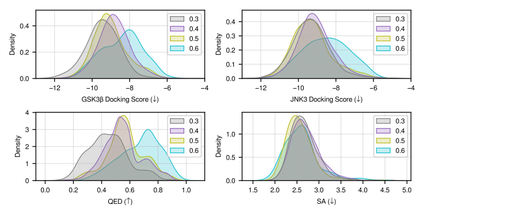
Figure 9 . Distributions plots comparing Tanimoto similarity thresholds on the GSK3β-JNK3 task. A value of 0.3 converges slower in QED. Values of 0.4 and 0.5 perform similarly but 0.4 presents more dual-actives. From 0.6, the search space is too small to find better tradeoffs.
원문 · CC BY 4.0 · Thibaud Southiratn, Bonil Koo, Yijingxiu Lu, Sun Kim · CombiMOTS: Combinatorial Multi-Objective Tree Search for Dual-Target Molecule Generation · 원문 그림 인용 · 원본 PDF 16쪽에서 그림 영역을 추출했습니다.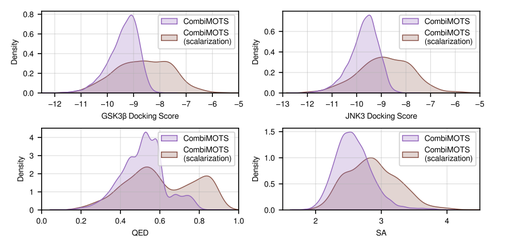
Figure 13 .Normalized distributions of CombiMOTS against its scalarized version on the GSK3β-JNK3.
원문 · CC BY 4.0 · Thibaud Southiratn, Bonil Koo, Yijingxiu Lu, Sun Kim · CombiMOTS: Combinatorial Multi-Objective Tree Search for Dual-Target Molecule Generation · 원문 그림 인용 · 원본 PDF 20쪽에서 그림 영역을 추출했습니다.적용 범위와 남은 한계
Mothra는 생성된 유효 분자 수가 매우 적었고, MolSearch는 계산 비용이 높아 실험이 중단되었다고 보고됩니다. 독성 최적화 추가 실험에서는 예측 독성이 낮아졌지만, 이는 GSK3β-JNK3 과제에서 얻은 결과입니다. 이 논문의 결과는 특정 표적 쌍, 특정 예측기와 도킹 설정에서 얻은 것이며, 실험적 활성 검증은 원문 범위에 포함되지 않습니다.
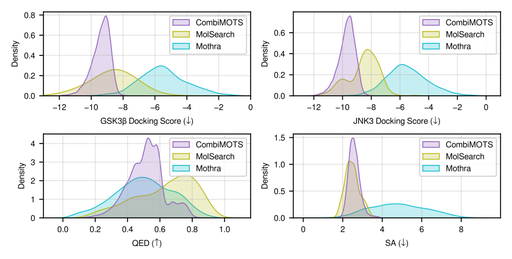
Figure 17 .Normalized distributions of CombiMOTS against Mothra and MolSearch on the GSK3β-JNK3 task.
원문 · CC BY 4.0 · Thibaud Southiratn, Bonil Koo, Yijingxiu Lu, Sun Kim · CombiMOTS: Combinatorial Multi-Objective Tree Search for Dual-Target Molecule Generation · 원문 그림 인용 · 원본 PDF 25쪽에서 그림 영역을 추출했습니다.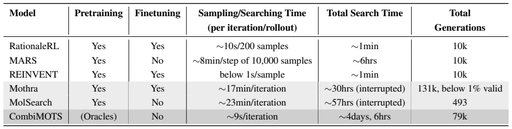
Table 11 .Approximate runtimes on the GSK3β-JNK3 task.
원문 · CC BY 4.0 · Thibaud Southiratn, Bonil Koo, Yijingxiu Lu, Sun Kim · CombiMOTS: Combinatorial Multi-Objective Tree Search for Dual-Target Molecule Generation · 원문 그림 인용 · 원본 PDF 27쪽에서 그림 영역을 추출했습니다.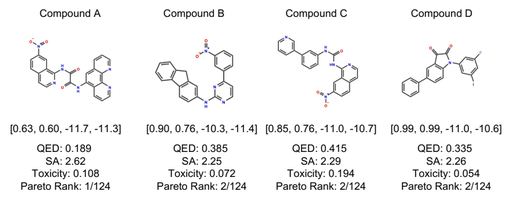
Figure 19 . The four selected compounds for toxicity prediction. The vector values account for GSK3β-JNK3 predicted activities, and GSK3β-JNK3 predicted docking scores, respectively.
원문 · CC BY 4.0 · Thibaud Southiratn, Bonil Koo, Yijingxiu Lu, Sun Kim · CombiMOTS: Combinatorial Multi-Objective Tree Search for Dual-Target Molecule Generation · 원문 그림 인용 · 원본 PDF 28쪽에서 그림 영역을 추출했습니다.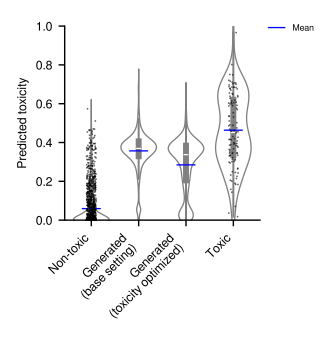
Figure 21 .Chemprop predictions of molecules generated while aiming to minimize toxicity.
원문 · CC BY 4.0 · Thibaud Southiratn, Bonil Koo, Yijingxiu Lu, Sun Kim · CombiMOTS: Combinatorial Multi-Objective Tree Search for Dual-Target Molecule Generation · 원문 그림 인용 · 원본 PDF 30쪽에서 그림 영역을 추출했습니다.논문 정보
- 저자
- Thibaud Southiratn, Bonil Koo, Yijingxiu Lu, Sun Kim
- 학회·저널
- arXiv · 프리프린트
- 최초 공개일
- 2026년 4월 25일
- 등록일
- 2026년 10월 29일
- 수정일
- 2026년 4월 25일
- 버전
- v1
- arXiv
- 2604.23307
- 분류
- cs.LG · cs.AI
- 원문 이용 조건
- CC BY 4.0
- 제공 범위
- 논문 정보, 해설, 허용된 원문 그림
AI 해설은 논문 원문과 별개의 설명이며 오류가 있을 수 있습니다. 원문과 그림은 각 출처의 이용 조건과 따로 표시된 권리를 따릅니다.
초록
Dual-target molecule generation, which focuses on discovering compounds capable of interacting with two target proteins, has garnered significant attention due to its potential for improving therapeutic efficiency, safety and resistance mitigation. Existing approaches face two critical challenges. First, by simplifying the complex dual-target optimization problem to scalarized combinations of individual objectives, they fail to capture important trade-offs between target engagement and molecular properties. Second, they typically do not integrate synthetic planning into the generative process. This highlights a need for more appropriate objective function design and synthesis-aware methodologies tailored to the dual-target molecule generation task. In this work, we propose CombiMOTS, a Pareto Monte Carlo Tree Search (PMCTS) framework that generates dual-target molecules. CombiMOTS is designed to explore a synthesizable fragment space while employing vectorized optimization constraints to encapsulate target affinity and physicochemical properties. Extensive experiments on real-world databases demonstrate that CombiMOTS produces novel dual-target molecules with high docking scores, enhanced diversity, and balanced pharmacological characteristics, showcasing its potential as a powerful tool for dual-target drug discovery. The code and data is accessible through https://github.com/Tibogoss/CombiMOTS.
원문 인용
Thibaud Southiratn, Bonil Koo, Yijingxiu Lu, Sun Kim (2026). CombiMOTS: Combinatorial Multi-Objective Tree Search for Dual-Target Molecule Generation. arXiv:2604.23307v1. https://arxiv.org/abs/2604.23307v1
BibTeX
@misc{southiratn2026combimots,
  title = {{CombiMOTS: Combinatorial Multi-Objective Tree Search for Dual-Target Molecule Generation}},
  author = {Thibaud Southiratn and Bonil Koo and Yijingxiu Lu and Sun Kim},
  year = {2026},
  eprint = {2604.23307},
  archivePrefix = {arXiv},
  url = {https://arxiv.org/abs/2604.23307v1}
}