논문 해설
Hybrid discrete-continuous compilation of trapped-ion quantum circuits with deep reinforcement learning
심층 강화학습을 이용한 포획 이온 양자 회로의 이산-연속 하이브리드 컴파일
- 연구 문제 이온 트랩 양자 회로에서 게이트 순서와 연속 각도를 함께 최적화해 더 짧은 회로를 찾는 문제입니다.
- 연구 방법 PS-LSTM 강화학습 에이전트가 게이트를 선택하고 L-BFGS-B가 연속 각도를 최적화하는 하이브리드 방법입니다.
- 주요 결과 3큐비트 Toffoli 게이트와 UCC 연산자 시뮬레이션에서 짧은 회로를 찾았으며, 큐비트 수가 커질수록 탐색이 어려워졌습니다.
문제 설정: 이온 트랩 회로에서 게이트 배치와 연속 각도의 동시 최적화
양자 회로를 짧게 줄이는 일은 환경 decoherence의 영향을 줄이는 데 중요합니다. 이 논문은 이온 트랩 플랫폼에서 목표 유니터리를 근사하는 회로를 만들 때, 게이트의 순서(이산적 선택)와 각 게이트의 연속 회전각(연속 파라미터)을 함께 다루는 문제를 설정합니다. 기존의 휴리스틱 탐색이나 층 기반 탐색은 게이트 수가 늘어날수록 조합 공간이 빠르게 커져 실용성이 떨어집니다. 원문은 3큐비트 회로에서 가능한 조합 수가 1049591개이고 4큐비트에서 5개의 얽힘 게이트를 쓰면 약 2^36 규모가 된다고 계산합니다. 따라서 이 논문은 게이트 위치는 강화학습 에이전트가 정하고, 각도는 기울기 기반 최적화기가 매 단계 맞추는 하이브리드 구조를 다룹니다.
빠른 지수화를 이용한 MS와 Cxy 게이트 계산
시뮬레이션에서 MS와 Cxy 게이트를 직접 행렬 지수 함수로 계산하면 행렬 곱셈 비용이 커집니다. 이 논문은 θ와 ϕ에 대해 게이트를 분해하여, 위상에 독립인 부분을 미리 캐싱하고 원소별 연산으로 유니터리를 얻는 방식을 제시합니다. 캐싱된 행렬 D는 θ에 의존하는 고유값 항과 결합되고, ϕ에 의존하는 위상 성분은 원소별 곱으로 들어갑니다. 부록의 측정에서 저자들은 캐싱 이후 12큐비트 이하에서 50배에서 250배의 속도 향상을 보고합니다. 이 속도 향상은 시뮬레이션 비용에 한정된 결과이며 실제 하드웨어 실행 비용을 뜻하지 않습니다.
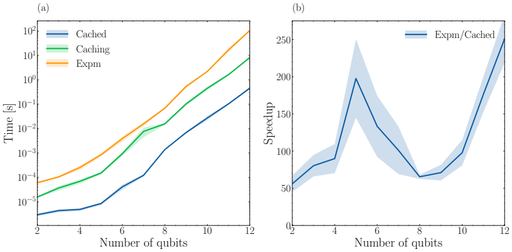
Figure 7 : (a) Walltime for MS gate construction with standard matrix exponentiation and with the analytical approach of this paper as a function of the number of qubits. The orange line corresponds to the functionscipy.expm, the blue and green lines represent the analytical approach during caching and after caching, respectively; (b) speedup of the new approach, once the parameter-indedependent matrices have been cached, as a function of the number of qubits. Here we see that the speedup is not constant as the number of qubits changes, but we have a maximum speedup around 5 qubits, which then decreases until we reach 8 qubits, and then increases again. This effect is most likely due to an underlying slowdown in the underlying fundamental operations, e.g., due to the processor cache being filled up quickly, so that access to the RAM becomes necessary. Moreover, our method is implemented only using NUMBA, i.e., compiled PYTHON code, whereas the exponential matrix function of SCIPY profits from underlying time-critical routines written in C, C++ and Fortran. It seems, however, that the speedup grows steadily for values larger than 8 qubits.
원문 · CC BY 4.0 · Francesco Preti, Michael Schilling, Sofiene Jerbi, Lea M. Trenkwalder, Hendrik Poulsen Nautrup, Felix Motzoi, Hans J. Briegel · Hybrid discrete-continuous compilation of trapped-ion quantum circuits with deep reinforcement learning · 원문 그림 인용 · 원본 PDF 19쪽에서 그림 영역을 추출했습니다.PS-LSTM 에이전트와 기울기 최적화의 결합
강화학습 에이전트는 Projective Simulation 구조에 LSTM 정책을 결합한 PS-LSTM입니다. 에이전트는 게이트 집합 {MS, Cxy, Z1, ..., Zn}에서 한 게이트를 골라 회로 끝에 붙이고, 이 회로를 목표 유니터리와 비교하는 비용 함수 C(α)를 L-BFGS-B로 최소화합니다. 그 최솟값으로 보상 R_t를 정하며, 이 보상은 충분히 낮은 오차를 얻은 시퀀스를 강화하는 curriculum 임계값 ϵ_t와 결합됩니다. 보상과 정책 갱신은 PS의 edge weight 업데이트와 glow 값을 통해 이전 전이들에 분배됩니다.
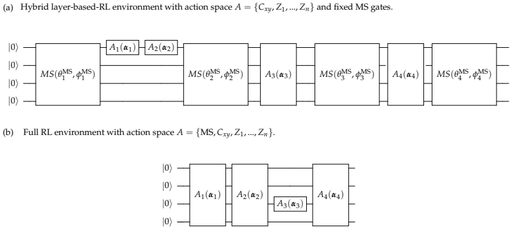
Figure 9 : Quantum circuit representation of two possible RL environments for quantum circuit optimization. The first environment (a) resembles the structure of the layer-based compilation, that is, the entangling MS gates are fixed and the agent can place rotations on the circuit between the entangling layers. The second one (b) has no pre-defined circuit structure but rather leaves the agent completely free to place any gate withing the gate set on the quantum circuit, with only one additional simplification: two gates of the same type placed immediately one after the other are automatically merged to form one single gate. This is done to prevent the agent from getting stuck in loops, i.e., local minima, where it keeps choosing the same gate over and over again. In general, the first circuit reduces the size of the action space and therefore the possible shapes of the corresponding cost function, hence reducing exploration in favour of a more standardized search.
원문 · CC BY 4.0 · Francesco Preti, Michael Schilling, Sofiene Jerbi, Lea M. Trenkwalder, Hendrik Poulsen Nautrup, Felix Motzoi, Hans J. Briegel · Hybrid discrete-continuous compilation of trapped-ion quantum circuits with deep reinforcement learning · 원문 그림 인용 · 원본 PDF 23쪽에서 그림 영역을 추출했습니다.비용 함수와 기울기 계산
목표 유니터리 U에 대한 비용은 게이트 충실도 기반의 C(α) = 1 − (1/d^2)|tr{∏V(α_l)U†}|^2로 주어집니다. 목표 유니터리가 알려진 경우에는 GRAPE 방식으로 중간 유니터리를 저장해 기울기를 계산하며, 블랙박스 목표에서는 Hilbert-Schmidt 검사(C_HST)나 지역 검사(C_LHS)를 실험적으로 추정하고 파라미터 이동 규칙으로 기울기를 얻습니다. 원문은 C_LHS가 C_HST와 n 배 이내의 상계·하계 관계를 가지므로, C_LHS를 최소화하면 C_HST도 함께 줄어든다고 설명합니다. 단, 이 관계는 원문이 제시한 부등식의 범위 안에서 읽어야 합니다.
Toffoli 게이트 컴파일 결과
3큐비트 Toffoli 게이트를 3큐비트 회로와 4큐비트 회로에서 컴파일한 실험에서 저자들은 에이전트가 충실도를 높이면서 평균 회로 크기를 줄이는 것을 관찰합니다. 최소 충실도 기준 ϵ_min = 10^-2에 도달하는 최단 시퀀스는 4큐비트 설정에서 10개에서 19개 게이트로 늘어난다고 보고됩니다. 3큐비트 설정의 최적 해는 Ref. [52]의 결과와 일치한다고 보고됩니다. 4큐비트 평균 회로 길이가 최단 길이보다 긴 이유로 저자들은 최적화 난도와 curriculum 변화를 제시하며, 이는 저자의 해석입니다.
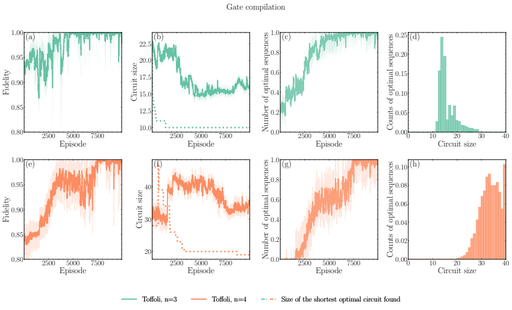
Figure 3 : Quantum circuit optimization of different gates using the gate set defined in Eqs.(1)-(3). (a), (e) show the average reward; (b), (f) the average circuit size (thick line) and the size of the best circuit found so far by all agents (dotted line); (c), (g) the number of optimal sequences per episode; (d), (h) are histograms which show the distribution of the optimal gate sequences over the circuit size. All lines refer to simulations of the3-qubit Toffoli gate, first compiled on a3-qubit (green line, average over 10 agents and 20 episodes) and then on a4-qubit circuit (orange line, average over 5 agents and 20 episodes). Due to then-qubit interaction of the trapped-ion gates, the optimal sequence that generates the gate – which we define as the shortest sequence whose infidelity falls belowϵmin = 10−2 – increases in size from10 to 19 gates. Shaded regions in the plots represent the corresponding standard deviations. While the average fidelity increases to reach the maximum for both circuits, we see that the average circuit length appears to be higher than the shortest circuit length. There are possible explanations for this: the shortest sequences can be harder to optimize, so there is a higher chance that the optimizer fails at outputting the cost function minimum for a given circuit structure and the curriculum scheme, that modifies the problem online during the training. Overall, we observe that the size of the optimal circuit decreases as training progresses, thus validating the successful optimization of the policy.
원문 · CC BY 4.0 · Francesco Preti, Michael Schilling, Sofiene Jerbi, Lea M. Trenkwalder, Hendrik Poulsen Nautrup, Felix Motzoi, Hans J. Briegel · Hybrid discrete-continuous compilation of trapped-ion quantum circuits with deep reinforcement learning · 원문 그림 인용 · 원본 PDF 10쪽에서 그림 영역을 추출했습니다.UCC 연산자 시뮬레이션 결과
UCC 연산자 U(β) = exp(iβ(∏(σx−iσy)+h.c.))를 β = π/2로 두고 3~8큐비트에서 PS-LSTM 에이전트를 실행한 결과가 보고됩니다. 큐비트 수가 늘수록 평균 최대 충실도는 낮아지고 최적 회로 크기는 커집니다. 7큐비트 UCC 유니터리의 경우 에이전트는 F=0.99 근처까지 충실도를 높이지만 고충실도 시퀀스 수를 훈련 중에 유의미하게 늘리지 못했다고 보고됩니다. 8큐비트에서는 1−F<10^-5 수준의 시퀀스를 찾았지만 수렴은 최적에 미치지 못했다고 원문은 밝힙니다.
XXZ 블랙박스 유니터리와 해석 범위
XXZ 모델 U(τ)=e^{-iHτ}를 블랙박스 목표로 삼아 J와 Δ를 바꾸며 3, 4, 5큐비트에서 회로 구조를 분석합니다. 원문은 J=0에서 1로 갈 때 얽힘이 늘면서 회로 크기가 빠르게 커지고, Δ 변화에서는 평균 회로 크기 증가가 상대적으로 완만하다고 보고합니다. 일부 파라미터에서는 최적 회로를 정확히 찾기 어렵다는 이상치가 나타납니다. 이 결과는 τ=0.25, 최대 회로 크기 50, 마지막 200 에피소드 평균이라는 조건에서 얻은 것입니다.
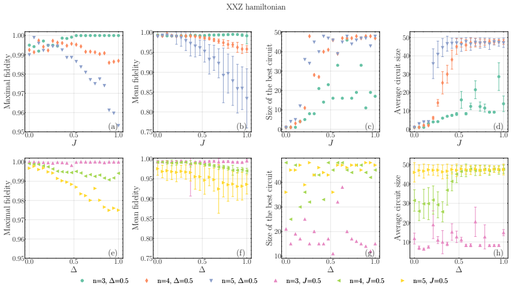
Figure 5 : These plots summarize the result of simulating the XXZ-model unitary with our approach for different parameter configurations forn = 3, 4, 5 qubits (3 agents for each parameter sample). (a) shows the maximal value of the fidelity found by the agents, (b) the mean fidelity, (c) the size of the shortest circuit associated with the fidelity in (a) and (d) the average circuit size, as a function of the couplingJ of the XXZ model for two different configuration of the transverse coupling∆ = 0.5 with varyingJ and andJ = 0.5 with varying∆ (dark green, orange and blue and pink, light green and yellow, respectively). The evolution time was fixed toτ = 0.25 and the maximum size of the circuit to 50. The average fidelity is calculated over the last 200 episodes. Vertical bars show the standard error for the mean values of fidelity and circuit size. We see here that the circuit size increases dramatically as the parameters∆ andJ increase. We also see from the number of outliers in (c) and (g), that for certain values of the parameters it is hard for the agents to exactly retrieve the optimal circuit.
원문 · CC BY 4.0 · Francesco Preti, Michael Schilling, Sofiene Jerbi, Lea M. Trenkwalder, Hendrik Poulsen Nautrup, Felix Motzoi, Hans J. Briegel · Hybrid discrete-continuous compilation of trapped-ion quantum circuits with deep reinforcement learning · 원문 그림 인용 · 원본 PDF 12쪽에서 그림 영역을 추출했습니다.BQSKit 비교와 탐색 비용
BQSKit의 QSearch 설정으로 같은 이온 트랩 게이트 집합에서 3큐비트 Toffoli 게이트를 컴파일한 결과도 보고됩니다. A*와 Dijkstra는 비슷한 해를 주었고 탐욕 휴리스틱은 전반적으로 더 나빴습니다. 원문은 BQSKit이 RL 방법보다 빠르지만 PS-LSTM이 찾은 compact 해에는 도달하지 못했다고 씁니다. 이 비교는 해당 설정과 시간 측정 조건에서의 결과입니다.
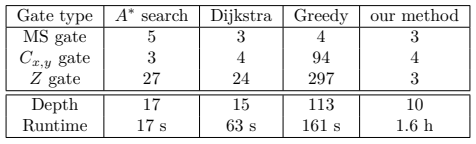
Table 1 : Result of the compilation of the 3-qubit Toffoli gate with BQSKit [7] using the gate set given by Eqs.(1)-(3) and three of the given search heuristics:A∗, Dijkstra, and greedy. The threshold is set toϵ = 10−2. We see that the compilation uses a considerable amount ofZ gates and a larger amount of collective gates than the RL algorithm. We see, however, that a standard compiler can be significantly faster than a RL-based search with 10000 episodes and it is therefore possible to apply further pruning methods and iterative optimization loops on top of the main compilation algorithm.
원문 · CC BY 4.0 · Francesco Preti, Michael Schilling, Sofiene Jerbi, Lea M. Trenkwalder, Hendrik Poulsen Nautrup, Felix Motzoi, Hans J. Briegel · Hybrid discrete-continuous compilation of trapped-ion quantum circuits with deep reinforcement learning · 원문 그림 인용 · 원본 PDF 25쪽에서 그림 영역을 추출했습니다.한계와 적용 범위
이 방법의 결과는 제공된 시뮬레이션과 설정된 게이트 집합, 임계값, 에이전트 구성에서 얻은 것입니다. 원문은 큐비트 수와 희소성이 커질수록 최적 시퀀스를 찾기 어려워진다고 밝히며, 7큐비트 UCC 사례가 대표적인 예입니다. 또한 실제 장치 실험은 본문의 주요 결과로 보고되지 않으므로, 시뮬레이션 결과를 하드웨어 성능으로 바로 옮길 수 없습니다.
논문 정보
- 저자
- Francesco Preti, Michael Schilling, Sofiene Jerbi, Lea M. Trenkwalder, Hendrik Poulsen Nautrup, Felix Motzoi, Hans J. Briegel
- 학회·저널
- arXiv · 프리프린트
- 최초 공개일
- 2023년 7월 12일
- 등록일
- 2026년 11월 6일
- 수정일
- 2025년 1월 27일
- 버전
- v3
- arXiv
- 2307.05744
- DOI
- 10.22331/q-2024-05-14-1343
- 분류
- quant-ph
- 원문 이용 조건
- CC BY 4.0
- 제공 범위
- 논문 정보, 해설, 허용된 원문 그림
AI 해설은 논문 원문과 별개의 설명이며 오류가 있을 수 있습니다. 원문과 그림은 각 출처의 이용 조건과 따로 표시된 권리를 따릅니다.
초록
Shortening quantum circuits is crucial to reducing the destructive effect of environmental decoherence and enabling useful algorithms. Here, we demonstrate an improvement in such compilation tasks via a combination of using hybrid discrete-continuous optimization across a continuous gate set, and architecture-tailored implementation. The continuous parameters are discovered with a gradient-based optimization algorithm, while in tandem the optimal gate orderings are learned via a deep reinforcement learning algorithm, based on projective simulation. To test this approach, we introduce a framework to simulate collective gates in trapped-ion systems efficiently on a classical device. The algorithm proves able to significantly reduce the size of relevant quantum circuits for trapped-ion computing. Furthermore, we show that our framework can also be applied to an experimental setup whose goal is to reproduce an unknown unitary process.
원문 인용
Francesco Preti, Michael Schilling, Sofiene Jerbi, Lea M. Trenkwalder, Hendrik Poulsen Nautrup, Felix Motzoi, Hans J. Briegel (2023). Hybrid discrete-continuous compilation of trapped-ion quantum circuits with deep reinforcement learning. arXiv:2307.05744v3. https://doi.org/10.22331/q-2024-05-14-1343
BibTeX
@article{preti2023hybrid,
  title = {{Hybrid discrete-continuous compilation of trapped-ion quantum circuits with deep reinforcement learning}},
  author = {Francesco Preti and Michael Schilling and Sofiene Jerbi and Lea M. Trenkwalder and Hendrik Poulsen Nautrup and Felix Motzoi and Hans J. Briegel},
  year = {2023},
  eprint = {2307.05744},
  archivePrefix = {arXiv},
  doi = {10.22331/q-2024-05-14-1343},
  url = {https://arxiv.org/abs/2307.05744v3}
}