논문 해설
Cosmos-Surg-dVRK: World Foundation Model-based Automated Online Evaluation of Surgical Robot Policy Learning
Cosmos-Surg-dVRK: 월드 파운데이션 모델 기반 수술 로봇 정책 학습의 자동화된 온라인 평가
- 연구 문제 수술 로봇 정책의 실제 평가는 비용과 시간이 많이 들어, 수술 데이터로 미세조정한 행동 조건부 Cosmos WFM을 시뮬레이터로 쓰는 온라인 자동 평가가 실제 성공률을 재현하는지 검증합니다.
- 연구 방법 Cosmos-Surg-dVRK가 정책의 행동을 받아 다음 K=12 프레임을 예측하고 이를 반복해 롤아웃을 만들며, V-JEPA 2 기반 분류기가 32프레임 청크 단위로 성공과 실패를 자동 판정합니다.
- 주요 결과 테이블톱 과제에서 자동 평가 성공률은 실제 dVRK Si 성공률과 전체 쌍 기준 r=0.756의 상관을 보였고 평균 MMRV는 0.10이었으며, 실패 에피소드를 제외하면 MBE가 0.325로 커졌습니다.
실제 로봇 평가의 비용과 시뮬레이터의 한계
수술 로봇 정책을 실제 dVRK Si에서 평가하려면 장비 준비, 재설정, 순차 실행에 많은 시간이 들고, 생체 시험에는 윤리와 규제 절차가 필요합니다. 로봇 개체와 내시경 위치의 차이 때문에 같은 조건을 반복하기도 어렵습니다. 기존 물리 시뮬레이터는 절단, 봉합, 소작에 대응하는 기능을 갖추었지만 다중 재료 연조직의 복잡한 거동을 충분히 모델링하지 못하고, 실제 물리와 외형을 맞추는 데 많은 엔지니어링 시간이 듭니다. 이 연구는 이러한 두 방식의 한계를 함께 고려하여, 수술 데이터로 미세조정한 Cosmos WFM을 정책 평가용 학습형 시뮬레이터로 사용할 수 있는지를 묻습니다. 실제 로봇 평가는 최종 검증 단계로 남기되, 개발 중 정책 순위를 가려내는 저비용 대리 평가가 가능한지가 이 글의 중심 질문입니다.
키네마틱 행동 조건부 자기회귀 롤아웃
Cosmos-Surg-dVRK는 Cosmos-Predict2-2B-Video2World 체크포인트를 출발점으로 삼아, 키네마틱 행동을 조건으로 받는 수술 시뮬레이터로 미세조정됩니다. 각 반복에서 모델은 현재 상태 s_i와 정책이 생성한 행동열을 입력받아 다음 K=12 프레임을 예측합니다. 마지막으로 예측된 프레임이 다음 반복의 입력 상태가 되므로, 영상은 정책 실행에 따라 자기회귀적으로 이어집니다. 정책이 여러 길이의 행동 청크를 내더라도 시뮬레이터는 매 반복 처음 K개의 행동만 사용합니다. 테이블톱 과제와 담낭절제 과제는 각각 별도로 미세조정되며, 두 경우 모두 20,000 스텝 동안 학습하고 데이터는 10 Hz에 맞춥니다.
이 구조는 로봇의 운동학 사슬을 별도의 관절 모델로 명시하지 않고, 행동과 프레임 사이의 대응을 학습으로 얻는다는 점에서 기존 물리 기반 설정과 다릅니다.
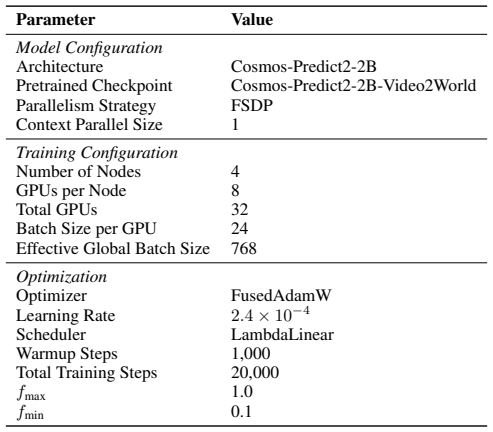
Table 5 : Cosmos-Surg-dVRK Training Configuration.
원문 · CC BY 4.0 · Lukas Zbinden, Nigel Nelson, Juo-Tung Chen, Xinhao Chen, Ji Woong Kim, Mahdi Azizian, Axel Krieger, Sean Huver · Cosmos-Surg-dVRK: World Foundation Model-based Automated Online Evaluation of Surgical Robot Policy Learning · 원문 그림 인용 · 원본 PDF 17쪽에서 그림 영역을 추출했습니다.V-JEPA 2 분류기로 롤아웃 자동 판정
생성된 롤아웃 영상은 길이가 수백 프레임에 이르기 때문에, 사람이 모든 영상을 검토하는 비용을 줄이려면 자동 판정기가 필요합니다. 이 연구는 V-JEPA 2의 ViT-H 백본을 동결하고, 그 위에 학습되는 4계층 attentive probe 분류기를 사용합니다. 동결은 백본에만 적용되고, 분류기 헤드는 수동으로 라벨링한 2,310개의 32프레임 클립으로 학습됩니다. 긴 영상은 문맥 길이에 맞추어 32프레임 청크로 나누고 6프레임씩 겹치게 처리합니다. 분류기는 성공, 이상(물리적으로 어색한 사건), 기본의 세 라벨을 붙이고, 최종 판정은 먼저 나타난 사건으로 정합니다. 성공이 이상보다 먼저면 성공, 이상이 먼저면 실패, 성공이 검출되지 않으면 실패입니다.
이 규칙 때문에 물리 이상이 성공 검출보다 앞서면 실패로 처리됩니다.
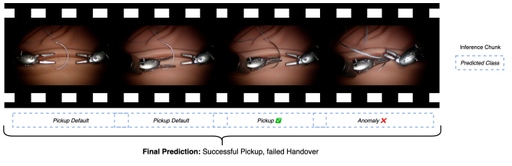
Figure 10 : V-JEPA 2 Chunked Inference Methodology
원문 · CC BY 4.0 · Lukas Zbinden, Nigel Nelson, Juo-Tung Chen, Xinhao Chen, Ji Woong Kim, Mahdi Azizian, Axel Krieger, Sean Huver · Cosmos-Surg-dVRK: World Foundation Model-based Automated Online Evaluation of Surgical Robot Policy Learning · 원문 그림 인용 · 원본 PDF 16쪽에서 그림 영역을 추출했습니다.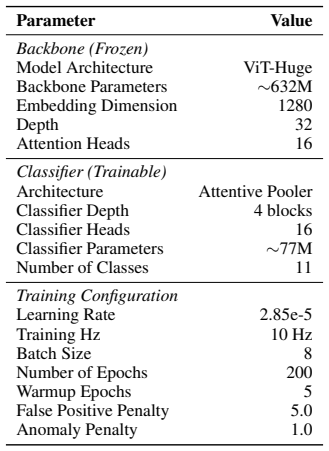
Table 4 : V-JEPA Training Configuration
원문 · CC BY 4.0 · Lukas Zbinden, Nigel Nelson, Juo-Tung Chen, Xinhao Chen, Ji Woong Kim, Mahdi Azizian, Axel Krieger, Sean Huver · Cosmos-Surg-dVRK: World Foundation Model-based Automated Online Evaluation of Surgical Robot Policy Learning · 원문 그림 인용 · 원본 PDF 17쪽에서 그림 영역을 추출했습니다.테이블톱 과제의 실제 로봇 대조 결과
테이블톱 실험에서는 π0, GR00T N1, GR00T N1.5를 각 정책마다 절반 학습과 전체 학습 두 체크포인트로 평가했습니다. 같은 정책은 dVRK Si에서도 실행되었고, 시뮬레이션 롤아웃은 실제 기록의 첫 내시경 프레임으로 초기화되었습니다. 사람이 라벨링한 시뮬레이션 성공률은 실제 성공률과 Pearson r=0.718(p<0.001)의 상관을 보였고, MBE는 0.140이었습니다. 이 상관은 전체 정책과 과제를 묶어 계산한 값이며, 과제별 Pearson 평균은 0.707입니다. 자동 분류기 라벨로 계산한 성공률은 전체 쌍에서 실제 성공률과 r=0.756(p<0.001)의 상관을 보였고, MBE는 0.153, 평균 MMRV는 0.10±0.04였습니다.
여기서 MMRV는 낮을수록 좋은 순위 불일치 지표이므로, 자동 평가는 정책 순위를 비교적 안정적으로 재현했습니다. 자동 평가의 과제별 Pearson 평균은 0.666입니다. 두 방식 모두 시뮬레이션 성공률이 실제보다 평균적으로 높은 양의 편향을 보였습니다. 분류기와 사람 라벨러 사이의 ICC(2,1)는 0.836이고 Pearson r은 0.840(p<0.001)입니다.
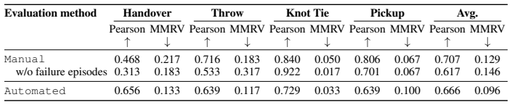
Table 1 :Quantitative results for policy evaluation in Cosmos-Surg-dVRK simulation.. Pearson correlation coefficient (higher is better) and MMRV (Mean Maximum Rank Violation; lower is better) between Cosmos-Surg-dVRK and dVRK Si policy evaluations. Manual refers to human- labeled task outcomes in the Cosmos-Surg-dVRK simulation, while automated refers to evaluation scores predicted by the V-JEPA 2 classifier.
원문 · CC BY 4.0 · Lukas Zbinden, Nigel Nelson, Juo-Tung Chen, Xinhao Chen, Ji Woong Kim, Mahdi Azizian, Axel Krieger, Sean Huver · Cosmos-Surg-dVRK: World Foundation Model-based Automated Online Evaluation of Surgical Robot Policy Learning · 원문 그림 인용 · 원본 PDF 8쪽에서 그림 영역을 추출했습니다.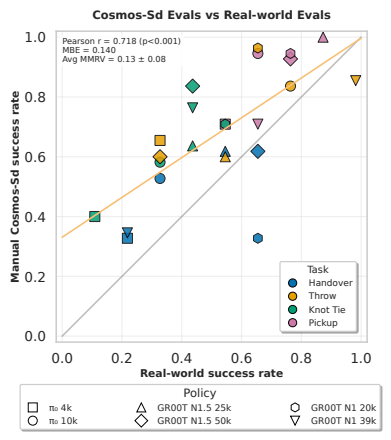
Figure 4 :Manual Cosmos-Surg-dVRK vs. real-world tabletop success rates. Relationship be- tween manual surgical policy success rate evaluation in Cosmos-Surg-dVRK simulation (vertical axis) and on the real-world dVRK (horizontal axis). Each policy is shown with two training regimes: half–training and full–training across four tabletop suture pad tasks.
원문 · CC BY 4.0 · Lukas Zbinden, Nigel Nelson, Juo-Tung Chen, Xinhao Chen, Ji Woong Kim, Mahdi Azizian, Axel Krieger, Sean Huver · Cosmos-Surg-dVRK: World Foundation Model-based Automated Online Evaluation of Surgical Robot Policy Learning · 원문 그림 인용 · 원본 PDF 9쪽에서 그림 영역을 추출했습니다.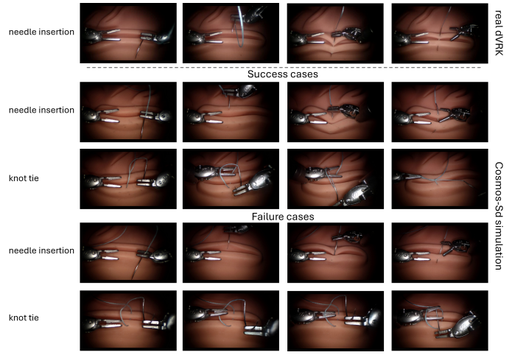
Figure 5 :Qualitative examples of tabletop policy online rollouts in Cosmos-Surg-dVRK.Each row represents one different policy rollout. Top row: Successful example as recorded on the real dVRK. Middle two rows: Successfully completed tasks in Cosmos-Surg-dVRK. Bottom two rows: Examples of failed tasks in Cosmos-Surg-dVRK. Four frames per task are chosen individually to best represent the example.
원문 · CC BY 4.0 · Lukas Zbinden, Nigel Nelson, Juo-Tung Chen, Xinhao Chen, Ji Woong Kim, Mahdi Azizian, Axel Krieger, Sean Huver · Cosmos-Surg-dVRK: World Foundation Model-based Automated Online Evaluation of Surgical Robot Policy Learning · 원문 그림 인용 · 원본 PDF 10쪽에서 그림 영역을 추출했습니다.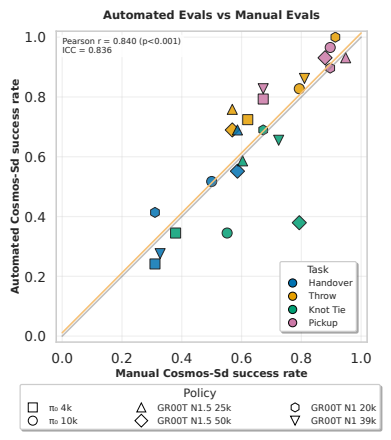
Figure 6 :Comparison of automated vs. manual evaluations.Relationship between surgical policy success rate evaluations from the V-JEPA 2 classifier and human raters in Cosmos-Surg- dVRK simulation.
원문 · CC BY 4.0 · Lukas Zbinden, Nigel Nelson, Juo-Tung Chen, Xinhao Chen, Ji Woong Kim, Mahdi Azizian, Axel Krieger, Sean Huver · Cosmos-Surg-dVRK: World Foundation Model-based Automated Online Evaluation of Surgical Robot Policy Learning · 원문 그림 인용 · 원본 PDF 11쪽에서 그림 영역을 추출했습니다.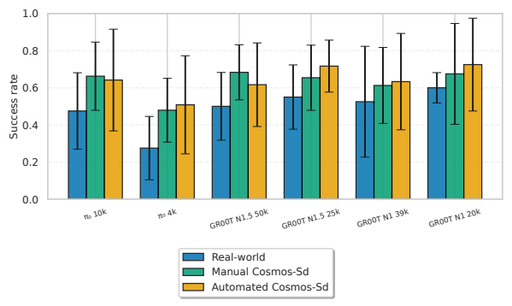
Figure 7 :Average tabletop policy success rates across evaluation techniques.Results are aver- aged over four tasks. Each task includes 10 real-world rollouts and 10 Cosmos-Surg-dVRK rollouts (averaged over three seeds).
원문 · CC BY 4.0 · Lukas Zbinden, Nigel Nelson, Juo-Tung Chen, Xinhao Chen, Ji Woong Kim, Mahdi Azizian, Axel Krieger, Sean Huver · Cosmos-Surg-dVRK: World Foundation Model-based Automated Online Evaluation of Surgical Robot Policy Learning · 원문 그림 인용 · 원본 PDF 11쪽에서 그림 영역을 추출했습니다.실패 에피소드 포함 여부의 효과
초기 실험에서는 성공 궤적만으로 미세조정한 모델이 정성적으로 강한 양의 편향을 보이며 거짓 양성을 자주 만들었습니다. 이에 따라 실패 궤적을 추가 수집하고, 성공만 사용한 절제 모델과 성공과 실패를 모두 사용한 전체 모델을 같은 보류 데이터에서 비교했습니다. 절제 평가는 하나의 시드에서 과제와 정책별로 10개 롤아웃을 두 명의 평가자가 라벨링한 결과입니다. 성공만 사용한 모델은 전체 평균 Pearson이 0.617로 전체 모델의 0.707보다 낮고, 평균 MMRV는 0.146으로 0.129보다 높았습니다. 다만 MMRV는 전체 모델과 비슷한 수준이라고 보고됩니다. 가장 뚜렷한 차이는 MBE입니다. 수동 성공률 평가에서 절제 모델의 MBE는 0.325로, 전체 모델의 0.140보다 큽니다.
이 결과는 실패 에피소드가 편향을 줄이는 데 중요했음을 보여 주지만, 실패 데이터의 최적 구성까지 확정하지는 않습니다.
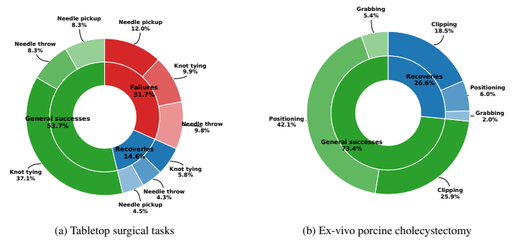
Figure 3 :Surgical autonomy dataset distributions.a) Tabletop dataset consists of success episodes, recoveries, as well as failure data. The label needle pickup includes task needle han- dover. b) Ex-vivo porcine cholecystectomy dataset consists of success and recovery episodes.
원문 · CC BY 4.0 · Lukas Zbinden, Nigel Nelson, Juo-Tung Chen, Xinhao Chen, Ji Woong Kim, Mahdi Azizian, Axel Krieger, Sean Huver · Cosmos-Surg-dVRK: World Foundation Model-based Automated Online Evaluation of Surgical Robot Policy Learning · 원문 그림 인용 · 원본 PDF 7쪽에서 그림 영역을 추출했습니다.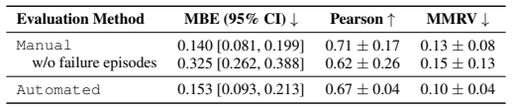
Table 2 :Mean bias error in success rates across Cosmos-Surg-dVRK policy evaluation meth- ods.MBE, average Pearson, and average MMRV across all tasks are shown. The positive bias in success rates is markedly higher for the Cosmos-Surg-dVRK finetune without failure episodes.
원문 · CC BY 4.0 · Lukas Zbinden, Nigel Nelson, Juo-Tung Chen, Xinhao Chen, Ji Woong Kim, Mahdi Azizian, Axel Krieger, Sean Huver · Cosmos-Surg-dVRK: World Foundation Model-based Automated Online Evaluation of Surgical Robot Policy Learning · 원문 그림 인용 · 원본 PDF 8쪽에서 그림 영역을 추출했습니다.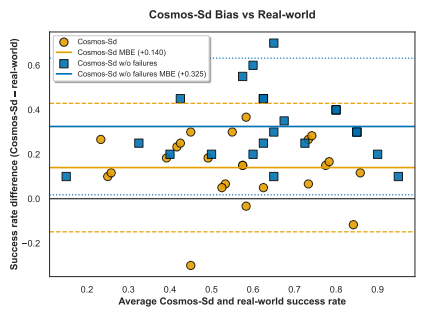
Figure 11 :Bland–Altman analysis.Mean bias error (MBE) and limits of agreement in Cosmos- Surg-dVRK vs. Cosmos-Surg-dVRK without failure episodes across all policies and tasks.
원문 · CC BY 4.0 · Lukas Zbinden, Nigel Nelson, Juo-Tung Chen, Xinhao Chen, Ji Woong Kim, Mahdi Azizian, Axel Krieger, Sean Huver · Cosmos-Surg-dVRK: World Foundation Model-based Automated Online Evaluation of Surgical Robot Policy Learning · 원문 그림 인용 · 원본 PDF 19쪽에서 그림 영역을 추출했습니다.돼지 담낭절제 과제의 예비 결과
돼지 담낭절제 실험은 테이블톱보다 복잡한 연조직 과제에서 같은 평가 틀을 적용한 예비 검증입니다. 이 실험은 16,506 에피소드 규모의 담낭절제 데이터로 미세조정한 Cosmos-Surg-dVRK를 사용하며, 단안 SRT-H 정책을 평가합니다. 홀드아웃 조직 9개를 사용하고 apply first clip, apply third clip, cut the cystic duct의 세 과제를 각 3회씩 시험하여 총 9회의 시험을 수행했습니다. dVRK Si 실제 실험에서는 9회 중 7회가 성공했고, Cosmos-Surg-dVRK에서는 8회가 성공했습니다. 시뮬레이션은 시드 3개로 반복되었고, 두 평가자가 여섯 개 라벨을 주어 그중 50%를 넘는 성공 라벨을 받은 시험을 성공으로 판정했습니다.
표본이 9회로 작기 때문에 이 결과는 방향성을 보여 주는 예비 결과로 읽어야 하며, 테이블톱 실험의 대규모 통계와 같은 수준의 근거로 취급할 수 없습니다.
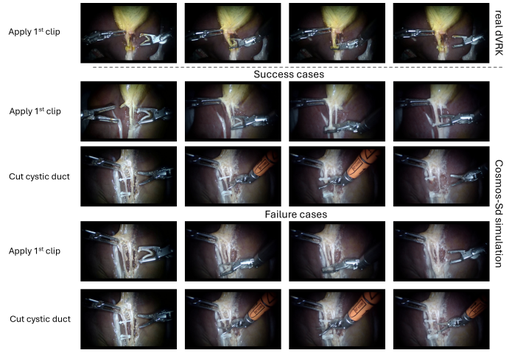
Figure 8 :Qualitative examples of SRT-H policy online evaluation in Cosmos-Surg-dVRK.Each row represents one different policy rollout. Top row: Successful example as recorded on the real dVRK Si. Middle two rows: Successfully completed tasks in Cosmos-Surg-dVRK. Bottom two rows: Examples of failed tasks in Cosmos-Surg-dVRK. The four frames shown are chosen individ- ually to best represent the example.
원문 · CC BY 4.0 · Lukas Zbinden, Nigel Nelson, Juo-Tung Chen, Xinhao Chen, Ji Woong Kim, Mahdi Azizian, Axel Krieger, Sean Huver · Cosmos-Surg-dVRK: World Foundation Model-based Automated Online Evaluation of Surgical Robot Policy Learning · 원문 그림 인용 · 원본 PDF 12쪽에서 그림 영역을 추출했습니다.적용 범위와 남은 한계
이 연구의 결과는 단일 카메라와 단안 정책 설정에서 얻은 것입니다. 최신 수술 정책은 다중 시점 입력을 쓰므로 Cosmos-Surg-dVRK도 다중 시점을 지원하도록 확장되어야 합니다. 또한 정책 학습에 고유수용성 상태 정보를 사용하지 않았기 때문에, 본체 상태를 활용하는 정책에 대한 결과는 별도로 확인해야 합니다. 생성 영상은 바늘, 실, 집게처럼 작은 물체에서 성공과 실패 판단이 모호한 경우가 있습니다. 저자들은 이 모호성이 일부는 가림이나 낮은 해상도 같은 우연적 요인에서, 일부는 학습 데이터와 성공·실패 비율의 제한에서 비롯된다고 해석합니다. 관찰된 거짓 양성 편향도 물리 제약을 충분히 학습하지 못한 결과로 해석됩니다.
담낭절제의 시뮬레이션 비교는 9회 시험의 예비 결과이고, 임의로 만든 분포 밖 궤적의 실험은 정성적 결과입니다. 따라서 이 평가 틀이 모든 수술 과제에서 같은 정확도를 보장한다고 말할 수 없습니다.
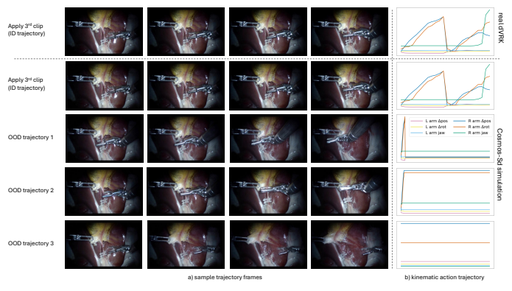
Figure 9 :Qualitative examples of cholecystectomy out-of-distribution action trajectories in Cosmos-Surg-dVRK.Top row: four frames of an in-distribution (ID) trajectory rolled out on the real dVRK Si (Kim et al., 2025) with the corresponding trajectory plot. Second row: four frames of the identical trajectory rolled out in Cosmos-Surg-dVRK. Bottom three rows: Examples of out-of- distribution (OOD) trajectories not part of the training data distribution, rolled out in Cosmos-Surg- dVRK. a) shows four video frames chosen individually to best represent the example; b) visualiza- tion of the corresponding kinematic action trajectories of the two dVRK Si arms.
원문 · CC BY 4.0 · Lukas Zbinden, Nigel Nelson, Juo-Tung Chen, Xinhao Chen, Ji Woong Kim, Mahdi Azizian, Axel Krieger, Sean Huver · Cosmos-Surg-dVRK: World Foundation Model-based Automated Online Evaluation of Surgical Robot Policy Learning · 원문 그림 인용 · 원본 PDF 13쪽에서 그림 영역을 추출했습니다.논문 정보
- 저자
- Lukas Zbinden, Nigel Nelson, Juo-Tung Chen, Xinhao Chen, Ji Woong Kim, Mahdi Azizian, Axel Krieger, Sean Huver
- 학회·저널
- arXiv · 프리프린트
- 최초 공개일
- 2025년 10월 17일
- 등록일
- 2026년 11월 6일
- 수정일
- 2025년 11월 3일
- 버전
- v2
- arXiv
- 2510.16240
- 분류
- cs.RO
- 원문 이용 조건
- CC BY 4.0
- 제공 범위
- 논문 정보, 해설, 허용된 원문 그림
AI 해설은 논문 원문과 별개의 설명이며 오류가 있을 수 있습니다. 원문과 그림은 각 출처의 이용 조건과 따로 표시된 권리를 따릅니다.
초록
The rise of surgical robots and vision-language-action models has accelerated the development of autonomous surgical policies and efficient assessment strategies. However, evaluating these policies directly on physical robotic platforms such as the da Vinci Research Kit (dVRK) remains hindered by high costs, time demands, reproducibility challenges, and variability in execution. World foundation models (WFM) for physical AI offer a transformative approach to simulate complex real-world surgical tasks, such as soft tissue deformation, with high fidelity. This work introduces Cosmos-Surg-dVRK, a surgical finetune of the Cosmos WFM, which, together with a trained video classifier, enables fully automated online evaluation and benchmarking of surgical policies. We evaluate Cosmos-Surg-dVRK using two distinct surgical datasets. On tabletop suture pad tasks, the automated pipeline achieves strong correlation between online rollouts in Cosmos-Surg-dVRK and policy outcomes on the real dVRK Si platform, as well as good agreement between human labelers and the V-JEPA 2-derived video classifier. Additionally, preliminary experiments with ex-vivo porcine cholecystectomy tasks in Cosmos-Surg-dVRK demonstrate promising alignment with real-world evaluations, highlighting the platform's potential for more complex surgical procedures.
원문 인용
Lukas Zbinden, Nigel Nelson, Juo-Tung Chen, Xinhao Chen, Ji Woong Kim, Mahdi Azizian, Axel Krieger, Sean Huver (2025). Cosmos-Surg-dVRK: World Foundation Model-based Automated Online Evaluation of Surgical Robot Policy Learning. arXiv:2510.16240v2. https://arxiv.org/abs/2510.16240v2
BibTeX
@misc{zbinden2025cosmos,
  title = {{Cosmos-Surg-dVRK: World Foundation Model-based Automated Online Evaluation of Surgical Robot Policy Learning}},
  author = {Lukas Zbinden and Nigel Nelson and Juo-Tung Chen and Xinhao Chen and Ji Woong Kim and Mahdi Azizian and Axel Krieger and Sean Huver},
  year = {2025},
  eprint = {2510.16240},
  archivePrefix = {arXiv},
  url = {https://arxiv.org/abs/2510.16240v2}
}