논문 해설
These Magic Moments: Differentiable Uncertainty Quantification of Radiance Field Models
이 마법 같은 순간들: 복사장(Radiance Field) 모델의 미분 가능한 불확실성 정량화
- 연구 문제 방사장 모델의 렌더링 불확실성은 기존 방식에서 근사나 후처리에 의존해 계산 비용이 큽니다.
- 연구 방법 렌더링 방정식을 확률 과정으로 해석해 픽셀별 고차 모멘트를 계산하고, 이 분산을 추가 학습 없이 불확실성으로 사용합니다.
- 주요 결과 제안된 색상 분산은 Blender와 Mip360, TUM 데이터셋에서 렌더링 색상 오차와 상관이 높고 실행 시간이 짧으며, NBV 선택에서도 기준선보다 우수합니다.
방사장 모델의 불확실성 정량화 문제
방사장 모델은 여러 시점의 이미지로부터 장면을 연속적인 체적 표현으로 학습해 새로운 시점의 이미지를 합성합니다. 그러나 이 모델들은 어느 영역의 표현이 부정확한지 판단하기 어렵습니다. 기존 방법은 모델 파라미터의 불확실성을 먼저 추정하고 이를 렌더링 불확실성으로 근사하는데, 렌더링 함수의 비선형성 때문에 픽셀별 확률밀도를 파라미터 불확실성으로부터 정확히 계산하기 어렵습니다. 그래서 신경망으로 불확실성을 직접 추정하거나, 사후 근사, 단순화된 근사 같은 휴리스틱에 의존하게 되며 이는 계산 비용을 키웁니다. 이 논문은 렌더링 출력 자체의 불확실성을 직접 계산하는 방법을 다룹니다.
렌더링 방정식의 확률 해석과 고차 모멘트
이 방법은 렌더링 방정식을 확률 과정으로 해석합니다. 식 (1)의 투과율 T는 광선이 구간을 충돌 없이 통과할 확률이며, 식 (2)의 렌더링 값은 이 투과율과 밀도 σ에 따라 적분됩니다. 국소 조명 광학 모델에서는 충돌이 확률 사건이므로 렌더링된 값은 확률변수가 되고, 식 (3)은 픽셀별 확률변수의 j차 모멘트 E[ρ^j]를 같은 적분 형태로 정의합니다. 이후 식 (4)는 Var[ρ]=E[ρ²]−E[ρ]²로 분산을 계산하며, 저자들은 이 분산을 정량화된 불확실성으로 사용합니다. 이 분산은 2차 중심 모멘트이며 다른 고차 중심 모멘트로 바꿀 수도 있다고 밝힙니다.
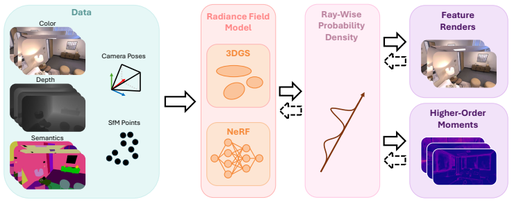
Figure 2 . Images containing color, depth, semantics, or other features of interest, along with camera poses and an initial point cloud, are used to train a radiance field model depicted. The rendered features (i.e. the expected feature of each pixel) are computed in a differentiable manner. Our proposed approach demonstrates that the same probabilistic process used to compute these renders can be used to differentiably compute the higher-order moments. Solid arrows indicate operation flow and dotted arrows indicate gradient flow.
원문 · CC BY 4.0 · Parker Ewen, Hao Chen, Seth Isaacson, Joey Wilson, Katherine A. Skinner, Ram Vasudevan · These Magic Moments: Differentiable Uncertainty Quantification of Radiance Field Models · 원문 그림 인용 · 원본 PDF 3쪽에서 그림 영역을 추출했습니다.NeRF와 3DGS에서의 모멘트 계산
NeRF에서는 광선을 N개의 구간으로 나누고 각 구간에서 샘플 t_i를 뽑아 몬테카를로 적분으로 식 (5)의 기댓값을 근사합니다. 같은 방식으로 식 (6)에서 모멘트를 계산합니다. 3DGS에서는 광선을 따라 샘플링하지 않고, 투영된 가우시안을 깊이 순서로 정렬한 뒤 식 (7)의 알파 합성으로 픽셀 값을 계산합니다. 3DGS의 모멘트는 식 (9)처럼 같은 알파 합성 가중치에 ρ의 j차 거듭제곱을 적용해 얻습니다. 이 가중치는 광선 위로 주변화한 가우시안 혼합 모델의 가중치에 대응합니다. 따라서 추가 학습 없이 같은 렌더링 과정에서 모멘트를 함께 계산할 수 있습니다.
분산과 렌더링 오차의 상관 평가
첫 번째 검증은 픽셀별 분산이 실제 렌더링 오차와 얼마나 상관되는지 측정합니다. 비교 대상은 Bayes’ Rays, FisherRF, CF-NeRF, 3DGS Ensemble이며 상관은 Pearson τp, Spearman τs, Kendall τk로 측정합니다. 색상 실험에서는 Blender, Mip360, TUM 데이터셋을 사용했고, 저자들은 제안 방법이 FisherRF와 CF-NeRF보다 상관과 실행 시간에서 모든 데이터셋에서 우수하다고 보고합니다. 3DGS Ensemble과는 상관이 비슷하지만 실행 시간은 한 자릿수 이상 짧다고 설명합니다. Blender의 색상 분산에서 제안 방법의 τp는 0.716, 3DGS Ensemble은 0.663입니다.
깊이 실험에서는 Blender와 TUM에서 기준선보다 상관과 시간이 우수합니다. 색상과 깊이 실험에서 CF-NeRF의 TUM 결과는 수렴하지 않아 계수가 없습니다.
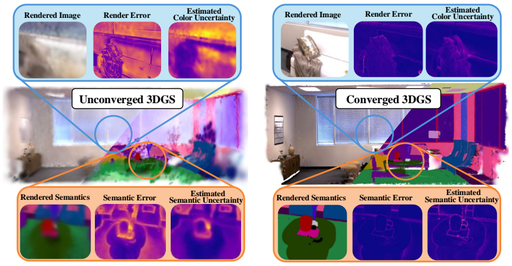
Figure 1 . Our proposed method quantifies uncertainty over rendered scenes generated through radiance field models by considering the differentiable higher-order moments of the rendering equation. The proposed approach requires no additional training, generalizes for color, depth, and semantics, and may be used for both NeRF and 3DGS methods. Shown is the variance, or second central moment, which is highly correlated to the rendering error for both color and semantics.
원문 · CC BY 4.0 · Parker Ewen, Hao Chen, Seth Isaacson, Joey Wilson, Katherine A. Skinner, Ram Vasudevan · These Magic Moments: Differentiable Uncertainty Quantification of Radiance Field Models · 원문 그림 인용 · 원본 PDF 1쪽에서 그림 영역을 추출했습니다.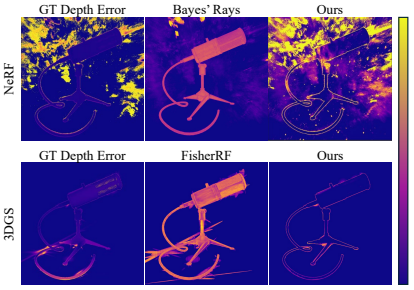
Figure 3 . Uncertainty quantification for the depth estimates of a NeRF and 3DGS model. A NeRF model is trained and we com- pare the Bayes’ Rays [11] uncertainty estimate with our proposed variance estimate. Similarly, a 3DGS model is trained and we compare the FisherRF [16] uncertainty estimate with our proposed variance estimate. Unlike existing methods, our approach works with both NeRF and 3DGS models. The CF-NeRF [49] and 3DGS Ensemble [43] methods are not shown as they require specialized models for uncertainty quantification.
원문 · CC BY 4.0 · Parker Ewen, Hao Chen, Seth Isaacson, Joey Wilson, Katherine A. Skinner, Ram Vasudevan · These Magic Moments: Differentiable Uncertainty Quantification of Radiance Field Models · 원문 그림 인용 · 원본 PDF 5쪽에서 그림 영역을 추출했습니다.
Table 1 . Correlation coefficients for color variance and rendered color error. The CF-NeRF baseline did not converge on the TUM dataset and therefore no correlation coefficients are given. Presented is the time to render uncertainty for a single image. Cells are highlighted with red, orange, and yellow for for the first, second, and third best performance, respectively. Higher is better for the correlation coefficients.
원문 · CC BY 4.0 · Parker Ewen, Hao Chen, Seth Isaacson, Joey Wilson, Katherine A. Skinner, Ram Vasudevan · These Magic Moments: Differentiable Uncertainty Quantification of Radiance Field Models · 원문 그림 인용 · 원본 PDF 6쪽에서 그림 영역을 추출했습니다.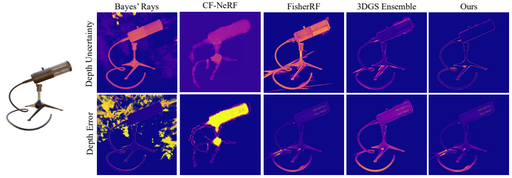
Figure 10 . Qualitative depth variance comparison for the mic scene from theBlender dataset. Bayes’ Rays [11] estimates uncertainty using a pre-trained NeRF model and a spatial uncertainty grid. The 3DGS Ensemble [43] uses 10 trained 3DGS models to estimate the mean and variance. CF-NeRF [49] estimates uncertainty using a continuous flow network. FisherRF and our proposed approach both estimate uncertainty for the same trained 3DGS model.
원문 · CC BY 4.0 · Parker Ewen, Hao Chen, Seth Isaacson, Joey Wilson, Katherine A. Skinner, Ram Vasudevan · These Magic Moments: Differentiable Uncertainty Quantification of Radiance Field Models · 원문 그림 인용 · 원본 PDF 13쪽에서 그림 영역을 추출했습니다.의미 분산의 상관과 한계
의미 실험은 Mip360 데이터셋에서 수행되며, 정답 의미 임베딩은 훈련 RGB 이미지를 CLIP-LSeg로 처리해 계산합니다. 렌더링된 언어 특징은 PCA로 첫 128개 주성분을 추출해 비교합니다. 이 실험에서는 비교할 기존 기준선이 없어 제안 방법의 결과만 보고됩니다. 의미 분산과 의미 오차의 상관은 깊이와 색상보다 뚜렷이 낮으며, 저자들은 CLIP-LSeg 특징이 시점에 따라 달라지는 잡음을 원인으로 해석합니다.
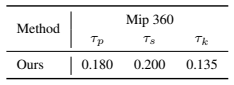
Table 3 . Correlation coefficients for semantic variance and ren- dered semantic error. Ground truth semantics are computed by processing the training RGB images through the CLIP-LSeg model.
원문 · CC BY 4.0 · Parker Ewen, Hao Chen, Seth Isaacson, Joey Wilson, Katherine A. Skinner, Ram Vasudevan · These Magic Moments: Differentiable Uncertainty Quantification of Radiance Field Models · 원문 그림 인용 · 원본 PDF 6쪽에서 그림 영역을 추출했습니다.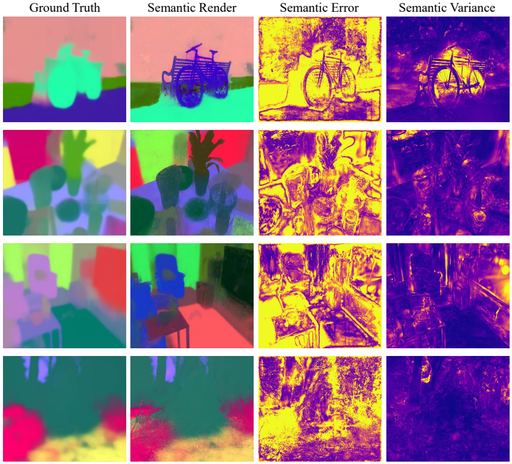
Figure 11 . Qualitative semantic correlation results for several scenes from the Mip360 dataset using open-set semantics in the form of visual-language embeddings. The semantic 3DGS model is trained using Feature-3DGS [50] by using visual-language features computed using the CLIP-LSeg network [21] for each input image. From the third column is seen that the semantic error is high between the CLIP- LSeg estimates and the semantic 3DGS model. We postulate this is due to the CLIP-LSeg model estimating inconsistent visual-language features between viewpoints.
원문 · CC BY 4.0 · Parker Ewen, Hao Chen, Seth Isaacson, Joey Wilson, Katherine A. Skinner, Ram Vasudevan · These Magic Moments: Differentiable Uncertainty Quantification of Radiance Field Models · 원문 그림 인용 · 원본 PDF 14쪽에서 그림 영역을 추출했습니다.NBV 선택 실험
NBV 실험은 분산이 가장 큰 시점을 다음 시점으로 선택합니다. 비교 대상은 ActiveNeRF, FisherRF, 무작위 선택입니다. Blender 데이터셋은 총 12개 시점을 사용하고 TUM 데이터셋은 총 300개 시점을 사용합니다. 색상 분산을 쓴 제안 방법은 두 데이터셋 모두에서 PSNR, SSIM, LPIPS 기준으로 기준선보다 우수하다고 보고됩니다. 깊이 분산은 색상 분산보다 낮은 성능을 보이며, 저자들은 평가 지표가 색상 렌더링의 품질을 나타내기 때문이라고 해석합니다. 무작위 선택도 TUM 데이터셋에서 예상보다 좋은 성능을 보입니다.
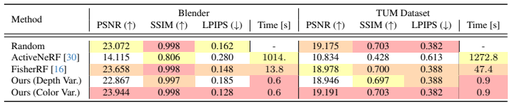
Table 4 . NBV selection on the Blender dataset with a total of 12 views and the TUM dataset with a total of 300 views. Times correspond to choosing the first NBV in the experiment. Times for the random baseline are excluded since it does not consider uncertainty and relies solely on a stochastic process. Cells are highlighted with red, orange, and yellow for for the first, second, and third best performance, respectively.
원문 · CC BY 4.0 · Parker Ewen, Hao Chen, Seth Isaacson, Joey Wilson, Katherine A. Skinner, Ram Vasudevan · These Magic Moments: Differentiable Uncertainty Quantification of Radiance Field Models · 원문 그림 인용 · 원본 PDF 7쪽에서 그림 영역을 추출했습니다.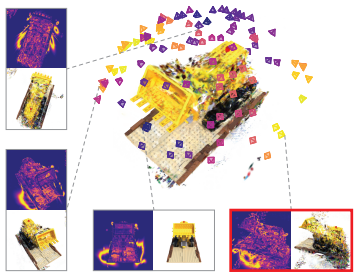
Figure 5 . Given a radiance field model that is trained using only a small number views, the goal is to find the next best view, or the view that improves the radiance field model the most. The ren- dered variance four four views is shown. The highlighted view- point has the highest pixel-wise variance and is therefore chosen as the NBV .
원문 · CC BY 4.0 · Parker Ewen, Hao Chen, Seth Isaacson, Joey Wilson, Katherine A. Skinner, Ram Vasudevan · These Magic Moments: Differentiable Uncertainty Quantification of Radiance Field Models · 원문 그림 인용 · 원본 PDF 8쪽에서 그림 영역을 추출했습니다.불확실성 기반 광선 샘플링
광선 샘플링 실험에서는 이미지를 셀 격자로 나누고 각 셀의 평균 광선 분산을 계산해 분산이 큰 셀에서 더 많은 학습 광선을 뽑습니다. iMAP은 같은 구조에서 평균 렌더링 오차를 사용합니다. Blender 장면 비교에서 제안 방법은 iMAP의 최신 성능과 비슷하며 두 방법 모두 균일 샘플링보다 최종 렌더링 품질을 크게 개선합니다. 이 결과는 Blender 장면에 대한 비교이며, 부록의 추가 장면에서도 두 방법의 성능이 비슷하다고 보고됩니다.
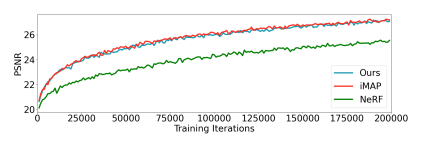
Figure 4 . Rendering quality using active ray selection for the fi- cus scene in the Blender dataset. For the NeRF baseline, rays are selected uniformly over the entire image. iMAP [42] and the pro- posed approach sample for high error and high variance regions of the image, respectfully. The proposed approach matches the per- formance of iMAP without needing to reference the ground-truth image.
원문 · CC BY 4.0 · Parker Ewen, Hao Chen, Seth Isaacson, Joey Wilson, Katherine A. Skinner, Ram Vasudevan · These Magic Moments: Differentiable Uncertainty Quantification of Radiance Field Models · 원문 그림 인용 · 원본 PDF 7쪽에서 그림 영역을 추출했습니다.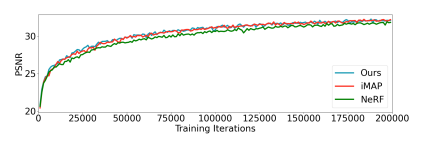
Figure 6 . Rendering quality using active ray selection for the lego scene in the Blender dataset. For the NeRF baseline, rays are se- lected uniformly over the entire image. iMAP [42] and the pro- posed approach sample for high error and high variance regions of the image, respectfully. The proposed approach matches the per- formance of iMAP without needing to reference the ground-truth image. All methods have similar performance for this scene.
원문 · CC BY 4.0 · Parker Ewen, Hao Chen, Seth Isaacson, Joey Wilson, Katherine A. Skinner, Ram Vasudevan · These Magic Moments: Differentiable Uncertainty Quantification of Radiance Field Models · 원문 그림 인용 · 원본 PDF 10쪽에서 그림 영역을 추출했습니다.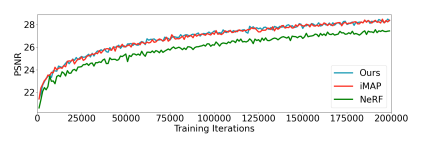
Figure 7 . Rendering quality using active ray selection for the mate- rials scene in the Blender dataset. For the NeRF baseline, rays are selected uniformly over the entire image. iMAP [42] and the pro- posed approach sample for high error and high variance regions of the image, respectfully. The proposed approach matches the per- formance of iMAP without needing to reference the ground-truth image. Both iMAP and our proposed approach both exceed the performance of the standard NeRF implementation.
원문 · CC BY 4.0 · Parker Ewen, Hao Chen, Seth Isaacson, Joey Wilson, Katherine A. Skinner, Ram Vasudevan · These Magic Moments: Differentiable Uncertainty Quantification of Radiance Field Models · 원문 그림 인용 · 원본 PDF 11쪽에서 그림 영역을 추출했습니다.적용 범위와 한계
저자들은 렌더링 분산이 모델이 수렴하지 않으면 부정확하거나 흐릿한 추정이 될 수 있다고 밝힙니다. 또한 NBV 실험에서 사용한 픽셀별 독립성 근사는 한 가우시안이 여러 픽셀에 영향을 주는 점을 반영하지 않으며, 결합 확률과 그에 따른 불확실성 계산은 향후 과제로 남깁니다. 의미 분산의 상관도 깊이와 색상보다 낮습니다. 이 결과들은 제안된 분산이 모든 장면과 모든 학습 단계에서 같은 신뢰도를 가진다는 뜻이 아니라, 제시된 데이터셋과 설정에서 얻은 결과입니다.
논문 정보
- 저자
- Parker Ewen, Hao Chen, Seth Isaacson, Joey Wilson, Katherine A. Skinner, Ram Vasudevan
- 학회·저널
- arXiv · 프리프린트
- 최초 공개일
- 2025년 3월 18일
- 등록일
- 2026년 11월 4일
- 수정일
- 2025년 3월 20일
- 버전
- v2
- arXiv
- 2503.14665
- 분류
- cs.CV · cs.RO
- 원문 이용 조건
- CC BY 4.0
- 제공 범위
- 논문 정보, 해설, 허용된 원문 그림
AI 해설은 논문 원문과 별개의 설명이며 오류가 있을 수 있습니다. 원문과 그림은 각 출처의 이용 조건과 따로 표시된 권리를 따릅니다.
초록
This paper introduces a novel approach to uncertainty quantification for radiance fields by leveraging higher-order moments of the rendering equation. Uncertainty quantification is crucial for downstream tasks including view planning and scene understanding, where safety and robustness are paramount. However, the high dimensionality and complexity of radiance fields pose significant challenges for uncertainty quantification, limiting the use of these uncertainty quantification methods in high-speed decision-making. We demonstrate that the probabilistic nature of the rendering process enables efficient and differentiable computation of higher-order moments for radiance field outputs, including color, depth, and semantic predictions. Our method outperforms existing radiance field uncertainty estimation techniques while offering a more direct, computationally efficient, and differentiable formulation without the need for post-processing. Beyond uncertainty quantification, we also illustrate the utility of our approach in downstream applications such as next-best-view (NBV) selection and active ray sampling for neural radiance field training. Extensive experiments on synthetic and real-world scenes confirm the efficacy of our approach, which achieves state-of-the-art performance while maintaining simplicity.
원문 인용
Parker Ewen, Hao Chen, Seth Isaacson, Joey Wilson, Katherine A. Skinner, Ram Vasudevan (2025). These Magic Moments: Differentiable Uncertainty Quantification of Radiance Field Models. arXiv:2503.14665v2. https://arxiv.org/abs/2503.14665v2
BibTeX
@misc{ewen2025these,
  title = {{These Magic Moments: Differentiable Uncertainty Quantification of Radiance Field Models}},
  author = {Parker Ewen and Hao Chen and Seth Isaacson and Joey Wilson and Katherine A. Skinner and Ram Vasudevan},
  year = {2025},
  eprint = {2503.14665},
  archivePrefix = {arXiv},
  url = {https://arxiv.org/abs/2503.14665v2}
}