논문 해설
Multi-View Face and Gesture Animation with Dynamic Gaussians
동적 가우시안을 이용한 다중 시점 얼굴 및 제스처 애니메이션
- 연구 문제 얼굴 표정과 손 제스처를 함께 담는 사실적인 상체 아바타를 다시점 일관성을 유지하며 재구성하고 새로운 시점에서 렌더링하는 문제를 다룹니다.
- 연구 방법 SMPL-X를 확장한 상체 파라메트릭 모델에 FLAME 얼굴 파라미터와 MANO 손 파라미터를 통합하고, 메시 삼각형마다 3D Gaussian을 배치해 미분 가능한 렌더링으로 최적화합니다.
- 주요 결과 자체 다시점 데이터셋에서 MVFGA는 LPIPS 0.053, PSNR 25.93, SSIM 0.938을 보고했으며, 손과 몸통의 AKD와 CSIM에서도 가장 좋은 값을 얻었습니다. 얼굴 AKD는 GUAVA에 가깝습니다.
상체 아바타의 얼굴과 손 충실도 문제
사실적인 3D 인간 아바타를 만들 때 얼굴 표정과 손 제스처는 자연스러운 의사소통에 중요하지만, 기존 방법들은 한쪽에 치우쳐 있습니다. 머리만 다루는 방법은 손 제스처를 놓치고, 전신을 재구성하는 방법은 세밀한 얼굴 충실도와 손 자세 정확도가 부족합니다. 또한 생성형 백본은 보이지 않는 영역을 채우는 과정에서 얼굴 충실도와 손가락 관절을 흐리게 만들 수 있습니다. 이 논문은 다시점 일관성을 유지하면서 얼굴과 손을 함께 다루는 상체 아바타 재구성과 재연 방법을 다룹니다.
상체 파라메트릭 모델과 Gaussian 스플랫 파이프라인
MVFGA는 17대의 보정된 카메라로 촬영한 다시점 RGB 영상에서 상체 메시를 먼저 복원합니다. 얼굴은 MICA로 형상 파라미터를 추정하고 FLAME 표정을 최적화 기반 추적으로 맞추며, 손은 HaMeR로 MANO 파라미터를 추정합니다. 이 결과를 SMPL-X를 확장한 상체 파라메트릭 모델에 결합하며, 이 모델은 전신 메시에서 상체 영역의 정점과 면을 제거한 형태입니다. 이후 메시의 각 삼각형에 하나의 3D Gaussian을 배치하고, 부모 삼각형의 지역 좌표계에서 정의한 평균, 회전, 스케일을 전역 좌표로 변환하여 렌더링합니다. 학습 중에는 적응적 밀도 제어로 splat을 추가하거나 제거하며, RGB 재구성 손실과 위치·스케일 정규화 손실로 최적화합니다.
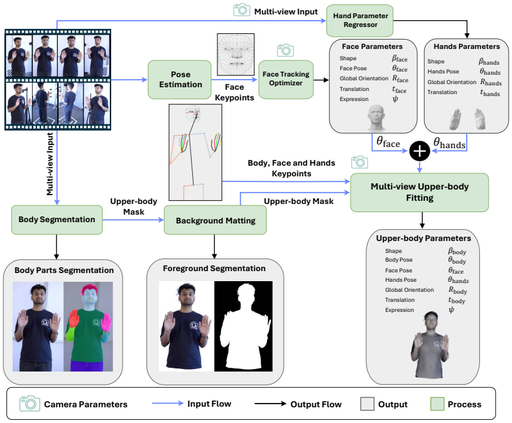
Figure 2 :Upper-body mesh generation pipeline: We perform keypoint extraction, body-part segmentation, and background matting, fol- lowed by refined face and hand fitting. The resulting face, hand, and body parameters are fused to obtain a complete upper-body representa- tion with accurate shape, pose, and global translation.
원문 · CC BY 4.0 · Alireza Javanmardi, Vippin Kumar Jeetmal, Christen Millerdurai, Alain Pagani, Didier Stricker · Multi-View Face and Gesture Animation with Dynamic Gaussians · 원문 그림 인용 · 원본 PDF 3쪽에서 그림 영역을 추출했습니다.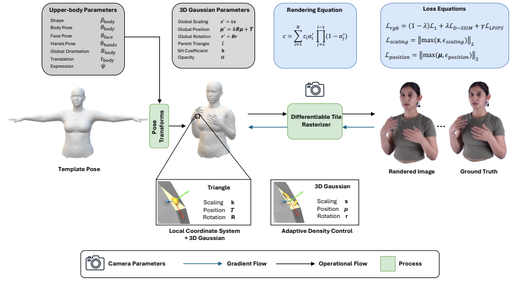
Figure 3 :Overview of our avatar synthesis pipeline. Given multi-view images and corresponding upper-body parameters, following Gaus- sianAvatar [QKS*24] the template mesh is posed into the deformed space. Each triangle is then assigned a 3D Gaussian representation. These Gaussians are rasterized using a tile-based rasterizer to produce rendered images, which are supervised using an RGB reconstruction loss. An adaptive density control mechanism is employed during training to dynamically densify or prune the Gaussians for efficient and accurate representation.
원문 · CC BY 4.0 · Alireza Javanmardi, Vippin Kumar Jeetmal, Christen Millerdurai, Alain Pagani, Didier Stricker · Multi-View Face and Gesture Animation with Dynamic Gaussians · 원문 그림 인용 · 원본 PDF 4쪽에서 그림 영역을 추출했습니다.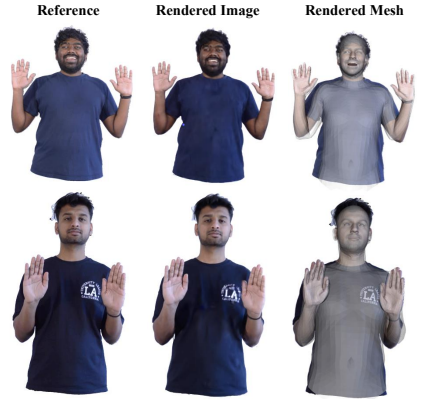
Figure 4 : Upper-body mesh fitting. From left to right: reference, rendered image, and rendered fitted mesh.
원문 · CC BY 4.0 · Alireza Javanmardi, Vippin Kumar Jeetmal, Christen Millerdurai, Alain Pagani, Didier Stricker · Multi-View Face and Gesture Animation with Dynamic Gaussians · 원문 그림 인용 · 원본 PDF 5쪽에서 그림 영역을 추출했습니다.렌더링 손실과 정규화 항의 역할
RGB 재구성 손실은 L1 항, D-SSIM 항, LPIPS 항을 가중합한 형태입니다. 위치 정규화 손실은 Gaussian 평균이 부모 삼각형 근처에 머물도록 max(μ, ε_position)의 제곱 노름으로 제약하며, 스케일 정규화 손실은 max(s, ε_scaling)의 제곱 노름으로 지나치게 큰 splat을 억제합니다. 이 두 정규화 항은 해당 타임스텝에서 RGB 재구성 손실이 활성화된 경우에만 적용됩니다.
MVFGA-MoCap 데이터셋
이 연구는 17대 카메라로 촬영한 다시점 상체 모션캡처 데이터셋을 구축했습니다. 15대는 약 150도 호에 걸쳐 정면 리그에 배치되고, 2대는 신체 키포인트 검출을 위해 후면에 배치됩니다. 영상은 1920×1080, 25 FPS로 기록되며 15명의 참가자가 다양한 얼굴 표정과 양손 제스처를 수행합니다.
실험 설정과 비교 기준
평가는 자기 재연, 새로운 시점 합성, 교차 정체성 애니메이션의 세 설정으로 이루어졌습니다. 비교 대상은 MagicAnimate, AnimateAnyone, Champ 같은 생성형 기준선과 그래픽 기반의 GUAVA입니다. 각 비교 방법은 첫 프레임을 원본으로 사용하고 나머지 프레임을 구동 영상으로 사용하며, 100프레임 클립으로 나누어 네 명의 보류 대상에서 평가했습니다.
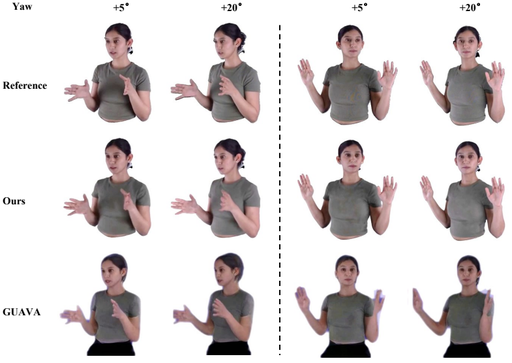
Figure 7 :Novel-view synthesis.Rendering at unseen yaw angles (+5 ◦,+20 ◦). Our method preserves geometry and appearance better than GUAVA [ZLL*25].
원문 · CC BY 4.0 · Alireza Javanmardi, Vippin Kumar Jeetmal, Christen Millerdurai, Alain Pagani, Didier Stricker · Multi-View Face and Gesture Animation with Dynamic Gaussians · 원문 그림 인용 · 원본 PDF 8쪽에서 그림 영역을 추출했습니다.이미지 품질과 자세·정체성 결과
Table 1의 이미지 품질 지표에서 MVFGA는 LPIPS 0.053과 PSNR 25.93을 보고합니다. 같은 표에서 SSIM은 0.938이고 L1은 4.06입니다. Table 2의 자세 지표에서는 손과 몸통의 AKD가 가장 낮고, 얼굴 AKD는 0.18로 GUAVA의 0.15에 가깝습니다. CSIM은 0.85로 가장 높습니다. 이 결과는 본 논문이 자체 데이터셋과 지정된 평가 프로토콜에서 측정한 값입니다.
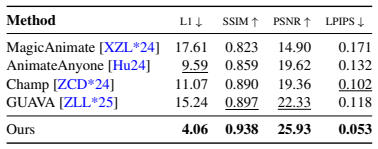
Table 1 :Quantitative comparison on our captured multi-view hu- man upper-body dataset.Best results are inboldand second best are underlined.
원문 · CC BY 4.0 · Alireza Javanmardi, Vippin Kumar Jeetmal, Christen Millerdurai, Alain Pagani, Didier Stricker · Multi-View Face and Gesture Animation with Dynamic Gaussians · 원문 그림 인용 · 원본 PDF 7쪽에서 그림 영역을 추출했습니다.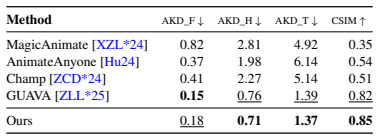
Table 2 :Quantitative comparison using keypoint and identity metrics.AKD denotes Average Keypoint Distance for face (F), hands (H), and Torso (T).
원문 · CC BY 4.0 · Alireza Javanmardi, Vippin Kumar Jeetmal, Christen Millerdurai, Alain Pagani, Didier Stricker · Multi-View Face and Gesture Animation with Dynamic Gaussians · 원문 그림 인용 · 원본 PDF 8쪽에서 그림 영역을 추출했습니다.시간적 일관성과 실행 속도
Temporal Jittering Error는 1k 프레임 구간에서 측정되었습니다. 확산 기반 방법들은 확률적 특성 때문에 지터가 크고 시퀀스가 길어질수록 성능이 저하되는 경향이 있습니다. 그래픽 기반의 GUAVA와 MVFGA는 더 낮은 TJE를 보였습니다. 실행 속도는 단일 NVIDIA RTX 3090 GPU에서 약 49 FPS로 보고되며, 같은 측정에서 Champ는 0.53 FPS, GUAVA는 52.21 FPS입니다.
구성요소 제거 실험
절제 실험은 FLAME과 MANO를 제거하고, 상체 파라메트릭 fine-tuning을 끄고, LPIPS 항을 제거한 세 변형을 비교합니다. FLAME과 MANO를 제거하면 새로운 시점 합성과 자기 재연 모두에서 L1, PSNR, SSIM, LPIPS 지표가 함께 나빠집니다. fine-tuning을 끄면 두 설정 모두에서 성능이 떨어집니다. LPIPS를 제거하면 LPIPS 값이 악화되며, 이는 픽셀 기반 손실을 보완하는 지각 손실의 효과로 해석됩니다.
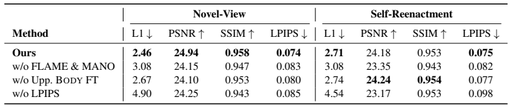
Table 3 :Ablation study on Novel-View synthesis and Self-Reenactment.“Upp. Body FT” denotes fine-tuning upper-body mesh parameters. Best results are shown inbold.
원문 · CC BY 4.0 · Alireza Javanmardi, Vippin Kumar Jeetmal, Christen Millerdurai, Alain Pagani, Didier Stricker · Multi-View Face and Gesture Animation with Dynamic Gaussians · 원문 그림 인용 · 원본 PDF 9쪽에서 그림 영역을 추출했습니다.적용 범위와 한계
저자들은 이 방법이 파라메트릭 모델에 의존하며 그 모델을 얻기 어렵다고 밝힙니다. 현재 데이터셋과 파이프라인에서는 전체 360도 렌더링이 어렵기 때문에 학습과 평가를 정면 시점에 제한했습니다. 또한 옷이나 액세서리의 2차 움직임은 명시적으로 모델링하지 않아 빠르거나 복잡한 움직임에서 현실감이 떨어질 수 있습니다.
논문 정보
- 저자
- Alireza Javanmardi, Vippin Kumar Jeetmal, Christen Millerdurai, Alain Pagani, Didier Stricker
- 학회·저널
- arXiv · 프리프린트
- 최초 공개일
- 2026년 8월 5일
- 등록일
- 2026년 11월 4일
- 수정일
- 2026년 8월 5일
- 버전
- v1
- arXiv
- 2608.04722
- DOI
- 10.1111/cgf.70567
- 분류
- cs.CV · cs.GR
- 원문 이용 조건
- CC BY 4.0
- 제공 범위
- 논문 정보, 해설, 허용된 원문 그림
AI 해설은 논문 원문과 별개의 설명이며 오류가 있을 수 있습니다. 원문과 그림은 각 출처의 이용 조건과 따로 표시된 권리를 따릅니다.
초록
Creating photorealistic 3D human avatars with realistic upper-body motion remains challenging. Existing approaches either focus on the head and overlook hand gestures, or reconstruct the full body but fail to preserve fine-grained facial fidelity and hand pose accuracy. As a result, current methods struggle to capture the subtle dynamics of facial expressions and hand gestures that are crucial for natural human communication. While methods based on full-body parametric models enable avatar reconstruction from monocular or multi-view inputs, they often lack accurate facial animation and detailed hand articulation. To address these limitations, we propose MVFGA, a novel multi-view-consistent pipeline for generating realistic upper-body avatars. Our approach models the face and hands separately and fuses them with a parametric upper-body mesh model, enabling the capture of fine-grained facial expressions and hand poses for accurate upper-body avatar reconstruction. We then splat 3D Gaussians onto the obtained mesh, enabling high-quality rendering of dynamic avatars from novel viewpoints. Furthermore, we introduce MVFGA-MoCap, a multi-view upper-body motion capture dataset featuring controlled facial expression sequences, diverse hand gestures, and free-form communication. Experiments show that MVFGA generates visually realistic avatars with high-fidelity facial expressions and hand motions, outperforming baselines for upper-body avatar animation. Project page: https://dfki-av.github.io/MVFGA/
원문 인용
Alireza Javanmardi, Vippin Kumar Jeetmal, Christen Millerdurai, Alain Pagani, Didier Stricker (2026). Multi-View Face and Gesture Animation with Dynamic Gaussians. arXiv:2608.04722v1. https://doi.org/10.1111/cgf.70567
BibTeX
@article{javanmardi2026multi,
  title = {{Multi-View Face and Gesture Animation with Dynamic Gaussians}},
  author = {Alireza Javanmardi and Vippin Kumar Jeetmal and Christen Millerdurai and Alain Pagani and Didier Stricker},
  year = {2026},
  eprint = {2608.04722},
  archivePrefix = {arXiv},
  doi = {10.1111/cgf.70567},
  url = {https://arxiv.org/abs/2608.04722v1}
}