논문 해설
Triangle Splatting+: Differentiable Rendering with Opaque Triangles
Triangle Splatting+: 불투명 삼각형을 이용한 미분 가능 렌더링
- 연구 문제 3D Gaussian Splatting은 실시간 렌더링을 가능하게 했지만 Gaussian primitive는 mesh 기반 그래픽스 파이프라인과 바로 맞지 않습니다. Triangle Splatting+는 삼각형을 직접 최적화하여 게임 엔진에서 후처리 없이 쓸 수 있는 메쉬 표현을 목표로 합니다.
- 연구 방법 Triangle Splatting+는 vertex를 공유하는 삼각형 파라미터화로 연결성을 만들고, σ 감소·opacity floor·pruning·midpoint subdivision을 결합해 불투명 삼각형으로 수렴하도록 학습합니다.
- 주요 결과 Mip-NeRF360 mesh 기반 novel view synthesis 비교에서 Triangle Splatting+는 PSNR 25.21, LPIPS 0.294, SSIM 0.742를 보고하며, 원문은 이 방법이 비교 방법보다 우수하다고 설명합니다. 절제 실험에서는 hard pruning과 blending weight pruning, σ decay가 시각 품질 유지에 기여하는 것으로 보고됩니다.
기존 Gaussian 기반 표현의 한계
3D Gaussian Splatting은 수백만 개의 Gaussian primitive로 장면을 표현해 실시간 렌더링과 빠른 최적화를 가능하게 했습니다. 그러나 Gaussian primitive는 VR 헤드셋이나 실시간 mesh 기반 렌더러가 쓰는 그래픽스 파이프라인과 기본적으로 호환되지 않습니다. 기존 해법은 Gaussian을 mesh로 바꾸는 후처리나 두 단계 파이프라인을 사용하며, 이는 복잡도를 높이고 시각 품질을 떨어뜨릴 수 있다고 원문은 제시합니다. 이 논문은 이 문제를 삼각형 자체를 미분 가능한 splatting 안에서 직접 최적화하는 방향으로 다룹니다.
공유 vertex 기반 triangle 표현
Triangle Splatting+는 각 vertex가 3D 위치, 색 c_i, opacity o_i를 가지는 공유 vertex 집합 V를 둡니다. 삼각형 T_m은 세 vertex 인덱스의 삼중항 (i, j, k)로 정의되므로 인접 삼각형이 vertex를 공유하며 연결될 수 있습니다. 삼각형의 opacity는 o_Tm = min(o_i, o_j, o_k)로 계산되고, 내부 색은 barycentric 좌표로 세 vertex 색을 보간해 얻습니다. 학습 중 각 삼각형의 gradient는 대응하는 vertex에 전달되고, 공유 vertex는 연결된 모든 삼각형에서 누적된 gradient를 받습니다. 이 파라미터화는 선행 Triangle Splatting이 삼각형마다 독립된 vertex를 가져 연결성을 만들지 못한 점을 바꾸기 위한 것입니다.
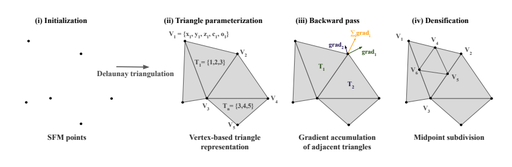
Figure 2 .Method overview of Triangle Splatting+ .(i) We start from sparse SfM points and apply 3D Delaunay triangulation to obtain an initial mesh. (ii) Triangles are parameterized through a shared vertex set, where each vertex stores positionx i, yi, zi, colorc i, and opacityo i. Each triangle is defined by the three indices in the vertex set that compose it. (iii) During training, gradients from all adjacent triangles accumulate at shared vertices. (iv) Densification is performed by midpoint subdivision, introducing new vertices and triangles while preserving connectivity.
원문 · CC BY 4.0 · Jan Held, Renaud Vandeghen, Sanghyun Son, Daniel Rebain, Matheus Gadelha, Yi Zhou, Ming C. Lin, Marc Van Droogenbroeck, Andrea Tagliasacchi · Triangle Splatting+: Differentiable Rendering with Opaque Triangles · 원문 그림 인용 · 원본 PDF 3쪽에서 그림 영역을 추출했습니다.Window function과 가중합 렌더링
투영된 삼각형의 signed distance field φ는 바깥에서 양수, 안에서 음수, 경계에서 0을 갖습니다. Window function I(p)는 ReLU(φ(p)/φ(s))^σ로 정의되며, s는 삼각형의 incenter입니다. σ가 0에 가까우면 날카로운 삼각형이 되고, 값이 커지면 경계에서 중심으로 부드럽게 변하는 함수가 됩니다. 픽셀 색은 깊이 순서대로 겹치는 삼각형의 기여를 누적한 식 C(p)로 계산되며, 학습 종료 시에는 이 식이 단일 삼각형 평가로 줄어든다고 원문은 설명합니다. 따라서 렌더링 시 픽셀당 평가 수가 줄어듭니다.
학습 전략: 불투명 삼각형으로의 전환
불투명 삼각형만으로 시작하면 σ가 작고 opacity가 높아 gradient가 사라지므로 최적화가 불가능해집니다. 이를 피하기 위해 학습 초기에는 삼각형을 부드럽고 반투명하게 두며, σ는 1.0에서 0.0001로 annealing합니다. Opacity는 시그모이드 대신 opacity(x)=O_t+(1−O_t)σ(x)로 매핑되며, 첫 5k iteration 이후 [O_t,1] 범위로 제약되고 O_t는 학습 중 점진적으로 올려 모든 삼각형이 불투명해지게 합니다. 이 구성은 학습 중 gradient 흐름과 최종 불투명성을 함께 얻기 위한 설계입니다.
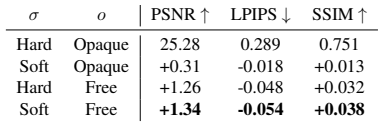
Table 3 .Relative improvements for differentσand opacity settings.Here,softdenotesα= 0.1,hardcorresponds to a sharp transition,opaqueenforces a fixed opacity of1, andfreeallows opacity to be optimized.
원문 · CC BY 4.0 · Jan Held, Renaud Vandeghen, Sanghyun Son, Daniel Rebain, Matheus Gadelha, Yi Zhou, Ming C. Lin, Marc Van Droogenbroeck, Andrea Tagliasacchi · Triangle Splatting+: Differentiable Rendering with Opaque Triangles · 원문 그림 인용 · 원본 PDF 8쪽에서 그림 영역을 추출했습니다.Pruning과 densification
학습 중 삼각형은 낮은 opacity 뒤에 숨을 수 없으므로 pruning이 특히 중요합니다. 5k iteration 이후에는 opacity가 임계값 T_o≈0.2보다 낮은 삼각형을 제거하는 hard pruning을 수행하며, 원문은 이 단계가 삼각형과 vertex의 약 70%를 제거한다고 보고합니다. 이후에는 opacity가 높게 밀려 낮은 opacity 기준이 무력해지므로, 각 삼각형의 최대 volume rendering weight T·o가 임계값 τ보다 낮으면 제거합니다. Densification은 opacity에서 만든 Bernoulli 샘플링으로 후보를 고르고, midpoint subdivision으로 삼각형을 네 개로 나눕니다.
새 vertex는 인접 두 vertex의 평균 색과 opacity를 받으며, 원문은 이 연산이 면적과 공간 범위를 보존하고 연결성을 유지한다고 설명합니다.
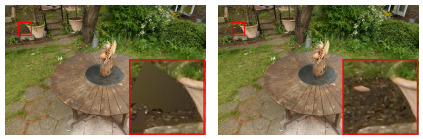
Figure 3 .Hard pruning step.We eliminate unnecessary triangles (right) that would otherwise remain in the scene (left).
원문 · CC BY 4.0 · Jan Held, Renaud Vandeghen, Sanghyun Son, Daniel Rebain, Matheus Gadelha, Yi Zhou, Ming C. Lin, Marc Van Droogenbroeck, Andrea Tagliasacchi · Triangle Splatting+: Differentiable Rendering with Opaque Triangles · 원문 그림 인용 · 원본 PDF 5쪽에서 그림 영역을 추출했습니다.메쉬 기반 novel view synthesis 비교
Mip-NeRF360과 Tanks and Temples에서 mesh 기반 novel view synthesis를 평가합니다. 표 1의 Mip-NeRF360 비교에서 Triangle Splatting+는 PSNR 25.21, LPIPS 0.294, SSIM 0.742를 보고하며, MiLo는 PSNR 24.09를 보고합니다. 이 비교에서 2DGS, GOF, RaDe-GS는 색칠과 mesh 추출을 위한 후처리를 필요로 하는 설정으로 함께 놓입니다. 저자들은 LPIPS가 사람의 지각과 가장 잘 상관된다고 보고 이 지표에서의 개선을 강조합니다. Tanks and Temples의 수치는 같은 표의 다른 열에서 확인되는 범위로 읽어야 합니다.
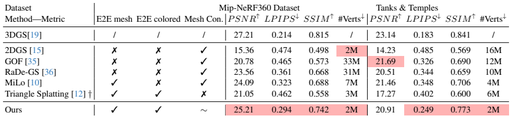
Table 1 .Mesh-based novel view synthesis on the Mip-NeRF360 dataset.E2E meshindicates whether a method directly produces a mesh.E2E coloreddenotes whether the mesh is already colored or requires post-processing.Mesh Con.specifies whether the reconstructed mesh consists of a connected component.∼stands for semi-connectivity.†with only opaque triangles.
원문 · CC BY 4.0 · Jan Held, Renaud Vandeghen, Sanghyun Son, Daniel Rebain, Matheus Gadelha, Yi Zhou, Ming C. Lin, Marc Van Droogenbroeck, Andrea Tagliasacchi · Triangle Splatting+: Differentiable Rendering with Opaque Triangles · 원문 그림 인용 · 원본 PDF 6쪽에서 그림 영역을 추출했습니다.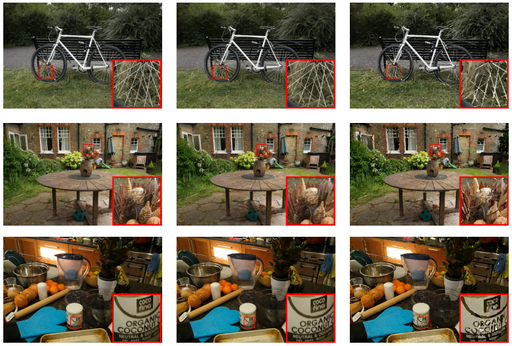
Figure 4 .Qualitative results.Comparison of our method with Ground Truth and opaque Triangle Splatting [12]. Our approach produces renderings that are closer to the ground truth, with sharper details and more faithful recovery of fine structures.†Opaque version of Triangle Splatting.
원문 · CC BY 4.0 · Jan Held, Renaud Vandeghen, Sanghyun Son, Daniel Rebain, Matheus Gadelha, Yi Zhou, Ming C. Lin, Marc Van Droogenbroeck, Andrea Tagliasacchi · Triangle Splatting+: Differentiable Rendering with Opaque Triangles · 원문 그림 인용 · 원본 PDF 7쪽에서 그림 영역을 추출했습니다.Pruning과 학습 전략 절제 실험
Table 2는 Mip-NeRF360에서 baseline의 PSNR 25.28, LPIPS 0.289, SSIM 0.751을 기준으로 두 pruning 구성요소와 σ decay를 각각 제거한 변형을 비교합니다. Hard pruning step을 제거하면 PSNR은 −0.46, LPIPS는 +0.029, SSIM은 −0.025 변합니다. Blending weight pruning을 제거하면 PSNR은 −0.51, LPIPS는 +0.069, SSIM은 −0.045 변합니다. σ decay를 제거한 변형은 PSNR −6.84로 가장 큰 하락을 보입니다. 이 결과는 각 구성요소를 유지했을 때 얻는 효용을 보여 줍니다.
낮은 pruning 기준에서만 유지하는 경우 삼각형을 제거할 수 없게 된다는 원문 설명도 함께 봐야 합니다.
학습 시간과 응용 가능성
원문은 NVIDIA A100에서 Triangle Splatting+가 Mip-NeRF360에서 39분, Tanks and Temples에서 25분 학습한다고 보고합니다. 같은 구절에서 MiLo는 T&T에서 약 45분, Mip-NeRF360에서 최대 2시간이 걸린다고 제시됩니다. Triangle Splatting은 Mip-NeRF360에서 17분, T&T에서 20분으로 더 짧지만 시각 품질이 크게 낮다고 저자들이 설명합니다. 또한 삼각형이 해석 가능한 hard surface로 쓰일 수 있어 Unity의 non-convex mesh collider에서 물리 상호작용과 walkable 환경을 시연하고, 객체 추출에서는 각 픽셀이 하나의 삼각형에 의해 결정되는 성질을 활용합니다.
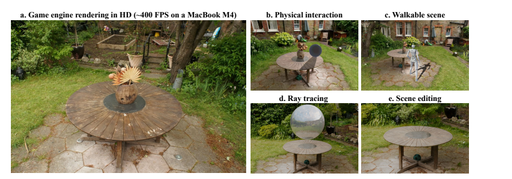
Figure 1 .Triangle Splatting+optimizes a triangle-based representation end-to-end and achieves high visual quality using onlyopaque triangles.The resulting representation can be directly imported into any game engine without post-processing and runs at 400 FPS on a consumer laptop. Within the engine, it naturally supports (b) physical interactions (e.g., collisions), (c) walkable scene interactions as in video games, (d) ray tracing, and (e) scene editing (e.g., object removal or addition).
원문 · CC BY 4.0 · Jan Held, Renaud Vandeghen, Sanghyun Son, Daniel Rebain, Matheus Gadelha, Yi Zhou, Ming C. Lin, Marc Van Droogenbroeck, Andrea Tagliasacchi · Triangle Splatting+: Differentiable Rendering with Opaque Triangles · 원문 그림 인용 · 원본 PDF 1쪽에서 그림 영역을 추출했습니다.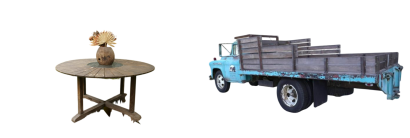
Figure 5 .Straightforward extraction of objects.With Triangle Splatting+ , objects can be extracted or removed from a scene.
원문 · CC BY 4.0 · Jan Held, Renaud Vandeghen, Sanghyun Son, Daniel Rebain, Matheus Gadelha, Yi Zhou, Ming C. Lin, Marc Van Droogenbroeck, Andrea Tagliasacchi · Triangle Splatting+: Differentiable Rendering with Opaque Triangles · 원문 그림 인용 · 원본 PDF 7쪽에서 그림 영역을 추출했습니다.연결성과 적용 범위의 한계
연결성은 최적화에서 엄격히 강제되지 않으며, pruning 때문에 부분적으로만 유지됩니다. 원문은 vertex당 평균 1.5개의 삼각형이 연결되고, 삼각형의 80%가 최소 하나의 다른 삼각형과 연결된다고 보고합니다. 점군 coverage가 희소한 배경 영역은 기하가 불완전하고 충실도가 낮으며, 학습 궤도 밖으로 이동하면 품질이 떨어집니다. 저자들은 불투명 삼각형이 이런 artifact를 더 뚜렷하게 만든다고 해석합니다. 투명한 유리나 병 같은 객체는 불투명 삼각형만으로 표현하기 어렵다고 원문이 밝힙니다.
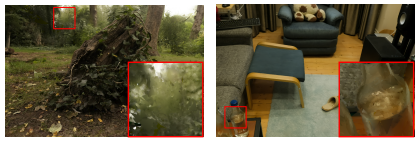
Figure 6 .Limitations.Accurately recovering backgrounds (left), particularly under limited viewpoints, and handling transparent objects (right) remain challenging.
원문 · CC BY 4.0 · Jan Held, Renaud Vandeghen, Sanghyun Son, Daniel Rebain, Matheus Gadelha, Yi Zhou, Ming C. Lin, Marc Van Droogenbroeck, Andrea Tagliasacchi · Triangle Splatting+: Differentiable Rendering with Opaque Triangles · 원문 그림 인용 · 원본 PDF 8쪽에서 그림 영역을 추출했습니다.논문 정보
- 저자
- Jan Held, Renaud Vandeghen, Sanghyun Son, Daniel Rebain, Matheus Gadelha, Yi Zhou, Ming C. Lin, Marc Van Droogenbroeck, Andrea Tagliasacchi
- 학회·저널
- arXiv · 프리프린트
- 최초 공개일
- 2025년 9월 29일
- 등록일
- 2026년 11월 4일
- 수정일
- 2025년 9월 29일
- 버전
- v1
- arXiv
- 2509.25122
- 분류
- cs.CV
- 원문 이용 조건
- CC BY 4.0
- 제공 범위
- 논문 정보, 해설, 허용된 원문 그림
AI 해설은 논문 원문과 별개의 설명이며 오류가 있을 수 있습니다. 원문과 그림은 각 출처의 이용 조건과 따로 표시된 권리를 따릅니다.
초록
Reconstructing 3D scenes and synthesizing novel views has seen rapid progress in recent years. Neural Radiance Fields demonstrated that continuous volumetric radiance fields can achieve high-quality image synthesis, but their long training and rendering times limit practicality. 3D Gaussian Splatting (3DGS) addressed these issues by representing scenes with millions of Gaussians, enabling real-time rendering and fast optimization. However, Gaussian primitives are not natively compatible with the mesh-based pipelines used in VR headsets, and real-time graphics applications. Existing solutions attempt to convert Gaussians into meshes through post-processing or two-stage pipelines, which increases complexity and degrades visual quality. In this work, we introduce Triangle Splatting+, which directly optimizes triangles, the fundamental primitive of computer graphics, within a differentiable splatting framework. We formulate triangle parametrization to enable connectivity through shared vertices, and we design a training strategy that enforces opaque triangles. The final output is immediately usable in standard graphics engines without post-processing. Experiments on the Mip-NeRF360 and Tanks & Temples datasets show that Triangle Splatting+achieves state-of-the-art performance in mesh-based novel view synthesis. Our method surpasses prior splatting approaches in visual fidelity while remaining efficient and fast to training. Moreover, the resulting semi-connected meshes support downstream applications such as physics-based simulation or interactive walkthroughs. The project page is https://trianglesplatting2.github.io/trianglesplatting2/.
원문 인용
Jan Held, Renaud Vandeghen, Sanghyun Son, Daniel Rebain, Matheus Gadelha, Yi Zhou, Ming C. Lin, Marc Van Droogenbroeck, Andrea Tagliasacchi (2025). Triangle Splatting+: Differentiable Rendering with Opaque Triangles. arXiv:2509.25122v1. https://arxiv.org/abs/2509.25122v1
BibTeX
@misc{held2025triangle,
  title = {{Triangle Splatting+: Differentiable Rendering with Opaque Triangles}},
  author = {Jan Held and Renaud Vandeghen and Sanghyun Son and Daniel Rebain and Matheus Gadelha and Yi Zhou and Ming C. Lin and Marc Van Droogenbroeck and Andrea Tagliasacchi},
  year = {2025},
  eprint = {2509.25122},
  archivePrefix = {arXiv},
  url = {https://arxiv.org/abs/2509.25122v1}
}