논문 해설
DeepHMap++: Combined Projection Grouping and Correspondence Learning for Full DoF Pose Estimation
- 연구 문제 로컬 패치 기반 투영 히트맵은 한 채널에 여러 국소 최댓값을 만들며, 기존 DeepHMap은 전역 최댓값만 선택해 이 모호성을 충분히 해결하지 못합니다.
- 연구 방법 투영 그룹핑 모듈로 채널별 불일치 피크를 제거하고, 가설 풀과 대응 평가 네트워크로 가중 2D–3D 대응을 선택해 PnP로 자세를 계산합니다.
- 주요 결과 LineMOD와 Occluded LineMOD에서 CorrNet 계열이 기준 방법보다 높은 정확도를 보고했고, YCB-Video에서도 전체 파이프라인이 여러 항목에서 개선을 보였습니다.
2단계 파이프라인 후처리의 문제
DeepHMap++는 가림이 있는 장면에서 6D 자세를 추정하는 2단계 파이프라인의 후처리(백엔드)를 다룹니다. 전단부는 로컬 패치로부터 3D 경계상자 꼭짓점(BBC)의 투영 히트맵을 예측하고, 후단부는 이 히트맵에서 2D–3D 대응을 골라 자세를 계산합니다. 기존 DeepHMap은 병합된 히트맵의 각 채널에서 전역 최댓값을 선택하는데, 로컬 패치를 독립적으로 예측하면 한 채널 안에 여러 국소 최댓값이 나타날 수 있습니다. 원문은 이 모호성을 전역 최댓값 선택만으로 해결하기 어렵다고 지적합니다. 따라서 이 논문은 투영 선택과 대응 선택이라는 두 후처리 단계를 개선하는 것을 목표로 합니다.
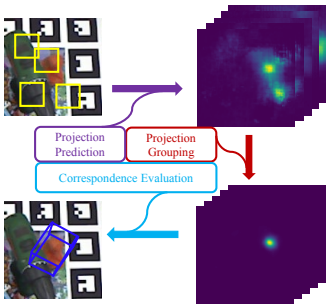
Figure 1 . Overview of the proposed two-stage approach for recovering the 6D pose. For any input patch (yellow box), its corresponding output from projection prediction module consists of projection heatmaps with eight layers.
원문 · CC BY 4.0 · Mingliang Fu, Weijia Zhou · DeepHMap++: Combined Projection Grouping and Correspondence Learning for Full DoF Pose Estimation · 원문 그림 인용 · 원본 PDF 3쪽에서 그림 영역을 추출했습니다.투영 그룹핑 모듈의 입력과 학습 목표
투영 그룹핑 모듈은 병합된 히트맵의 각 채널에서 불일치하는 국소 최댓값을 제거하도록 설계되었습니다. 기존 방식은 각 채널의 전역 최댓값만 취하는 연산이며, 이 모듈은 다른 채널의 투영들 사이의 상관 제약을 함께 사용해 채널별 선택을 바꿉니다. 원문은 완전연결 잔차 구조를 사용하고, 마지막 층의 출력 벡터에 교차 엔트로피 손실을 적용해 정답 가우시안 히트맵에서 만든 확률 라벨과 비교한다고 설명합니다. 이 모듈은 전단부와 별도로 학습되며, 원문에 따르면 전체 파이프라인은 미분 불가능한 경로 때문에 종단간 학습되지 않습니다.
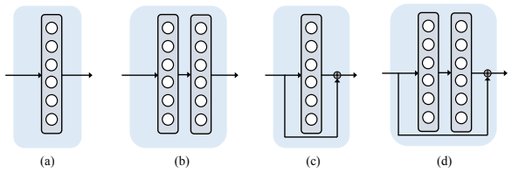
Figure 2 . Architecture of the projection grouping module. The projection grouping network adopts a residual structure [46] consisting of a fully connected network based feedforward path and a shortcut connection (see case (c) and case (d)). Compared with case (c), case (d) utilizes a fully connected two-layer feedforward network. The projection grouping layer takes merged heatmaps with a shape of [w, h, 8] as input and generates the same sized heatmaps containing only one peak in each channel. On the input side, merged heatmaps with a shape of [w, h, 8] are flattened to match the architecture of projection grouping module. On the output side, the immediate output is reshaped to generate filtered projection heatmaps. All layers have rectified linear unit (ReLU) [47] activation function except for the output layer. Dropout layers [48] are employed for the first dense layer, and the softmax function are placed after the add operation. Different configurations of projection grouping layer are detailed in the evaluation section. Additional case (a) and case (b) are plain module without shortcut connection, which are tested for comparison purposes.
원문 · CC BY 4.0 · Mingliang Fu, Weijia Zhou · DeepHMap++: Combined Projection Grouping and Correspondence Learning for Full DoF Pose Estimation · 원문 그림 인용 · 원본 PDF 7쪽에서 그림 영역을 추출했습니다.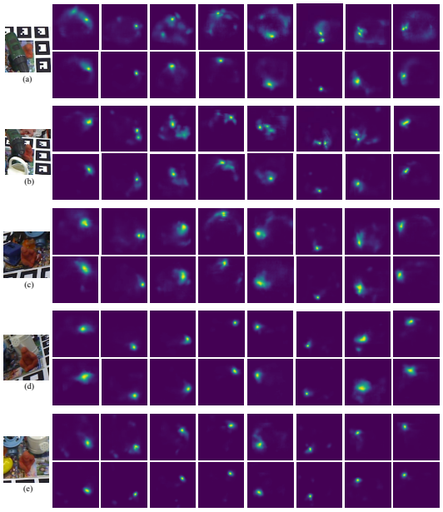
Figure 6 . Predicted projection heatmaps from different RGB images of Occluded LineMOD dataset [ 6]. From (a) to (e), the region of interest of different test frames and its corresponding predicted heatmap channels with DeepHMap (up) and projection grouping module (down) are given, respectively.
원문 · CC BY 4.0 · Mingliang Fu, Weijia Zhou · DeepHMap++: Combined Projection Grouping and Correspondence Learning for Full DoF Pose Estimation · 원문 그림 인용 · 원본 PDF 12쪽에서 그림 영역을 추출했습니다.대응 가설 샘플링과 대응 평가
후단부는 투영 그룹핑 이후 채널당 하나의 피크를 남긴 투영을 중심으로 반경 R의 관심 투영을 정하고, 그 주변에서 대응 가설을 샘플링해 가설 풀을 만듭니다. 이 가설들은 대응 평가 네트워크에 입력되어 신뢰도(가중치)를 받으며, 높은 신뢰도의 대응이 최종 자세 계산에 쓰입니다. 원문은 대응 평가 네트워크가 원래 스테레오 기반 2D–2D 대응 학습을 기반으로 하지만, 여기서는 2D–3D 대응을 입력으로 사용하도록 바뀌었다고 설명합니다. 손실에서는 분류 항과 재투영 오차 기반 회귀 항을 결합하며, 원문 식 (7)은 Lgeo를 대응들의 HPi와 pi 차이의 제곱 노름 평균으로 정의합니다.
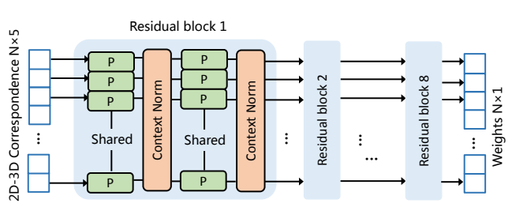
Figure 3 . Architecture of the correspondence–evaluation network. It takes 2D–3D correspondences as input and produces directly correspondence weights. The basic residual block consisting of weight-sharing perceptrons and context normalization. In practice, the multi-layer perceptrons are implemented using conv1d in tensorflow [50].
원문 · CC BY 4.0 · Mingliang Fu, Weijia Zhou · DeepHMap++: Combined Projection Grouping and Correspondence Learning for Full DoF Pose Estimation · 원문 그림 인용 · 원본 PDF 9쪽에서 그림 영역을 추출했습니다.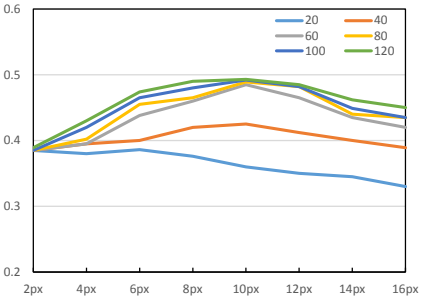
Figure 7 . Evaluation of our proposal with a varying radius of projection of interest (POI) and different sampled correspondences. A horizontal axis denotes the radius of POI in pixels. The vertical axis denotes the fraction of correctly estimated scenes under the 2D reprojection error metric.
원문 · CC BY 4.0 · Mingliang Fu, Weijia Zhou · DeepHMap++: Combined Projection Grouping and Correspondence Learning for Full DoF Pose Estimation · 원문 그림 인용 · 원본 PDF 13쪽에서 그림 영역을 추출했습니다.LineMOD와 Occluded LineMOD에서의 비교
투영 그룹핑 구성 비교에서 원문은 잘못된 투영 선택(FPS)을 100개 채널당으로 세고, PG-2-2048+D를 최적 구성으로 보고합니다. 이 구성은 DeepHMap의 max 함수 기준보다 낮은 FPS를 보였습니다. 대응 평가 비교에서는 CorrNet w/o CC가 LineMOD에서 BB8보다 평균 ADD|I가 약 9.7% 높고 2D 재투영 오차 정확도가 약 5.3% 높다고 보고됩니다. 상관 제약을 포함한 CorrNet은 이 차이를 조금 더 높이며, Occluded LineMOD에서는 DeepHMap의 RANSAC 기반 전략보다 평균 ADD|I에서 1.0%에서 1.6%, 2D 재투영 오차에서 3.0%에서 5.2% 높은 차이를 보고합니다.
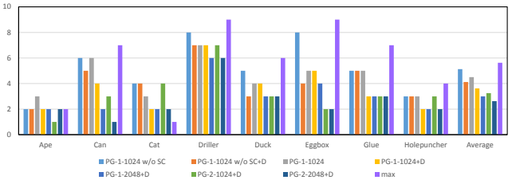
Figure 4 . Statistics of false projection selection per one hundred channels for different configurations on parts of the LineMOD dataset [ 18]. A typical configuration can be expressed as PG-x-y w/o SC+D, where PG denotes the abbreviation of projection grouping module, w/o SC indicates that the network doesn’t contain shortcut connection (SC), D is the dropout layer, x and y represents the number of fully connected layers and dimensionality of the output space, respectively. max refers to the strategy utilized in DeepHMap. For results shown in figure, lower is better.
원문 · CC BY 4.0 · Mingliang Fu, Weijia Zhou · DeepHMap++: Combined Projection Grouping and Correspondence Learning for Full DoF Pose Estimation · 원문 그림 인용 · 원본 PDF 10쪽에서 그림 영역을 추출했습니다.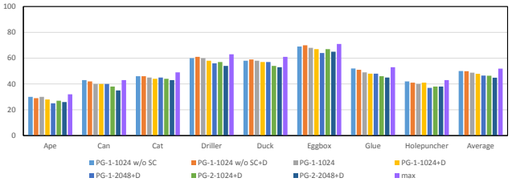
Figure 5 . Statistics of false projection selection per one hundred channels on Occluded LineMOD dataset [6]. All test methods here are the same as Figure 4.
원문 · CC BY 4.0 · Mingliang Fu, Weijia Zhou · DeepHMap++: Combined Projection Grouping and Correspondence Learning for Full DoF Pose Estimation · 원문 그림 인용 · 원본 PDF 11쪽에서 그림 영역을 추출했습니다.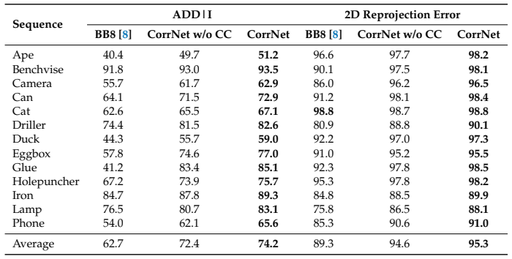
Table 1 . Pose estimation results of two different versions: CorrNet and CorrNet w/o CC on the LineMOD dataset [18]. The best results for each term are shown in bold.
원문 · CC BY 4.0 · Mingliang Fu, Weijia Zhou · DeepHMap++: Combined Projection Grouping and Correspondence Learning for Full DoF Pose Estimation · 원문 그림 인용 · 원본 PDF 14쪽에서 그림 영역을 추출했습니다.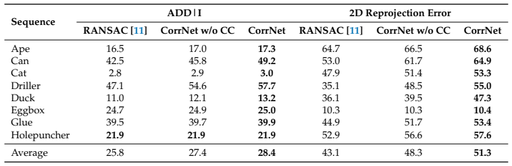
Table 2 . Pose estimation results of CorrNet (ours) and RANSAC [ 11] based method on an Occluded LineMOD dataset [6]. The best results for each term are shown in bold.
원문 · CC BY 4.0 · Mingliang Fu, Weijia Zhou · DeepHMap++: Combined Projection Grouping and Correspondence Learning for Full DoF Pose Estimation · 원문 그림 인용 · 원본 PDF 14쪽에서 그림 영역을 추출했습니다.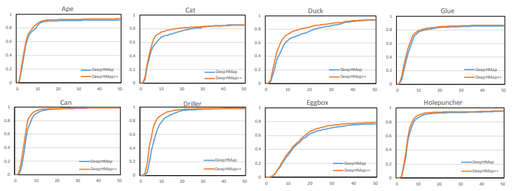
Figure 8 . Evaluations on an Occluded LineMOD dataset [ 6]. The curve represents accuracy vs. pixel threshold in a 2D reprojection error metric. The vertical axis denotes a fraction of correctly estimated scenes. The horizontal axis denotes pixel threshold.
원문 · CC BY 4.0 · Mingliang Fu, Weijia Zhou · DeepHMap++: Combined Projection Grouping and Correspondence Learning for Full DoF Pose Estimation · 원문 그림 인용 · 원본 PDF 15쪽에서 그림 영역을 추출했습니다.YCB-Video 전체 파이프라인 결과
YCB-Video에서 원문은 DeepHMap++를 PoseCNN 및 DeepHMap과 비교합니다. 세 비교 대상은 모두 RGB 영상만 입력으로 사용합니다. 표 3에서 DeepHMap++의 평균 AUC는 65.5, ADD|I는 38.6, 2D 재투영 오차는 30.6으로 보고되며, DeepHMap은 61.4, 33.8, 23.1입니다. 이 값들은 원문 표의 평균 행을 그대로 옮긴 것이며, 2D 재투영 오차는 낮을수록 좋은 지표입니다. 따라서 이 표에서 DeepHMap++의 2D 재투영 오차 평균은 DeepHMap보다 높습니다. 원문은 DeepHMap++가 대부분의 항목에서 가장 좋다고 해석하지만, 같은 표 안에서도 지표마다 방향이 다르므로 이 결과를 모든 지표의 개선으로 읽으면 안 됩니다.
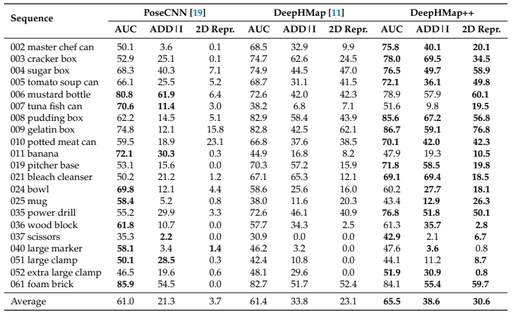
Table 3 . Comparisons with state-of-the-art methods on YCB-Video dataset [19]. We report the AUC scores, ADD|I and 2D reprojection error for the 21 image sequences of YCB-Video dataset. The best results for each term are shown in bold.
원문 · CC BY 4.0 · Mingliang Fu, Weijia Zhou · DeepHMap++: Combined Projection Grouping and Correspondence Learning for Full DoF Pose Estimation · 원문 그림 인용 · 원본 PDF 15쪽에서 그림 영역을 추출했습니다.적용 범위와 한계
원문의 실험은 LineMOD, Occluded LineMOD, YCB-Video와 DeepHMap 기준 설정에서 보고되었습니다. 원문은 다른 객체 집합이나 설정으로의 일반화를 보장하지 않으며, 본 논문은 종단간 학습 구조의 장점을 아직 실현하지 않았다고 밝힙니다. 실행 시간은 파이썬 구현과 특정 하드웨어에서 측정된 값입니다. 따라서 결과는 이 설정에서 얻은 근거로 읽어야 하며, 다른 파이프라인이나 다른 하드웨어와의 직접 비교로 바꾸면 안 됩니다.
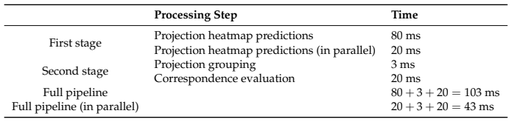
Table 4 . The runtime statistics of different subparts in the complete pipeline.
원문 · CC BY 4.0 · Mingliang Fu, Weijia Zhou · DeepHMap++: Combined Projection Grouping and Correspondence Learning for Full DoF Pose Estimation · 원문 그림 인용 · 원본 PDF 18쪽에서 그림 영역을 추출했습니다.논문 정보
- 저자
- Mingliang Fu, Weijia Zhou
- 학회·저널
- arXiv · 프리프린트
- 최초 공개일
- 2019년 4월 29일
- 등록일
- 2026년 11월 6일
- 수정일
- 2019년 4월 29일
- 버전
- v1
- arXiv
- 1904.12735
- DOI
- 10.3390/s19051032
- 분류
- cs.CV
- 원문 이용 조건
- CC BY 4.0
- 제공 범위
- 논문 정보, 해설, 허용된 원문 그림
AI 해설은 논문 원문과 별개의 설명이며 오류가 있을 수 있습니다. 원문과 그림은 각 출처의 이용 조건과 따로 표시된 권리를 따릅니다.
초록
In recent years, estimating the 6D pose of object instances with convolutional neural network (CNN) has received considerable attention. Depending on whether intermediate cues are used, the relevant literature can be roughly divided into two broad categories: direct methods and two stage pipelines. For the latter, intermediate cues, such as 3D object coordinates, semantic keypoints, or virtual control points instead of pose parameters are regressed by CNN in the first stage. Object pose can then be solved by correspondence constraints constructed with these intermediate cues. In this paper, we focus on the postprocessing of a two-stage pipeline and propose to combine two learning concepts for estimating object pose under challenging scenes: projection grouping on one side, and correspondence learning on the other. We firstly employ a local patch based method to predict projection heatmaps which denote the confidence distribution of projection of 3D bounding box's corners. A projection grouping module is then proposed to remove redundant local maxima from each layer of heatmaps. Instead of directly feeding 2D-3D correspondences to the perspective-n-point (PnP) algorithm, multiple correspondence hypotheses are sampled from local maxima and its corresponding neighborhood and ranked by a correspondence-evaluation network. Finally, correspondences with higher confidence are selected to determine object pose. Extensive experiments on three public datasets demonstrate that the proposed framework outperforms several state of the art methods.
원문 인용
Mingliang Fu, Weijia Zhou (2019). DeepHMap++: Combined Projection Grouping and Correspondence Learning for Full DoF Pose Estimation. arXiv:1904.12735v1. https://doi.org/10.3390/s19051032
BibTeX
@article{fu2019deephmap,
  title = {{DeepHMap++: Combined Projection Grouping and Correspondence Learning for Full DoF Pose Estimation}},
  author = {Mingliang Fu and Weijia Zhou},
  year = {2019},
  eprint = {1904.12735},
  archivePrefix = {arXiv},
  doi = {10.3390/s19051032},
  url = {https://arxiv.org/abs/1904.12735v1}
}