논문 해설
Efficient Parallel Samplers for Recurrent-Depth Models and Their Connection to Diffusion Language Models
순환 깊이 모델을 위한 효율적인 병렬 샘플러와 확산 언어 모델과의 연결
- 연구 문제 반복 깊이 언어 모델은 토큰마다 모든 반복을 순차적으로 수행해야 하므로 자기회귀 생성이 느립니다.
- 연구 방법 diffusion forcing 원리를 적용하여 토큰 위치 방향으로 반복 단계를 대각선 병렬화하는 샘플러를 제안합니다.
- 주요 결과 Huginn-0125에서 GSM8K 기준 약 5배 속도 향상을 보고하며 정확도 차이는 최대 약 2.4%p입니다.
recurrent-depth models 생성의 느린 속도
반복 깊이(recurrent-depth) 언어 모델은 같은 층 블록을 여러 번 반복 적용하여 계산량을 늘리는 구조입니다. 이 구조는 수학이나 프로그래밍처럼 여러 단계의 논리가 필요한 과제에서 장점을 보입니다. 그러나 자기회귀 방식으로 생성할 때에는 다음 토큰을 만들기 전에 모든 반복 단계를 순차적으로 끝내야 하므로 생성이 느립니다. 이 논문은 이 문제를 해결하기 위해 확산 모델의 diffusion forcing 샘플링 원리를 recurrent-depth models에 적용합니다. 핵심 질문은 같은 학습된 체크포인트에서 생성 속도를 높이면서도 정확도를 크게 잃지 않을 수 있는가입니다.
대각선으로 진행하는 diffusion forcing 샘플러
제안 샘플러는 토큰 위치마다 반복 단계를 하나씩 진행하는 대각선 방식으로 생성을 병렬화합니다. 모델은 프롬프트를 입력 임베딩 e로 바꾸고, 각 위치의 잠재 상태를 내부 반복으로 정제합니다. 정제 중인 위치들의 집합을 wavefront라고 부르며, 이 집합의 최대 길이를 제한해 메모리 사용을 제한합니다. 샘플러는 충분히 수렴한 위치를 고정하고 KV 상태를 캐시에 추가합니다. 원문은 wavefront 크기를 1로 두고 적응형 종료를 사용하면 기존 토큰 단위 적응형 샘플러를 정확히 회복한다고 설명합니다. 또한 r′를 r과 같게 두면 원래의 자기회귀 샘플러가 회복된다고 설명합니다.
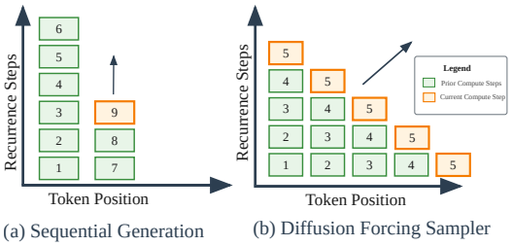
Figure 1 :Different generation schemes for autoregressive, recurrent-depth models.Left:Standard sequential generation, which proceeds one token and step of the recurrence at a time (time steps denoted by integers).Right: A diffusion forcing sampler used for the same model can parallelize generation “diagonally”, by computing one step of the recurrence per token position, iteratively refining its estimate of the generated sequence. However, generation with autoregressive recurrent-depth models is typically slow, given that every repetition of the model layers must be executed sequentially before the next token can be produced. In this work, we discuss how generation from recurrent-depth models can be efficiently parallelized by connecting this architecture to diffusion model architectures. Both architectures “recur” in a related sense, and even though both are trained with different objectives, we show that samplers adapted from diffusion literature, namely,diffusion forcing(Chen et al., 2024a), can be directly applied to parallelize the generation of already existing recurrent-depth models from Geiping et al. (2025).
원문 · CC BY 4.0 · Geiping, Jonas, Yang, Xinyu, Su, Guinan · Efficient Parallel Samplers for Recurrent-Depth Models and Their Connection to Diffusion Language Models · 원문 그림 인용 · 원본 PDF 2쪽에서 그림 영역을 추출했습니다.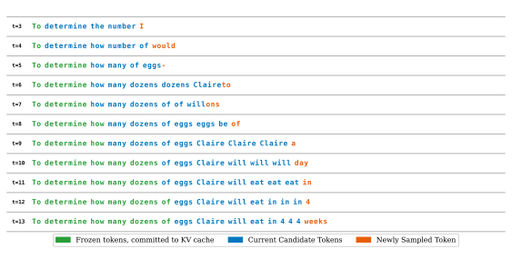
Figure 2 :An example of a text sequence being generated with the proposed diffusion forcing sampler from a depth-recurrent model. While the original recurrent-depth model requires 32 recurrence steps to produce a single token (the default for this model), the diffusion sampler has already produced and committed 8 new tokens (green). As described, the sampler advances by at least one token per step of the recurrence. Decoded candidate tokens are initial spell out incoherent text, but map into the right concepts, and quickly improve with more steps. Note that the “freeze” decision is dynamic, based on distance to the previous state in latent space (not pictured).
원문 · CC BY 4.0 · Geiping, Jonas, Yang, Xinyu, Su, Guinan · Efficient Parallel Samplers for Recurrent-Depth Models and Their Connection to Diffusion Language Models · 원문 그림 인용 · 원본 PDF 3쪽에서 그림 영역을 추출했습니다.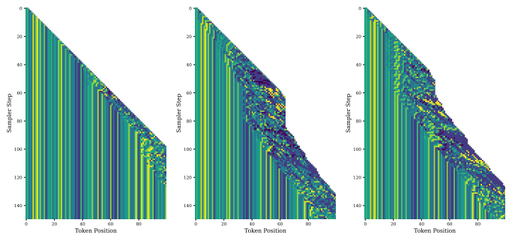
Figure 4 : Examples of adaptive sampler behavior. Each color represents a token id in the vocabulary of the model, showing the development of the generated sequence (running left to right) as a function of sampler steps (running top to bottom) fordifferent hyperparameter choices. The leftmost example is r′ = 4, and tokens are frozen quickly, whereas middle and right show sequences with r <4 require more adaptive computation, and in both cases the sampler stalls after hitting the maximal length of the wavefront (here 32 to visualize), before resolving the sequence and advancing again.
원문 · CC BY 4.0 · Geiping, Jonas, Yang, Xinyu, Su, Guinan · Efficient Parallel Samplers for Recurrent-Depth Models and Their Connection to Diffusion Language Models · 원문 그림 인용 · 원본 PDF 7쪽에서 그림 영역을 추출했습니다.샘플러가 요구하는 모델 구성 조건
원문의 Huginn-0125 구조는 prelude 블록 P, 반복 블록 R, coda 블록 C로 이루어집니다. 입력 토큰은 P를 거쳐 e가 되고, 상태 s는 R을 반복하며 갱신된 뒤 C를 거쳐 다음 토큰 확률을 냅니다. 샘플러가 적용되려면 반복이 입력 임베딩에 조건화되는 input injection과, 반복의 중간 상태가 근사적으로 올바른 해로 디코딩될 수 있는 robust recurrence가 필요합니다. KV 캐시 공유는 필수는 아니지만 메모리 측면에서 큰 이점이 있습니다. 원문의 그림 3은 KV 캐시 공유를 허용하면 GSM8k에서 기준선과 비슷한 정확도를 유지하면서 반복 횟수 r배만큼 KV 메모리를 줄일 수 있음을 보여 준다고 설명합니다.
기준선과 비교한 속도와 정확도
평가에서 제안 샘플러는 GSM8K, MATH500, HumanEval, MBPP에서 자기회귀 기준선과 비교되었습니다. 측정은 배치 크기 1과 동일한 백엔드 조건에서 이루어졌고, 기본 설정은 exit threshold 0.03, βt=0, η=0.1, r′=4, 최대 wavefront 128입니다. Table 1에서 Huginn-0125의 정적 AR(r=32)은 GSM8K에서 정확도 41.77%와 36.1 t/s를 보였고, 샘플러(r′=4, βt=0)는 42.08%와 157.3 t/s를 보였습니다. 논문은 모든 벤치마크에서 약 4.4배에서 4.8배의 속도 향상을 보고하며, 정확도 차이는 최대 약 2.4%p 감소로 보고합니다.
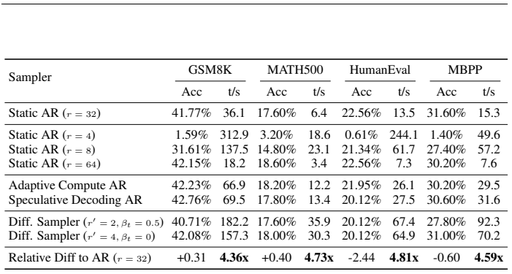
Table 1 :Performance comparison of autoregressive (AR) and diffusion samplers for theHuginn-0125model using a comparable backend (batch size 1, transformers with dynamic KV caching, no further inference optimizations). For both samplers, we record the total evaluation time divided by the number of samples. “Acc” denotes task accuracy, and “t/s” denotes the median of tokens/second measurements for all samples in the task.
원문 · CC BY 4.0 · Geiping, Jonas, Yang, Xinyu, Su, Guinan · Efficient Parallel Samplers for Recurrent-Depth Models and Their Connection to Diffusion Language Models · 원문 그림 인용 · 원본 PDF 9쪽에서 그림 영역을 추출했습니다.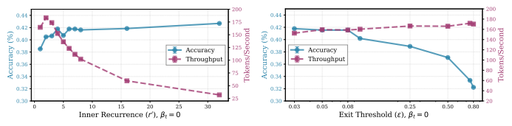
Figure 5 :Trade-off between accuracy and speed on GSM8k under different hyperparameter choices.Left: Effect of increasing inner recurrence r′. Inner recurrence stabilizes the sampling, increasing accuracy at the cost of throughput.Right:Effect of varying the exit threshold ε. Modulating the exit threshold most directly trades off throughput and accuracy.
원문 · CC BY 4.0 · Geiping, Jonas, Yang, Xinyu, Su, Guinan · Efficient Parallel Samplers for Recurrent-Depth Models and Their Connection to Diffusion Language Models · 원문 그림 인용 · 원본 PDF 9쪽에서 그림 영역을 추출했습니다.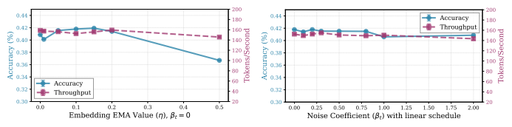
Figure 6 : Left:Scaling the amount of momentum η in the conditioning., showing that small, but non-zero η values are optimal.Right:Scaling the amount of noise added during inference for r′ = 4, scheduled linearly in the number of recurrence steps, also measured on GSM8k. Atr ′ = 4, adding noise is not optimal. We plot the full spectrum ofr ′ toβ t in
원문 · CC BY 4.0 · Geiping, Jonas, Yang, Xinyu, Su, Guinan · Efficient Parallel Samplers for Recurrent-Depth Models and Their Connection to Diffusion Language Models · 원문 그림 인용 · 원본 PDF 10쪽에서 그림 영역을 추출했습니다.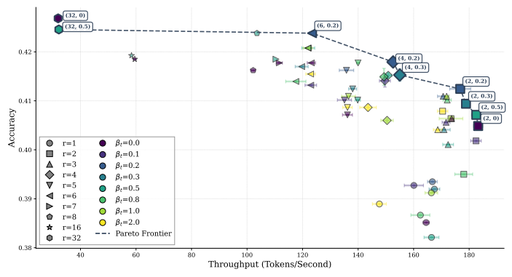
Figure 7 :The Pareto Curve of Accuracy and Throughput on GSM8k spanned by varying inner recurrence and noise hyperparameter pairs (r′, βt). Adding moderate amounts of noise, e.g. βt = 0.2is dominating runs with no noise added. Note also the scale of y-axis, as even at the rightmost part of the frontier, we are observing accuracy losses of only2%.
원문 · CC BY 4.0 · Geiping, Jonas, Yang, Xinyu, Su, Guinan · Efficient Parallel Samplers for Recurrent-Depth Models and Their Connection to Diffusion Language Models · 원문 그림 인용 · 원본 PDF 11쪽에서 그림 영역을 추출했습니다.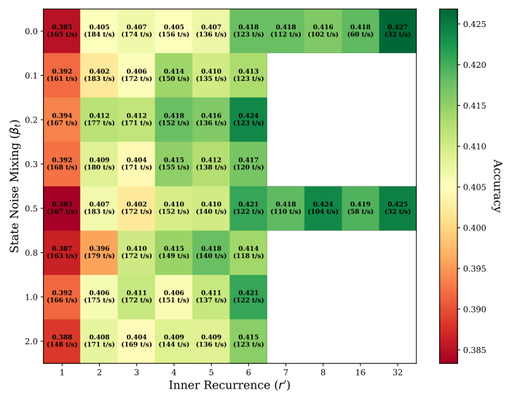
Figure 10 :A heatmap of accuracy and throughput measurements spanned by varying noise and inner recurrence.
원문 · CC BY 4.0 · Geiping, Jonas, Yang, Xinyu, Su, Guinan · Efficient Parallel Samplers for Recurrent-Depth Models and Their Connection to Diffusion Language Models · 원문 그림 인용 · 원본 PDF 18쪽에서 그림 영역을 추출했습니다.다른 체크포인트에서의 재현
Table 2에서 SWA 체크포인트와 MetaMath로 미세조정한 수학 변형 모델도 같은 방향의 결과를 보입니다. 논문은 두 모델에서 샘플러가 4배에서 5배 수준의 속도 향상을 보이고 정확도 차이는 0.5~1% 범위라고 보고합니다. 이 결과는 원 체크포인트의 평균화 모델과 추가 미세조정 모델에서 얻은 것이며, 다른 모델 계열에 대한 일반적 보장은 아닙니다.
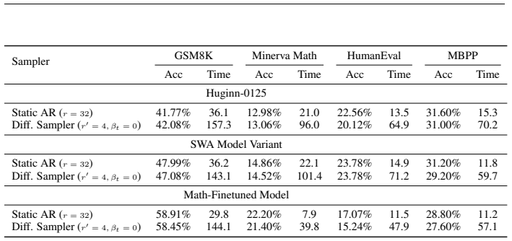
Table 2 :Hyperparameters remain stable across different model variants. For example, both the weight-averaged checkpoint from the original work and the model finetuned on MetaMath for this study exhibit consistent speed gains in the range of 4–5× and accuracy deviations within 0.5–1%, even when baseline values change.
원문 · CC BY 4.0 · Geiping, Jonas, Yang, Xinyu, Su, Guinan · Efficient Parallel Samplers for Recurrent-Depth Models and Their Connection to Diffusion Language Models · 원문 그림 인용 · 원본 PDF 10쪽에서 그림 영역을 추출했습니다.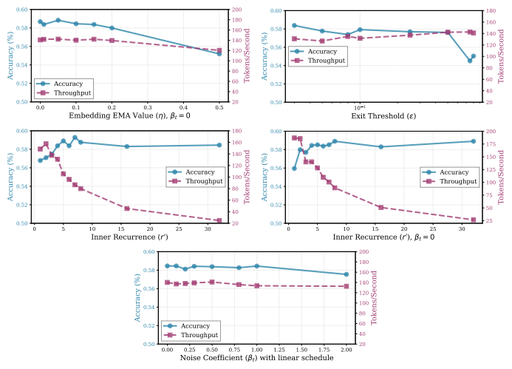
Figure 13 :Hyperparameter Robustness for the finetuned math model on GSM8k. These figure repeat the ablation study from the main body concerning hyperparameter robustness also for the finetuned math model, showing that behaviors are largely similar, even though the model’s capability has noticeably changed.
원문 · CC BY 4.0 · Geiping, Jonas, Yang, Xinyu, Su, Guinan · Efficient Parallel Samplers for Recurrent-Depth Models and Their Connection to Diffusion Language Models · 원문 그림 인용 · 원본 PDF 19쪽에서 그림 영역을 추출했습니다.깊이와 너비 확장에 대한 이론적 논거
논문은 recurrent-depth models에서 prefilling 단계는 깊이 확장을, decoding 단계는 너비 확장을 우선해야 한다는 두 정리를 제시합니다. Theorem 4.2는 같은 확장 계수에서 깊이 확장이 너비 확장보다 표현력이 크거나 같다는 비공식 정리입니다. Theorem 4.4는 r>1 내부 반복을 쓰고 KV-cache sharing을 적용하며 wavefront 크기가 L⋆ 이하일 때 diffusion forcing 디코딩이 같은 깊이에서 더 큰 너비를 가진다는 비공식 정리입니다. 이 정리들은 조건부 결과이며, 모든 설정에 대한 보편적 성질로 읽으면 안 됩니다.
적용 범위와 남은 한계
저자들은 제안 샘플러가 현재 causal 모델 구조 안에서 설명되며, 추가 학습 없이는 진정한 양방향 디퓨전 모델로 간주되지 않는다고 밝힙니다. 원문은 배치 처리 엔진으로의 확장을 이 연구의 범위 밖으로 두고 향후 과제로 남깁니다. 또한 큰 헤드웨이는 실질적인 속도 향상을 주지 못했다고 보고합니다. 이 결과들은 주로 Huginn-0125 계열과 제시된 벤치마크에서 얻은 것입니다.
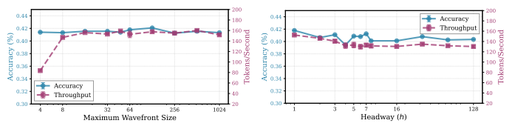
Figure 8 :Impact of Additional Hyperparameter Choices on GSM8k.Left:Size of the wavefront. Increasing wavefront size up to a value around 64-128 appears optimal. We note that the optimal wavefront size is also likely to be accelerator-specific.Right:Amount of headway. Larger amounts of headway than 1, i.e. advancing the sampler more than 1 token per step, do not seem to materialize practical speedups for the studied model.
원문 · CC BY 4.0 · Geiping, Jonas, Yang, Xinyu, Su, Guinan · Efficient Parallel Samplers for Recurrent-Depth Models and Their Connection to Diffusion Language Models · 원문 그림 인용 · 원본 PDF 11쪽에서 그림 영역을 추출했습니다.논문 정보
- 저자
- Geiping, Jonas, Yang, Xinyu, Su, Guinan
- 학회·저널
- arXiv · 프리프린트
- 최초 공개일
- 2025년 10월 16일
- 등록일
- 2026년 10월 30일
- 수정일
- 2025년 10월 16일
- 버전
- v1
- arXiv
- 2510.14961
- 원문 이용 조건
- CC BY 4.0
- 제공 범위
- 논문 정보, 해설, 허용된 원문 그림
AI 해설은 논문 원문과 별개의 설명이며 오류가 있을 수 있습니다. 원문과 그림은 각 출처의 이용 조건과 따로 표시된 권리를 따릅니다.
초록
Language models with recurrent depth, also referred to as universal or looped when considering transformers, are defined by the capacity to increase their computation through the repetition of layers. Recent efforts in pretraining have demonstrated that these architectures can scale to modern language modeling tasks while exhibiting advantages in reasoning tasks. In this work, we examine the relationship between recurrent-depth models and diffusion language models. Building on their similarities, we develop a new diffusion forcing sampler for these models to accelerate generation. The sampler advances by decoding new tokens at every forward pass of the model, while the latent states of these tokens can be further refined in parallel through recurrence. Theoretically, generation with our sampler is strictly more expressive than the baseline autoregressive generation using the same time budget on modern hardware. Moreover, this sampler, based on principles from diffusion literature, can be directly applied to existing 3.5B recurrent-depth transformers without any tuning, leading to up to a 5x speedup. Consequently, our findings not only provide an efficient mechanism for parallelizing the extra computation in recurrent-depth models at inference, but also suggest that such models can be naturally viewed as strong continuous, though causal, diffusion language models.
원문 인용
Geiping, Jonas, Yang, Xinyu, Su, Guinan (2025). Efficient Parallel Samplers for Recurrent-Depth Models and Their Connection to Diffusion Language Models. arXiv:2510.14961v1. https://arxiv.org/abs/2510.14961v1
BibTeX
@misc{jonas2025efficient,
  title = {{Efficient Parallel Samplers for Recurrent-Depth Models and Their Connection to Diffusion Language Models}},
  author = {Geiping, Jonas and Yang, Xinyu and Su, Guinan},
  year = {2025},
  eprint = {2510.14961},
  archivePrefix = {arXiv},
  url = {https://arxiv.org/abs/2510.14961v1}
}