논문 해설
PianoBench: Evaluating Musical Perception and Reasoning in Language Models
PianoBench: 언어 모델의 음악 지각과 추론 평가
- 연구 문제 음악 이해 벤치마크가 늘어나고 있지만, 다중모달 언어 모델이 음원에서 국소적인 음악 특징을 지각하는지와 명시적 음표 정보에서 그 특징을 추론하는지는 분리되어 확인되지 않았습니다.
- 연구 방법 교육 영상에서 음성 해설과 MIDI-text를 시간 순서대로 교차 배열한 PianoTalk으로 학습 데이터를 만들고, 같은 악절을 음원과 기호 표현으로 제시하는 PianoBench로 평가합니다. 또한 Qwen 3.5 9B Base를 인터리브, 분리, 음성 전용 방식으로 중간 학습하여 COT 없는 MIDI-text 질문응답 효과를 비교합니다.
- 주요 결과 개방형 오디오-언어 모델은 음원 입력에서 음악 없는 대조군 대비 제한적인 향상만 보였고, COT를 사용한 최첨단 모델은 MIDI-text에서 최대 93.2%를 기록했습니다. 인터리브 중간 학습은 COT 없이 MIDI-text 정확도를 56.0%로 높여 분리 학습의 42.4%와 명령 튜닝만 한 42.8%를 넘었습니다.
음악을 듣는 능력과 음악을 추론하는 능력의 간극
대규모 다중모달 언어 모델은 넓은 음악 이해 벤치마크에서 점점 나아지고 있지만, 모델이 음악의 어떤 특징을 실제로 지각하고 그 위에서 추론할 수 있는지는 분명하지 않습니다. 기존 오디오 음악 벤치마크와 학습 데이터는 주로 곡 단위의 캡션과 태그에서 만들어지므로, 화음 진행이나 모티프처럼 시간상 국소적인 음악 요소를 언어로 설명하는 능력을 직접 재지는 못합니다. 이 논문은 이 공백을 메우기 위해 같은 악절을 음원과 기호 표현으로 나란히 제시할 수 있는 평가 체계를 제안합니다. 핵심 질문은 모델이 음원에서 얻은 정보와 명시적인 음표 사건에서 얻은 정보를 얼마나 다르게 활용하는지입니다.
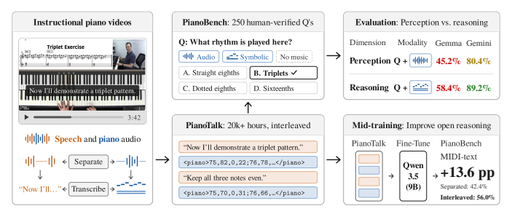
Figure 1 : We release PianoBench, a benchmark for evaluating music perception and reasoning in LLMs. PianoBench is derived from PianoTalk, a training-scale (20k hours) dataset of interleaved commentary and music transcripts, which is derived from instructional piano videos. Evaluation results are on PianoBench using Gemma 4 12B (thinking) and Gemini 3.1 Pro Preview (medium).
원문 · CC BY 4.0 · Louis Bradshaw, Irmak Bukey, Daniel Chenyu Lin, John Thickstun, Chris Donahue · PianoBench: Evaluating Musical Perception and Reasoning in Language Models · 원문 그림 인용 · 원본 PDF 2쪽에서 그림 영역을 추출했습니다.교육 영상에서 만든 PianoTalk 데이터
PianoTalk은 악기 교육 영상에서 음성 해설과 피아노 연주를 시간 순서대로 교차 배열한 학습용 데이터셋입니다. 파이프라인은 시드 영상에서 출발해 LLM이 메타데이터를 평가하며 관련 영상과 채널을 넓혀 가는 방식으로 음성과 피아노가 함께 있는 영상을 고릅니다. 선택된 녹음에서는 음원 분리로 피아노 스템을 얻고, 피아노 스템을 MIDI로 전사하며, 음성은 자동 음성 인식으로 텍스트화합니다. 피아노 전사는 Aria 토크나이저로 먼저 토큰화한 뒤 음 높이, 속도, 온셋, 지속 시간으로 구성된 MIDI-text 형식으로 바꿉니다. 이 과정에서 온셋은 5초마다 놓인 표지를 기준으로 기록되어 긴 구간에서도 값의 범위가 제한됩니다.
최종 데이터는 138,212개 영상, 약 20,000시간 규모이며 학습·검증·테스트 분할은 채널 단위로 나뉩니다.
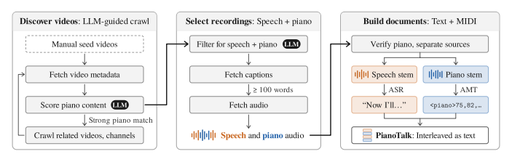
Figure 2 : PianoTalk data recipe. Starting from seed videos, we crawl related videos and YouTube channels. An LLM evaluates video metadata to select videos likely to contain both speech and piano. Audio from videos with captions is fetched and screened for piano content. Audio is converted into interleaved speech and music transcripts via source separation, automatic speech recognition (ASR) and automatic music transcription (AMT).
원문 · CC BY 4.0 · Louis Bradshaw, Irmak Bukey, Daniel Chenyu Lin, John Thickstun, Chris Donahue · PianoBench: Evaluating Musical Perception and Reasoning in Language Models · 원문 그림 인용 · 원본 PDF 4쪽에서 그림 영역을 추출했습니다.PianoBench의 문항 구성과 입력 조건
PianoBench는 PianoTalk 테스트 분할에서 만든 250개의 사람이 검증한 객관식 문항입니다. 문항은 짧은 피아노 악절에서 나오며, 같은 악절을 분리된 피아노 음원, Pianoteq로 합성한 오디오, MIDI-text, 그리고 음악이 없는 대조 조건으로 제시할 수 있습니다. 질문과 정답은 음원 없이 타임라인만 보는 LLM이 먼저 만들고, 오답 후보는 텍스트만 보는 모델이 점수화합니다. 사람은 음원과 MIDI 렌더링을 함께 들으며 정답이 두 표현 모두에서 모호하지 않은지 확인합니다. 음악 없는 대조 조건은 질문과 선택지만으로 맞힐 수 있는 정도를 재며, 음악 입력의 효과는 각 모델의 대조 정확도 대비 변화량 ∆로 계산합니다.
이렇게 하면 같은 악절을 소리로 들을 때와 명시적인 음표로 읽을 때의 차이를 직접 비교할 수 있습니다.
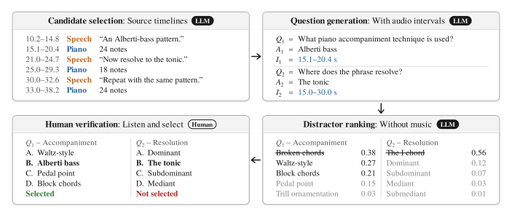
Figure 4 : Schematic construction of PianoBench (clockwise from top left). Speech and piano activ- ity form a source timeline. An LLM with access to the source timeline proposes questions, answers, audio intervals, and distractors. A model ranks distractors without hearing the music. A human checks the passages and answer choices, retaining Q1 and rejecting Q2.
원문 · CC BY 4.0 · Louis Bradshaw, Irmak Bukey, Daniel Chenyu Lin, John Thickstun, Chris Donahue · PianoBench: Evaluating Musical Perception and Reasoning in Language Models · 원문 그림 인용 · 원본 PDF 6쪽에서 그림 영역을 추출했습니다.입력 조건별 모델 비교 결과
개방형 오디오-언어 모델은 음악 없는 대조 조건보다 음원 입력에서 얻는 향상이 작았습니다. 개방형 모델의 음원 입력 변화량은 -1.6에서 +6.0 퍼센트포인트 범위였습니다. 반면 독점형 모델인 Gemini 3.1 Pro Preview는 분리된 피아노 스템에서 80.4%를 기록하여 음원 조건의 최고 정확도를 보였고, 음악 없는 조건 대비 +16.8 퍼센트포인트 향상되었습니다. MIDI-text 입력에서는 COT를 사용한 GPT 6 Astra(high)가 93.2%로 가장 높았습니다. 같은 모델군에서도 COT를 켜면 MIDI-text 정확도가 크게 올라갔지만, Qwen 3 Omni와 Gemma 4 12B는 사고 기능을 켜도 음원 정확도가 뚜렷이 오르지 않았습니다.
이 결과는 명시적인 음표가 주어졌을 때의 추론 능력과 음원에서 음악적 특징을 복원하는 지각 능력이 서로 다르다는 해석을 뒷받침합니다.
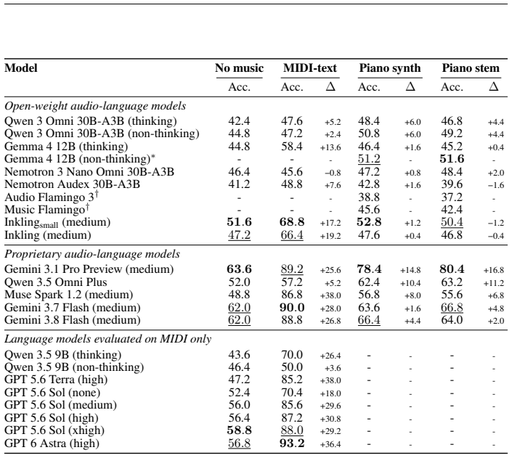
Table 1 : Zero-shot accuracy (%) on the 250 PianoBench MCQs. Models are evaluated with the ques- tion and choices alone (no music), MIDI-text, Pianoteq-synthesized audio, and the source-separated piano stem, where supported.∆denotes the percentage-point change from that model’s no-music accuracy.†: Audio Flamingo 3 and Music Flamingo had inconsistent instruction following on text- only inputs.∗: Gemma 4 12B continued to produce chain-of-thought on MIDI-text and no-music inputs despite thinking being disabled; we therefore omit these results.Boldis best per column / section, underline is second best.
원문 · CC BY 4.0 · Louis Bradshaw, Irmak Bukey, Daniel Chenyu Lin, John Thickstun, Chris Donahue · PianoBench: Evaluating Musical Perception and Reasoning in Language Models · 원문 그림 인용 · 원본 PDF 7쪽에서 그림 영역을 추출했습니다.인터리브 중간 학습의 설계
연구진은 Qwen 3.5 9B Base를 PianoTalk 학습 분할에서 중간 학습하여, 음악 정보를 텍스트로 다루는 능력이 COT 없이도 향상되는지 확인했습니다. 비교 조건은 세 가지입니다. 인터리브 조건은 음성 해설 청크와 MIDI-text 청크를 시간 순서대로 한 문서에 배열합니다. 분리 조건은 같은 청크를 음성 전용 문서와 MIDI 전용 문서로 나눕니다. 음성 전용 조건은 해설만 사용하여 설명 텍스트 자체의 효과를 통제합니다. 세 조건 모두 같은 표준 명령 튜닝을 거치며, 명령 튜닝 데이터에는 MIDI-text 질문응답 자료나 COT 지도 신호를 넣지 않습니다. 이 설계는 모델 구조와 학습 목표를 고정하고 데이터의 배열만 바꿉니다.
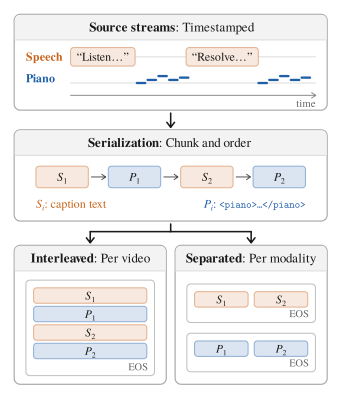
Figure 5 : Construction of mid-training docu- ments. Interleaved and separated training setups use the same speech and piano chunks, orga- nized either chronologically in one interleaved document or as separate speech-only and piano- only documents.
원문 · CC BY 4.0 · Louis Bradshaw, Irmak Bukey, Daniel Chenyu Lin, John Thickstun, Chris Donahue · PianoBench: Evaluating Musical Perception and Reasoning in Language Models · 원문 그림 인용 · 원본 PDF 9쪽에서 그림 영역을 추출했습니다.중간 학습 효과의 검증 결과
명령 튜닝만 한 Base-SFT 모델은 MIDI-text 입력에서 42.8%였고, 분리 학습 모델은 42.4%, 음성 전용 모델은 37.6%였습니다. 인터리브 학습 모델은 56.0%로, 음악 없는 조건 45.6%보다 10.4 퍼센트포인트 높았습니다. 이 차이는 같은 내용을 분리된 문서로 노출한 경우보다 음성 해설과 음표의 시간적 관계를 보존한 쪽이 MIDI-text 활용에 더 도움이 되었다는 관찰입니다. 한편 공식 명령 튜닝 체크포인트는 COT 없이 50.0%였고, COT를 켜면 70.0%였습니다. 따라서 인터리브 학습은 COT 없는 조건에서 공식 체크포인트를 넘어섰지만, COT를 사용한 공식 체크포인트의 수준에는 도달하지 않았습니다.
두 방향의 개선은 서로 다른 축으로 해석하는 것이 적절합니다.
전사 오류와 평가의 범위
저자들은 PianoBench에서 몇 가지 전사 오류를 발견했으며, 이 문항들은 태그를 붙여 공개했지만 보고된 결과에는 그대로 포함했다고 밝힙니다. GPT 6 Astra가 MIDI-text에서 틀린 17개 문항을 분석한 결과, 4개는 검증 과정에서 놓친 전사 오류였고 1개는 사람이 고른 참조 정답이 잘못된 경우였습니다. 나머지 오류는 음표가 많은 악절에서 박자나 반주 유형처럼 상위 수준의 음악 구조를 해석하는 문제에 가까웠습니다. 따라서 명시적 음표가 주어져도 상위 구조 해석은 여전히 어렵다는 결론을 얻을 수 있습니다. 다만 이 분석은 한 모델의 오답 17개에 한정되며, 다른 모델의 오류 구조까지 같은 방식으로 확인된 것은 아닙니다.
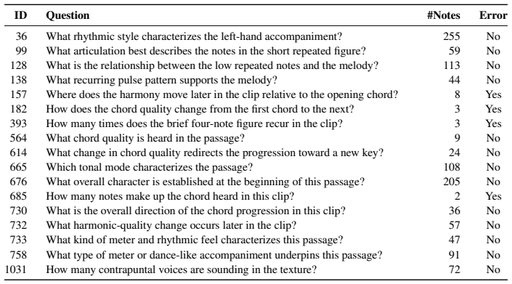
Table 4 : Questions answered incorrectly by GPT 6 Astra with MIDI-text input. The 17 errors correspond to 93.2% accuracy on 250 questions. Question 564 has an incorrect human-selected reference answer rather than a transcription error: the notes C–E♭–G–B form a minor–major seventh chord, not a minor seventh chord.
원문 · CC BY 4.0 · Louis Bradshaw, Irmak Bukey, Daniel Chenyu Lin, John Thickstun, Chris Donahue · PianoBench: Evaluating Musical Perception and Reasoning in Language Models · 원문 그림 인용 · 원본 PDF 21쪽에서 그림 영역을 추출했습니다.논문 정보
- 저자
- Louis Bradshaw, Irmak Bukey, Daniel Chenyu Lin, John Thickstun, Chris Donahue
- 학회·저널
- arXiv · 프리프린트
- 최초 공개일
- 2026년 11월 2일
- 등록일
- 2026년 11월 5일
- 수정일
- 2026년 11월 2일
- 버전
- v1
- arXiv
- 2611.03839
- 분류
- cs.SD · cs.AI · cs.LG
- 원문 이용 조건
- CC BY 4.0
- 제공 범위
- 논문 정보, 해설, 허용된 원문 그림
AI 해설은 논문 원문과 별개의 설명이며 오류가 있을 수 있습니다. 원문과 그림은 각 출처의 이용 조건과 따로 표시된 권리를 따릅니다.
초록
Multimodal language models continue to improve on broad music understanding benchmarks, but which musical features can they perceive and reason about? We investigate this question by introducing PianoBench, a benchmark that tasks language models with reasoning about musical performances across congruent acoustic and symbolic input representations. PianoBench is derived from our new multimodal, training-scale dataset comprising more than 20,000 hours of interleaved transcripts of music and spoken musical commentary from instructional piano videos. Open-weight audio-language models achieve at most 52.8% accuracy on PianoBench, and at best only modestly outperform their accuracy on a no-audio control. In contrast, frontier models using chain of thought achieve up to 93.2% accuracy when provided transcripts of music as text, exposing a gap between perceiving musical features from audio and reasoning about musical events when they are given explicitly. We then test whether mid-training on interleaved musical instruction can improve question answering without chain of thought, raising Qwen 3.5 9B Base's zero-shot accuracy on PianoBench with music transcripts from 42.8% to 56.0% after instruction tuning. These experiments suggest that instructional videos may represent an overlooked source of multimodal supervision for music. Available: https://gclef-cmu.org/pianobench.
원문 인용
Louis Bradshaw, Irmak Bukey, Daniel Chenyu Lin, John Thickstun, Chris Donahue (2026). PianoBench: Evaluating Musical Perception and Reasoning in Language Models. arXiv:2611.03839v1. https://arxiv.org/abs/2611.03839v1
BibTeX
@misc{bradshaw2026pianobench,
  title = {{PianoBench: Evaluating Musical Perception and Reasoning in Language Models}},
  author = {Louis Bradshaw and Irmak Bukey and Daniel Chenyu Lin and John Thickstun and Chris Donahue},
  year = {2026},
  eprint = {2611.03839},
  archivePrefix = {arXiv},
  url = {https://arxiv.org/abs/2611.03839v1}
}