논문 해설
Prophet: Prompting Large Language Models with Complementary Answer Heuristics for Knowledge-based Visual Question Answering
Prophet: 지식 기반 시각 질의응답을 위해 상보적 답변 휴리스틱으로 대규모 언어 모델에 프롬프팅하기
- 연구 문제 외부 지식이 필요한 지식 기반 VQA에서 LLM이 이미지 정보를 충분히 받지 못해 능력을 덜 쓰는 문제를 다룹니다.
- 연구 방법 바닐라 VQA 모델에서 답변 후보와 답변 인지 예시를 얻고, 이를 형식화된 프롬프트에 넣어 동결된 GPT-3가 답을 예측하게 합니다.
- 주요 결과 OK-VQA에서 Prophet은 MCAN 기반 설정으로 61.1을 기록하여 GPT-3만 쓴 PICa의 48.0보다 13.1점 높았습니다.
외부 지식 질문에서 LLM이 덜 쓰이는 문제
지식 기반 VQA는 이미지만으로는 답할 수 없고 외부 지식이 필요한 질문에 답하는 과제입니다. 기존 방법은 명시적 지식베이스에서 지식을 검색하는데, 필요한 지식이 검색되지 않거나 관련 없는 지식이 많이 섞여 성능이 제한됩니다. 이후 방법은 GPT-3 같은 대규모 언어 모델을 암묵적 지식 엔진으로 사용하지만, 입력 텍스트가 이미지의 필요한 시각 정보를 충분히 담지 못해 LLM의 능력을 충분히 끌어내지 못합니다. 특히 PICa 계열은 이미지를 캡션으로 바꾸어 넣기 때문에 캡션에 없는 정보는 LLM이 알 수 없고, 예시 선택도 정답 유사도를 쓸 수 없는 테스트 상황에서는 성능이 낮아집니다. 이 논문은 이 두 한계를 답변 힌트를 프롬프트에 넣는 방식으로 다룹니다.
바닐라 VQA 모델에서 두 종류의 답변 힌트 얻기
Prophet의 첫 단계는 외부 지식 없이 특정 지식 기반 VQA 데이터셋에서 학습한 바닐라 VQA 모델을 사용합니다. 이 모델에서 답변 후보와 답변 인지 예시라는 두 종류의 답변 힌트를 함께 얻습니다. 답변 후보는 상위 K개 답과 신뢰도 점수로 구성되며, 판별형 모델은 답 어휘에 대한 점수 벡터에서 상위 K개를 고르고 생성형 모델은 빔 서치로 상위 K개 답과 누적 점수를 얻습니다. 답변 인지 예시는 융합 특징 공간에서 테스트 입력과 가까운 학습 샘플을 최근접 이웃으로 골라 얻으며, 생성형 모델에서는 답 단어별 특징 그룹의 평균 내적 유사도를 씁니다. 두 힌트는 서로 보완적이어서, 하나는 LLM이 볼 수 있는 후보 답을 제공하고 다른 하나는 비슷한 답을 가진 예시를 제공합니다.
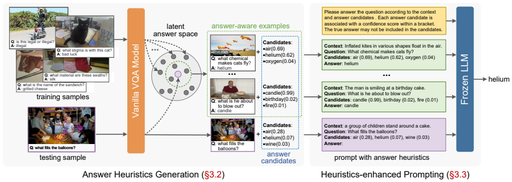
Fig. 2 : Our Prophet framework has two stages: answer heuristics generation and heuristics-enhanced prompting. In the answer heuristics generation stage, a vanilla VQA model trained on specific knowledge-based VQA dataset is employed to generate two types of complementary answer heuristics, i.e., answer candidates and answer-aware examples. In the heuristics-enhanced prompting stage, the answer heuristics, question, and caption are integrated into a formatted prompt to instruct a frozen LLM ( e.g., GPT-3) to predict an answer. As shown in the example, both answer heuristics contribute to the answer of “helium”.
원문 · CC BY 4.0 · Zhou Yu, Xuecheng Ouyang, Zhenwei Shao, Meng Wang, Jun Yu · Prophet: Prompting Large Language Models with Complementary Answer Heuristics for Knowledge-based Visual Question Answering · 원문 그림 인용 · 원본 PDF 3쪽에서 그림 영역을 추출했습니다.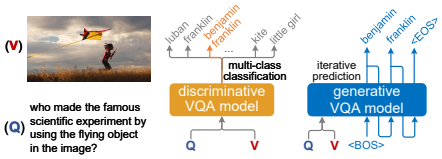
Fig. 3 : Discriminative vs. generative VQA models. Taking an image (V) and a question (Q) as inputs, a typical dis- criminative VQA model performs multi-class classification to predict the most relevant answer (may contain multiple words) from a predefined answer vocabulary, while a typ- ical generative VQA model iteratively predicts one answer word at a time to constitute the final answer.
원문 · CC BY 4.0 · Zhou Yu, Xuecheng Ouyang, Zhenwei Shao, Meng Wang, Jun Yu · Prophet: Prompting Large Language Models with Complementary Answer Heuristics for Knowledge-based Visual Question Answering · 원문 그림 인용 · 원본 PDF 4쪽에서 그림 영역을 추출했습니다.힌트를 넣은 프롬프트와 동결된 LLM 예측
두 번째 단계에서 Prophet은 답변 후보, 답변 인지 예시, 질문, 캡션을 하나의 형식화된 프롬프트로 구성합니다. 기본 구현은 PICa의 파이프라인을 상속하여 캡션을 이미지 텍스트 입력으로 쓰고, 동결된 GPT-3에 프롬프트를 넣어 답을 생성합니다. 예시마다 답변 후보와 신뢰도 점수를 함께 제공하여 LLM이 후보를 더 신뢰할지 판단하도록 합니다. 테스트 입력에서는 답 자리를 비워 두며, 여러 쿼리를 만든 뒤 답의 다수결로 최종 답을 정합니다. 프롬프트 머리말은 후보를 기준으로 답하라고 지시하지만, 후보 밖의 답도 허용합니다. 따라서 Prophet은 fine-tuning 없이 LLM의 few-shot 능력을 사용하는 방식입니다.
데이터셋과 기본 설정의 범위
주요 평가는 OK-VQA와 A-OKVQA에서 이루어졌고, 일반화 실험으로 ScienceQA의 이미지 부분 집합과 TextVQA가 추가되었습니다. OK-VQA 기본 설정에서는 MCAN을 바닐라 VQA 모델로 쓰고, CLIP 기반 격자 특징과 BERT 기반 텍스트 인코더로 개선한 뒤 VQAv2와 Visual Genome에서 사전 학습하고 OK-VQA에서 미세조정합니다. 이 설정에서 답변 후보 K=10, 예시 수 N=16, 쿼리 수 T=5를 기본값으로 사용하며 GPT-3는 text-davinci-002를 온도 0으로 호출합니다. 다른 데이터셋이나 Prophet++ 변형에는 같은 기본값을 그대로 적용하지 않고 각 실험의 설정을 따릅니다.
예를 들어 주요 비교표에서는 OK-VQA와 A-OKVQA에 N=20을, ScienceQA와 TextVQA에 N=7과 N=16을 사용합니다.
절제 실험으로 본 힌트와 예시 선택의 역할
절제 실험에서 답변 후보가 없으면 정확도는 49.63에서 답변 후보 K=1일 때 56.04로 올라가고, K=10에서는 60.84까지 상승합니다. 이 결과는 답변 후보가 Prophet의 성능에 중요한 역할을 한다는 점을 보여 줍니다. 예시 선택 전략에서는 융합 특징 유사도 기반 선택이 무작위나 질문과 이미지 유사도 기반 선택보다 높은 정확도와 힌트 적중률을 보였습니다. 또 예시 수 N과 쿼리 수 T를 늘리면 정확도가 올라가지만 비용도 선형으로 늘어납니다. 같은 VQA 모델을 쓴 비교에서는 프롬프트 기반 방식이 MAVEx의 검색 기반 방식보다 44.97%와 40.28%로 높았습니다. 이 대비는 같은 ViLBERT 기반 바닐라 모델을 쓴 설정에서 얻은 것입니다.
주요 결과와 비교 범위
OK-VQA에서 Prophet은 MCAN 기반 설정으로 61.1을, mPLUG 기반 설정으로 62.5를 기록합니다. 같은 GPT-3만 지식 자원으로 쓰는 PICa의 48.0과 비교하면 13.1점 높습니다. 이 비교는 두 방법 모두 GPT-3를 유일한 지식 자원으로 쓴 조건에서 얻은 것입니다. KAT와 REVIVE는 GPT-3와 외부 지식베이스를 함께 쓰므로 조건이 다릅니다. A-OKVQA에서는 직접 답변 과제에서 Prophet 기반 설정이 MCAN보다 높았고 객관식 과제에서는 별도의 프롬프트 변형을 사용했습니다. ScienceQA와 TextVQA에서도 Prophet(mPLUG)가 비교된 기존 방법보다 높은 결과를 보고합니다.
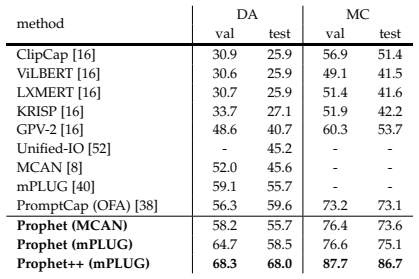
TABLE 5 : Comparisons to the state-of-the-art methods on A-OKVQA. DA and MC refer to the direct-answer and multiple-choice tasks, respectively. For the MC task, we devise a Prophet variant with a slightly different prompt.
원문 · CC BY 4.0 · Zhou Yu, Xuecheng Ouyang, Zhenwei Shao, Meng Wang, Jun Yu · Prophet: Prompting Large Language Models with Complementary Answer Heuristics for Knowledge-based Visual Question Answering · 원문 그림 인용 · 원본 PDF 10쪽에서 그림 영역을 추출했습니다.Prophet++의 확장과 추가 효과
Prophet++는 Prophet의 두 단계에 대형 멀티모달 모델을 넣는 확장입니다. 첫 단계에서는 LMM이 추론 과정을 담은 답변 인지 근거를 생성하여 기존 두 힌트에 세 번째 힌트로 추가합니다. 둘째 단계에서는 LLM 대신 LMM을 사용하여 테스트 이미지를 추가 시각 입력으로 받습니다. 이때 in-context 예시의 이미지는 입력 길이를 줄이기 위해 생략합니다. 절제 결과에서 GPT-4o를 직접 예측에 쓴 경우 46.0이었고, Prophet 방식은 62.9였으며, 근거를 추가한 Prophet++는 63.8, 시각 입력까지 쓴 변형은 64.2를 보고합니다. 이 수치는 이 설정에서의 관찰이며 다른 LMM 전체에 일반화된 결론은 아닙니다.
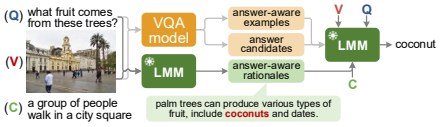
Fig. 4 : The Prophet++ framework additionally introduces large multimodal models (LMMs) in different stages of Prophet. Specifically, the LMM in stage-1 is used to gen- erate a new type of answer heuristic, i.e., the answer-aware rationales while the LMM in stage-2 is used to handle an extra visual input (V), thus providing more comprehensive knowledge to answer the question.
원문 · CC BY 4.0 · Zhou Yu, Xuecheng Ouyang, Zhenwei Shao, Meng Wang, Jun Yu · Prophet: Prompting Large Language Models with Complementary Answer Heuristics for Knowledge-based Visual Question Answering · 원문 그림 인용 · 원본 PDF 6쪽에서 그림 영역을 추출했습니다.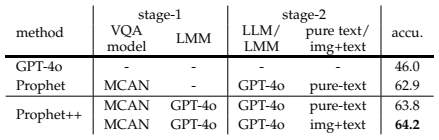
TABLE 3 : Ablation study for Prophet++ on the testing set of OK-VQA. The first split contains the results of direct- prediction and Prophet-based prediction using the same LMM (GPT-4o). The second split contains two Prophet++ variants with different settings. N=16 is used for Prophet and Prophet++.
원문 · CC BY 4.0 · Zhou Yu, Xuecheng Ouyang, Zhenwei Shao, Meng Wang, Jun Yu · Prophet: Prompting Large Language Models with Complementary Answer Heuristics for Knowledge-based Visual Question Answering · 원문 그림 인용 · 원본 PDF 9쪽에서 그림 영역을 추출했습니다.적용 범위와 남은 제약
이 결과는 OK-VQA 기본 설정에서 MCAN과 GPT-3를 조합한 실험과, 명시된 데이터셋 및 모델 설정에서 얻은 것입니다. 답변 후보와 답변 인지 예시의 실험 조건은 원문 표와 각 설정에 따라 다르므로, 한 설정의 결과를 다른 데이터셋이나 다른 LLM으로 그대로 옮길 수 없습니다. 또한 LLM을 여러 번 호출하는 비용은 예시 수와 쿼리 수에 따라 커지며, 저자들은 이 비용을 실험에서 함께 보고합니다. 오류 분석에서도 지식 추론 실패가 가장 큰 비중을 차지하여 지식 획득과 추론이 여전히 병목으로 남아 있음을 시사합니다.
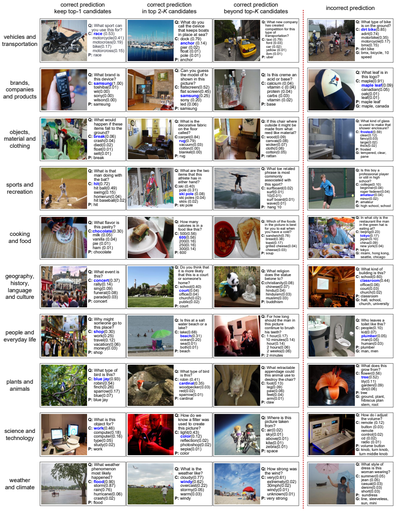
Fig. 7 : Different categories and prediction behaviors. Each row contains four testing samples from a specific knowledge category. The first to the third columns correspond to the correctly answered samples of different prediction behaviors (i.e., keep top-1, in top 2- K, and beyond top-K). The last column contains failure samples.
원문 · CC BY 4.0 · Zhou Yu, Xuecheng Ouyang, Zhenwei Shao, Meng Wang, Jun Yu · Prophet: Prompting Large Language Models with Complementary Answer Heuristics for Knowledge-based Visual Question Answering · 원문 그림 인용 · 원본 PDF 16쪽에서 그림 영역을 추출했습니다.논문 정보
- 저자
- Zhou Yu, Xuecheng Ouyang, Zhenwei Shao, Meng Wang, Jun Yu
- 학회·저널
- arXiv · 프리프린트
- 최초 공개일
- 2023년 3월 3일
- 등록일
- 2026년 11월 6일
- 수정일
- 2025년 4월 29일
- 버전
- v4
- arXiv
- 2303.01903
- DOI
- 10.1109/tpami.2025.3562422
- 분류
- cs.CV · cs.CL · cs.LG
- 원문 이용 조건
- CC BY 4.0
- 제공 범위
- 논문 정보, 해설, 허용된 원문 그림
AI 해설은 논문 원문과 별개의 설명이며 오류가 있을 수 있습니다. 원문과 그림은 각 출처의 이용 조건과 따로 표시된 권리를 따릅니다.
초록
Knowledge-based visual question answering (VQA) requires external knowledge beyond the image to answer the question. Early studies retrieve required knowledge from explicit knowledge bases (KBs), which often introduces irrelevant information to the question, hence restricting the performance of their models. Recent works have resorted to using a powerful large language model (LLM) as an implicit knowledge engine to acquire the necessary knowledge for answering. Despite the encouraging results achieved by these methods, we argue that they have not fully activated the capacity of the \emph{blind} LLM as the provided textual input is insufficient to depict the required visual information to answer the question. In this paper, we present Prophet -- a conceptually simple, flexible, and general framework designed to prompt LLM with answer heuristics for knowledge-based VQA. Specifically, we first train a vanilla VQA model on a specific knowledge-based VQA dataset without external knowledge. After that, we extract two types of complementary answer heuristics from the VQA model: answer candidates and answer-aware examples. The two types of answer heuristics are jointly encoded into a formatted prompt to facilitate the LLM's understanding of both the image and question, thus generating a more accurate answer. By incorporating the state-of-the-art LLM GPT-3, Prophet significantly outperforms existing state-of-the-art methods on four challenging knowledge-based VQA datasets. Prophet is general that can be instantiated with the combinations of different VQA models (i.e., both discriminative and generative ones) and different LLMs (i.e., both commercial and open-source ones). Moreover, Prophet can also be integrated with modern large multimodal models in different stages, which is named Prophet++, to further improve the capabilities on knowledge-based VQA tasks.
원문 인용
Zhou Yu, Xuecheng Ouyang, Zhenwei Shao, Meng Wang, Jun Yu (2023). Prophet: Prompting Large Language Models with Complementary Answer Heuristics for Knowledge-based Visual Question Answering. arXiv:2303.01903v4. https://doi.org/10.1109/tpami.2025.3562422
BibTeX
@article{yu2023prophet,
  title = {{Prophet: Prompting Large Language Models with Complementary Answer Heuristics for Knowledge-based Visual Question Answering}},
  author = {Zhou Yu and Xuecheng Ouyang and Zhenwei Shao and Meng Wang and Jun Yu},
  year = {2023},
  eprint = {2303.01903},
  archivePrefix = {arXiv},
  doi = {10.1109/tpami.2025.3562422},
  url = {https://arxiv.org/abs/2303.01903v4}
}