논문 해설
Axis-LoRA: Probing and Adapting Embedding Models for Personal-Memory Retrieval
Axis-LoRA: 개인 메모리 검색을 위한 임베딩 모델 탐색 및 적응
- 연구 문제 개인 기억을 묻는 질문에서 고정된 임베딩 모델은 시간·장소·인물·사건 축을 잘 구분하지 못해 검색 정답을 놓칩니다.
- 연구 방법 고정된 임베딩 모델의 후반 어텐션 레이어에 축별 LoRA 어댑터 네 개를 붙이고, 질의별 sparsemax 게이트로 축 항의 가중치를 정하는 Axis-LoRA를 제안합니다.
- 주요 결과 세 임베딩 모델과 네 벤치마크 분할의 네 시드 평균 R@10이 +1.28에서 +1.56 pp 개선되며, 일반 검색 평균 변화는 Qwen3-Embedding-0.6B에서 약 −0.50 pp입니다.
개인 기억 검색에서 임베딩이 축 정보를 놓치는 문제
개인 기억을 묻는 질문에 답하려면 검색기가 기억을 시간, 장소, 인물, 사건이라는 축으로 구분해야 합니다. 현재 개인 기억 파이프라인은 대부분 일반 목적의 고정된 밀집 임베딩 모델을 그대로 사용합니다. 이 논문은 이러한 모델이 네 축을 충분히 표현하지 못한다고 봅니다. 예를 들어 기억의 날짜나 장소를 바꾸어도 임베딩이 거의 움직이지 않습니다. 또한 고정된 임베딩 위에 학습한 투영 층을 두어도 빠진 신호를 회복하지 못합니다. 이 문제는 임베딩 출력 이후의 처리가 아니라 모델 내부의 표현 문제로 설정됩니다.
축 값 교체에 대한 임베딩과 검색 반응
논문은 AxisCF라는 합성 축-반사실 코퍼스를 사용해 기억 하나에서 한 축의 값만 바꾼 반사실을 만듭니다. 각 축의 반사실과 원래 기억 사이의 코사인 거리를 측정했을 때, 시간 축은 비축 단어 한 개를 바꾼 기준 하한 수준에 머물렀습니다. 공간, 인물, 사건 축은 이 하한보다 2.6배에서 8.0배 큰 반응을 보였지만 기억 간 평균 거리 µinter의 1%에서 14% 수준에 그쳤습니다. 즉 축 정보가 임베딩에 존재하더라도 코사인 순위를 가를 만한 크기가 아닙니다. 이어서 각 축 값으로 만든 짧은 질의를 사용해 R@10을 측정했을 때, 네 축 모두 낮은 값을 보였고 시간 축은 세 인코더 모두에서 가장 낮았습니다.
이 결과는 축 정보가 고정 임베딩의 코사인 검색에서 충분히 노출되지 않는다는 관찰입니다.
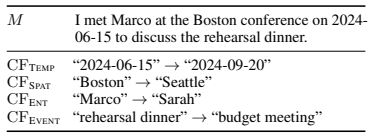
Table 1 : Axis-isolated counterfactual example. Each CFA swaps the value of axis A while keeping the rest of the memory unchanged.
원문 · CC BY 4.0 · Dohoon Kim, Junho Park, Hyunwoong Bae, Seyoon Kim, Taesup Moon · Axis-LoRA: Probing and Adapting Embedding Models for Personal-Memory Retrieval · 원문 그림 인용 · 원본 PDF 3쪽에서 그림 영역을 추출했습니다.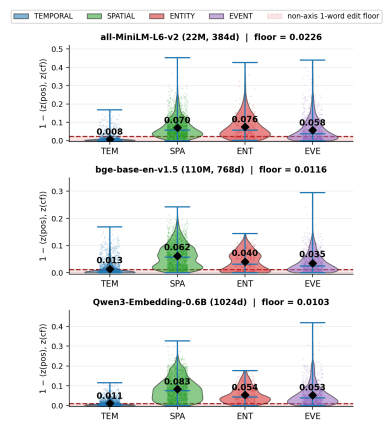
Figure 2 : Axis-counterfactual cosine distance per axis across three embedding models. Violins show the dis- tribution over the evaluation pool; diamonds mark the per-axis mean. The red dashed line is the per-model non- axis 1-word edit floor. TEMPORAL sits at this floor on every model, while SPATIAL, ENTITY , and EVENT clear the floor but remain small in absolute magnitude.
원문 · CC BY 4.0 · Dohoon Kim, Junho Park, Hyunwoong Bae, Seyoon Kim, Taesup Moon · Axis-LoRA: Probing and Adapting Embedding Models for Personal-Memory Retrieval · 원문 그림 인용 · 원본 PDF 3쪽에서 그림 영역을 추출했습니다.외부 투영과 어텐션 헤드 분포 진단
논문은 두 가지 진단으로 축 신호의 위치를 좁힙니다. 첫째, 축별 2층 MLP 투영을 InfoNCE로 학습하면 시간 축 R@10은 세 인코더에서 8.9에서 14.4 pp 올라가지만, 절대 R@10은 0.15에서 0.18 수준에 머뭅니다. 공간, 인물, 사건 축은 효과가 일정하지 않아 일부는 최대 8.1 pp 낮아집니다. 따라서 출력 쪽 투영만으로는 격차를 메우지 못한다고 해석됩니다. 둘째, Head-spectrum probe는 레이어와 어텐션 헤드별로 축 값을 바꿨을 때 풀링된 헤드 출력이 얼마나 변하는지 측정합니다. 축 반응은 후반 레이어에 모이며, 50% 반응을 덮는 헤드 비율은 시간 축이 가장 넓고 공간과 인물 축이 상대적으로 좁게 나타납니다.
이 결과는 각 축이 서로 다른 헤드 분포를 가진다는 관찰이며, 그 해석을 통해 축별 내부 적응이 필요하다는 설계 근거가 됩니다.
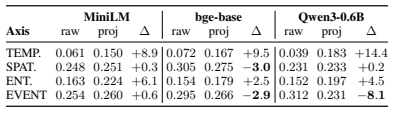
Table 3 : Axis-anchored retrieval R@10 on the eval- uation set: raw cosine vs. projected (per-axis MLP trained with InfoNCE), with ∆ = projected − raw. TEMPORAL gets the largest projection lift, while non- TEMPORAL cells stay flat or decrease.
원문 · CC BY 4.0 · Dohoon Kim, Junho Park, Hyunwoong Bae, Seyoon Kim, Taesup Moon · Axis-LoRA: Probing and Adapting Embedding Models for Personal-Memory Retrieval · 원문 그림 인용 · 원본 PDF 4쪽에서 그림 영역을 추출했습니다.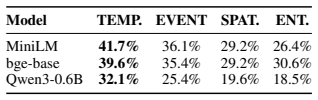
Table 4 : Fraction of attention heads needed to cover 50% of per-axis single-edit response. A small fraction means the axis is concentrated in few heads, a large fraction that it is spread across many; the largest per model (most diffuse axis) is bolded. Within each model, TEMPORAL is the most diffuse, EVENT next, and SPATIAL and ENTITY are the most concentrated.
원문 · CC BY 4.0 · Dohoon Kim, Junho Park, Hyunwoong Bae, Seyoon Kim, Taesup Moon · Axis-LoRA: Probing and Adapting Embedding Models for Personal-Memory Retrieval · 원문 그림 인용 · 원본 PDF 5쪽에서 그림 영역을 추출했습니다.Axis-LoRA의 구조와 질의별 게이트
Axis-LoRA는 고정된 기반 임베딩 모델을 유지한 채 그 내부 마지막 20% 어텐션 레이어의 q_proj와 v_proj에 축별 LoRA 어댑터 네 개를 붙입니다. 어댑터들은 파라미터를 공유하지 않으므로 각 축이 독립적인 변형 방향을 학습할 수 있습니다. 점수는 기반 임베딩 사이의 정규화된 내적에 축 항의 가중합을 더한 형태입니다. 축 항은 질의별 게이트 가중치와 축별 어댑터가 만든 질의·기억 표현의 내적으로 계산되며, 혼합 가중치 α는 0.25로 설정됩니다. 게이트는 기반 임베딩 출력을 입력으로 받는 한 은닉층 MLP에서 시작해 sparsemax를 적용합니다. sparsemax는 softmax와 달리 관련 없는 축에 정확히 0을 주므로, 사용하지 않는 어댑터가 점수에 잡음을 더하지 않습니다.
게이트의 온도는 학습 중 2.0에서 0.5로 줄어듭니다. 이 설계는 두 진단의 결과에 따라 외부 투영이 아니라 모델 내부를 바꾸고, 축마다 별도 어댑터를 두며, 후반 레이어에 적용하도록 정해졌습니다.
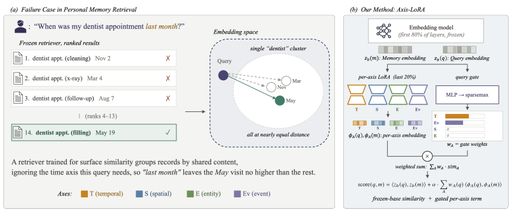
Figure 1 : Overview.(a) Failure case in personal-memory retrieval.A frozen retriever groups same-content memories into a single embedding cluster, where shared content tokens place candidates at near-equal cosine distance. An axis cue in the query (here, the time axis) does not separate the gold from content-similar distractors that mismatch on the axis, so the gold falls below them in the ranked list.(b) Axis-LoRA.Four axis-conditional LoRA adapters (T/S/E/Ev) attach to the last 20% of layers of the frozen embedding model and produce per-axis representations ϕA(q), ϕA(m). A per-query gate (MLP → sparsemax) outputs routing weights wA with exact zeros on inactive axes. The final score is the frozen-base similarity plus a gated per-axis term.
원문 · CC BY 4.0 · Dohoon Kim, Junho Park, Hyunwoong Bae, Seyoon Kim, Taesup Moon · Axis-LoRA: Probing and Adapting Embedding Models for Personal-Memory Retrieval · 원문 그림 인용 · 원본 PDF 2쪽에서 그림 영역을 추출했습니다.
Table 14 : 4-seed mean ±std R@10 on bge-base-en- v1.5. The two gate variants give comparable 4-bench means (difference 0.24 pp, within per-bench seed vari- ance) with different per-bench trade-offs: sparsemax is slightly stronger on hard-distractor splits (LME, ATM- H), softmax+axis-CE is slightly stronger on the longer- context splits (ATM-N, LoCoMo).
원문 · CC BY 4.0 · Dohoon Kim, Junho Park, Hyunwoong Bae, Seyoon Kim, Taesup Moon · Axis-LoRA: Probing and Adapting Embedding Models for Personal-Memory Retrieval · 원문 그림 인용 · 원본 PDF 16쪽에서 그림 영역을 추출했습니다.AxisCF 대조 학습과 KD 앵커
학습은 네 어댑터와 게이트 MLP를 함께 갱신하며, 기반 임베딩 모델은 고정됩니다. 학습 데이터는 4,196개의 AxisCF 삼중항입니다. 각 삼중항은 양성 기억, 양성 기억에서 가져온 앵커 질의, 그리고 한 개 이상의 축별 단일 편집 반사실로 구성됩니다. 배치의 기억 풀에는 모든 양성과 반사실이 들어가므로 같은 기억의 반사실은 해당 질의의 어려운 음성이 됩니다. 손실은 이 풀에 대한 InfoNCE 항과 MS MARCO 일부에 대한 지식 증류 앵커 항을 합칩니다. 앵커 항은 각 어댑터의 출력을 기반 모델의 정규화된 출력 가까이 묶어, 축 항이 일반 텍스트에서 잡음을 만들지 않도록 합니다. 이 앵커는 AxisCF 대조 손실과 별도로 작동하며, 어댑터가 AxisCF에서 축별로 특화되는 것을 막지 않도록 MS MARCO 입력에만 적용됩니다.
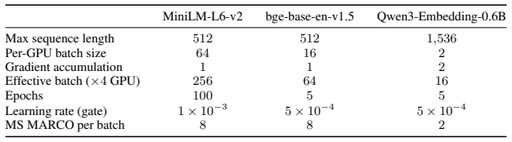
Table 22 : Per-architecture optimization hyperparameters. Shared method hyperparameters are listed in the surround- ing text.
원문 · CC BY 4.0 · Dohoon Kim, Junho Park, Hyunwoong Bae, Seyoon Kim, Taesup Moon · Axis-LoRA: Probing and Adapting Embedding Models for Personal-Memory Retrieval · 원문 그림 인용 · 원본 PDF 21쪽에서 그림 영역을 추출했습니다.네 분할의 R@10 개선
주 실험은 MiniLM-L6-v2, bge-base-en-v1.5, Qwen3-Embedding-0.6B 세 인코더에서 LongMemEval, ATM-Bench의 Normal과 Hard, LoCoMo 네 분할을 평가합니다. 네 분할 평균 R@10은 MiniLM에서 0.4608에서 0.4765로, bge-base에서 0.5635에서 0.5773으로, Qwen3-Embedding-0.6B에서 0.5892에서 0.6020으로 올라갑니다. 이를 pp로 나타내면 각각 +1.56, +1.38, +1.28입니다. 세 인코더 모두에서 평균 개선이 나타나지만 모든 분할에서 개선되는 것은 아닙니다. Qwen3-0.6B의 ATM-Normal과 bge-base의 LoCoMo는 각각 −1.24 pp와 −0.66 pp로 낮아졌습니다.
가장 큰 분할별 개선은 Qwen3-0.6B의 ATM-Hard에서 +3.75 pp이며, 이 분할은 질의당 여러 정답 기억을 가진 다중 증거 질의입니다. 질의 단위 부트스트랩 신뢰구간은 네 분할 평균에서 세 인코더 모두 0을 포함하지 않습니다. ATM-Hard는 31개 질의라 단독 구간은 0을 포함하지만, 세 인코더를 함께 묶으면 +2.86 pp의 구간이 0을 제외합니다. 이 결과는 네 벤치마크, 세 인코더, 네 시드의 평균에 대한 관찰입니다.
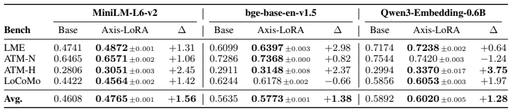
Table 5 : R@10 across three encoders on LongMemEval (LME), ATM-Bench Normal (ATM-N), ATM-Bench Hard (ATM-H, the multi-evidence split), and LoCoMo. Each encoder block reportsBase(the frozen embedding model with no adaptation, deterministic across seeds) andAxis-LoRA(mean ±std over 4 random seeds), with ∆ the per-benchmark gain in pp on the seed mean; the bottom row averages across the four benchmarks. Axis-LoRA delivers +1.28 to +1.56 pp 4-bench mean R@10 across all three encoders, with the largest per-bench gain+3.75 pp on ATM-Hard (Qwen3-0.6B).
원문 · CC BY 4.0 · Dohoon Kim, Junho Park, Hyunwoong Bae, Seyoon Kim, Taesup Moon · Axis-LoRA: Probing and Adapting Embedding Models for Personal-Memory Retrieval · 원문 그림 인용 · 원본 PDF 7쪽에서 그림 영역을 추출했습니다.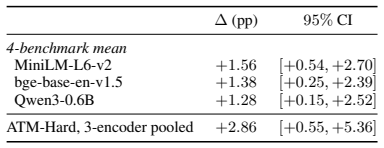
Table 6 : Query-level bootstrap 95% confidence inter- vals for the R@10 gains of Table 5 (20k resamples of per-query deltas, averaged over 4 seeds). All intervals exclude zero. ATM-Hard (n=31) is pooled across the three encoders. Per-split intervals are in Appendix F.2.
원문 · CC BY 4.0 · Dohoon Kim, Junho Park, Hyunwoong Bae, Seyoon Kim, Taesup Moon · Axis-LoRA: Probing and Adapting Embedding Models for Personal-Memory Retrieval · 원문 그림 인용 · 원본 PDF 7쪽에서 그림 영역을 추출했습니다.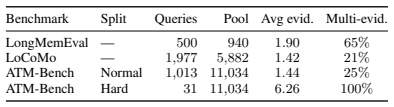
Table 21 : Per-split statistics.Poolis the memory pool the retriever ranks over.Avg evid.is the mean number of gold supporting memories per query;Multi-evid.is the fraction of queries with more than one gold memory.
원문 · CC BY 4.0 · Dohoon Kim, Junho Park, Hyunwoong Bae, Seyoon Kim, Taesup Moon · Axis-LoRA: Probing and Adapting Embedding Models for Personal-Memory Retrieval · 원문 그림 인용 · 원본 PDF 19쪽에서 그림 영역을 추출했습니다.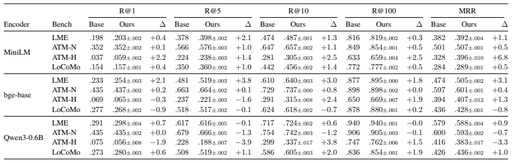
Table 24 : Per-metric breakdown of the main 4-benchmark result (4-seed mean±std, α= 0.25 ). ∆ = Ours − Base in pp.
원문 · CC BY 4.0 · Dohoon Kim, Junho Park, Hyunwoong Bae, Seyoon Kim, Taesup Moon · Axis-LoRA: Probing and Adapting Embedding Models for Personal-Memory Retrieval · 원문 그림 인용 · 원본 PDF 22쪽에서 그림 영역을 추출했습니다.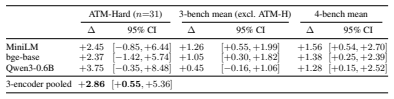
Table 25 : Query-level bootstrap 95% CIs for R@10 gains (pp). At n=31 no single ATM-Hard interval ex- cludes zero, reflecting the sample size; the gain is posi- tive for all three encoders and significant when pooled across them.
원문 · CC BY 4.0 · Dohoon Kim, Junho Park, Hyunwoong Bae, Seyoon Kim, Taesup Moon · Axis-LoRA: Probing and Adapting Embedding Models for Personal-Memory Retrieval · 원문 그림 인용 · 원본 PDF 22쪽에서 그림 영역을 추출했습니다.
Table 26 : Per-query anatomy of the two regressing cells (4-seed averages). “Unchanged” = same top-10 hit outcome under Base and Axis-LoRA; “wins/losses” = golds that newly enter / drop out of the top-10 per seed; ranks are medians before→after.
원문 · CC BY 4.0 · Dohoon Kim, Junho Park, Hyunwoong Bae, Seyoon Kim, Taesup Moon · Axis-LoRA: Probing and Adapting Embedding Models for Personal-Memory Retrieval · 원문 그림 인용 · 원본 PDF 22쪽에서 그림 영역을 추출했습니다.일반 검색 능력 보존
축 특화가 일반 검색 능력을 해치는지 확인하기 위해 BEIR 6개 과제의 nDCG@10을 측정했습니다. Qwen3-Embedding-0.6B에서 기반 모델의 평균은 0.5449이고 Axis-LoRA의 평균은 0.5399로, 평균 변화는 약 −0.50 pp입니다. 과제별로는 TRECCOVID가 가장 큰 하락을 보입니다. 같은 평가를 MiniLM과 bge-base에도 적용하면 MiniLM은 −1.10 pp, bge-base는 −0.02 pp입니다. 이 값들은 각 인코더에서 정해진 쿼리 접두어와 같은 짧은 평가 설정으로 얻은 것입니다. 따라서 이 결과는 BEIR 6개 과제와 짧은 최대 길이 설정에서 측정된 보존 정도로 읽어야 하며, 이 수치에서 모든 일반 검색 과제가 보존된다고 일반화할 수는 없습니다.

Table 7 : General retrieval on MTEB BEIR-6 (nDCG@10) with Qwen3-Embedding-0.6B. Axis- LoRA preserves general retrieval competence (mean ∆ =−0.50pp).
원문 · CC BY 4.0 · Dohoon Kim, Junho Park, Hyunwoong Bae, Seyoon Kim, Taesup Moon · Axis-LoRA: Probing and Adapting Embedding Models for Personal-Memory Retrieval · 원문 그림 인용 · 원본 PDF 7쪽에서 그림 영역을 추출했습니다.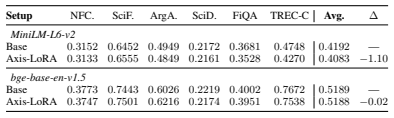
Table 23 : General retrieval (MTEB BEIR-6, nDCG@10) on MiniLM-L6-v2 and bge-base-en-v1.5. The two BERT-style embedding models show different preservation: bge-base near-perfect ( −0.02 pp) and MiniLM mildly degraded (−1.10pp).
원문 · CC BY 4.0 · Dohoon Kim, Junho Park, Hyunwoong Bae, Seyoon Kim, Taesup Moon · Axis-LoRA: Probing and Adapting Embedding Models for Personal-Memory Retrieval · 원문 그림 인용 · 원본 PDF 21쪽에서 그림 영역을 추출했습니다.설계 변형과 구성요소 기여
절제 실험은 Qwen3-Embedding-0.6B에서 네 시드 평균과 결정적 기준선을 비교합니다. 기반 모델의 평균 R@10은 0.589입니다. 축 프롬프트는 0.596으로 약간 올리고, TF-PCA는 0.583, MLP+InfoNCE는 0.592로 기반 모델에 가깝습니다. 이 결과는 출력 쪽 처리로는 큰 개선이 나타나지 않는다는 점을 보여 줍니다. 공유 trunk LoRA는 네 축을 하나의 LoRA로 학습한 뒤 축별 출력 헤드로 나누며, 평균 0.493으로 기반 모델보다 9.6 pp 낮습니다. 축별 분기를 sparsemax 게이트와 함께 둔 Axis-LoRA는 0.602로, 공유 trunk보다 10.9 pp 높습니다.
구성요소 제거 실험에서는 AxisCF 대신 MS MARCO 음성을 쓰면 평균이 0.593으로 떨어지고, KD 앵커를 제거하면 0.588로 떨어집니다. 게이트를 균일 혼합으로 바꾸면 0.599가 됩니다. 이 결과들은 각 요소를 유지했을 때 평균이 높다는 관찰이며, 모든 요소가 같은 크기로 필수라는 인과 증명은 아닙니다.
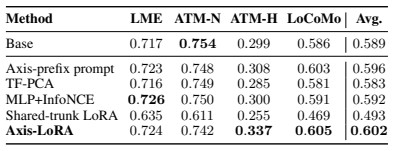
Table 8 : Design-variant ablation (R@10 per bench- mark). Rows progress from no axis-aware treatment (Base) through axis-aware prompting, training-free and trained external projections, inside-model shared-trunk LoRA, and full Axis-LoRA. MLP+InfoNCE, Shared- trunk LoRA, and Axis-LoRA are 4-seed means; other rows are deterministic. Per-cell stds in Appendix D.5.
원문 · CC BY 4.0 · Dohoon Kim, Junho Park, Hyunwoong Bae, Seyoon Kim, Taesup Moon · Axis-LoRA: Probing and Adapting Embedding Models for Personal-Memory Retrieval · 원문 그림 인용 · 원본 PDF 8쪽에서 그림 영역을 추출했습니다.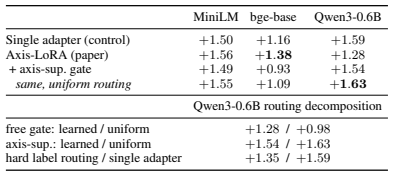
Table 15 : Gate analysis, ∆ 4-benchmark mean R@10 (pp) over Base, 4-seed means.Top:single-adapter control vs. Axis-LoRA vs. the axis-supervised gate (the loss of Table 14 at λgate=0.05 with sparsemax retained), with the supervised branches also read out under uniform routing.Bottom:routing decomposition on Qwen3-0.6B.
원문 · CC BY 4.0 · Dohoon Kim, Junho Park, Hyunwoong Bae, Seyoon Kim, Taesup Moon · Axis-LoRA: Probing and Adapting Embedding Models for Personal-Memory Retrieval · 원문 그림 인용 · 원본 PDF 17쪽에서 그림 영역을 추출했습니다.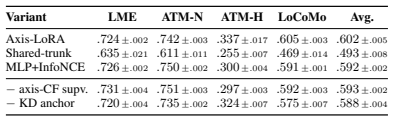
Table 18 : 4-seed mean±std for the trained rows of Ta- bles 8 and 9.
원문 · CC BY 4.0 · Dohoon Kim, Junho Park, Hyunwoong Bae, Seyoon Kim, Taesup Moon · Axis-LoRA: Probing and Adapting Embedding Models for Personal-Memory Retrieval · 원문 그림 인용 · 원본 PDF 18쪽에서 그림 영역을 추출했습니다.범위와 한계
논문은 몇 가지 한계를 명시합니다. 네 축은 벤치마크 주석 스키마에 맞춰 정의되었으므로 임상이나 법률처럼 다른 도메인에는 별도의 축 스키마와 반사실 구성이 필요합니다. AxisCF의 반사실은 명시적인 축 값을 바꾸며, 상대적 시간 표현, 모호한 장소, 여러 개체가 얽힌 사건 같은 암묵적 단서는 충분히 포함하지 않습니다. 또한 Axis-LoRA는 단순한 축별 기준선으로 설명되며, 혼합 전문가 게이트나 더 강한 내부 감독, 검색 목적 함수와의 공동 학습은 향후 과제로 남습니다. 개인별 개인화로의 확장도 아직 검증되지 않았습니다. 이 한계들은 본문의 실험 범위를 정하며, 여기서 제시한 개선은 명시된 벤치마크와 합성 학습 데이터의 조건에서 얻은 결과입니다.
논문 정보
- 저자
- Dohoon Kim, Junho Park, Hyunwoong Bae, Seyoon Kim, Taesup Moon
- 학회·저널
- arXiv · 프리프린트
- 최초 공개일
- 2026년 11월 5일
- 등록일
- 2026년 11월 6일
- 수정일
- 2026년 11월 5일
- 버전
- v1
- arXiv
- 2611.07820
- 분류
- cs.CL · cs.AI
- 원문 이용 조건
- CC BY 4.0
- 제공 범위
- 논문 정보, 해설, 허용된 원문 그림
AI 해설은 논문 원문과 별개의 설명이며 오류가 있을 수 있습니다. 원문과 그림은 각 출처의 이용 조건과 따로 표시된 권리를 따릅니다.
초록
As LLMs are increasingly asked questions about a user's personal experiences, retrieval must distinguish memories by time, place, person, and event. Current personal-memory pipelines rely on frozen dense embedding models to embed memories for retrieval, but we find that these models do not capture the four axes well. Swapping a memory's date or place barely shifts its embedding, and a trained projection on top of the frozen embedding does not recover the missing signal. The problem lives inside the model, where each axis is encoded by a distinct attention-head pattern. Guided by these findings, we propose Axis-LoRA, a per-axis adapter that places four LoRA branches inside the embedding model and combines them via a per-query gate. Across three standard embedding models evaluated on LongMemEval, ATM-Bench, and LoCoMo, Axis-LoRA improves 4-benchmark mean R@10 by $+1.28$ to $+1.56$~pp while training only a small fraction of the base parameters on a small axis-counterfactual training set. Code is available at https://github.com/dohoonkim-ai/axis-lora.
원문 인용
Dohoon Kim, Junho Park, Hyunwoong Bae, Seyoon Kim, Taesup Moon (2026). Axis-LoRA: Probing and Adapting Embedding Models for Personal-Memory Retrieval. arXiv:2611.07820v1. https://arxiv.org/abs/2611.07820v1
BibTeX
@misc{kim2026axis,
  title = {{Axis-LoRA: Probing and Adapting Embedding Models for Personal-Memory Retrieval}},
  author = {Dohoon Kim and Junho Park and Hyunwoong Bae and Seyoon Kim and Taesup Moon},
  year = {2026},
  eprint = {2611.07820},
  archivePrefix = {arXiv},
  url = {https://arxiv.org/abs/2611.07820v1}
}