논문 해설
FedAUX: Leveraging Unlabeled Auxiliary Data in Federated Learning
FedAUX: 연합 학습에서 레이블이 없는 보조 데이터 활용하기
- 연구 문제 비라벨 보조 데이터를 활용하면 non-iid 환경에서 연합 증류와 중앙집중 학습 사이의 성능 격차를 줄일 수 있는지 검증합니다.
- 연구 방법 FEDAUX는 서버 측 자기지도 pre-training과 클라이언트 측 차분 프라이버시 확신도 점수를 결합하고, 이 점수로 클라이언트 예측을 가중 앙상블 증류합니다.
- 주요 결과 CIFAR-10 ResNet8(n=80, α=0.01)에서 최대 정확도가 FEDDF의 18.2%에서 FEDAUX의 78.1%로 보고되었고, 이질적 설정에서 기준 방법을 크게 앞섭니다.
연합 증류의 성능 격차와 보조 데이터의 역할
연합학습(FL)은 클라이언트가 데이터를 서버로 옮기지 않고 함께 모델을 학습하는 방식입니다. 기존 파라미터 평균 방식은 모든 클라이언트가 같은 구조의 모델을 가져야 하지만, 연합 증류(FD)는 클라이언트가 서로 다른 구조의 모델을 학습하고 비라벨 보조 데이터에 대한 예측만 주고받아 학생 모델로 증류합니다. 다만 FD도 클라이언트 데이터가 non-iid로 분포하면 성능이 중앙집중 학습에 못 미치고 빠르게 떨어집니다. FEDAUX는 서버가 가진 비라벨 보조 데이터를 더 많이 활용하여 이 격차를 줄이는 것을 목표로 합니다. 저자들은 서버가 클라이언트 분포와 대략 맞는 비라벨 보조 데이터에 접근할 수 있다고 가정합니다.
FEDAUX의 두 가지 변경: pre-training과 확신도 가중 증류
FEDAUX는 FD 학습 절차를 두 방향으로 바꿉니다. 첫째, 서버가 보조 데이터로 특징 추출기를 자기지도 방식(예: 대조 표현 학습)으로 사전학습하여 클라이언트 초기화에 씁니다. 둘째, 각 클라이언트는 고정된 특징 추출기 위에서 로지스틱 점수 모델을 학습합니다. 이 모델은 로컬 데이터 Di와 보조 데이터의 음성 집합 D− 를 구분하도록 정규화된 경험적 위험 최소화 문제를 풀어 얻어지며, 그 결과로 보조 데이터 각 점에 대한 확신도 점수 si(x)가 계산됩니다. 서버는 이 점수로 클라이언트 예측을 가중 평균(σ(Σ si(x) fi(x) / Σ si(x)))하여 학생 모델을 증류합니다. 균등 평균을 쓰는 FEDDF와 비교하면 가중치만 확신도로 바뀝니다.
점수 공유에 따른 프라이버시 손실은 점수 모델을 민감도 기반 가우시안 노이즈로 가린 (ε,δ)-차분 프라이버시 메커니즘으로 제한합니다.
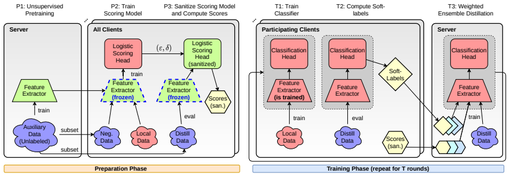
Figure 1 . Training procedure of FEDAUX. Preparation phase: P1) The unlabeled auxiliary data is used to pre-train a feature extractor (e.g. using contrastive representation learning). P2) The feature-extractor is sent to the clients, where it is used to initialize the client models. Based on extracted features, a logistic scoring head is trained to distinguish local client data from a subset of the auxiliary data. P3) The trained scoring head is sanitized using a (ε,δ )-differentially private mechanism and then used to compute certainty scores on the distillation data. Training Phase: T1) In each communication round, a subset of the client population is selected for training. Each selected client downloads a model initialization from the server, and then updates the full modelfi (feature extractor & scoring head) using their private local data. T2) The locally trained classifier and scoring modelsfi andsi are sent to the server, where they are combined into a weighted ensemble. T3) Using the unlabeled auxiliary data and the weighted ensemble as a teacher, the server distills a student model which is used as the initialization point for the next round of Federated training. *Note that in practice we perform computation of soft-labels and scores at the server to save client resources.
원문 · CC BY 4.0 · Felix Sattler, Tim Korjakow, Roman Rischke, Wojciech Samek · FedAUX: Leveraging Unlabeled Auxiliary Data in Federated Learning · 원문 그림 인용 · 원본 PDF 2쪽에서 그림 영역을 추출했습니다.
Figure 2 . Weighted Ensemble Distillation illustrated in a toy example on the Iris data set (data points are projected to their two principal components). Three Federated Learning clients hold disjoint non-iid subsets of the training data. Panels 1-3: Predictions made by linear classifiers trained on the data of each client. Labels and predictions are color-coded, client certainty (measured via Gaussian KDE) is visualized via the alpha-channel. The mean of client predictions (panel 4) only poorly captures the distribution of training data. In contrast, the certainty-weighted mean of client predictions (panel 5) achieves much higher accuracy.
원문 · CC BY 4.0 · Felix Sattler, Tim Korjakow, Roman Rischke, Wojciech Samek · FedAUX: Leveraging Unlabeled Auxiliary Data in Federated Learning · 원문 그림 인용 · 원본 PDF 4쪽에서 그림 영역을 추출했습니다.실험 설정과 비교 대상
실험은 이미지 분류에서 ResNet-8, MobileNetv2, ShuffleNet 계열과 CIFAR-10, CIFAR-100 등을 사용하고, 텍스트 분류에서는 Tiny-BERT를 AG-NEWS와 Multilingual Amazon Reviews Corpus에 적용합니다. 보조 데이터로는 STL-10, CIFAR-100, SVHN 및 ImageNet의 하위 집합을 사용하며, 이미지 실험에서 80%는 증류 데이터, 20%는 음성 데이터로 나눕니다. 클라이언트 데이터는 Dirichlet 분포의 파라미터 α로 분할하고, α는 100.0에서 0.01까지 바꿉니다. 비교 대상은 FEDAVG, FEDPROX, FEDDF, FEDBE이며 pre-training 특징 추출기를 쓴 +P 변형도 함께 보고합니다.
기본 프라이버시 설정은 λ=0.1, ε=0.1, δ=1e-5입니다.
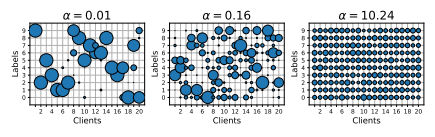
Figure 6 . Illustration of the Dirichlet data splitting strategy we use throughout the paper, exemplary for a Federated Learning set- ting with 20 Clients and 10 different classes. Marker size indicates the number of samples held by one client for each particular class. Lower values of α lead to more heterogeneous distributions of client data. Figure adapted from (Lin et al., 2020).
원문 · CC BY 4.0 · Felix Sattler, Tim Korjakow, Roman Rischke, Wojciech Samek · FedAUX: Leveraging Unlabeled Auxiliary Data in Federated Learning · 원문 그림 인용 · 원본 PDF 8쪽에서 그림 영역을 추출했습니다.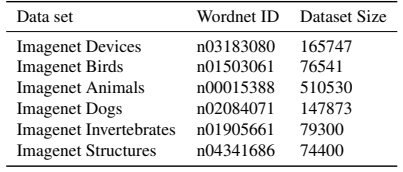
Table 6 . Auxiliary data sets used in this study and their defining Wordnet IDs and data sets sizes.
원문 · CC BY 4.0 · Felix Sattler, Tim Korjakow, Roman Rischke, Wojciech Samek · FedAUX: Leveraging Unlabeled Auxiliary Data in Federated Learning · 원문 그림 인용 · 원본 PDF 17쪽에서 그림 영역을 추출했습니다.이미지와 텍스트 분류의 주요 비교 결과
CIFAR-10에서 ResNet8, n=80, α=0.01 설정의 최대 정확도는 FEDDF의 18.2%에서 FEDAUX의 78.1%로 보고됩니다. Table 1에서 20개 클라이언트가 ResNet-8을 학습하는 α=0.01 설정에서는 FEDAUX가 다른 기준 방법보다 최대 29% 높은 정확도를 보였다고 보고됩니다. α=100.0의 독립 동질 설정에서는 FEDAUX가 FEDAVG+P, FEDPROX+P와 대체로 비슷하며 최대 격차는 0.8%입니다. 텍스트 실험에서 FEDAUX는 AG News와 Amazon의 이질적 설정(α=0.01)에서 FEDAVG+P, FEDDF+P보다 높은 성능을 보였고, 한 라운드 뒤 최종 정확도의 95%에 도달했습니다.
이 결과는 여러 이질성 수준과 특정 모델·데이터 조건에서 얻은 것입니다.
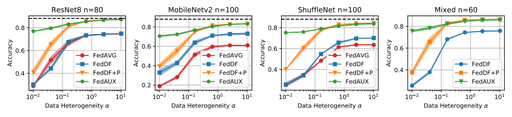
Figure 3 . Evaluation on different neural networks and client population sizes n. Accuracy achieved after T = 100 communication rounds by different Federated Distillation methods at different levels of data heterogeneityα. STL-10 is used as auxiliary data set. In the ”Mixed” setting one third of the client population each trains on ResNet8, MobileNetv2 and Shufflenet respectively. Black dashed line indicates centralized training performance.
원문 · CC BY 4.0 · Felix Sattler, Tim Korjakow, Roman Rischke, Wojciech Samek · FedAUX: Leveraging Unlabeled Auxiliary Data in Federated Learning · 원문 그림 인용 · 원본 PDF 6쪽에서 그림 영역을 추출했습니다.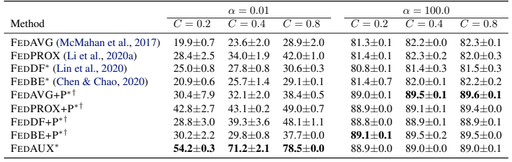
Table 1 . Maximum accuracy achieved by FEDAUX and other baseline FL methods afterT = 100 communication rounds, at different participation ratesC and levels of data heterogeneityα. 20 Clients training ResNet-8 on CIFAR-10. Auxiliary data used is STL10. ∗Methods assume availability of auxiliary data.
원문 · CC BY 4.0 · Felix Sattler, Tim Korjakow, Roman Rischke, Wojciech Samek · FedAUX: Leveraging Unlabeled Auxiliary Data in Federated Learning · 원문 그림 인용 · 원본 PDF 7쪽에서 그림 영역을 추출했습니다.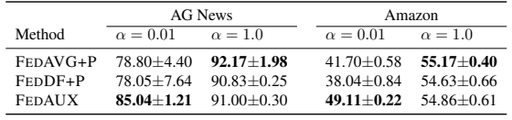
Table 7 . NLP Benchmarks of different FL methods. Maximum accuracy achieved afterT = 20 communication rounds at participation- rateC = 100%.
원문 · CC BY 4.0 · Felix Sattler, Tim Korjakow, Roman Rischke, Wojciech Samek · FedAUX: Leveraging Unlabeled Auxiliary Data in Federated Learning · 원문 그림 인용 · 원본 PDF 19쪽에서 그림 영역을 추출했습니다.적용 범위와 한계
Table 3의 one-shot 설정에서 FEDAUX는 모든 데이터 이질성 수준 α에서 기준 방법을 능가한다고 보고됩니다. 이 결과는 T=1, C=100%, 클라이언트당 40 로컬 에폭이라는 조건의 결과입니다. 프라이버시 분석에서 ε와 δ를 보수적으로 설정하면 정확도 저하가 작았지만, 원문은 더 강한 프라이버시와 성능 사이의 정량적 절충이 남는다고 설명합니다. 보조 데이터의 유사성과 효과가 항상 같은 방향으로 움직이지 않는다는 점도 보고됩니다. 또한 저자들은 이 방법이 서버에 비라벨 보조 데이터가 있다는 가정 위에서 작동한다고 밝히며, 이 가정이 강한 전제임을 인정합니다.
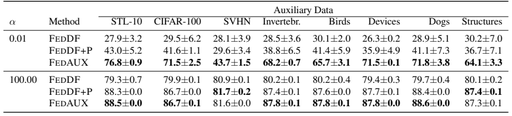
Table 2 . Maximum accuracy achieved by FEDAUX and other baseline FL methods after 100 communication rounds, when different sets of unlabeled auxiliary data are used for pre-training and/ or distillation. 40 Clients training ResNet-8 on CIFAR-10 atC = 40%.
원문 · CC BY 4.0 · Felix Sattler, Tim Korjakow, Roman Rischke, Wojciech Samek · FedAUX: Leveraging Unlabeled Auxiliary Data in Federated Learning · 원문 그림 인용 · 원본 PDF 7쪽에서 그림 영역을 추출했습니다.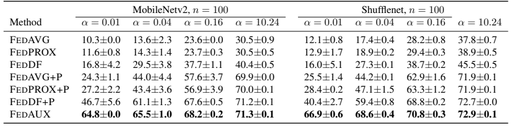
Table 3 . One-shot performance of different FL methods. Maximum accuracy achieved after T = 1 communication rounds at participation-rateC = 100%. Each client trains forE = 40 local epochs.
원문 · CC BY 4.0 · Felix Sattler, Tim Korjakow, Roman Rischke, Wojciech Samek · FedAUX: Leveraging Unlabeled Auxiliary Data in Federated Learning · 원문 그림 인용 · 원본 PDF 7쪽에서 그림 영역을 추출했습니다.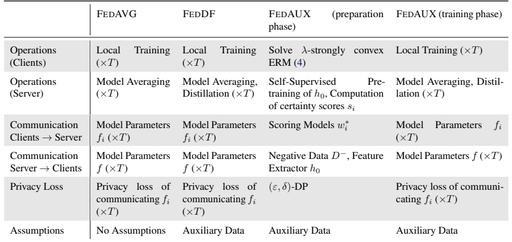
Table 4 . Qualitative Comparison: Complexity, communication overhead, privacy loss afterT communication rounds as well as implicit assumptions made by different Federated Learning methods.
원문 · CC BY 4.0 · Felix Sattler, Tim Korjakow, Roman Rischke, Wojciech Samek · FedAUX: Leveraging Unlabeled Auxiliary Data in Federated Learning · 원문 그림 인용 · 원본 PDF 17쪽에서 그림 영역을 추출했습니다.논문 정보
- 저자
- Felix Sattler, Tim Korjakow, Roman Rischke, Wojciech Samek
- 학회·저널
- arXiv · 프리프린트
- 최초 공개일
- 2021년 2월 4일
- 등록일
- 2026년 11월 6일
- 수정일
- 2021년 2월 4일
- 버전
- v1
- arXiv
- 2102.02514
- 분류
- cs.LG · cs.DC · stat.ML
- 원문 이용 조건
- CC BY 4.0
- 제공 범위
- 논문 정보, 해설, 허용된 원문 그림
AI 해설은 논문 원문과 별개의 설명이며 오류가 있을 수 있습니다. 원문과 그림은 각 출처의 이용 조건과 따로 표시된 권리를 따릅니다.
초록
Federated Distillation (FD) is a popular novel algorithmic paradigm for Federated Learning, which achieves training performance competitive to prior parameter averaging based methods, while additionally allowing the clients to train different model architectures, by distilling the client predictions on an unlabeled auxiliary set of data into a student model. In this work we propose FedAUX, an extension to FD, which, under the same set of assumptions, drastically improves performance by deriving maximum utility from the unlabeled auxiliary data. FedAUX modifies the FD training procedure in two ways: First, unsupervised pre-training on the auxiliary data is performed to find a model initialization for the distributed training. Second, $(\varepsilon, δ)$-differentially private certainty scoring is used to weight the ensemble predictions on the auxiliary data according to the certainty of each client model. Experiments on large-scale convolutional neural networks and transformer models demonstrate, that the training performance of FedAUX exceeds SOTA FL baseline methods by a substantial margin in both the iid and non-iid regime, further closing the gap to centralized training performance. Code is available at github.com/fedl-repo/fedaux.
원문 인용
Felix Sattler, Tim Korjakow, Roman Rischke, Wojciech Samek (2021). FedAUX: Leveraging Unlabeled Auxiliary Data in Federated Learning. arXiv:2102.02514v1. https://arxiv.org/abs/2102.02514v1
BibTeX
@misc{sattler2021fedaux,
  title = {{FedAUX: Leveraging Unlabeled Auxiliary Data in Federated Learning}},
  author = {Felix Sattler and Tim Korjakow and Roman Rischke and Wojciech Samek},
  year = {2021},
  eprint = {2102.02514},
  archivePrefix = {arXiv},
  url = {https://arxiv.org/abs/2102.02514v1}
}