논문 해설
Reinforcement Learning Assisted Recursive QAOA
강화학습 보조 재귀형 QAOA
- 연구 문제 RQAOA가 실패하는 작은 Ising 하드 인스턴스를 찾고, 강화학습으로 변수 선택 규칙을 개선할 수 있는지 살펴봅니다.
- 연구 방법 RL-RQAOA는 QAOA 상관계수에 softmax 정책을 적용하고 REINFORCE로 정책과 QAOA 각도를 학습합니다.
- 주요 결과 선별된 하드 인스턴스에서 RL-RQAOA는 RQAOA보다 높은 근사비를 보고합니다.
RQAOA의 실패 사례를 찾는 이유
RQAOA는 얕은 깊이의 QAOA 회로를 반복 사용하고, 매 반복마다 두 상관계수가 가장 큰 간선을 골라 변수를 제거하는 비지역적 방법입니다. 이 방법은 깊이 1 QAOA에서도 기존 QAOA보다 나은 결과를 보고하지만, Ising 문제가 NP-hard이므로 일부 인스턴스에서는 정확한 해를 찾지 못할 것으로 예상됩니다. 본 논문은 이런 실패 사례를 작은 규모의 인스턴스에서 찾고, 실패 원인을 분석하는 것을 첫 번째 목표로 합니다. 이 예상은 저자들의 가정으로 제시되며, NP ⊆ BQP 여부와 연결된 논의는 원문의 가정을 따릅니다.
RL-RQAOA의 정책과 변수 제거
RL-RQAOA는 RQAOA의 변수 제거 규칙을 강화학습 정책으로 바꿉니다. 깊이 1 QAOA 상태에서 간선 (u,v)의 두 상관계수 M_{u,v}를 계산하고, 정책은 exp(β_{u,v}·|M_{u,v}|)를 모든 간선 합으로 나눈 softmax로 간선을 선택합니다. 학습 가능한 역온도 β_{u,v}가 커지면 가장 큰 |M_{u,v}|를 고르는 RQAOA에 가까워집니다. 선택된 간선에는 제약 Z_v = sign(M_{u,v})Z_u를 부과하여 변수를 하나 줄입니다. QAOA 각도 α, γ도 에너지 최적값 대신 학습 대상이 됩니다.
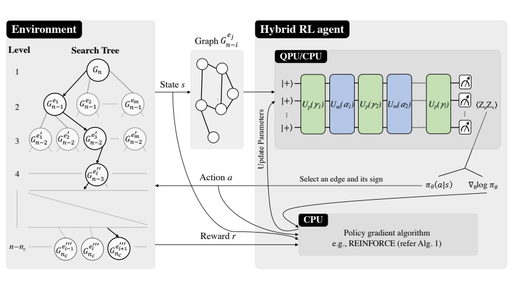
FIG. 1 . T raining QAOA-based policies for reinforcement learning.We consider an RL-enhanced recursive QAOA (RL-RQAOA) scenario where a hybrid quantum-classical agent learns by interacting with an environment which we represent as a search tree induced by the recursive framework of RQAOA. The agent samples the next actiona (corresponding to selecting an edge and its sign) from its policy πθ(a|s) and receives feedback in the form of a reward r, where each state corresponds to a graph (the state space is characterized by a search tree of weighted graphs, where each node of the tree corresponds to a graph). The nodes at each level of the search tree correspond to the candidate states for an agent to perceive by taking action. For our hybrid agents, the policy πθ of RL-RQAOA (see Def. 1) along with the gradient estimate ∇θ log πθ is evaluated on a CPU as we are in the regime where depth l = 1. However, the policy can also be evaluated on a quantum processing unit (QPU) for higher depths, when classical simulations can only be performed efficiently for graphs of small size. The training of the policy is performed by a classical algorithm such as REINFORCE (see Alg. 1), which uses sample interactions and policy gradients to update parameters.
원문 · CC BY 4.0 · Yash J. Patel, Sofiene Jerbi, Thomas Bäck, Vedran Dunjko · Reinforcement Learning Assisted Recursive QAOA · 원문 그림 인용 · 원본 PDF 3쪽에서 그림 영역을 추출했습니다.REINFORCE 기반 정책 학습
RL-RQAOA의 정책은 REINFORCE 알고리즘으로 학습합니다. 각 에피소드는 RQAOA의 한 번의 실행에 해당하며, 에피소드의 반환값으로 정책 경사를 추정하여 θ = (α, γ, β)를 갱신합니다. 정책 경사 정리는 정책 로그 경사와 가치 함수의 기대로 기울기를 표현하며, 이 방법은 몬테카를로 추정으로 구현됩니다. 실험에서는 이 학습이 하나의 인스턴스에서 진행되며, QAOA 각도는 깊이 1에서 최적 각도로 시작하도록 초기화됩니다.
하드 인스턴스와 캐이지 그래프 비교
연구진은 G[n,d,w] 앙상블에서 무작위 탐색으로 근사비가 0.95 미만인 1027개의 하드 인스턴스를 얻었습니다. 캐이지 그래프 실험에서는 RQAOA를 1400회 독립 실행해 최고 해를 취했고, RL-RQAOA는 15회 독립 실행의 평균 학습 성능으로 평가되었습니다. 이 비교에서 RL-RQAOA-vote는 (3,12)-cage 그래프를 예산 안에서 최적으로 찾지 못했다고 보고됩니다. 같은 설정을 모든 실험 결과에 일반화하지 않으며, 이 실험은 캐이지 그래프 설정에 한정됩니다.
하드 인스턴스에서의 근사비 차이
하드 인스턴스 실험에서 RL-RQAOA는 RQAOA보다 최고 근사비가 높다고 보고됩니다. 이 실험은 nc = 8로 설정되었고, RL-RQAOA는 15회 독립 실행의 1400 에피소드 평균으로 평가되었습니다. 이 결과는 선별된 하드 인스턴스에 한정되며, 랜덤 인스턴스 전체의 우위로 해석되지 않습니다. 또한 RL-RONE과의 비교는 양자 회로의 기여를 확인하는 대조 실험으로 제시됩니다.
적용 범위와 한계
본 논문의 수치 실험은 깊이 1 RQAOA와 RL-RQAOA에 한정되며, 더 높은 깊이의 실행은 고전적으로 수행되지 않았습니다. 따라서 양자 우위에 대한 주장은 높은 깊이와 실제 양자 처리 장치에서의 추가 검증이 필요합니다. 또한 학습은 한 인스턴스에서 진행되어 인스턴스 간 일반화는 본 논문의 범위 밖입니다.
논문 정보
- 저자
- Yash J. Patel, Sofiene Jerbi, Thomas Bäck, Vedran Dunjko
- 학회·저널
- arXiv · 프리프린트
- 최초 공개일
- 2022년 7월 13일
- 등록일
- 2026년 11월 6일
- 수정일
- 2024년 2월 5일
- 버전
- v2
- arXiv
- 2207.06294
- DOI
- 10.1140/epjqt/s40507-023-00214-w
- 분류
- quant-ph · cs.AI · cs.LG
- 원문 이용 조건
- CC BY 4.0
- 제공 범위
- 논문 정보, 해설, 허용된 원문 그림
AI 해설은 논문 원문과 별개의 설명이며 오류가 있을 수 있습니다. 원문과 그림은 각 출처의 이용 조건과 따로 표시된 권리를 따릅니다.
초록
Variational quantum algorithms such as the Quantum Approximation Optimization Algorithm (QAOA) in recent years have gained popularity as they provide the hope of using NISQ devices to tackle hard combinatorial optimization problems. It is, however, known that at low depth, certain locality constraints of QAOA limit its performance. To go beyond these limitations, a non-local variant of QAOA, namely recursive QAOA (RQAOA), was proposed to improve the quality of approximate solutions. The RQAOA has been studied comparatively less than QAOA, and it is less understood, for instance, for what family of instances it may fail to provide high quality solutions. However, as we are tackling $\mathsf{NP}$-hard problems (specifically, the Ising spin model), it is expected that RQAOA does fail, raising the question of designing even better quantum algorithms for combinatorial optimization. In this spirit, we identify and analyze cases where RQAOA fails and, based on this, propose a reinforcement learning enhanced RQAOA variant (RL-RQAOA) that improves upon RQAOA. We show that the performance of RL-RQAOA improves over RQAOA: RL-RQAOA is strictly better on these identified instances where RQAOA underperforms, and is similarly performing on instances where RQAOA is near-optimal. Our work exemplifies the potentially beneficial synergy between reinforcement learning and quantum (inspired) optimization in the design of new, even better heuristics for hard problems.
원문 인용
Yash J. Patel, Sofiene Jerbi, Thomas Bäck, Vedran Dunjko (2022). Reinforcement Learning Assisted Recursive QAOA. arXiv:2207.06294v2. https://doi.org/10.1140/epjqt/s40507-023-00214-w
BibTeX
@article{patel2022reinforcement,
  title = {{Reinforcement Learning Assisted Recursive QAOA}},
  author = {Yash J. Patel and Sofiene Jerbi and Thomas Bäck and Vedran Dunjko},
  year = {2022},
  eprint = {2207.06294},
  archivePrefix = {arXiv},
  doi = {10.1140/epjqt/s40507-023-00214-w},
  url = {https://arxiv.org/abs/2207.06294v2}
}