논문 해설
Clouds of Oriented Gradients for 3D Detection of Objects, Surfaces, and Indoor Scene Layouts
객체, 표면 및 실내 장면 레이아웃의 3D 탐지를 위한 방향성 그래디언트 구름
- 연구 문제 실내 RGB-D 장면에서 작은 물체의 거짓 양성과 방 배치 예측의 어려움을 함께 다루어, 3D 큐보이드 탐지와 레이아웃 예측을 하나의 기하학적 틀로 수행합니다.
- 연구 방법 COG 기술자로 물체의 3D 자세에 맞춘 기울기 특징을 계산하고, 잠재 지지 표면과 Manhattan 복셀을 결합한 구조화 SVM과 캐스케이드 분류기로 탐지와 맥락을 학습합니다.
- 주요 결과 SUN RGB-D 19개 범주 평가에서 +layout 설정은 mAP(19) 36.6을 기록하여 DSS의 26.9보다 높았습니다.
실내 3D 탐지의 어려움
실내 장면에서는 램프나 모니터처럼 작은 물체가 방 전체 부피의 극히 일부만 차지하여, 후보 큐보이드를 많이 검토해야 하고 거짓 양성이 많이 생깁니다. 또한 2D 바운딩 박스는 물체의 방향과 맥락 관계를 명시적으로 표현하지 못합니다. 이 논문은 RGB-D 영상에서 물체의 3D 크기, 위치, 방향을 큐보이드로 탐지하고, 방의 벽·바닥·ceiling 배치를 함께 예측하는 기하학적 틀을 다룹니다.
COG 기술자와 3D 방향 빈
COG 기술자는 큐보이드의 각 복셀에 대해 원근 투영을 이용하여 3D 방향 빈을 2D 이미지 좌표로 옮기고, 그 빈에 2D 기울기를 누적합니다. 기존 HOG는 2D 이미지 좌표에서 기울기 방향을 고정 빈에 나누기 때문에 물체의 3D 자세가 달라지면 같은 부위라도 기술자가 크게 달라집니다. COG는 빈 자체를 3D 자세에 맞추어 변형하므로, 이미지를 고정 방향 빈에 맞춰 워핑하는 방식과 달리 비평면 물체에도 적용할 수 있다고 설명합니다. 각 복셀의 특징은 9개 방향 빈으로 구성되며, 5×5×5 복셀에서 1125차원 COG 특징이 만들어집니다.
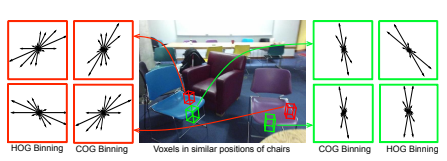
Fig. 2 . For two corresponding voxels (red and green) on two chairs, we illustrate the orientation histograms that would be computed by a standard HOG descrip- tor [24] in 2D image coordinates, and our COG descriptor in which perspective geometry is used to align descriptor bins. Even though these object instances are very similar, their 3D pose leads to wildly different HOG descriptors.
원문 · CC BY 4.0 · Zhile Ren, Erik B. Sudderth · Clouds of Oriented Gradients for 3D Detection of Objects, Surfaces, and Indoor Scene Layouts · 원문 그림 인용 · 원본 PDF 3쪽에서 그림 영역을 추출했습니다.구조화 SVM 학습과 확장 특징
각 범주에 대해 큐보이드 가설의 특징을 점군 밀도, 법선 방향 히스토그램, COG 특징, 카메라 시점 특징으로 구성하고, 마진 재조정 제약을 가진 구조화 SVM 목적식으로 학습합니다. 손실은 IOU와 방향 오차를 함께 반영하며, 정답 큐보이드와 겹침이 크고 방향이 맞을수록 작아집니다. 확장 큐보이드 특징은 큐보이드를 각 방향으로 한 층 넓혀 7×7×7 복셀로 주변 맥락을 포착합니다. 저자들은 이 확장이 의자와 변기처럼 외형은 비슷해도 주변 환경이 다른 범주를 구분하는 데 도움이 된다고 해석합니다.
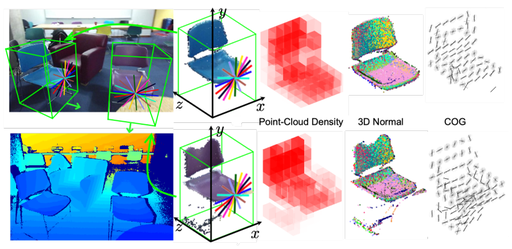
Fig. 1 . Given input RGB and Depth images (left), we align oriented cuboids and transform observed data into a canonical coordinate frame. For each voxel, we then extract (from left to right) point cloud density features, 3D normal orientation histograms, and COG descriptors of back-projected image gradient orientations. COG bins (left) are colored to show the alignment between instances. The value of the point cloud density feature is proportional to the voxel intensity, each 3D orientation histogram bin is assigned a distinct color, and COG features are proportional to the normalized energy in each orientation bin, similarly to HOG descriptors [24].
원문 · CC BY 4.0 · Zhile Ren, Erik B. Sudderth · Clouds of Oriented Gradients for 3D Detection of Objects, Surfaces, and Indoor Scene Layouts · 원문 그림 인용 · 원본 PDF 3쪽에서 그림 영역을 추출했습니다.
Fig. 13 . Visualization of learned 3D COG descriptors with expanded cuboid features for several categories. Reference orientation bins with larger weights are darker, providing a 3D visualization of the typical appearance of each object category. Cuboid sizes are matched to the median of the training data.
원문 · CC BY 4.0 · Zhile Ren, Erik B. Sudderth · Clouds of Oriented Gradients for 3D Detection of Objects, Surfaces, and Indoor Scene Layouts · 원문 그림 인용 · 원본 PDF 10쪽에서 그림 영역을 추출했습니다.잠재 지지 표면과 작은 물체 탐색
지지 표면의 높이를 각 물체의 잠재 변수로 두고, 잠재 구조 SVM으로 탐지기를 학습합니다. 큐보이드 높이는 7개 구간으로 나뉘며, 그중 하나의 슬라이스가 지지 표면을 나타내도록 학습합니다. 이 표현은 같은 범주 안에서 책상 높이처럼 지지 표면의 차이로 생기는 외형 스타일 변화를 설명합니다. 또한 베개·모니터·램프 같은 작은 물체는 큰 물체의 지지 표면 위에서만 탐색하므로 탐색 공간이 줄어듭니다. 이 지지 표면 추정은 표면 예측 과제의 정답 없이 학습됩니다.
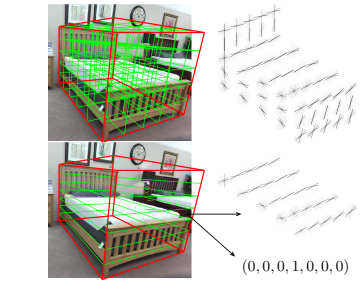
Fig.7 .COGfeaturesfor3Dcuboidsandsupportsurfaces.Thesurfacefeatureis computed within a single slice of the cuboid, and concatenated with an indicator vectorencodingtherelativeheight.Expandedcuboidfeaturesarenotvisualized.
원문 · CC BY 4.0 · Zhile Ren, Erik B. Sudderth · Clouds of Oriented Gradients for 3D Detection of Objects, Surfaces, and Indoor Scene Layouts · 원문 그림 인용 · 원본 PDF 6쪽에서 그림 영역을 추출했습니다.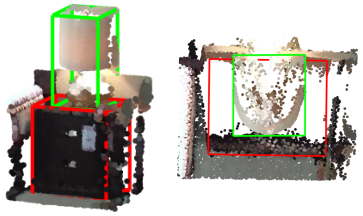
Fig. 10 . To model contextual relationships between small objects and the large objects supporting them, we compute the 2D areas and overlaps between 3D bounding boxes (left) seen from a top-down view (right).
원문 · CC BY 4.0 · Zhile Ren, Erik B. Sudderth · Clouds of Oriented Gradients for 3D Detection of Objects, Surfaces, and Indoor Scene Layouts · 원문 그림 인용 · 원본 PDF 8쪽에서 그림 영역을 추출했습니다.Manhattan 복셀과 맥락 캐스케이드
Manhattan 복셀은 바닥과 ceiling 사이를 6개 구간으로 나누고, 벽 근처 점과 내부·외부 점을 구분하는 영역을 두어 전체 공간을 12×6=72개 빈으로 나눕니다. 레이아웃 후보는 정답 방의 3D 점 80% 이상을 포함하도록 생성됩니다. 맥락 모델은 첫 단계 탐지 결과를 입력 특징으로 삼는 2단계 분류기로 구성됩니다. 이 캐스케이드는 범주 간 완전 연결 MRF를 직접 추론하지 않고도 객체와 레이아웃 사이의 관계를 학습하며, 각 2단계 탐지기는 독립적으로 학습됩니다.
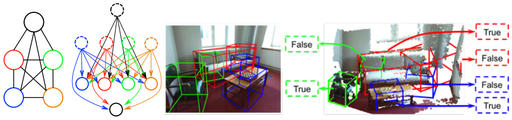
Fig. 9 . Cascaded classifiers capture contextual relationships among objects. From left to right: (i) A traditional undirected MRF representation of contextual relation- ships. Colored nodes represent object categories, and black nodes represent the room layout. (ii) A directed graphical representation of cascaded classification, where the first-stage detectors are hidden variables (dashed) that model contextual relationships among object and layout hypotheses (solid). Marginalizing the hidden nodes recovers the undirected MRF. (iii) First-stage detections independently computed for each category as in Sec. 3.4. (iv) Second-stage detections (Sec. 6) efficiently computed using our directed representation of context, and capturing contextual relationships between objects and the overall scene layout.
원문 · CC BY 4.0 · Zhile Ren, Erik B. Sudderth · Clouds of Oriented Gradients for 3D Detection of Objects, Surfaces, and Indoor Scene Layouts · 원문 그림 인용 · 원본 PDF 8쪽에서 그림 영역을 추출했습니다.SUN RGB-D에서의 탐지 결과
SUN RGB-D의 5285개 학습 영상과 5050개 시험 영상에서 19개 범주의 3D 탐지를 평가했습니다. 19개 범주 평균 정밀도는 surface 설정에서 32.6, +context에서 36.3, +layout에서 36.6이며, DSS는 26.9입니다. 이 비교는 같은 SUN RGB-D 평가 설정에서 얻은 결과이며, 다른 데이터셋이나 다른 백본으로 일반화된 결론이 아닙니다. 저자들은 지지 표면 모델링이 큰 물체를 개선하고 작은 물체의 거짓 양성을 줄인다고 보고합니다.
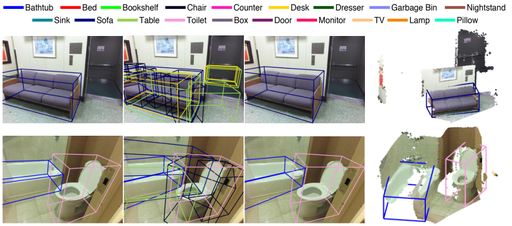
Fig. 14 . Detections with confidence scores larger than the same threshold for each stage of our cascaded classification framework. Notice that using contextual information helps prune away false positives while preserving true positives.
원문 · CC BY 4.0 · Zhile Ren, Erik B. Sudderth · Clouds of Oriented Gradients for 3D Detection of Objects, Surfaces, and Indoor Scene Layouts · 원문 그림 인용 · 원본 PDF 10쪽에서 그림 영역을 추출했습니다.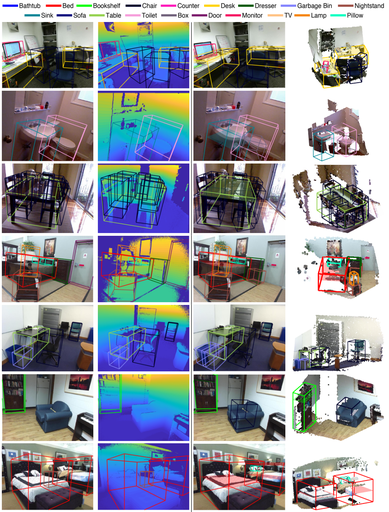
Fig. 15 . Visualizing our final stage 3D detections for objects with high confidence scores. Support surfaces are depicted with faded colors inside each large object.
원문 · CC BY 4.0 · Zhile Ren, Erik B. Sudderth · Clouds of Oriented Gradients for 3D Detection of Objects, Surfaces, and Indoor Scene Layouts · 원문 그림 인용 · 원본 PDF 11쪽에서 그림 영역을 추출했습니다.레이아웃 예측과 계산 비용
레이아웃 평가는 자유 공간 IOU로 수행했습니다. 일반 복셀은 72.33, SUN RGB-D 기준선은 73.4, Manhattan 복셀과 구조화 학습은 78.96, 객체 맥락을 추가하면 80.03입니다. 계산 비용은 MATLAB과 2.5GHz 단일 코어 CPU 기준으로 이미지당 10-30분이며, 특징 계산이 가장 많은 시간을 차지합니다. 이 한계는 저자가 밝힌 구현 조건에 따른 것입니다.
적용 범위와 한계
이 평가는 SUN RGB-D의 학습·시험 분할에 한정되며, NYU Depth 데이터셋은 SUN RGB-D의 부분집합이므로 평가에 사용하지 않았습니다. 또한 큐보이드 밀집 탐색으로 인해 계산 속도가 느린 점이 저자에 의해 한계로 지적됩니다. 본 논문은 주요 지표인 mAP와 IOU로 탐지 성능을 확인했으며, 그 밖의 현상에 대한 별도 측정은 제공된 근거에서 확인되지 않습니다.
논문 정보
- 저자
- Zhile Ren, Erik B. Sudderth
- 학회·저널
- arXiv · 프리프린트
- 최초 공개일
- 2019년 6월 11일
- 등록일
- 2026년 11월 6일
- 수정일
- 2019년 6월 11일
- 버전
- v1
- arXiv
- 1906.04725
- 분류
- cs.CV
- 원문 이용 조건
- CC BY 4.0
- 제공 범위
- 논문 정보, 해설, 허용된 원문 그림
AI 해설은 논문 원문과 별개의 설명이며 오류가 있을 수 있습니다. 원문과 그림은 각 출처의 이용 조건과 따로 표시된 권리를 따릅니다.
초록
We develop new representations and algorithms for three-dimensional (3D) object detection and spatial layout prediction in cluttered indoor scenes. We first propose a clouds of oriented gradient (COG) descriptor that links the 2D appearance and 3D pose of object categories, and thus accurately models how perspective projection affects perceived image gradients. To better represent the 3D visual styles of large objects and provide contextual cues to improve the detection of small objects, we introduce latent support surfaces. We then propose a "Manhattan voxel" representation which better captures the 3D room layout geometry of common indoor environments. Effective classification rules are learned via a latent structured prediction framework. Contextual relationships among categories and layout are captured via a cascade of classifiers, leading to holistic scene hypotheses that exceed the state-of-the-art on the SUN RGB-D database.
원문 인용
Zhile Ren, Erik B. Sudderth (2019). Clouds of Oriented Gradients for 3D Detection of Objects, Surfaces, and Indoor Scene Layouts. arXiv:1906.04725v1. https://arxiv.org/abs/1906.04725v1
BibTeX
@misc{ren2019clouds,
  title = {{Clouds of Oriented Gradients for 3D Detection of Objects, Surfaces, and Indoor Scene Layouts}},
  author = {Zhile Ren and Erik B. Sudderth},
  year = {2019},
  eprint = {1906.04725},
  archivePrefix = {arXiv},
  url = {https://arxiv.org/abs/1906.04725v1}
}