논문 해설
Scalable Detection and Tracking of Geometric Extended Objects
기하학적 확장 객체의 확장 가능한 탐지 및 추적
- 연구 문제 확장 객체의 측정과 객체 연관이 조합적으로 늘어나는 상황에서, 게이팅과 클러스터링 없이 근접한 다수의 확장 객체를 검출하고 추적하는 문제를 다룹니다.
- 연구 방법 잠재 객체의 존재 변수와 측정 중심 연관 변수를 팩터 그래프로 표현하고, 입자 기반 합곱 알고리즘으로 메시지를 전달하여 객체 신념을 근사합니다.
- 주요 결과 열 개 근접 객체 시뮬레이션과 nuScenes 실데이터에서 제안 방법은 PMBM 필터보다 낮은 GOSPA 오차를 보고했으며, 실행 시간은 PMBM 필터와 비슷하다고 보고되었습니다.
연구 문제와 기존 방법의 한계
확장 객체 추적은 고해상도 센서에서 객체가 하나의 점이 아니라 여러 측정을 만들어 내는 상황을 다룹니다. 이때 측정과 객체의 연관 경우의 수가 측정 수에 따라 조합적으로 늘어나고, 기존 방법은 이를 줄이기 위해 게이팅과 클러스터링을 사용합니다. 이 방식은 객체들이 가까이 있을 때 성능이 떨어집니다. 본 논문은 게이팅과 클러스터링 없이, 새로 나타난 객체의 존재를 포함해 다수의 근접 확장 객체를 검출하고 추적하는 방법을 다룹니다.
팩터 그래프와 측정 중심 연관 변수
제안 방법은 객체 상태를 운동 상태와 확장 상태, 그리고 존재 변수로 구성하는 잠재 객체 표현을 사용합니다. 연관은 측정마다 어느 잠재 객체에서 왔는지를 나타내는 측정 중심 변수로 표현되며, 새로 검출된 객체는 포아송 생성 과정으로 도입됩니다. 이 모델을 팩터 그래프로 나타내고 합곱 알고리즘으로 메시지를 주고받아 각 잠재 객체의 주변 존재 확률과 상태 신념을 근사합니다. 계산은 예측, 반복 메시지 전달, 신념 계산 단계로 나뉘며 입자 기반 구현에서는 중요도 샘플링으로 신념을 갱신합니다.
시뮬레이션 평가 설계
시뮬레이션에서는 열 개의 확장 객체가 관측 영역 중심에서 교차하는 시나리오를 사용하고, 같은 설정에서 PMBM 필터와 비교합니다. 제안 방법은 입자 수와 합곱 반복 횟수를 바꾼 여러 설정으로 평가되며, 추정 성능은 OSPA와 GOSPA로 측정합니다. GOSPA는 Gaussian-Wasserstein 거리와 매개변수 p=1, c=20을 사용합니다. 근접 객체 시나리오는 제안 방법이 클러스터링을 피하는 효과를 보여 주기 위한 조건입니다.
시뮬레이션과 실데이터 결과
열 개 객체 시뮬레이션에서 제안 방법은 PMBM 필터보다 OSPA 오차가 낮게 나타났고, 특히 객체가 근접한 시점에서 차이가 컸습니다. 표 I에서 SPA-3-10000의 전체 GOSPA 오차는 7.5, PMBM-FR은 22.5로 보고됩니다. 실행 시간은 SPA-2-1000의 1.05초부터 SPA-3-10000의 11.67초까지이며 PMBM-FR은 50.59초입니다. 스무 개 객체 시뮬레이션에서도 같은 경향이 보고됩니다. 실데이터 nuScenes 평가에서는 제안 방법의 평균 GOSPA 오차가 SPA-1000에서 7.63, SPA-10000에서 7.21로 보고되고 PMBM 변형들은 8.57에서 8.61 사이입니다.
이 실데이터 결과는 네 개 장면과 라이다 기반 차량 추적이라는 조건에서 얻은 것입니다.
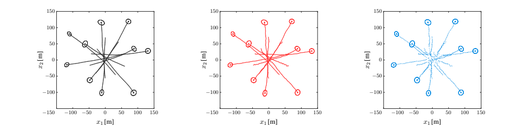
Fig. 3 : Example realization of true object tracks are depicted in (a). Estimation results of the proposed SPA and the PMBM-FR are depicted in (b) and (c), respectively. True and estimated object shapes at the last time step of an object’s existence are also shown. In (a), track estimates provided by the proposed SPA method are shown as red line. In (b), state estimates provided by PMBM-FR are shown as blue dots.
원문 · CC BY 4.0 · Florian Meyer, Jason L. Williams · Scalable Detection and Tracking of Geometric Extended Objects · 원문 그림 인용 · 원본 PDF 11쪽에서 그림 영역을 추출했습니다.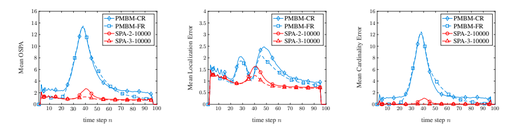
Fig. 4 : Mean total OSPA (a) mean state error (b) and mean cardinality error (c) versus time of the proposed SPA method compared to the PMBM filter in a scenario with 10 closely-spaced extended objects.
원문 · CC BY 4.0 · Florian Meyer, Jason L. Williams · Scalable Detection and Tracking of Geometric Extended Objects · 원문 그림 인용 · 원본 PDF 12쪽에서 그림 영역을 추출했습니다.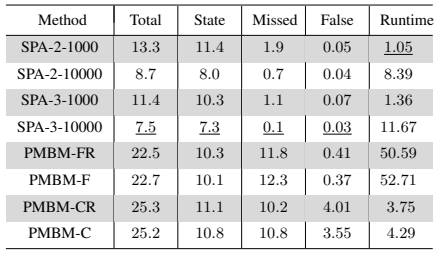
원문 그림 TABLE I: Mean GOSPA and runtime per time step in seconds for the considered simulation. The total GOSPA error as well as individual error contributions are shown.
원문 · CC BY 4.0 · Florian Meyer, Jason L. Williams · Scalable Detection and Tracking of Geometric Extended Objects · 원문 그림 인용 · 원본 PDF 12쪽에서 그림 영역을 추출했습니다.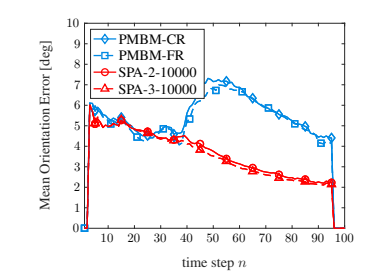
Fig. 5 : Mean size error (a) and mean orientation error (b) of the proposed SPA method compared to the PMBM filter in a scenario with 10 closely-spaced extended objects.
원문 · CC BY 4.0 · Florian Meyer, Jason L. Williams · Scalable Detection and Tracking of Geometric Extended Objects · 원문 그림 인용 · 원본 PDF 13쪽에서 그림 영역을 추출했습니다.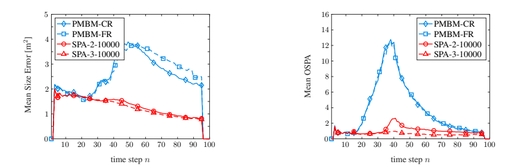
Fig. 6 : Mean total OSPA of the proposed SPA method compared to the PMBM filter in a scenario with 20 closely-spaced extended objects.
원문 · CC BY 4.0 · Florian Meyer, Jason L. Williams · Scalable Detection and Tracking of Geometric Extended Objects · 원문 그림 인용 · 원본 PDF 13쪽에서 그림 영역을 추출했습니다.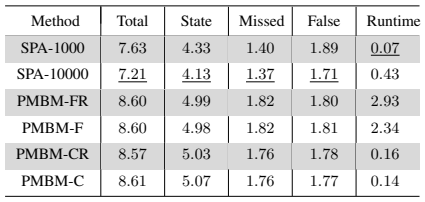
원문 그림 TABLE II: Mean GOSPA and runtime per time step in seconds for the considered vehicle tracking scenario. The total GOSPA error as well as individual error contributions are shown.
원문 · CC BY 4.0 · Florian Meyer, Jason L. Williams · Scalable Detection and Tracking of Geometric Extended Objects · 원문 그림 인용 · 원본 PDF 14쪽에서 그림 영역을 추출했습니다.적용 범위와 한계
본 논문의 모델은 가우시안 측정 생성 가정과 선형 가우시안 측정 모델을 사용하는 실험 설정을 포함하며, 이는 PMBM 필터와 비교 가능한 구조를 맞추기 위한 선택입니다. 따라서 결과는 이 가정과 시뮬레이션 설정, 그리고 네 개 장면의 차량 추적 조건에 한정됩니다. 원문은 복잡도가 객체 수와 측정 수에 대해 이차적으로 증가한다고 설명하지만, 잘 떨어진 객체에는 분리 방식이 더 적합할 수 있다고 함께 밝힙니다.
논문 정보
- 저자
- Florian Meyer, Jason L. Williams
- 학회·저널
- arXiv · 프리프린트
- 최초 공개일
- 2021년 3월 21일
- 등록일
- 2026년 11월 6일
- 수정일
- 2021년 12월 9일
- 버전
- v4
- arXiv
- 2103.11279
- DOI
- 10.1109/tsp.2021.3121631
- 분류
- eess.SP
- 원문 이용 조건
- CC BY 4.0
- 제공 범위
- 논문 정보, 해설, 허용된 원문 그림
AI 해설은 논문 원문과 별개의 설명이며 오류가 있을 수 있습니다. 원문과 그림은 각 출처의 이용 조건과 따로 표시된 권리를 따릅니다.
초록
Multiobject tracking provides situational awareness that enables new applications for modern convenience, public safety, and homeland security. This paper presents a factor graph formulation and a particle-based sum-product algorithm (SPA) for scalable detection and tracking of extended objects. The proposed method dynamically introduces states of newly detected objects, efficiently performs probabilistic multiple-measurement to object association, and jointly infers the geometric shapes of objects. Scalable extended object tracking (EOT) is enabled by modeling association uncertainty by measurement-oriented association variables and newly detected objects by a Poisson birth process. Contrary to conventional EOT methods, a fully particle-based approach makes it possible to describe different geometric object shapes. The proposed method can reliably detect, localize, and track a large number of closely-spaced extended objects without gating and clustering of measurements. We demonstrate significant performance advantages of our approach compared to the recently introduced Poisson multi-Bernoulli mixture filter. In particular, we consider a simulated scenarios with up to twenty closely-spaced objects and a real autonomous driving application where measurements are captured by a lidar sensor.
원문 인용
Florian Meyer, Jason L. Williams (2021). Scalable Detection and Tracking of Geometric Extended Objects. arXiv:2103.11279v4. https://doi.org/10.1109/tsp.2021.3121631
BibTeX
@article{meyer2021scalable,
  title = {{Scalable Detection and Tracking of Geometric Extended Objects}},
  author = {Florian Meyer and Jason L. Williams},
  year = {2021},
  eprint = {2103.11279},
  archivePrefix = {arXiv},
  doi = {10.1109/tsp.2021.3121631},
  url = {https://arxiv.org/abs/2103.11279v4}
}