논문 해설
From Low Rank Gradient Subspace Stabilization to Low-Rank Weights: Observations, Theories, and Applications
저랭크 그래디언트 부분공간 안정화에서 저랭크 가중치로: 관찰, 이론, 그리고 응용
- 연구 문제 대형 언어 모델의 가중치 저랭크 구조가 학습 중 그래디언트 안정화와 어떻게 연결되는지 설명하고, 이를 압축과 fine-tuning에 활용할 방법이 필요합니다.
- 연구 방법 Hessian 고유공간 안정화 이론을 바탕으로 레이어별 정규화 특이값 임계값으로 LRC와 N-LRC를 나누고, LRC만 압축하거나 미세조정하는 WeLore를 제안합니다.
- 주요 결과 WeLore-COMP는 여러 perplexity 비교에서 Uniform 감소보다 낮은 perplexity를 보였고, LRC 중심 fine-tuning은 50% 압축 설정에서 학습 가능한 파라미터 35%로 전체 fine-tuning과 비슷하거나 나은 성능을 보고합니다.
저랭크 구조가 왜 생기는가
대형 언어 모델의 가중치 행렬은 실제로 저랭크 형태로 근사될 수 있어 메모리와 연산 자원을 줄일 여지가 있습니다. 그러나 이 저랭크 구조가 어떻게 생겨나는지는 충분히 설명되지 않았습니다. 이 논문은 저랭크 구조의 출현을 pre-training 중 그래디언트 부분공간이 안정화되는 과정과 연결해서 살펴봅니다. 이를 위해 손실 함수의 Hessian 고유공간이 학습 중 어떻게 변하는지 이론적으로 분석합니다.
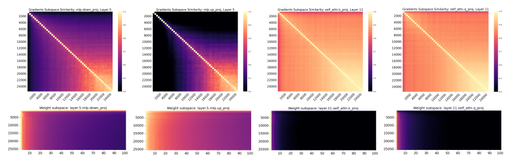
Figure 2 . (Row 1) Gradients subspace similarity obtained from various checkpoints during pretraining of LLaMA-130M on C4 dataset for 25,000 training steps using Adam Optimizer. (Row 2) Emergence of Low-rank Weight Subspace during pretraining of LLaMA-130M. Each row of individual subplot represents the singular values of weights in a given training step.
원문 · CC BY 4.0 · Jaiswal, Ajay, Wang, Yifan, Yin, Lu, Liu, Shiwei, Chen, Runjin, Zhao, Jiawei, Grama, Ananth, Tian, Yuandong, Wang, Zhangyang · From Low Rank Gradient Subspace Stabilization to Low-Rank Weights: Observations, Theories, and Applications · 원문 그림 인용 · 원본 PDF 4쪽에서 그림 영역을 추출했습니다.Hessian 고유공간의 안정화와 그래디언트 정렬
Theorem 2.1은 Hessian의 고유값과 상위 r개 고유공간이 학습 중 안정화된다는 결과입니다. 증명은 Hessian의 단계별 변화를 Lipschitz 조건으로 제한하고, KŁ 조건에서 그래디언트 노름이 거듭제곱 법칙으로 줄어든다는 사실을 사용합니다. Theorem 2.2는 그래디언트 G_t가 Hessian의 주요 고유공간에 점근적으로 정렬된다는 결과입니다. 이 증명은 비지배 성분에 스펙트럴 갭 조건을 적용해 그 성분이 기하급수적으로 줄어든다는 점을 보입니다.
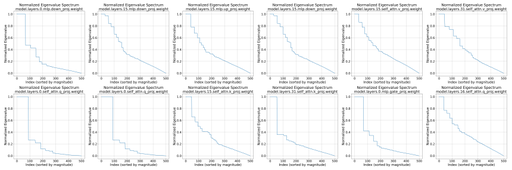
Figure 1 . Hessian gap across layers and components of LLaMA2-7B. We observe that: 1) mlp.up proj, mlp.down proj, and self attn.v proj exhibit less pronounced Hessian gaps compared to self attn.k proj, self attn.q proj, self attn.o proj, and mlp.gate proj; 2) early and late layers generally display clearer gaps than middle layers; 3) components with a pronounced Hessian gap (self attn.k proj, self attn.q proj, self attn.o proj, and mlp.gate proj) tend to be more low-rank, as shown in our experiments.
원문 · CC BY 4.0 · Jaiswal, Ajay, Wang, Yifan, Yin, Lu, Liu, Shiwei, Chen, Runjin, Zhao, Jiawei, Grama, Ananth, Tian, Yuandong, Wang, Zhangyang · From Low Rank Gradient Subspace Stabilization to Low-Rank Weights: Observations, Theories, and Applications · 원문 그림 인용 · 원본 PDF 3쪽에서 그림 영역을 추출했습니다.WeLore-COMP 압축과 LRC 분류
WeLore-COMP는 각 레이어의 가중치 행렬에 대해 torch.svd로 얻은 정규화 특이값을 전역 임계값 k와 비교합니다. 임계값 이상의 특이값 개수로 각 레이어의 랭크 r을 정하며, 전체 랭크 감소 비율인 ERR가 목표값에 맞도록 k를 선형 탐색으로 찾습니다. 레이어의 저랭크 분해 랭크가 원래 랭크의 0.5배보다 작으면 LRC로 분류되고 나머지는 N-LRC로 남습니다. LRC의 가중치 행렬은 두 작은 행렬의 곱으로 바뀌어 압축됩니다.
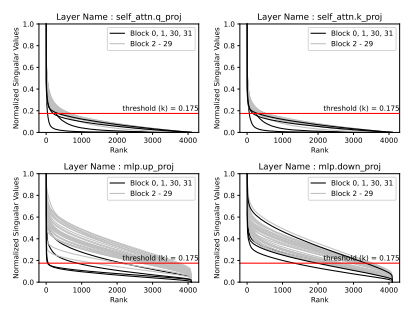
Figure 3 . Normalized singular values of the weight matrices cor- responding to different layers of LLaMa-2 7B pretrained check- point from HuggingFace. Each subplot indicates 4096 sorted and normalized singular values corresponding to a layer ( e.g., self attn.q proj) from 32 transformer blocks.
원문 · CC BY 4.0 · Jaiswal, Ajay, Wang, Yifan, Yin, Lu, Liu, Shiwei, Chen, Runjin, Zhao, Jiawei, Grama, Ananth, Tian, Yuandong, Wang, Zhangyang · From Low Rank Gradient Subspace Stabilization to Low-Rank Weights: Observations, Theories, and Applications · 원문 그림 인용 · 원본 PDF 5쪽에서 그림 영역을 추출했습니다.LRC 중심 fine-tuning
WeLore-PEFT는 압축된 체크포인트에서 LRC만 역전파로 갱신하고 N-LRC는 고정합니다. LRC는 저랭크 형식으로 표현되어 그래디언트와 옵티마이저 상태도 저랭크로 유지됩니다. 원문은 50% 압축된 LLaMA-7B에서 LRC fine-tuning이 N-LRC fine-tuning보다 학습 손실과 검증 perplexity가 더 좋았고, 처리량은 약 2배라고 보고합니다. 이 결과는 해당 압축 설정과 연속 fine-tuning 조건에서 얻은 것입니다.
압축과 fine-tuning 결과
LLaMa-2 7B에서 EER 30% 조건의 perplexity는 WeLore-COMP가 Uniform 감소보다 약 6.4배 우수하다고 보고됩니다. 같은 표에서 OWL 감소는 Uniform보다 나은 경우도 있지만 감소 비율이 커질수록 성능 저하가 더 심합니다. 50% 압축된 LLaMA-2 7B에서 WeLore는 전체 fine-tuning 대비 학습 가능한 파라미터의 35%만 필요하고 처리량은 약 3배, GPU 메모리 사용량은 40% 감소한다고 보고됩니다. 사실 기반 질의응답 과제에서는 WeLore-COMP가 SVD-LLM보다 약간 낮습니다.

Table 1 . Perplexity (C4 dataset) comparison of LLaMa-2 7B, 13B and Mistral-7B pretrained checkpoints compressed with WeLore-COMP, Uniform, and outlier-sensitive rank reduction ratios.
원문 · CC BY 4.0 · Jaiswal, Ajay, Wang, Yifan, Yin, Lu, Liu, Shiwei, Chen, Runjin, Zhao, Jiawei, Grama, Ananth, Tian, Yuandong, Wang, Zhangyang · From Low Rank Gradient Subspace Stabilization to Low-Rank Weights: Observations, Theories, and Applications · 원문 그림 인용 · 원본 PDF 6쪽에서 그림 영역을 추출했습니다.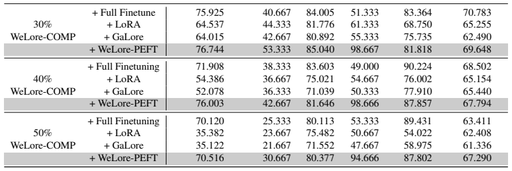
Table 6 . Downstream performance of Dense and WeLore compressed LLaMa-2 7B checkpoint under full-finetuning along with memory- efficient finetuning techniques (LoRA and GaLore). All downstream finetuning is performed starting from the same initial checkpoint state for fair comparison.
원문 · CC BY 4.0 · Jaiswal, Ajay, Wang, Yifan, Yin, Lu, Liu, Shiwei, Chen, Runjin, Zhao, Jiawei, Grama, Ananth, Tian, Yuandong, Wang, Zhangyang · From Low Rank Gradient Subspace Stabilization to Low-Rank Weights: Observations, Theories, and Applications · 원문 그림 인용 · 원본 PDF 8쪽에서 그림 영역을 추출했습니다.이론과 적용의 한계
Theorem 2.1은 θ가 0과 1/2 사이일 때 수렴을 보장하지 않으며, 이 구간에서는 각 유한 구간의 단계별 변화에 대한 균일한 상한만 제공합니다. 스펙트럴 갭 가정은 Hessian의 상위 r개 고유값과 나머지 고유값 사이에 균일한 양의 간격 γ가 있다고 가정합니다. 사실 기반 질의응답처럼 일부 과제에서는 WeLore-COMP가 SVD-LLM보다 낮은 성능을 보였습니다.
논문 정보
- 저자
- Jaiswal, Ajay, Wang, Yifan, Yin, Lu, Liu, Shiwei, Chen, Runjin, Zhao, Jiawei, Grama, Ananth, Tian, Yuandong, Wang, Zhangyang
- 학회·저널
- arXiv · 프리프린트
- 최초 공개일
- 2024년 7월 15일
- 등록일
- 2026년 10월 29일
- 수정일
- 2025년 6월 7일
- 버전
- v2
- arXiv
- 2407.11239
- 원문 이용 조건
- CC BY 4.0
- 제공 범위
- 논문 정보, 해설, 허용된 원문 그림
AI 해설은 논문 원문과 별개의 설명이며 오류가 있을 수 있습니다. 원문과 그림은 각 출처의 이용 조건과 따로 표시된 권리를 따릅니다.
초록
Large Language Models' (LLMs) weight matrices can often be expressed in low-rank form with potential to relax memory and compute resource requirements. Unlike prior efforts that focus on developing novel matrix decompositions, in this work we study the non-uniform low-rank properties of weight matrices in LLMs through the lens of stabilizing gradient subspace. First, we provide a theoretical framework to understand the stabilization of gradient subspaces through Hessian analysis. Second, we empirically establish an important relationship between gradient dynamics and low-rank expressiveness of weight matrices. Our findings reveal that different LLM components exhibit varying levels of converged low-rank structures, necessitating variable rank reduction across them to minimize drop in performance due to compression. Drawing on this result, we present Weight Low-Rank Projection(WeLore) that unifies weight compression and memory-efficient fine-tuning into one, in a data-agnostic and one-shot manner. When used as a compression technique, WeLore categorizes weight matrices into Low-rank Components (LRCs) and Non-Low-rank Components (N-LRCs) and suitably encodes them for minimum performance loss. Our gradient dynamics perspective illustrates that LRCs tend to have better fine-tuning capabilities and their standalone fine-tuning can closely mimic and sometimes outperform the training loss trajectory and performance of full fine-tuning with notable memory and compute footprint reduction. Codes are available at https://github.com/VITA-Group/WeLore.
원문 인용
Jaiswal, Ajay, Wang, Yifan, Yin, Lu, Liu, Shiwei, Chen, Runjin, Zhao, Jiawei, Grama, Ananth, Tian, Yuandong, Wang, Zhangyang (2024). From Low Rank Gradient Subspace Stabilization to Low-Rank Weights: Observations, Theories, and Applications. arXiv:2407.11239v2. https://arxiv.org/abs/2407.11239v2
BibTeX
@misc{ajay2024from,
  title = {{From Low Rank Gradient Subspace Stabilization to Low-Rank Weights: Observations, Theories, and Applications}},
  author = {Jaiswal, Ajay and Wang, Yifan and Yin, Lu and Liu, Shiwei and Chen, Runjin and Zhao, Jiawei and Grama, Ananth and Tian, Yuandong and Wang, Zhangyang},
  year = {2024},
  eprint = {2407.11239},
  archivePrefix = {arXiv},
  url = {https://arxiv.org/abs/2407.11239v2}
}