논문 해설
The Surprising Agreement Between Convex Optimization Theory and Learning-Rate Scheduling for Large Model Training
대규모 모델 학습을 위한 볼록 최적화 이론과 학습률 스케줄링 사이의 놀라운 일치
- 연구 문제 대규모 모델 학습의 학습률 스케줄이 실제로 왜 잘 작동하는지는 경험적으로만 알려져 있어, cosine과 wsd 스케줄의 차이를 이론적으로 설명하는 것이 어렵습니다.
- 연구 방법 SGD의 볼록 설정에서 마지막 반복 상한을 기본 학습률에 대해 최소화하고, 그 상한에 스케줄별 형태를 대입해 wsd와 cosine을 비교합니다.
- 주요 결과 wsd 상한은 상수 스케줄의 로그 항을 제거하며, 이론 상한의 형태가 실제 검증 손실 곡선과 유사하게 나타납니다. 조정된 wsd 스케줄은 긴 학습에서 검증 손실을 약 0.01 개선했다고 보고됩니다.
학습률 스케줄의 이론적 설명 공백
대규모 모델 학습에서 학습률 스케줄은 실무적으로 중요한 선택이지만, 그 형태가 왜 성능을 좌우하는지에 대한 이론적 이해는 부족합니다. 특히 널리 쓰이는 cosine 스케줄은 학습 길이 전체에 의존하므로 연속 학습에 적합하지 않습니다. 반면 상수 구간 뒤에 쿨다운을 두는 wsd 스케줄은 손실이 쿨다운 직후 급격히 줄어드는 특징을 보입니다. 이 논문은 비볼록 딥러닝의 경험적 현상을 볼록 최적화의 상한으로 설명할 수 있는지를 묻습니다.
마지막 반복 상한과 기본 학습률 최적화
논문은 SGD 반복식 x_{t+1} = x_t − γη_t g_t에서 기본 학습률 γ와 스케줄 η_t를 분리합니다. 볼록 가정 아래 정리 3.1은 마지막 반복의 기대 최적성 격차 상한을 제시하며, 이 상한은 D와 η_t, γ, 기대 기울기 노름 상한 G_t로 결정됩니다. 따름정리 3.3은 이 상한을 γ에 대해 최소화하여 최적 기본 학습률 γ⋆를 얻습니다. 이 최적화 결과는 스케줄별로 상한의 형태를 비교할 수 있게 해 줍니다.
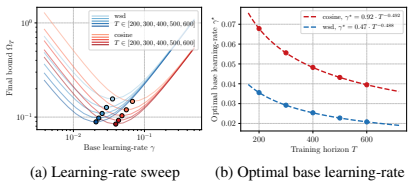
Figure 3 . Optimal base learning-rate decays with inverse square- root of training horizon T (right). For cosine, it is roughly twice as large as for wsd (as 0.92/0.47 ≈ 2). The dashed curve in the right-hand side plot is obtained with a least-squares fit.
원문 · CC BY 4.0 · Fabian Schaipp, Alexander Hägele, Adrien Taylor, Umut Simsekli, Francis Bach · The Surprising Agreement Between Convex Optimization Theory and Learning-Rate Scheduling for Large Model Training · 원문 그림 인용 · 원본 PDF 4쪽에서 그림 영역을 추출했습니다.wsd와 cosine의 상한 형태 비교
논문은 γ⋆를 대입해 wsd와 cosine 스케줄의 상한을 비교합니다. 상수 스케줄의 상한은 DG√T 곱하기 √(1+H_{T−1}) 형태로 주어지며, 여기서 H_t는 조화수입니다. 정리 3.4는 wsd에 대해 쿨다운 길이가 T에 비례할 때 이 로그 항이 사라지는 상한을 보입니다. 저자들은 이 차이가 쿨다운 구간에서 생긴다고 해석하며, 그림 1은 210M Llama 모델의 검증 손실과 상한 형태가 wsd와 cosine에서 유사하다고 보여 줍니다.
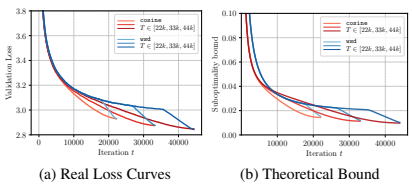
Figure 1 . Strikingly similar: Validation loss for a 210M Llama model trained with AdamW (left) and the theoretical suboptimality bound (6) from convex optimization (right). Both plots show wsd and cosine schedule with different training lengths T , and with base learning-rate of cosine being twice as large as for wsd.
원문 · CC BY 4.0 · Fabian Schaipp, Alexander Hägele, Adrien Taylor, Umut Simsekli, Francis Bach · The Surprising Agreement Between Convex Optimization Theory and Learning-Rate Scheduling for Large Model Training · 원문 그림 인용 · 원본 PDF 1쪽에서 그림 영역을 추출했습니다.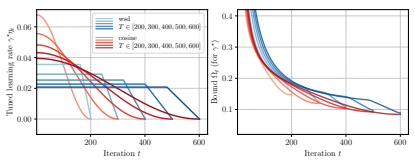
Figure 2 . Schedule (left) and theoretical bound (right) for cosine and wsd, and various T , with base learning-rate γ⋆.
원문 · CC BY 4.0 · Fabian Schaipp, Alexander Hägele, Adrien Taylor, Umut Simsekli, Francis Bach · The Surprising Agreement Between Convex Optimization Theory and Learning-Rate Scheduling for Large Model Training · 원문 그림 인용 · 원본 PDF 4쪽에서 그림 영역을 추출했습니다.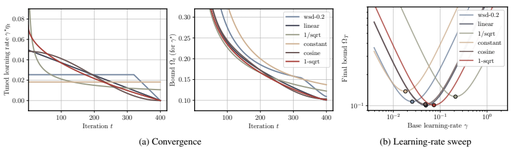
Figure 18 . Comparison of various learning-rate schedules. Convergence is plotted with the optimal base learning-rate γ⋆ (chosen individually for each schedule).
원문 · CC BY 4.0 · Fabian Schaipp, Alexander Hägele, Adrien Taylor, Umut Simsekli, Francis Bach · The Surprising Agreement Between Convex Optimization Theory and Learning-Rate Scheduling for Large Model Training · 원문 그림 인용 · 원본 PDF 15쪽에서 그림 영역을 추출했습니다.쿨다운 비율과 기울기 노름의 영향
이론 시뮬레이션에서 기본 학습률을 완전히 튜닝하면 최적 쿨다운 비율은 1, 즉 선형 감쇠로 나타납니다. 고정된 γ에서는 최적 쿨다운 비율이 1보다 작을 수 있습니다. 또한 기대 기울기 노름 G_t가 0으로 가지 않을 때 쿨다운 중 상한의 급격한 감소가 가장 두드러집니다. 이 시뮬레이션은 G_t=1과 D=1로 설정한 조건에서 수행되었습니다.
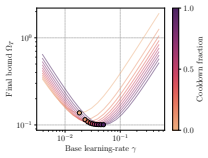
Figure 4 . (Left) Optimal base learning-rate increases with cooldown fraction. (Right) For fixed γ, the optimal cooldown fraction can be smaller than 1. The analogous curves for real ex- periments with similar parabola shapes are in
원문 · CC BY 4.0 · Fabian Schaipp, Alexander Hägele, Adrien Taylor, Umut Simsekli, Francis Bach · The Surprising Agreement Between Convex Optimization Theory and Learning-Rate Scheduling for Large Model Training · 원문 그림 인용 · 원본 PDF 5쪽에서 그림 영역을 추출했습니다.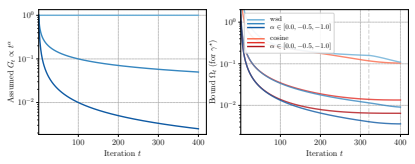
Figure 6 . Assumed gradient shape (left) and theoretical convereg- nce (right). Only with α = 0 (constant Gt), the sudden drop for wsd is clearly visible.
원문 · CC BY 4.0 · Fabian Schaipp, Alexander Hägele, Adrien Taylor, Umut Simsekli, Francis Bach · The Surprising Agreement Between Convex Optimization Theory and Learning-Rate Scheduling for Large Model Training · 원문 그림 인용 · 원본 PDF 5쪽에서 그림 영역을 추출했습니다.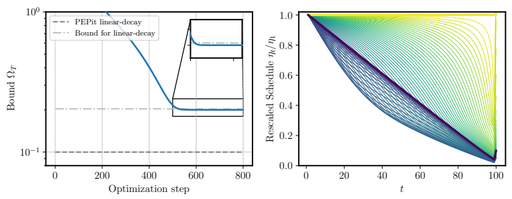
Figure 28 . Optimizing the bound ΩT with respect to the schedule η1, . . . , ηT . (Left) Convergence of the value of the bound, matching the bound of a linear-decay schedule. (Right) Optimization trajectory from constant schedule (yellow) to linear-decay (purple).
원문 · CC BY 4.0 · Fabian Schaipp, Alexander Hägele, Adrien Taylor, Umut Simsekli, Francis Bach · The Surprising Agreement Between Convex Optimization Theory and Learning-Rate Scheduling for Large Model Training · 원문 그림 인용 · 원본 PDF 21쪽에서 그림 영역을 추출했습니다.PEP 하한과 비볼록 토이 예제
논문은 상한이 실제 최악 사례와 얼마나 가까운지 PEP 프레임워크로 확인합니다. T=60에서 cosine과 wsd의 PEP 하한 값은 매우 비슷하다고 보고됩니다. 또한 2차원 non-smooth 볼록 문제 min ∥Ax−b∥∞에서도 wsd의 손실 급감이 관찰됩니다. 이 결과는 급감이 특정 모델 구조에만 속한 현상이 아니라는 저자의 해석을 뒷받침합니다.
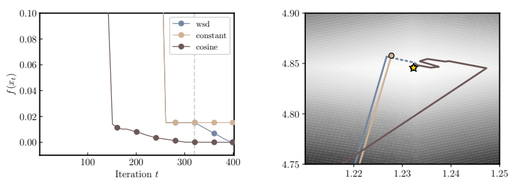
Figure 17 . (Left) Sudden drop of the loss for wsd schedule for a convex, non-smooth problem. (Right) Iterate path for the three schedules. For wsd, the cooldown period is indicated with the dashed line. Star marks solution.
원문 · CC BY 4.0 · Fabian Schaipp, Alexander Hägele, Adrien Taylor, Umut Simsekli, Francis Bach · The Surprising Agreement Between Convex Optimization Theory and Learning-Rate Scheduling for Large Model Training · 원문 그림 인용 · 원본 PDF 14쪽에서 그림 영역을 추출했습니다.연속 학습과 학습률 전이
논문은 짧은 학습에서 튜닝한 wsd 스케줄을 긴 학습으로 확장하는 두 방법을 제시합니다. (B2)는 쿨다운 비율을 유지하면서 상수 구간의 학습률을 이론이 정한 비율로 낮추는 방식이고, (B1)은 쿨다운 비율을 늘리는 방식입니다. 124M과 210M Llama 스타일 트랜스포머를 SlimPajama 데이터셋으로 학습한 실험에서, 조정된 wsd 스케줄은 검증 손실을 약 0.01 개선했다고 보고됩니다. 이 차이는 스케일링 법칙 추정에서 약 6~8% 더 긴 학습에 해당한다고 저자가 해석합니다. 또한 20% 쿨다운에서 튜닝한 γ⋆로부터 선형 감쇠 스케줄의 학습률을 전이한 결과, 선형 감쇠 실행의 최종 검증 손실은 2.9535로 20% 쿨다운 최선 실행의 2.9660보다 낮았습니다.
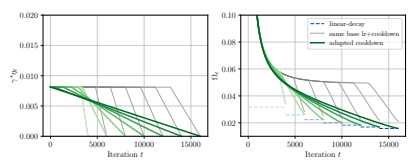
Figure 8 . (Left) Transferring the wsd schedule from horizon T1 = 4000 to T2 ∈ [1.5T1, 4T1]. (Right) Not adapting the cooldown length leads to significant suboptimality. Dashed horizontal lines mark bound for the linear-decay schedule with tuned γ⋆.
원문 · CC BY 4.0 · Fabian Schaipp, Alexander Hägele, Adrien Taylor, Umut Simsekli, Francis Bach · The Surprising Agreement Between Convex Optimization Theory and Learning-Rate Scheduling for Large Model Training · 원문 그림 인용 · 원본 PDF 6쪽에서 그림 영역을 추출했습니다.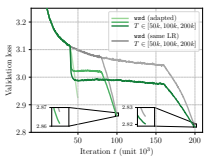
Figure 10 . Transferring the learning-rate schedule from horizon T1 = 50 000 to T2 ∈ [2T1, 4T1]. Decreasing the base learning- rate (green) after 40k steps leads to small improvements in vali- dation loss compared to keeping it the same (grey). We discuss the significance of the difference in loss values of (around 0.01) in Section 5.1 and Appendix B.5. See
원문 · CC BY 4.0 · Fabian Schaipp, Alexander Hägele, Adrien Taylor, Umut Simsekli, Francis Bach · The Surprising Agreement Between Convex Optimization Theory and Learning-Rate Scheduling for Large Model Training · 원문 그림 인용 · 원본 PDF 7쪽에서 그림 영역을 추출했습니다.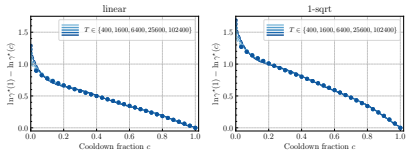
Figure 11 . Transferring the optimal base learning-rate from cooldown fraction c to linear-decay (c = 1): for linear cooldown (left) and 1-sqrt cooldown (right). Dashed lines are fitted poly- nomial of degree 6.
원문 · CC BY 4.0 · Fabian Schaipp, Alexander Hägele, Adrien Taylor, Umut Simsekli, Francis Bach · The Surprising Agreement Between Convex Optimization Theory and Learning-Rate Scheduling for Large Model Training · 원문 그림 인용 · 원본 PDF 8쪽에서 그림 영역을 추출했습니다.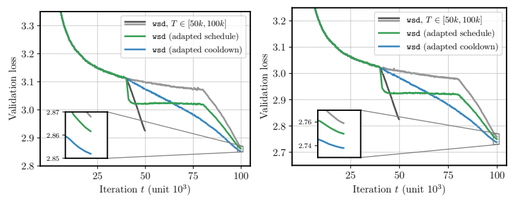
Figure 24 . Experiment with adapted cooldown length for 124M model (left) and 210M (right). See Section 5.1, (B1) for details.
원문 · CC BY 4.0 · Fabian Schaipp, Alexander Hägele, Adrien Taylor, Umut Simsekli, Francis Bach · The Surprising Agreement Between Convex Optimization Theory and Learning-Rate Scheduling for Large Model Training · 원문 그림 인용 · 원본 PDF 19쪽에서 그림 영역을 추출했습니다.SGD 이론과 Adam(W) 실험 사이의 간극
가장 큰 한계는 이론 결과가 SGD에 대한 것이지만 실증 근거는 대부분 Adam(W)로 얻어졌다는 점입니다. 따라서 정리 3.1은 옵티마이저 차이에서 생기는 성능 차이를 설명하지 못합니다. 저자들은 미러 하강법에 대한 부록 분석과 관련 선행 연구를 근거로 이 간극을 향후 연구로 남겨 둡니다. 또한 정리 3.1은 볼록성 가정에 기반하므로 비볼록 딥러닝 현상을 직접 증명하지 않으며, 테스트 손실이 일반화 격차가 작은 상황에서만 비교에 적합하다는 제약도 있습니다.
논문 정보
- 저자
- Fabian Schaipp, Alexander Hägele, Adrien Taylor, Umut Simsekli, Francis Bach
- 학회·저널
- arXiv · 프리프린트
- 최초 공개일
- 2025년 1월 31일
- 등록일
- 2026년 10월 31일
- 수정일
- 2025년 7월 23일
- 버전
- v2
- arXiv
- 2501.18965
- 분류
- cs.LG · math.OC · stat.ML
- 원문 이용 조건
- CC BY 4.0
- 제공 범위
- 논문 정보, 해설, 허용된 원문 그림
AI 해설은 논문 원문과 별개의 설명이며 오류가 있을 수 있습니다. 원문과 그림은 각 출처의 이용 조건과 따로 표시된 권리를 따릅니다.
초록
We show that learning-rate schedules for large model training behave surprisingly similar to a performance bound from non-smooth convex optimization theory. We provide a bound for the constant schedule with linear cooldown; in particular, the practical benefit of cooldown is reflected in the bound due to the absence of logarithmic terms. Further, we show that this surprisingly close match between optimization theory and practice can be exploited for learning-rate tuning: we achieve noticeable improvements for training 124M and 210M Llama-type models by (i) extending the schedule for continued training with optimal learning-rate, and (ii) transferring the optimal learning-rate across schedules.
원문 인용
Fabian Schaipp, Alexander Hägele, Adrien Taylor, Umut Simsekli, Francis Bach (2025). The Surprising Agreement Between Convex Optimization Theory and Learning-Rate Scheduling for Large Model Training. arXiv:2501.18965v2. https://arxiv.org/abs/2501.18965v2
BibTeX
@misc{schaipp2025surprising,
  title = {{The Surprising Agreement Between Convex Optimization Theory and Learning-Rate Scheduling for Large Model Training}},
  author = {Fabian Schaipp and Alexander Hägele and Adrien Taylor and Umut Simsekli and Francis Bach},
  year = {2025},
  eprint = {2501.18965},
  archivePrefix = {arXiv},
  url = {https://arxiv.org/abs/2501.18965v2}
}