논문 해설
A Theory of Cross-Validation Variance
교차 검증 분산의 이론
- 연구 문제 교차검증 추정치의 분산이 모델, 학습 비율, 분할 설계에 따라 어떻게 결정되는지 일반 이론이 부족했습니다.
- 연구 방법 각 관측치의 검증 가중치와 학습 가중치로 추정치를 표현하고, 분산을 샘플링 분산과 분할 잡음으로 나누는 정확한 유한 표본 항등식을 제시합니다.
- 주요 결과 K-fold는 두 가중치가 모두 1/n인 균형 설계로 1차 분산이 K에 의존하지 않으며, 쌍별 지표에서는 일반 K-fold가 분할 잡음을 더하고 leave-pair-out이 이를 제거합니다. 시뮬레이션은 예측 항등식과 측정 분산의 일치를 보고합니다.
교차검증 분산을 설명하는 이론의 공백
교차검증은 데이터를 학습 세트와 검증 세트로 반복해서 나누어 모델의 예측 성능을 추정하는 절차입니다. 이 논문은 K-fold, 반복 K-fold, Monte Carlo 분할, 부트스트랩이 분할 방식에서만 다르다고 보고, 모델·학습 비율·재표본 설계가 함께 교차검증 분산을 어떻게 결정하는지 일반 이론이 부족하다는 점을 문제로 삼습니다. 기존 연구는 개별 설계를 따로 다루었고, 각 관측치가 검증 대상으로서의 역할과 학습 데이터로서의 역할을 동시에 맡는다는 점을 정확한 유한 표본 분해로 제시하지 못했습니다.
역할 가중치와 분산 항등식
논문은 각 관측치가 검증 가중치 v_i와 학습 가중치 w_i라는 두 역할 가중치로 추정치에 기여한다고 설명합니다. 검증 가중치는 전체 검증 평가 중 그 관측치가 차지하는 비율이고, 학습 가중치는 관측치가 학습 세트 사용에서 차지하는 비율입니다. K-fold 교차검증은 반복 횟수와 관계없이 두 가중치가 모두 1/n인 균형 설계이며, Monte Carlo와 부트스트랩은 관측치가 검증되는 횟수가 무작위여서 균형이 깨집니다. 분산 항등식은 1차 분산을 샘플링 분산과 두 가중치의 이차형식으로 나타내고, 쌍별 지표에서도 같은 형태가 유지된다고 제시합니다.
불균형 페널티와 설계 비교
가중치가 균등하지 않으면 1차 분산에 불균형 페널티가 더해집니다. 이 페널티는 두 가중치의 편차를 공분산 행렬로 이차형식화한 값으로 계산되며, 균형 설계에서는 0이 됩니다. 원문은 K-fold가 이 페널티를 갖지 않는다고 보고하고, Monte Carlo와 부트스트랩은 분할 횟수 S에 대해 대략 1/S 수준의 페널티를 가진다고 계산합니다. 따라서 같은 학습 크기에서는 샘플링 분산이 같고, 설계 간 차이는 분할 잡음에서 나타납니다.
쌍별 지표와 leave-pair-out
AUC처럼 사례와 대조 쌍을 비교하는 지표에서는 한 평가가 두 관측치에 걸쳐 있습니다. 논문은 이 경우에도 항등식이 확장되며, 일반 K-fold는 같은 분할에 속한 쌍만 평가하여 K가 커질수록 증가하는 분할 잡음을 더한다고 설명합니다. 모든 사례-대조 쌍을 한 번씩 평가하는 leave-pair-out과 쌍별 교차검증은 이 분할 잡음을 제거하는 설계로 제시됩니다.
시뮬레이션 검증과 적용 범위
저자들은 고정 대역폭 0.7의 Nadaraya–Watson 평활기를 사용하여 MSE, Brier score, AUC에 대해 n이 250, 500, 1000인 조건에서 K-fold(K=2, 5, 10), leave-one-out, Monte Carlo 교차검증(p=0.5, 0.9, S=10)의 측정 분산을 예측 항등식과 비교합니다. 측정 분산과 예측 값의 비율은 대부분의 셀에서 1 근처에 있습니다. 쌍 항을 빼면 AUC 분할 잡음의 예측이 크게 벗어나므로, 1차 항만으로는 쌍별 지표의 교차 쌍 기여를 설명하지 못한다고 보고합니다. 이 검증은 특정 평활기와 설정에서 얻은 결과이며 다른 학습기 전체에 대한 증명이 아닙니다.
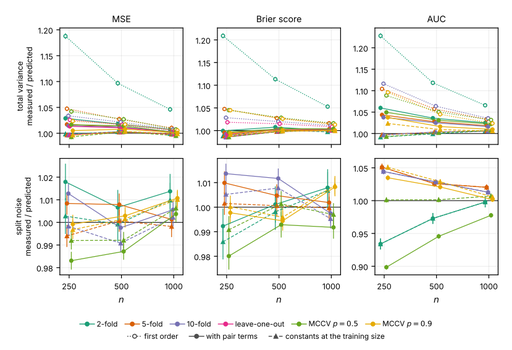
Figure 1 : Measured variance against the identity’s predictions, for three metrics, six designs, and three sample sizes. Error bars are one standard error. Top row: total variance over 10 5 datasets, as a ratio to the prediction at first order (hollow markers, dotted) and to the prediction with the limiting pair terms added (filled markers, solid). Bottom row: split noise over 6000 datasets with 30 redraws, as a ratio to the prediction with the pair terms. Triangles: ratio to the prediction with the constants at the training size, through order three for MSE and the Brier score and at first order for the AUC. Leave-one-out has no split noise.
원문 · CC BY 4.0 · Nathaniel S. O'Connell, Jaime L. Speiser · A Theory of Cross-Validation Variance · 원문 그림 인용 · 원본 PDF 24쪽에서 그림 영역을 추출했습니다.한계와 남은 질문
이 분석은 고정 분할 수, 특정 가정(A1 등), 그리고 영향 함수 조건을 전제로 합니다. 쌍별 지표에서는 쌍 항의 보정이 필요하며 이를 빼면 분할 잡음이 과소추정됩니다. 원문은 실제 학습기 전반에서 이 조건이 성립하는지를 완전히 보장하지 않으며, 고차 항을 추정하는 실용적 추정기의 개발은 향후 과제로 남겨 둡니다.
논문 정보
- 저자
- Nathaniel S. O'Connell, Jaime L. Speiser
- 학회·저널
- arXiv · 프리프린트
- 최초 공개일
- 2026년 11월 10일
- 등록일
- 2026년 11월 12일
- 수정일
- 2026년 11월 10일
- 버전
- v1
- arXiv
- 2611.14463
- 분류
- stat.ML · cs.LG · math.ST
- 원문 이용 조건
- CC BY 4.0
- 제공 범위
- 논문 정보, 해설, 허용된 원문 그림
AI 해설은 논문 원문과 별개의 설명이며 오류가 있을 수 있습니다. 원문과 그림은 각 출처의 이용 조건과 따로 표시된 권리를 따릅니다.
초록
Cross-validation estimates predictive performance by repeatedly splitting the data into training and validation sets, fitting the model on the first and evaluating it on the second. Every observation influences the estimate in two roles, through its own evaluation when it is held out and through the models it helps fit when it trains. The random splits determine its weight in each role. From this representation, we prove an exact finite-sample identity for the variance of the cross-validated estimate. For a given splitting scheme with a common training set size, the variance is a function of these weights, with constants of the model, the metric, and the population. It covers metrics averaged over observations, such as mean squared error, and over case--control pairs, such as the AUC. The identity shows which schemes to use. The variance decomposes into sampling variance, which depends only on the training size, and variance due to the random fold splitting, which arises when the weights change from one draw of the splits to the next. K-fold cross-validation, whose weights are equal across observations by design, is therefore variance optimal at first order; Monte Carlo and bootstrap cross-validation are not. The first-order variance of K-fold does not depend on K, and under reasonable conditions on the model leave-one-out has the smallest variance of any K-fold scheme. For the AUC the same holds for leave-pair-out, which evaluates every case--control pair. Finally, we show the cross-validated estimate is asymptotically normal with the identity's full variance. Together, these results provide a general theoretical foundation for inference on cross-validated performance and establish principles for selecting variance-optimal cross-validation designs.
원문 인용
Nathaniel S. O'Connell, Jaime L. Speiser (2026). A Theory of Cross-Validation Variance. arXiv:2611.14463v1. https://arxiv.org/abs/2611.14463v1
BibTeX
@misc{oconnell2026theory,
  title = {{A Theory of Cross-Validation Variance}},
  author = {Nathaniel S. O'Connell and Jaime L. Speiser},
  year = {2026},
  eprint = {2611.14463},
  archivePrefix = {arXiv},
  url = {https://arxiv.org/abs/2611.14463v1}
}