논문 해설
PAPERBENCHX: Can AI Reproduce Science Across Disciplines?
PAPERBENCHX: AI가 여러 학문 분야에서 과학을 재현할 수 있을까?
- 연구 문제 AI가 이미 알려진 과학 주장을 도메인 네이티브 환경에서 재현하고 독립적으로 검증 가능한 증거를 만들 수 있는지를 평가합니다.
- 연구 방법 논문 단위 과제를 클린 리플레이로 재실행하고 재생성된 증거만 루브릭으로 채점하는 벤치마크를 제시합니다.
- 주요 결과 10개 구성 중 최고 평균 부분 점수는 59.08%였지만 완전 재현율은 13.98%였고, 어떤 구성도 71개 과제를 완전 재현하지 못했습니다.
논문 단위 과학 재현이라는 문제
이 논문은 AI가 새로운 과학을 발견하기 전에 이미 알려진 과학을 재현할 수 있는지를 묻습니다. 재현은 목표 주장이 이미 알려져 있다는 점에서 명확한 점검 지점이지만, 불완전한 과학 기술을 실행 가능한 실험으로 옮기고 독립적으로 검증 가능한 증거를 만들어야 하므로 여전히 어렵습니다. 기존 연구 재현 벤치마크는 주로 머신러닝 분야에 집중되어 있어 소프트웨어 환경이 상대적으로 동질적입니다.
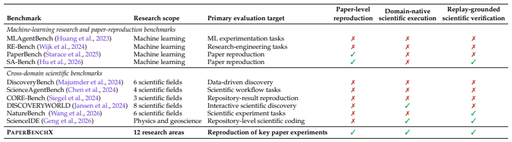
Table 1 :Comparison with prior agent benchmarks.Checkmarks indicate that a benchmark explicitly evaluates the named capability.
원문 · CC BY 4.0 · Ruoyu Wu, Zengji Tu, Aolong Sun, Tianyi Ma, Junren Li, Xinbo Xu, Li Fu, Ziyan Zhang, Pinrui Huang, Xiaochen Wang, Chengda Wu, Yutao Zhou, Jianjun Wu, Lin Chang, Baobao Chang, Liang Chen, Kuan Li · PAPERBENCHX: Can AI Reproduce Science Across Disciplines? · 원문 그림 인용 · 원본 PDF 4쪽에서 그림 영역을 추출했습니다.과학 분야 전반으로 확장하면 에이전트는 분야별 과학 소프트웨어를 조작하고, 물리적·수치적 선택을 내리며, 오래 걸리는 계산을 진단하고, 그럴듯하지만 잘못된 출력과 유효한 증거를 구분해야 합니다. 논문은 이 세 가지 도전을 과학적 재구성, 도메인 네이티브 실행, 과학적 검증으로 나누어 제시합니다.
PAPERBENCHX의 구성과 과제 정의
PAPERBENCHX는 93개 전문가 구축 과제로 이루어진 벤치마크이며, 12개 연구 영역과 10개 도메인 네이티브 과학 컴퓨팅 환경을 포함합니다. 각 과제는 출판된 논문의 검증 가능한 과학적 주장을 중심으로 합니다. 에이전트는 논문, 공개 과제 명세, 필요한 과학 환경을 받지만 비공개 참조 워크플로와 평가 루브릭은 받지 않습니다.
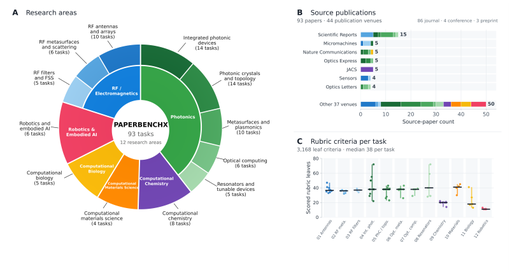
Figure 3 :Coverage and evaluation structure of PAPERBENCHX. A, The 93 tasks span 12 research areas in six scientific domains.B, Their 93 source papers span 44 publication venues; bar colors correspond to the 12 research areas in A.C, The task rubrics contain 3,168 scorable criteria (median 38 per task); points are tasks and black ticks mark research-area medians.
원문 · CC BY 4.0 · Ruoyu Wu, Zengji Tu, Aolong Sun, Tianyi Ma, Junren Li, Xinbo Xu, Li Fu, Ziyan Zhang, Pinrui Huang, Xiaochen Wang, Chengda Wu, Yutao Zhou, Jianjun Wu, Lin Chang, Baobao Chang, Liang Chen, Kuan Li · PAPERBENCHX: Can AI Reproduce Science Across Disciplines? · 원문 그림 인용 · 원본 PDF 5쪽에서 그림 영역을 추출했습니다.에이전트의 목표는 실험을 재구성하고, 제출 시 증거를 재생성하는 실행 가능한 워크플로를 전달하는 것입니다. 환경은 과제 정의의 일부로 취급됩니다. 모델 표현, 수치 규약, 실행 절차, 수렴 증거가 과학 소프트웨어마다 다르기 때문입니다.
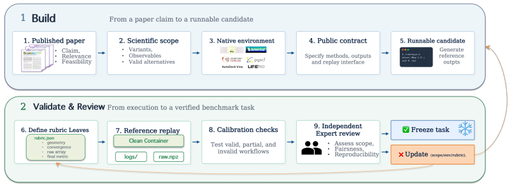
Figure 4 :Task construction and quality control.Experts turn a published claim into a runnable task by defining its scientific scope, provisioning the domain-native environment, and specifying the public task contract. Reference replay, calibration checks, and independent expert review verify executability, fairness, and evidence requirements before the task is admitted to the benchmark.
원문 · CC BY 4.0 · Ruoyu Wu, Zengji Tu, Aolong Sun, Tianyi Ma, Junren Li, Xinbo Xu, Li Fu, Ziyan Zhang, Pinrui Huang, Xiaochen Wang, Chengda Wu, Yutao Zhou, Jianjun Wu, Lin Chang, Baobao Chang, Liang Chen, Kuan Li · PAPERBENCHX: Can AI Reproduce Science Across Disciplines? · 원문 그림 인용 · 원본 PDF 6쪽에서 그림 영역을 추출했습니다.클린 리플레이와 증거 기반 채점
제출 후 평가기는 과제 컨테이너를 새로 준비하고, 제출된 패키지만 복원한 뒤 reproduce.sh를 실행합니다. 이 재실행에서 재생성된 산출물만 증거로 인정되며, 에이전트의 보고서는 증거를 대신할 수 없습니다. 재생성된 출력은 읽기 전용 증거 집합으로 고정되고, 각 과학적 결론은 이 집합의 어떤 증거에 추적되어야 합니다.
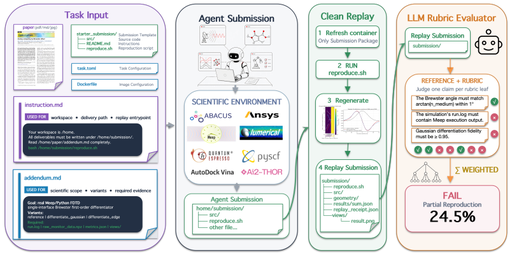
Figure 2 :From task package to replay-grounded score.An agent receives the paper, task specification, environment, and starter submission; interacts with domain-native scientific software; and returns a runnable package. Clean replay regenerates the evidence used to score the scientific rubric. The displayed leaves and scores are illustrative.
원문 · CC BY 4.0 · Ruoyu Wu, Zengji Tu, Aolong Sun, Tianyi Ma, Junren Li, Xinbo Xu, Li Fu, Ziyan Zhang, Pinrui Huang, Xiaochen Wang, Chengda Wu, Yutao Zhou, Jianjun Wu, Lin Chang, Baobao Chang, Liang Chen, Kuan Li · PAPERBENCHX: Can AI Reproduce Science Across Disciplines? · 원문 그림 인용 · 원본 PDF 2쪽에서 그림 영역을 추출했습니다.채점은 루브릭 리프 단위로 이루어지며, 각 리프는 Modeling, Execution, Validation 중 한 단계에 속합니다. 과제 점수 R은 리프 점수 si와 유효 가중치 wi의 가중합으로 계산되며 wi의 합은 1입니다. 결정론적 검사로 평가할 수 있는 속성은 그 검사로 처리하고, 도메인 해석이 필요한 요구는 GPT-5.6-sol 평가자가 같은 방식으로 판단합니다.
Full rate와 Partial score
논문은 두 지표로 성능을 보고합니다. Full rate는 R이 0.9를 엄격히 초과하는 과제의 비율이며, 정확히 0.9인 경우는 포함되지 않습니다. Partial score는 93개 과제 결과 집합에서 R의 평균으로, 완전하지 않은 긴 재현에서도 가중된 진행 정도를 포착합니다.
모든 구성은 같은 과제 집합에서 평가됩니다. Fable 5 또는 Fable 5.1이 거부한 과제는 Opus 5로 대체되며, 원래 거부는 거부율에 보존됩니다. 결측 결과와 유효한 대체가 없는 거부는 0으로 계산됩니다.
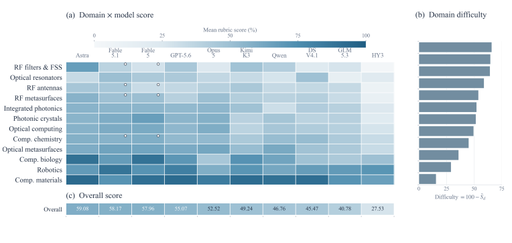
Figure 5 :Domain-specific capability profiles. (a)Mean rubric score by model and research area, ordered from hardest to easiest; circles mark Fable refusals scored using the Opus 5 fallback.(b)Domain difficulty, defined as 100 minus the cross-model mean.(c)Overall scores, matching Table 2. Names are abbreviated.
원문 · CC BY 4.0 · Ruoyu Wu, Zengji Tu, Aolong Sun, Tianyi Ma, Junren Li, Xinbo Xu, Li Fu, Ziyan Zhang, Pinrui Huang, Xiaochen Wang, Chengda Wu, Yutao Zhou, Jianjun Wu, Lin Chang, Baobao Chang, Liang Chen, Kuan Li · PAPERBENCHX: Can AI Reproduce Science Across Disciplines? · 원문 그림 인용 · 원본 PDF 9쪽에서 그림 영역을 추출했습니다.10개 구성의 재현 결과
가장 높은 평균 부분 점수는 GPT-6-Astra(Codex)의 59.08%였으며, 완전 재현율은 13.98%였습니다. 이 구성은 93개 과제 중 13개에서만 90% 기준을 넘었습니다. 10개 구성의 평균 부분 점수는 49.26%이고 평균 완전 재현율은 8.60%로, 부분적 진행이 완전한 재현으로 잘 이어지지 않음을 보여 줍니다.
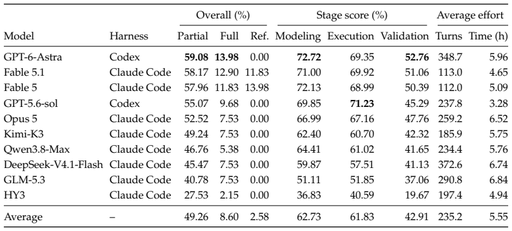
Table 2 :Model-level results on the shared set of 93 tasks.Partial, Full, Ref., and all stage scores are reported as percentages; metric definitions and outcome handling follow Section 4.1.
원문 · CC BY 4.0 · Ruoyu Wu, Zengji Tu, Aolong Sun, Tianyi Ma, Junren Li, Xinbo Xu, Li Fu, Ziyan Zhang, Pinrui Huang, Xiaochen Wang, Chengda Wu, Yutao Zhou, Jianjun Wu, Lin Chang, Baobao Chang, Liang Chen, Kuan Li · PAPERBENCHX: Can AI Reproduce Science Across Disciplines? · 원문 그림 인용 · 원본 PDF 8쪽에서 그림 영역을 추출했습니다.단계별로 보면 평균 Modeling은 62.73%, Execution은 61.83%, Validation은 42.91%입니다. 어떤 구성도 71개 과제를 완전하게 재현하지 못했습니다. 이 결과는 본 벤치마크와 평가 조건에서 얻은 것입니다.
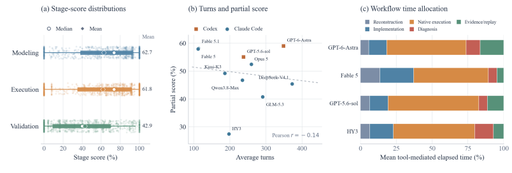
Figure 6 :Stage performance, interaction length, and workflow allocation. (a)Stage-score distributions over 930 outcomes; thick and thin lines denote the interquartile and 10th–90th percentile ranges, and circles and diamonds denote medians and means.(b)Partial score versus the trimmed average turns in Table 2.(c)Mean tool-mediated time allocation across 200 sampled trajectories (50 per model), with phases coded from timestamped tool actions using fixed rules.
원문 · CC BY 4.0 · Ruoyu Wu, Zengji Tu, Aolong Sun, Tianyi Ma, Junren Li, Xinbo Xu, Li Fu, Ziyan Zhang, Pinrui Huang, Xiaochen Wang, Chengda Wu, Yutao Zhou, Jianjun Wu, Lin Chang, Baobao Chang, Liang Chen, Kuan Li · PAPERBENCHX: Can AI Reproduce Science Across Disciplines? · 원문 그림 인용 · 원본 PDF 10쪽에서 그림 영역을 추출했습니다.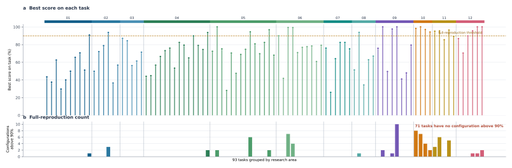
Figure 8 :Task-level completion landscape. (a)Maximum Partial score attained on each of the 93 tasks, ordered by research area.(b)Number of configurations exceeding 90% on the same task. The horizontal line marks the operational full-reproduction threshold; 71 tasks have no configuration above it.
원문 · CC BY 4.0 · Ruoyu Wu, Zengji Tu, Aolong Sun, Tianyi Ma, Junren Li, Xinbo Xu, Li Fu, Ziyan Zhang, Pinrui Huang, Xiaochen Wang, Chengda Wu, Yutao Zhou, Jianjun Wu, Lin Chang, Baobao Chang, Liang Chen, Kuan Li · PAPERBENCHX: Can AI Reproduce Science Across Disciplines? · 원문 그림 인용 · 원본 PDF 21쪽에서 그림 영역을 추출했습니다.해석의 범위와 남은 질문
논문의 결과는 이 93개 과제, 10개 구성, 그리고 GPT-5.6-sol 평가자의 채점 조건에서 나온 것입니다. 저자들은 검증 단계가 가장 약한 지점이라고 해석하지만, 이는 이 벤치마크의 집계 결과에서 도출한 해석입니다. 전체 과학 분야에 대한 일반적 능력을 확정하는 자료로 읽어서는 안 됩니다.
또한 대부분의 과제는 숨겨진 평가 집합으로 남겨져 있어, 공개된 12개 대표 과제 외의 세부 채점은 직접 확인할 수 없습니다.
논문 정보
- 저자
- Ruoyu Wu, Zengji Tu, Aolong Sun, Tianyi Ma, Junren Li, Xinbo Xu, Li Fu, Ziyan Zhang, Pinrui Huang, Xiaochen Wang, Chengda Wu, Yutao Zhou, Jianjun Wu, Lin Chang, Baobao Chang, Liang Chen, Kuan Li
- 학회·저널
- arXiv · 프리프린트
- 최초 공개일
- 2026년 10월 29일
- 등록일
- 2026년 11월 1일
- 수정일
- 2026년 10월 29일
- 버전
- v1
- arXiv
- 2610.39744
- 분류
- cs.AI
- 원문 이용 조건
- CC BY 4.0
- 제공 범위
- 논문 정보, 해설, 허용된 원문 그림
AI 해설은 논문 원문과 별개의 설명이며 오류가 있을 수 있습니다. 원문과 그림은 각 출처의 이용 조건과 따로 표시된 권리를 따릅니다.
초록
Before AI can be trusted to discover new science, it should be able to reproduce what science already knows. Reproduction provides a rigorous checkpoint for an AI scientist: the target claim is known, yet recovering it still requires translating an incomplete scientific description into an executable experiment and producing evidence that can be independently verified. Existing research-reproduction benchmarks largely focus on AI and machine learning, where experiments share relatively homogeneous software stacks. Extending this capability across scientific disciplines introduces a different challenge: agents must operate domain-specific scientific software, make physical and numerical choices, diagnose long-running computations, and distinguish valid evidence from merely plausible outputs. We introduce PAPERBENCHX, a benchmark of 93 expert-constructed paper-reproduction tasks spanning 12 research areas across electromagnetics, photonics, chemistry, materials science, biology, and robotics. Each task provides the source paper, a public task specification, and a domain-native scientific environment involving specialized scientific software. Agents must reconstruct a key experiment, execute and diagnose it, and deliver a runnable workflow that supports the target scientific claim. To evaluate scientific validity rather than surface-level agreement, we replay every submission from scratch and score only regenerated evidence against expert-validated criteria. Across 10 frontier agent configurations, the best configuration fully reproduces only 14% tasks under the 90% threshold. Meanwhile, mean rubric scores range from 27.53% to 59.08%, indicating that substantial partial progress rarely translates into complete scientific reproduction. These results reveal a large gap between paper understanding and reliably producing reproducible scientific evidence.
원문 인용
Ruoyu Wu, Zengji Tu, Aolong Sun, Tianyi Ma, Junren Li, Xinbo Xu, Li Fu, Ziyan Zhang, Pinrui Huang, Xiaochen Wang, Chengda Wu, Yutao Zhou, Jianjun Wu, Lin Chang, Baobao Chang, Liang Chen, Kuan Li (2026). PAPERBENCHX: Can AI Reproduce Science Across Disciplines?. arXiv:2610.39744v1. https://arxiv.org/abs/2610.39744v1
BibTeX
@misc{wu2026paperbenchx,
  title = {{PAPERBENCHX: Can AI Reproduce Science Across Disciplines?}},
  author = {Ruoyu Wu and Zengji Tu and Aolong Sun and Tianyi Ma and Junren Li and Xinbo Xu and Li Fu and Ziyan Zhang and Pinrui Huang and Xiaochen Wang and Chengda Wu and Yutao Zhou and Jianjun Wu and Lin Chang and Baobao Chang and Liang Chen and Kuan Li},
  year = {2026},
  eprint = {2610.39744},
  archivePrefix = {arXiv},
  url = {https://arxiv.org/abs/2610.39744v1}
}