논문 해설
Bilateral Reference for High-Resolution Dichotomous Image Segmentation
고해상도 이분 이미지 분할을 위한 양방향 참조
- 연구 문제 고해상도 영상의 얇고 복잡한 객체를 정확히 분할하는 것이 기존 방법에서 어렵습니다.
- 연구 방법 원본 해상도 패치를 쓰는 inward reference와 그래디언트 감독을 쓰는 outward reference를 결합한 BiRefNet을 제안합니다.
- 주요 결과 절제 실험에서 RM과 BiRef 구성 요소가 F^x_β를 높였고, DIS5K 등 여러 벤치마크에서 비교 결과가 보고되었습니다.
고해상도 이분 영상 분할의 어려움
고해상도 이분 영상 분할(DIS)은 고해상도 영상에서 얇고 복잡한 구조를 가진 객체를 정확히 분할하는 과제입니다. 기존 방법들은 중간 감독, 주파수 사전 정보, 분할 감독 등을 활용했지만 매우 미세한 특징을 충분히 포착하지 못한다고 저자들은 설명합니다. 저자들은 세부 특징이 원본 영상의 미분 연산으로 얻은 그래디언트 특징에서 잘 드러난다고 관찰했고, 배경과 색과 질감이 비슷한 위치에서는 그래디언트가 약해질 수 있다고 봅니다. 이 논문은 이러한 한계를 다루기 위해 원본 해상도 정보와 그래디언트 정보를 함께 사용하는 BiRefNet을 제안합니다.
BiRefNet의 구조와 bilateral reference
BiRefNet은 위치 추정을 담당하는 localization module(LM)과 고해상도 복원을 담당하는 reconstruction module(RM)로 나뉩니다. LM은 인코더의 계층적 특징을 결합하여 저해상도 깊은 층에서 거친 예측을 얻고, RM은 bilateral reference(BiRef) 블록으로 예측을 단계적으로 복원합니다. BiRef는 원본 해상도 이미지를 디코더 단계 크기에 맞게 적응적으로 잘라 패치로 제공하는 inward reference와, 그래디언트 레이블로 세부 구조가 많은 영역에 주의를 집중시키는 outward reference로 구성됩니다. outward reference에서는 그래디언트 맵 예측을 감독하여 특징이 그래디언트에 민감하도록 하며, 예측 맵을 기반으로 만든 마스크로 배경의 비대상 그래디언트를 줄입니다.
학습 목적함수
학습 목적함수는 픽셀 수준의 BCE 손실, 영역 수준의 IoU 손실, 경계 수준의 SSIM 손실, 의미 수준의 CE 손실을 가중합으로 결합합니다. 원문은 λ1부터 λ4를 각각 30, 0.5, 10, 5로 설정하여 손실들이 학습 초기에 비슷한 수준이 되도록 한다고 밝힙니다. 이 설정은 이 논문의 학습 조건이며 다른 모델에 그대로 적용된다는 근거는 아닙니다.
다중 단계 감독과 학습 에폭
저자들은 DIS 학습에서 긴 학습이 세부 구조 성능을 높이지만 계산 비용이 크다는 점을 확인했습니다. 다중 단계 감독(MSS)은 각 디코더 단계의 중간 예측에 감독을 주어 세부 구조 학습을 가속합니다. DIS-VD에서 MSS 없이 200 epoch 학습한 모델의 F^x_β는 .875이고 400 epoch 학습 모델은 .897입니다. MSS를 적용한 200 epoch 모델은 .892로, 저자들은 이를 400 epoch 학습에 가까운 성능이라고 보고합니다. 원문은 이 절제 표의 조건과 DIS 학습 설정 600 epoch를 구분하여 읽어야 한다고 봅니다.
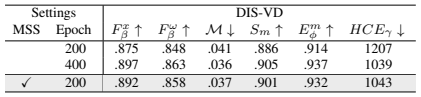
Table 1 . Quantitative ablation studies of the proposed multi- stage supervision for acceleration and training epochs.
원문 · CC BY 4.0 · Peng Zheng, Dehong Gao, Deng-Ping Fan, Li Liu, Jorma Laaksonen, Wanli Ouyang, Nicu Sebe · Bilateral Reference for High-Resolution Dichotomous Image Segmentation · 원문 그림 인용 · 원본 PDF 6쪽에서 그림 영역을 추출했습니다.구성 요소 절제 실험
DIS-VD에서 RM, InRef, OutRef를 바꾼 절제 실험은 각 구성 요소의 기여를 확인합니다. RM을 추가하면 F^x_β가 .837에서 .855로 증가하며, 원문은 이를 약 2.2%의 상대 향상으로 기술합니다. 두 BiRef 구성 요소는 함께 사용될 때 F^x_β 향상에 기여하며, 원문은 RM과 BiRef를 결합하면 약 6.2%의 상대 향상이 나온다고 보고합니다. 이 결과는 DIS-VD에서 측정한 절제 조건에 한정됩니다.
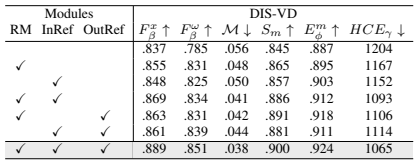
Table 2 . Quantitative ablation studies of the proposed com- ponents in the proposed BiRefNet. The ablation studies are con- ducted on the effectiveness of the proposed components, including reconstruction module (RM), inward reference (InRef), outward reference (OutRef), and their combinations.
원문 · CC BY 4.0 · Peng Zheng, Dehong Gao, Deng-Ping Fan, Li Liu, Jorma Laaksonen, Wanli Ouyang, Nicu Sebe · Bilateral Reference for High-Resolution Dichotomous Image Segmentation · 원문 그림 인용 · 원본 PDF 6쪽에서 그림 영역을 추출했습니다.DIS5K 비교 결과
DIS5K 테스트 세트에서 BiRefNet은 DIS-TE1에 대해 F^x_β .860, F^ω_β .819, M .037, Sm .885, HCE_γ 106을 보고합니다. 원문은 DIS5K, HRSOD, COD에서 각각 6.8%, 2.0%, 5.6%의 평균 Sm 향상을 보고합니다. 이 수치는 원문이 보고한 각 과제의 비교 결과이며, 같은 기준선과 같은 조건의 통합 실험으로 합산한 값이 아닙니다.
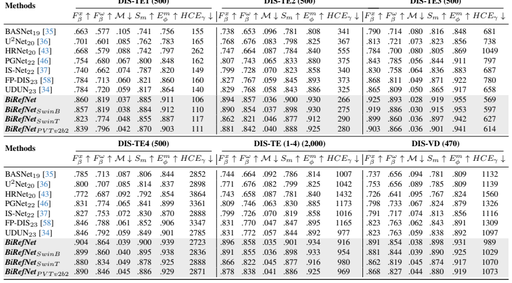
Table 4 . Quantitative comparisons between our BiRefNet and the state-of-the-art methods on DIS5K.“↑” (“↓”) means that the higher (lower) is better. We use the results from [34], where all methods take 1024×1024 input.
원문 · CC BY 4.0 · Peng Zheng, Dehong Gao, Deng-Ping Fan, Li Liu, Jorma Laaksonen, Wanli Ouyang, Nicu Sebe · Bilateral Reference for High-Resolution Dichotomous Image Segmentation · 원문 그림 인용 · 원본 PDF 9쪽에서 그림 영역을 추출했습니다.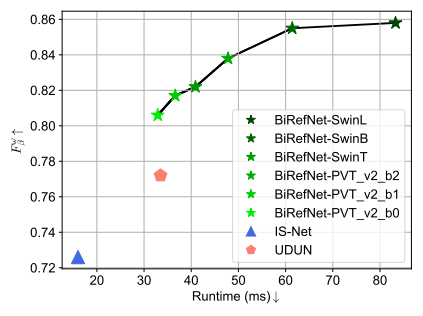
Figure 8 . Comparison of the efficiency, size, complexity, and per- formance of BiRefNet and existing DIS methods.
원문 · CC BY 4.0 · Peng Zheng, Dehong Gao, Deng-Ping Fan, Li Liu, Jorma Laaksonen, Wanli Ouyang, Nicu Sebe · Bilateral Reference for High-Resolution Dichotomous Image Segmentation · 원문 그림 인용 · 원본 PDF 10쪽에서 그림 영역을 추출했습니다.적용 범위와 한계
본 논문의 주요 결과는 DIS5K, HRSOD, COD 등 제시된 벤치마크와 지표에 한정됩니다. 절제 실험과 학습 전략의 효과는 DIS-VD와 해당 학습 조건에서 확인되었으며, 다른 데이터셋이나 다른 백본에서의 효과는 원문 근거로 확정되지 않습니다. 또한 저자들이 제시한 응용 사례는 잠재적 활용과 제3자 사례를 포함하며, 그 결과를 이 논문의 검증 결과와 같은 수준으로 보지 않아야 합니다.
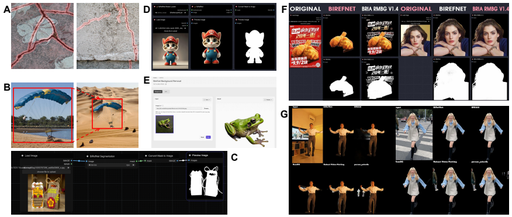
Figure 9 . Potenial applications and selected existing third-party applications based on BiRefNet, and visual comparisons on social media. (A) Potential application #1. Building crack detection for the maintenance of architecture health. (B) Potential application #2. Highly accurate object extraction in high-resolution natural images. (C) A project by viperyl first packs our BiRefNet as a ComfyUI node and makes this SOTA model easier to use for everyone. (D) ZHO also provides a ComfyUI-based project to further improve the UI for our BiRefNet, especially for video data. (E) Fal.AI encapsulates our BiRefNet online with more useful options in UI and API to call the model. (F) ZHO provides a visual comparison between our BiRefNet and previous SOTA method BRIA RMGB v1.4 which has extra training on their private training dataset. (G) Toyxyz conducted a comparison between our BiRefNet and previous competitive human matting methods (e.g., BRIAAI, RemBG, Robust Video Matting, and Person YOLOv8s) with both videos and images.
원문 · CC BY 4.0 · Peng Zheng, Dehong Gao, Deng-Ping Fan, Li Liu, Jorma Laaksonen, Wanli Ouyang, Nicu Sebe · Bilateral Reference for High-Resolution Dichotomous Image Segmentation · 원문 그림 인용 · 원본 PDF 11쪽에서 그림 영역을 추출했습니다.논문 정보
- 저자
- Peng Zheng, Dehong Gao, Deng-Ping Fan, Li Liu, Jorma Laaksonen, Wanli Ouyang, Nicu Sebe
- 학회·저널
- arXiv · 프리프린트
- 최초 공개일
- 2024년 1월 7일
- 등록일
- 2026년 11월 6일
- 수정일
- 2025년 7월 25일
- 버전
- v7
- arXiv
- 2401.03407
- DOI
- 10.26599/air.2024.9150038
- 분류
- cs.CV
- 원문 이용 조건
- CC BY 4.0
- 제공 범위
- 논문 정보, 해설, 허용된 원문 그림
AI 해설은 논문 원문과 별개의 설명이며 오류가 있을 수 있습니다. 원문과 그림은 각 출처의 이용 조건과 따로 표시된 권리를 따릅니다.
초록
We introduce a novel bilateral reference framework (BiRefNet) for high-resolution dichotomous image segmentation (DIS). It comprises two essential components: the localization module (LM) and the reconstruction module (RM) with our proposed bilateral reference (BiRef). The LM aids in object localization using global semantic information. Within the RM, we utilize BiRef for the reconstruction process, where hierarchical patches of images provide the source reference and gradient maps serve as the target reference. These components collaborate to generate the final predicted maps. We also introduce auxiliary gradient supervision to enhance focus on regions with finer details. Furthermore, we outline practical training strategies tailored for DIS to improve map quality and training process. To validate the general applicability of our approach, we conduct extensive experiments on four tasks to evince that BiRefNet exhibits remarkable performance, outperforming task-specific cutting-edge methods across all benchmarks. Our codes are available at https://github.com/ZhengPeng7/BiRefNet.
원문 인용
Peng Zheng, Dehong Gao, Deng-Ping Fan, Li Liu, Jorma Laaksonen, Wanli Ouyang, Nicu Sebe (2024). Bilateral Reference for High-Resolution Dichotomous Image Segmentation. arXiv:2401.03407v7. https://doi.org/10.26599/air.2024.9150038
BibTeX
@article{zheng2024bilateral,
  title = {{Bilateral Reference for High-Resolution Dichotomous Image Segmentation}},
  author = {Peng Zheng and Dehong Gao and Deng-Ping Fan and Li Liu and Jorma Laaksonen and Wanli Ouyang and Nicu Sebe},
  year = {2024},
  eprint = {2401.03407},
  archivePrefix = {arXiv},
  doi = {10.26599/air.2024.9150038},
  url = {https://arxiv.org/abs/2401.03407v7}
}