논문 해설
From Retouched Images to Paired Videos: A Synthetic Benchmark for Face Video Retouching
보정된 이미지에서 짝지은 비디오까지: 얼굴 비디오 보정을 위한 합성 벤치마크
- 연구 문제 얼굴 영상 리터칭에는 시간적으로 정렬된 before-and-after 영상 쌍이 필요하지만 이를 대량으로 얻기 어렵습니다.
- 연구 방법 DeepFRR 이미지 쌍의 raw 이미지를 Wan2.2로 움직이게 한 뒤 Akool과 SimSwap 얼굴 전이로 프레임별 proxy 타깃을 만듭니다.
페어 영상 리터칭 데이터가 부족한 이유
얼굴 영상 리터칭을 학습하려면 같은 정체성, 표정, 자세, 움직임을 공유하면서 보정 스타일만 다른 raw와 retouched 영상 쌍이 필요합니다. 그런데 전문가가 프레임마다 일관되게 보정한 영상을 만드는 일은 비용이 크고, 얼굴 영상을 공개하면 프라이버시와 동의 문제가 생깁니다. 이미지 단위 리터칭 데이터셋은 여럿 있지만, 프레임이 시간적으로 정렬된 before-and-after 얼굴 영상 쌍은 널리 쓰이는 벤치마크가 없습니다. 이미지 모델을 프레임마다 적용하면 깜빡임과 정체성 속성의 불안정이 생기는데, 이런 문제를 평가하려면 시간 정렬된 쌍이 필요합니다. 저자들은 이 빈자리를 메우기 위해 DeepVFR을 제시하며, 이를 새 리터칭 구조가 아니라 통제된 합성 벤치마크로 한정합니다.

Table 1 : Representative supervision sources for video face retouching.
원문 · CC BY 4.0 · Peiyuan Zeng, Fengchuang Xing, Shiming Wu, Hongwei Yue, Chao Zhou · From Retouched Images to Paired Videos: A Synthetic Benchmark for Face Video Retouching · 원문 그림 인용 · 원본 PDF 3쪽에서 그림 영역을 추출했습니다.DeepFRR 이미지 쌍을 영상 쌍으로 바꾸는 방법
구성은 DeepFRR의 1:1 raw/retouched 이미지 쌍에서 시작합니다. 저자들은 품질 필터링과 계층 샘플링으로 1,024쌍을 골랐습니다. 각 raw 이미지는 Wan2.2 image-to-video 모델로 150프레임, 30 fps의 mild-motion 원본 영상이 됩니다. 이때 I2V 모델은 최종 리터칭 모델이 아니라 움직임 사전을 만드는 생성기로만 쓰입니다. 다음으로 각 프레임에서 대응 retouched 이미지의 외형을 얼굴 전이 연산으로 옮깁니다. 주 경로는 Akool이고, SimSwap은 더 작은 보완 부분집합에 쓰입니다. 전이된 얼굴 영역은 BiSeNet 얼굴 파싱 마스크의 feathered alpha로 원본 프레임과 섞입니다.
배경과 머리카락, 얼굴 밖 영역은 원본 프레임이 유지됩니다. 자동 검사와 시각 검수로 실패 클립을 같은 층에서 교체합니다.
분할과 구성의 범위
DeepVFR은 1,024개 클립 쌍을 가지며 각 클립은 150프레임입니다. 식별자 분리 프로토콜에 따라 885개 클립을 학습에, 139개 클립을 테스트에 배정했습니다. 프레임은 한 클립 안에서 서로 강하게 연관되므로 153,600개 프레임 대응을 독립 예제 수로 해석하면 안 됩니다. 연령 집단과 성별 표현 태그는 분석용으로 제공되며, 예측 목표가 아닙니다. 어린 아이 샘플은 상대적으로 적은데, 현재 I2V와 얼굴 전이 파이프라인이 매우 어린 얼굴에서 덜 안정적이기 때문입니다. 식별자 분리 분할은 기억을 줄이지만, 합성에서 실제 영상으로의 일반화를 직접 재지는 않습니다.
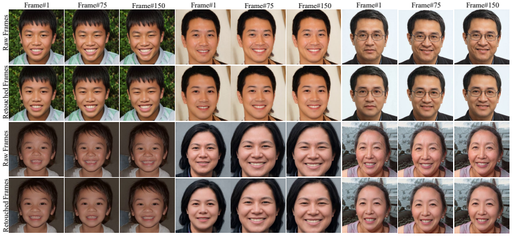
Figure 2 : Representative DeepVFR samples. Each group contains three frames from one clip; the six examples were selected from metadata strata crossing age group (child, youth, elderly) and gender (male, female).
원문 · CC BY 4.0 · Peiyuan Zeng, Fengchuang Xing, Shiming Wu, Hongwei Yue, Chao Zhou · From Retouched Images to Paired Videos: A Synthetic Benchmark for Face Video Retouching · 원문 그림 인용 · 원본 PDF 6쪽에서 그림 영역을 추출했습니다.식별자 분리 테스트 분할에서의 비교
공식 식별자 분리 테스트 분할에서 RestoreFormer, GPEN, RetouchFormer, RetouchGPT, VRetouchEr를 비교했습니다. 목표 참조 충실도에서 RestoreFormer와 GPEN은 PSNR 24.0368과 23.9788을 기록했고, RetouchFormer는 27.9078이었습니다. 다만 LPIPS-T와 RGBFlicker는 움직임과 깜빡임을 구분하지 않으므로, 작은 값을 곧바로 더 나은 시간적 품질로 읽으면 안 됩니다. 또 PSNR과 SSIM은 복사된 배경까지 포함하므로 얼굴 리터칭 기여만 분리하지 못합니다.
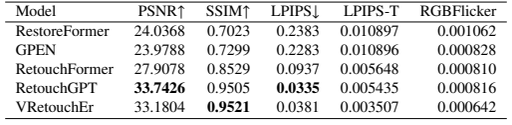
Table 3 : Results on the official identity-disjoint DeepVFR test split. Bold values mark the best target-referenced fidelity scores. Temporal columns describe unaligned adjacent-frame change; smaller values do not establish better temporal quality.
원문 · CC BY 4.0 · Peiyuan Zeng, Fengchuang Xing, Shiming Wu, Hongwei Yue, Chao Zhou · From Retouched Images to Paired Videos: A Synthetic Benchmark for Face Video Retouching · 원문 그림 인용 · 원본 PDF 8쪽에서 그림 영역을 추출했습니다.외부 체크포인트의 전체 클립 적용 진단
이 진단에서는 DeepVFR에서 학습한 모델이 아니라 공개 체크포인트를 재학습 없이 1,024개 고정 클립 전체에 적용했습니다. 공개 체크포인트의 소스 감독은 FFHQR 이미지 쌍, FFHQR 기반 지시문, FFHQR-Seq 의사 시퀀스로 서로 다릅니다. 그래서 이 표는 공정성을 통제한 순위가 아니라 감독 불일치 아래의 호환성 진단입니다. VRetouchEr의 우위는 구조와 pre-training, 감독이 함께 다르므로 시간 모델링 덕분이라고 귀속할 수 없습니다. 이 표의 값과 식별자 분리 테스트 표의 값은 분할이 달라 직접 비교하면 안 됩니다.

Table 4 : External checkpoints applied to all 1,024 DeepVFR clips (153,600 frames). “Source supervision” follows the corresponding method paper; the comparison is not fairness-controlled.
원문 · CC BY 4.0 · Peiyuan Zeng, Fengchuang Xing, Shiming Wu, Hongwei Yue, Chao Zhou · From Retouched Images to Paired Videos: A Synthetic Benchmark for Face Video Retouching · 원문 그림 인용 · 원본 PDF 9쪽에서 그림 영역을 추출했습니다.17명 참가자의 순위 결과
17명의 참가자가 외부 체크포인트 진단의 100개 클립에서 네 후보를 시각 품질, 불완전성 제거, 자연스러움, 시간적 일관성 기준으로 순위화했습니다. DeepVFR 타깃은 Rank-1 57.82%를 받았지만 Rank-4도 21.06%를 받아 Rank-2와 Rank-3의 합에 가까운 낮은 선호 꼬리가 나타났습니다. 자극 순서와 후보 위치는 무작위화했지만, 17명의 결과는 이 자극 집합에 대한 기술 통계이며 모집단 추정이 아닙니다.
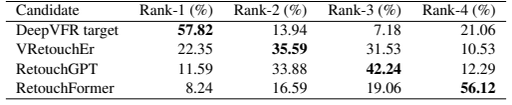
Table 5 : Human subjective ranking results (%) on 100 DeepVFR study clips. Higher Rank-1 indicates stronger preference within this stimulus set.
원문 · CC BY 4.0 · Peiyuan Zeng, Fengchuang Xing, Shiming Wu, Hongwei Yue, Chao Zhou · From Retouched Images to Paired Videos: A Synthetic Benchmark for Face Video Retouching · 원문 그림 인용 · 원본 PDF 10쪽에서 그림 영역을 추출했습니다.합성 도메인과 측정의 한계
DeepVFR은 합성 이미지와 I2V 특성을 함께 물려받고, 타깃은 얼굴 전이와 블렌딩 아티팩트를 추가로 물려받습니다. 따라서 실제 촬영 영상이나 전문가가 리터칭한 영상으로의 일반화는 확인되지 않았습니다. 움직임은 빠른 발화, 큰 자세 변화, 가림, 동적 조명을 다루지 않습니다. Akool은 닫혀 있고 바뀔 수 있는 상용 서비스이므로 같은 클립을 정확히 재생성하지 못할 수 있습니다. 그래서 고정 패키지와 출처 기록이 필요합니다. LPIPS-T와 RGBFlicker는 실제 움직임과 깜빡임을 구분하지 못하며, ArcFace 정체성 유사도 같은 추가 검증은 이 연구에 포함되지 않았습니다.
논문 정보
- 저자
- Peiyuan Zeng, Fengchuang Xing, Shiming Wu, Hongwei Yue, Chao Zhou
- 학회·저널
- arXiv · 프리프린트
- 최초 공개일
- 2026년 11월 13일
- 등록일
- 2026년 11월 17일
- 수정일
- 2026년 11월 13일
- 버전
- v1
- arXiv
- 2611.18791
- 분류
- cs.CV
- 원문 이용 조건
- CC BY 4.0
- 제공 범위
- 논문 정보, 해설, 허용된 원문 그림
AI 해설은 논문 원문과 별개의 설명이며 오류가 있을 수 있습니다. 원문과 그림은 각 출처의 이용 조건과 따로 표시된 권리를 따릅니다.
초록
Paired unretouched/retouched face videos are costly to produce because professional editing must remain consistent over time, while releasing identifiable face footage raises privacy, consent, and governance concerns. We present DeepVFR, an initial controlled synthetic benchmark-not a new retouching architecture-for paired face video retouching. Starting from paired synthetic DeepFRR images, Wan2.2 generates mild-motion source clips, and backend-specific face transfer constructs synchronized proxy retouching targets, followed by automatic validity screening and manual visual inspection. DeepVFR contains 1,024 pairs of 150-frame clips at 30 fps, evaluated under an identity-disjoint protocol with explicit frame correspondence; release metadata will record the construction route. Within-benchmark baselines, external checkpoints applied to DeepVFR, qualitative analysis, and a 17-participant ranking study establish reference behavior in the controlled domain. The constructed targets exhibit a substantial low-preference tail in the human study. Because both streams inherit synthetic content and the targets additionally inherit commercial-API or face-transfer artifacts, the benchmark neither replaces artist-retouched captured video nor establishes synthetic-to-real generalization. DeepVFR provides a starting point for paired supervision and controlled evaluation. Data, individual study rankings, and training logs will be made publicly available upon acceptance. Broader motion coverage and real-video validation remain future work.
원문 인용
Peiyuan Zeng, Fengchuang Xing, Shiming Wu, Hongwei Yue, Chao Zhou (2026). From Retouched Images to Paired Videos: A Synthetic Benchmark for Face Video Retouching. arXiv:2611.18791v1. https://arxiv.org/abs/2611.18791v1
BibTeX
@misc{zeng2026from,
  title = {{From Retouched Images to Paired Videos: A Synthetic Benchmark for Face Video Retouching}},
  author = {Peiyuan Zeng and Fengchuang Xing and Shiming Wu and Hongwei Yue and Chao Zhou},
  year = {2026},
  eprint = {2611.18791},
  archivePrefix = {arXiv},
  url = {https://arxiv.org/abs/2611.18791v1}
}